




Sign In to Your Account
Subscribers have complete access to the archive.
Sign In Not a Subscriber?Join NowMeredith Man
Vanities
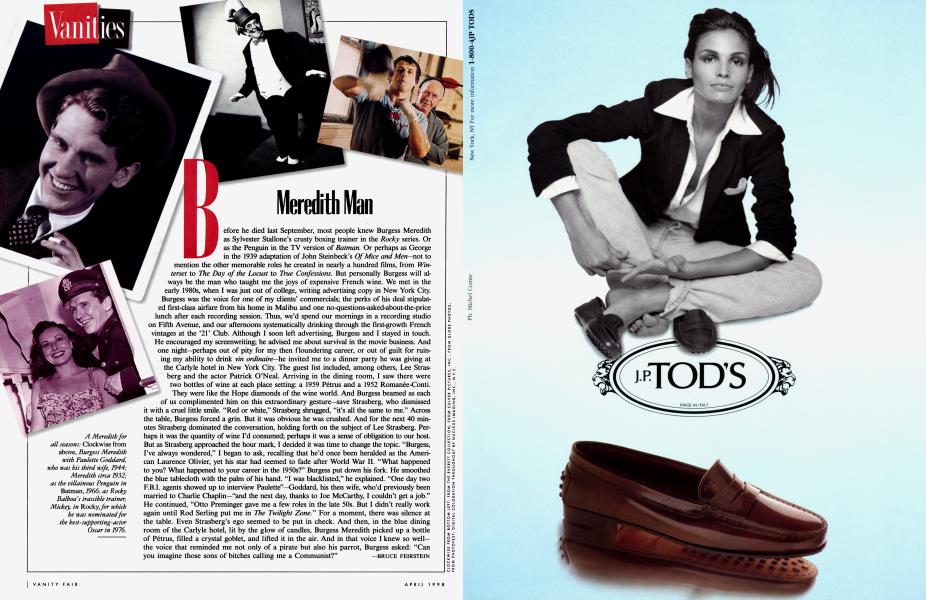
Before he died last September, most people knew Burgess Meredith as Sylvester Stallone’s crusty boxing trainer in the Rocky series. Or as the Penguin in the TV version of Batman. Or perhaps as George in the 1939 adaptation of John Steinbeck’s Of Mice and Men—not to mention the other memorable roles he created in nearly a hundred films, from Winterset to The Day of the Locust to True Confessions. But personally Burgess will always be the man who taught me the joys of expensive French wine. We met in the early 1980s, when I was just out of college, writing advertising copy in New York City. Burgess was the voice for one of my clients’ commercials; the perks of his deal stipulated first-class airfare from his home in Malibu and one no-questions-asked-about-the-price lunch after each recording session. Thus, we’d spend our mornings in a recording studio on Fifth Avenue, and our afternoons systematically drinking through the first-growth French vintages at the ‘21’ Club. Although I soon left advertising, Burgess and I stayed in touch. He encouraged my screenwriting; he advised me about survival in the movie business. And one night—perhaps out of pity for my then floundering career, or out of guilt for ruining my ability to drink vin ordinaire—he invited me to a dinner party he was giving at the Carlyle hotel in New York City. The guest list included, among others, Lee Strasberg and the actor Patrick O’Neal. Arriving in the dining room, I saw there were two bottles of wine at each place setting: a 1959 Petrus and a 1952 Romanee-Conti. They were like the Hope diamonds of the wine world. And Burgess beamed as each of us complimented him on this extraordinary gesture—save Strasberg, who dismissed it with a cruel little smile. “Red or white,” Strasberg shrugged, “it’s all the same to me.” Across the table, Burgess forced a grin. But it was obvious he was crushed. And for the next 40 minutes Strasberg dominated the conversation, holding forth on the subject of Lee Strasberg. Perhaps it was the quantity of wine I’d consumed; perhaps it was a sense of obligation to our host. But as Strasberg approached the hour mark, I decided it was time to change the topic. “Burgess, I’ve always wondered,” I began to ask, recalling that he’d once been heralded as the American Laurence Olivier, yet his star had seemed to fade after World War II. “What happened to you? What happened to your career in the 1950s?” Burgess put down his fork. He smoothed the blue tablecloth with the palm of his hand. “I was blacklisted,” he explained. “One day two F.B.I. agents showed up to interview Paulette”—Goddard, his then wife, who’d previously been married to Charlie Chaplin—“and the next day, thanks to Joe McCarthy, I couldn’t get a job.” He continued, “Otto Preminger gave me a few roles in the late 50s. But I didn’t really work again until Rod Serling put me in The Twilight Zone.” For a moment, there was silence at the table. Even Strasberg’s ego seemed to be put in check. And then, in the blue dining room of the Carlyle hotel, lit by the glow of candles, Burgess Meredith picked up a bottle of Petrus, filled a crystal goblet, and lifted it in the air. And in that voice I knew so well— the voice that reminded me not only of a pirate but also his parrot, Burgess asked: “Can you imagine those sons of bitches calling me a Communist?”
BRUCE FEIRSTEIN
Subscribers have complete access to the archive.
Sign In Not a Subscriber?Join Now