




Sign In to Your Account
Subscribers have complete access to the archive.
Sign In Not a Subscriber?Join NowLONDON CALLING
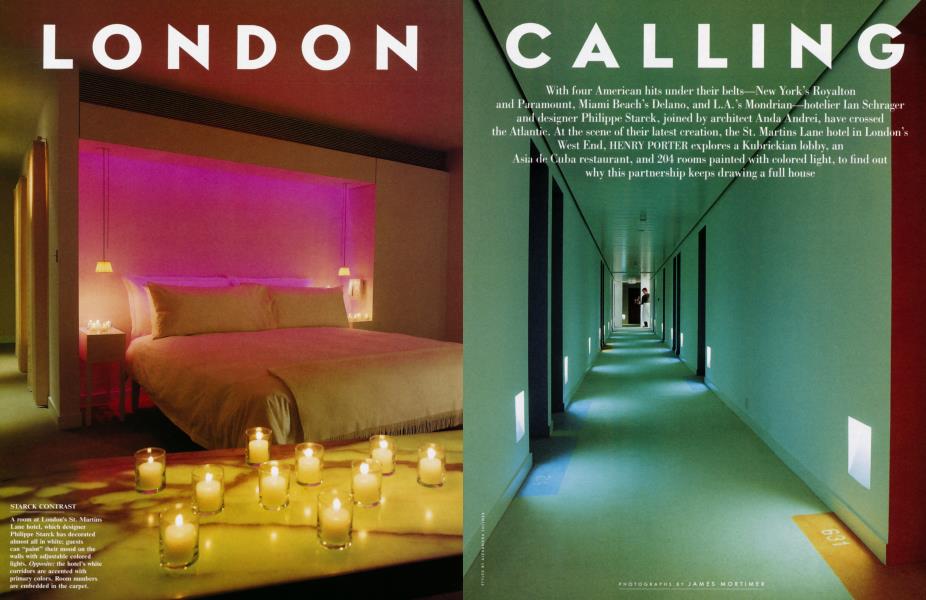
With four American hits under their belts—New York's Royalton and Paramount, Miami Beach's Delano, and L.A.'s Mondrian—hotelier Ian Schrager and designer Philippe Starck, joined by architect Anda Andrei, have crossed the Atlantic. At the scene of their latest creation, the St. Martins Lane hotel in London's West End, HENRY PORTER explores a Kubrickian lobby, an Asia de Cuba restaurant, and 204 rooms painted with colored light, to find out why this partnership keeps drawing a full house
HENRY PORTER
This is not about decoration: it's about feeling," says Philippe Starck as we prepare to enter the huge, as yet unpowered revolving door of the St. Martins Lane, the new hotel developed by Ian Schrager in London. He waves me through with Gallic impatience and then pushes on the door so that we are both released from the yellow cylinder into a large, dazzling white lobby.
What little decoration there is is jokey and random. Three pottery gnomes, which serve as squatting stools, are grouped in battle formation, and an 18th-century-style desk stands some way off to our left. I mention that the lobby reminds me not only of the Schrager-owned and Starck-designed lobby of the Mondrian hotel in Los Angeles, but also of the last scenes in Stanley Kubrick's 2001: A Space Odyssey, when the astronaut is seen sitting in a white time void with pieces of ornate furniture. The idea pleases Starck, who has been in full flow about entertainment and the humorlessness of most design. "Trend is not interesting," he said as we reached the renovated building in St. Martin's Lane. "When someone arrives here and goes through the door, it's an experience. The door is the gate between the outside life and the possibility of inside. People can dream here; they can be smarter, be more stylish."
There is probably no other designer in the world from whom you would accept these mystical effusions, but the hotels that Philippe Starck has designed for Ian Schrager (Royalton, Paramount, Delano, and Mondrian) are big commercial hits which often register occupancy rates 20 percent above the average in the United States, according to Schrager. This is why you find yourself listening straight-faced when he implies that the entrance is an air lock between reality and fantasy.
St. Martins Lane is Schrager's first London hotel. It is set in the West End theater district, in an office building which on the ground floor once housed the Lumiere movie theater, and the less mourned Cafe Pelican. With just 204 rooms it is smaller than most of Schrager's American hotels, but the public spaces are airy and full of Starck playfulness. Directly across the lobby from the entrance is the hotel bar, which plunges back into the building like an infinity of mirrors and is lit by huge color voids above the tables. To the left is the Asia de Cuba restaurant, where Starck (who also designed an Asia de Cuba for Morgans in New York) says he has drawn inspiration from the Belgian Congo of the 1950s—which, although he insists it is true, seems to me to be a joke, because in truth the restaurant is a melee of styles and whim that is pure late-period Starck. Each space has a distinct, if rather indefinable, character, and it is obvious that Starck has been at pains to resist the lures of decoration and theme. The brasserie-style St. M and the Sea Bar, on the right side of the building, owe something to the understatement of the successful neighboring restaurants J. Sheekey and the Ivy, but the whole feel is younger and more surprising.
AT NIGHT THE HOTEL WILL PULSE WITH LIGHT, EACH GUEST IMPRINTING HIS MOOD ON THE EXTERIOR.
Starck designed the main parts of the hotel in a 48-hour flurry after Ian Schrager and his business partner, who is also the director of design for Ian Schrager Hotels, the slinky Romanian architect Anda Andrei, had met with him to hammer out what Schrager calls "the program." "It is our take on London," says Andrei, who acts as the unflappable midwife to Starck's rush of ideas. "We don't take the same thing on the road. St. Martins is young, cool, happy, light—it's like the essence of London all packed together. Room-wise, it is the simplest one we have ever done. There's so little design. We didn't agonize over a chair leg. It's about atmosphere and feeling."
From Starck's two-day session with the building there emerged a blizzard of little drawings which have pretty much been transformed by Andrei into the hotel that opened in September. Quite apart from the building's good location in Covent Garden, she says, they were helped by its hidden qualities. "You know how it is with these renovations—we always use existing buildings. There are good bones and not-so-good bones. This one has great bones."
One of the most difficult parts of the conversion was achieved by tearing out the old windows of the 60s office block and replacing them with floor-to-ceiling glass, which means that each bedroom has at least one wall which is a changing frieze of the London cityscape. Starck has conceived the bedrooms as a kind of blank sheet—white and very bare—on which the guest "paints" his mood with colored lights operated from an ingenious dial at the head of the bed. At night the hotel will pulse with combinations of light, each guest imprinting his mood and taste on the exterior.
"It's not how it looks, but how it feels," says Schrager. "It's the same kind of thing you get when you go to a great movie or a show. It's an experience." He is singing from the same hymnbook as Andrei and Starck, which is a sign of more than coordinated publicity strategy. They work harmoniously together and are currently renovating buildings for an additional seven hotels, one of which is Sanderson, less than half a mile away in Soho. "I did my first hotel with Philippe in 1987 [Royalton]," says Schrager. "I have tried to find other designers, but I can't find anyone with his humor, irony, irreverence, and wit. Philippe always pulls new rabbits out of a hat." What is striking is that each member of the trio goes out of his way to praise the other two. Schrager is considered a great editor and impresario by Andrei and Starck. Andrei is the person without whom nothing would happen, while Starck is acknowledged as the creative prodigy. "Philippe enjoys life," says Andrei. "When people are miserable, no matter how talented they are, they can't create places where people enjoy themselves. We love to travel; we like good food, and we like good wine. We know how to create somewhere people enjoy themselves."
Starck, naturally, could never put it so simply. He believes that he has jumped ahead 10 years in design, and declares that St. Martins Lane is the first truly modern hotel in the world. "It is a new tool to speak to humans. It's fertile surprise. It's a brain cure."



Subscribers have complete access to the archive.
Sign In Not a Subscriber?Join Now


