Sign In to Your Account
Subscribers have complete access to the archive.
Sign In Not a Subscriber?Join NowSprts
The Men Who Made the Mastas
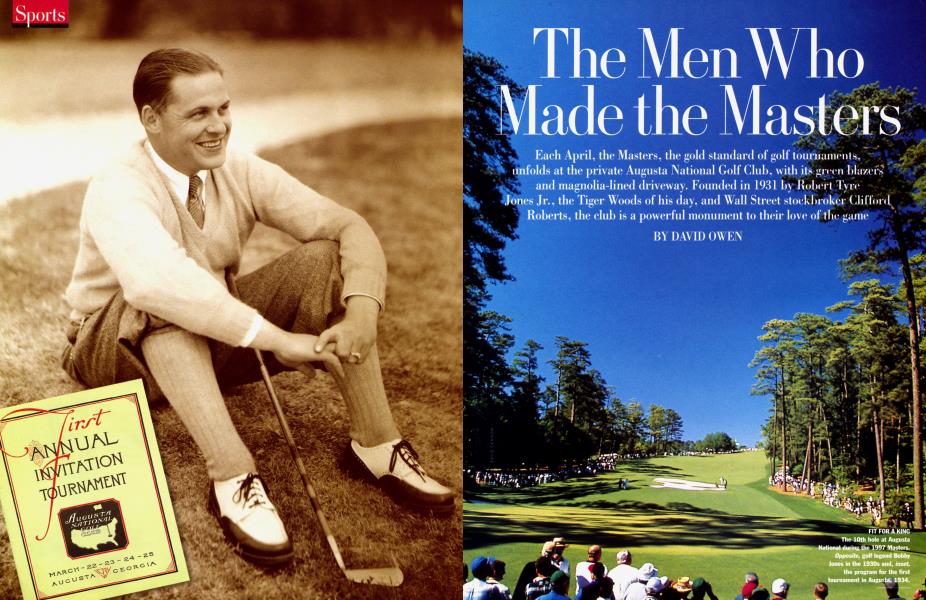
Each April, the Masters, the gold standard of golf tournaments, unfolds at the private Augusta National Golf Club, with its green blazers and magnolia-lined driveway. Founded in 1931 by Robert Tyre Jones Jr., the Tiger Woods of his day, and Wall Street stockbroker Clifford Roberts, the club is a powerful monument to their love of the game
DAVID OWEN
The modern golf season never ends, but it does begin. When the first contestant tees off at Augusta National Golf Club in Augusta, Georgia, on Thursday morning during Masters week, golfers all over the world reset their internal clocks. The first page in a golfer's calendar is April.
For the world's best players, the Masters divides one season's aspirations from another's. Success at the highest levels on tour means recognition, money, endorsements, exemptions—and an invitation to Augusta. As the first full week of April draws near, players who have not yet qualified for invitations juggle their schedules to maximize their chances, and television commentators count down the tournaments remaining. When the Masters begins, every competitor has a theoretical chance of matching Bobby Jones's unduplicated feat of winning all four major tournaments in one year. When the Masters ends, the Grand Slam field has shrunk to one.
Gary Player, of South Africa, who won the Masters three times, once said, "The Masters is the only tournament I ever knew where you choke when you drive through the front gate." The trip down Magnolia Lane—the club's fabled driveway, which is flanked by rows of pre-Civil War magnolia trees—may be the most dreamed-about entrance in sports. Although the Masters is not ancient as golf goes, no contest runs deeper in the imaginations of participants. The club's green blazer, which is presented each year to the tournament's winner, is the game's most coveted adornment. Sam Snead says, "If you asked golfers what tournament they would rather win over all the others, I think every one of them to a man would say the Masters." Late at night after Tiger Woods's record-breaking victory in 1997, Earl Woods looked in on his son and found him curled up in bed, asleep with a smile on his face, his arms wrapped around his green jacket.
The Masters is unique among major tournaments in that it is conducted not by a national golf organization but by a private club. (Augusta National has roughly 300 members, among them General Electric chairman Jack Welch, Berkshire Hathaway C.E.O. Warren Buffett, former secretary of state George Shultz, and coC.E.O. of Citigroup John Reed.) Two dozen committees headed by club members assume responsibility for everything from the placement of the holes to the price of the barbecued-pork sandwiches at the concession stands. The course is closed from late May until early October, a period when summer heat threatens the turf, and it receives little play during January and February, months when the weather is chilly, wet, and unpredictable. In March, the members share the course with crews erecting scoreboards, spectator stands, refreshment tents, and television towers. In early April, they vacate their clubhouse and turn their dining room into a commissary.
The prestige of the Masters is so great that a modern golf fan has difficulty imagining that neither the club nor the tournament was a foreordained success. Founded in 1931, at the beginning of the Great Depression, the club faced financial ruin repeatedly during its first 15 years. In 1934, when the Masters got under way—it was then called the Augusta National Invitation Tournament—the club couldn't afford to pay the first winner, Horton Smith, or any of the other top finishers until 17 members chipped in the purse of $5,000. (Only the first 12 places were paid.) The winner in 1946, Herman Keiser, had to be told that his plaque would be along shortly, just as soon as the club could come up with the silver.
Excerpted from The Making of the Masters: Clifford Roberts, Augusta National and Golf's Most Prestigious Tournament, by David Owen, to be published in March by Simon & Schuster; © 1999 by the author.
Augusta National survived those early adversities because of the perseverance of its two founders: Clifford Roberts and Robert Tyre "Bobby" Jones Jr. They were, respectively, the club's first chairman and its only president. (In 1966 the members declared Jones "president in perpetuity.") They are commemorated by a pair of bronze plaques set in the ground at the base of the flagpole in front of the clubhouse. The modesty of the memorial, known as the Founders Circle, would have pleased both men: Jones loved Augusta National in part because for him it was a refuge from celebrity; Roberts was proud of what he and his friend had created but was an enemy of ostentation.
The partnership of Jones and Roberts was as unlikely as it was successful. "They were as different as day and night," Sam Snead says, "but, you know, that's the type that get along." At the time of the club's founding, Jones was the most beloved athlete in the world. In 1930, at the age of 28, he had conquered what George Trevor of the New York Sun called "the impregnable quadrilateral of golf"—the British and U.S. Amateur championships and the British and U.S. Opens. (Today the four major tournaments are the U.S. Open, the British Open, the Masters, and the RG.A. Championship.) He had been honored with two New York City ticker-tape parades and had retired from competition. He was "the model American athlete come to life," according to the sportswriter Herbert Warren Wind. "Everybody adored him—not just dyed-in-the-wool golfers, but people who had never struck a golf ball or had the least desire to. They admired the ingrained modesty, the humor, the generosity of spirit that were evident in Jones's remarks and deportment. They liked the way he looked, this handsome, clean-cut young man, whose eyes gleamed with both a frank boyishness and a perceptiveness far beyond his years."
Roberts in 1930 was a pragmatic and frequently grim-faced 36-year-old Wall Street stockbroker and speculator who had taken a beating in the Crash of 1929. He knew all about hardship, having grown up on the edges of poverty in a dozen small towns in Iowa, Kansas, California, Oklahoma, and Texas. His last completed year of school was eighth grade. He had farmed, sold dry goods, worked in an oyster house, taken a three-week course in shorthand and other clerical skills, and managed a failing orchard. At the age of 23, having worked for several years as a traveling salesman of men's clothing, he went to New York to escape the world into which he had been bom.
In historical accounts of the club and the tournament, Jones has always overshadowed Roberts. That is as Roberts would have wished it; Augusta National, in his view, was Jones's club, and the Masters was Jones's tournament. But they were Jones's in large measure because Roberts made them that way. The easiest way to describe Roberts's conception of the Masters is that his goal was to put on a tournament worthy of its association with Jones. Jones was always involved in important decisions, especially during the early years, and his influence went far beyond consultation. But Roberts was generally the man behind the curtain, and he pursued the job with a dedication that sometimes gave others pause.
Jones and Roberts met through mutual friends in the mid-20s. Jones was already a celebrity and a hero, and Roberts, despite some growing success in the investment world, was still at heart an awestruck country boy. For Jones, Roberts was at first a congenial acquaintance who enjoyed sharing a drink and a funny story in a clubhouse grill. During at least one such gathering, Jones spoke of a wish to build in the South a golf course that would reflect his ideas about the game. In the spring of 1931, through an acquaintance in Augusta, Roberts discovered a likely piece of property for Jones's course: a long-abandoned commercial nursery on the outskirts of town. Seeing the land for the first time was an "unforgettable" experience, Jones wrote in Golf Is My Game, which was published in 1960: "It seemed that this land had been lying here for years just waiting for someone to lay a golf course upon it."
As for the founders, their outlines are harder to discern. Jones has been celebrated for so long and in such exalted terms that today he belongs as much to mythology as to the history of golf. Sportswriters have maintained the pious tone established by O. B. Keeler—Jones's close friend and adoring first biographer—who described his golf in biblical terms, dividing his career into "seven lean years" and "seven fat years," and was reverent even in depicting his foibles, such as the temper that had sometimes threatened to eclipse his promise. ("To the finish of my golfing
days," Jones himself wrote, "I encountered golfing emotions which could not be endured with the club still in my hands.") People close to Jones say that he really was the remarkable gentleman Keeler and many other writers portrayed him to be. But legends acquire a power of their own, and no one today can hope to see past Jones's aura to the man his drinking buddies knew.
Roberts is equally hard to see clearly. Among sportswriters he has been demonized to almost the same extent that Jones has been deified. He is known today mainly as the villain in a handful of classic press-tent anecdotes—as a tyrant who ejected a player from the Masters for a trivial infraction, sent members bills for course improvements they had been rash enough to suggest, withdrew the memberships of men who had dared to cross him, and administered near nervous breakdowns to a succession of executives at CBS, which began broadcasting the tournament on television in 1956. Most of the stories about Roberts contain at least a kernel of truth— he could be hard to work with, especially for anyone who wasn't used to dealing with a determined man who said exactly what he thought—but none of the stories begins to do him justice.
The misperceptions were to a great extent his own fault. He seldom spoke publicly about himself or any part of his life outside his responsibilities with the tournament and the club. In a letter to Jones in 1964, he offered one explanation for his reticence: "I have repeatedly [taken] the position that one personality, meaning yourself, was enough for any one Club." His forbidding manner invited hasty summarization: autocratic, domineering, stubborn, humorless, mean. All such terms obscured not only the real dimensions of his personality but also the true achievements of his life.
Roberts and Jones "were as different as day and night—that's the type that get along."
In 1976 the British golf correspondent Peter Dobereiner wrote, "To a large degree Roberts is not the ogre he pretends to be. The style of the man, as an uncompromising dictator, hides a natural shyness and a generous spirit. He has helped many people, in large and small ways, but always by stealth, covering his traces so well that as often as not his benefaction is not even suspected. If this austere old man commands respect rather than affection, then that is by his own choice, a sacrifice he has made in the cause of his beloved Masters." And in the cause of his beloved club, which in Roberts's mind always came first.
Roberts's commitment was so intense that his life outside of Augusta was almost invisible. He was married three times, but during many periods of his life it was possible to be a friend of his and not realize he had been married at all. His wives didn't spend much time at the club, and he seldom talked about them, even with people he knew well. Marriage, in Roberts's mind, had nothing to do with the club or the tournament and was therefore unlikely to arise as a topic of conversation. Byron Nelson, who won the Masters twice, in 1937 and 1942, says, "This place was his bride."
For decades, sportswriters who wouldn't dream of quoting a baseball score without double-checking it have felt no compunction about repeating and embellishing even the unlikeliest tales about Roberts. Indeed, he has so often been portrayed as a conniving misanthrope that few stories about him today are automatically dismissed as too outrageous to be believed. But the cartoon that so often stands in for Roberts defies credibility. If he really had been the monster that the meaner tales make him out to be, Jones would never have associated with him, friends from all over the world would not have sought and cherished his company, some of golf's most celebrated names would not credit him with having helped to build their careers, Dwight D. Eisenhower would never have reserved a White House bedroom for his frequent use, and the Masters today would be nothing more than a long-forgotten artifact of the halting early years of American competitive golf.
Roberts died in 1977, at the age of 83, but he is still very much in evidence at Augusta National. He is quoted at meetings, sometimes in the present tense. His book about the club—The Story of the Augusta National Golf Club, published the year before he died—is always the first source young staff members check when a question arises concerning the cracker barrel in the golf shop, the origin of the green jacket, or the location of the original bunker in the second fairway. Pictures at the club are still hung on two hooks, because crooked pictures drove him to distraction. The golf shop still makes change with brand-new currency, because he couldn't stand dirty bills. (He folded his bills in groups, by denomination, and he always carried enough of each kind so that no one would ever have to give him change.) He is often referred to as Mr. Roberts, even by men who are older than he was when he died.
A portrait of Roberts hangs on a wall in the club library. It was painted by Eisenhower, who first visited Augusta National in 1948, became a member shortly afterward, and loved the club above all other retreats. The Masters is viewed almost universally as the best-run golf tournament in the world, and, as Roberts would have insisted, it has maintained its standing without acquiring the modem trappings of success. Spectators can still buy lunch for about what they might pay for a soft drink at any other tournament, because Roberts believed that anyone who had traveled 200 miles to watch a round of golf ought to be able to buy a decent meal at a decent price. Teams of uniformed workers still intercept crumpled paper cups almost before they hit the ground, because Roberts felt that litter detracted from the beauty of the course and the dignity of the event. (The cups and sandwich bags are green, making them nearly invisible to television cameras— a major issue with Roberts.) Amateur competitors are offered inexpensive accommodations in the clubhouse itself, because Roberts didn't want an invitation to the Masters to be a financial burden. Members wear their green coats every day during tournament week, as they have since 1937, because Roberts felt that knowledgeable sources of information ought to be easily identifiable to spectators in need of assistance.
The writer Herbert Wairen Wind called Jones "the model American athlete come to life."
You can still hear his voice at the club. There are members, employees, and caddies who do accurate impressions, and when they quote him in a funny story they inevitably adopt his glacier-slow delivery.
Roberts spoke as though he were dictating to an engraver. He silently considered any question until he had thoroughly arranged his answer. The first sound out of his mouth was usually a cough, a clearing of his throat, or "Uh," a monosyllable he was capable of drawing to narrative length. ("Cliff could say 'uh' for two days," a friend says.) Strangers sometimes interpreted his hesitation as deafness or an encouragement to restate the topic; his friends knew to wait. If Roberts was preoccupied with a club matter or a tournament detail, the wait could be considerable. A member who greeted him in passing on the sidewalk outside the clubhouse might hear his greeting returned from a distance, many seconds later.
CONTINUED ON PAGE 125
CONTINUED FROM PAGE 120
Charles DeClifford Roberts Jr. was born on March 6, 1894, on his mother's parents' farm, near a tiny Iowa town called Morning Sun. Clifford, as he was known throughout his life, was the second of five children. His mother, Rebecca Key Roberts, was 24 years old and pleasantly attractive. She was proud of her long brown hair and her skills as a baker. She enjoyed the antics of her children, and when Clifford, at the age of nine, became captivated by marbles, she sewed extra pockets into his pants so that he could carry more of them. Her diaries make fascinating reading, especially if you know that in 1913, when Clifford was 19, she committed suicide. "Read nearly all day—very blue and discouraged," she wrote in 1902. "I left John & Clifford to keep house while I went up town in evening. There had been a fight and shooting on the street.... Boys distributed some Rip Van Winkle show bills and so each got a free pass.... Tramp here for dinner.... Boy here selling needles to keep from begging_ Still it rains. Things floating in our cellar.... Boys have carpenter fever—new nails and nail apron and making twins a play house.... Bought new milk strainer, shoe polish, steel pens & school sponges. Clifford churned."
Rebecca had numerous ailments, among them severe headaches, back pain, "curvature of the spine," a miscarriage followed by months of hemorrhaging, pleurisy, "nervous chills," and a persistent melancholy that a modern reader does not hesitate to diagnose as depression. On many mornings, she was unable to get out of bed. At such times, she left the housework and the care of the younger children to Clifford and John, beginning when Clifford was six and John was seven.
Clifford's father had gastrointestinal trouble, a rupture, and "heart failure palpitation." John, with whom Clifford shared a bed, stammered and suffered seizures that various doctors diagnosed as St. Vi-
tus's dance, "worm spasms," and (correctly) grand-mal epilepsy. Clifford had trouble with his eyes, suffered from "malaria & biliousness," and endured devastating bouts with poison ivy. Days when everyone was well were rare enough to be noted in the diary.
Charles DeClifford Roberts Sr. was a restless small-time entrepreneur who tried his hand and failed at a broad variety of undertakings. "My father always was interested in seeing what was on the other side of the next hill," Roberts Jr. said with understatement many years later. Charles was apt to trade the family store on a whim for a farm in another state—then, after harvesting a single crop of wheat and oats, to trade the farm for a business somewhere else, and then to sell that business and invest the proceeds in another.
Founded in the Depression, the dub faced financial rain repeatedly during its first 15 years.
Rebecca—who was never consulted— lamented most of these transactions. As soon as she had decorated a house to her satisfaction, it seemed, Charles put it up for sale. His quixotic dealings didn't bring him happiness, either; he suffered from insomnia and sometimes paced the floor, terrified that his world was coming apart. He died in Texas in 1921, after being struck by a train, and his death may have been a suicide. At the time, he was recovering from a stroke, and was dependent on regular checks from Clifford.
In the fall of 1904, when Clifford was 10, Rebecca took the children to live with relatives of hers in California. She was acting on the advice of a doctor in Kansas, who had said that a trip and "a complete change" might improve her still-mysterious condition. Not long before, she had written in her diary, "I am going down hill as rapidly as possible and there seems to be nothing to stop it." They made the journey by train and stayed for seven months, while Charles attended to business interests elsewhere.
John and Clifford both worked outside the house from early ages. They did odd jobs, raised and sold chickens and dogs, made deliveries for their father, served as clerks in the family's various stores, milked cows, raised pigs, caddied at local golf courses, and sold onions. Shortly after the family moved from Kansas to Oklahoma in 1906, Rebecca noted that Clifford, who was 12, was "using his Spanish selling goods to Mexicans working on R.R."
On October 30, 1910, Clifford went to Sunday school at the Presbyterian church and then escorted his mother to the regular service. On the way, he realized he had left his gloves at home and ran back to get them. He lit a kerosene lamp in his and John's dark room and dropped the match on the floor, accidentally starting a fire that consumed the house. Two younger siblings sounded the alarm. "We got back to see its finish," Rebecca wrote in her diary. Almost everything was destroyed, and there was no insurance.
Clifford promised his mother he would try to make up for his negligence by doing as much as he could to help out. He was 16 years old and had left school for good the previous spring. He continued to work on the family's farm—which was failing— and to help his father with various business ventures. He got a job as a clerk in a dry-goods store in Blessing, a town several miles to the north.
Not quite three years after the fire, Rebecca rose quietly from her bed at four o'clock one morning, crept downstairs without waking her husband or her children, walked behind the house to a spot near the garage, and shot herself in the chest with a shotgun. It was three days after her 44th birthday.
Rebecca left a separate note, written in pencil, for each family member. The one to Clifford read: "I write to beg you to not grieve but be a man in time of trial. Papa will need you. Be a sober upright son & all will be well."
Charles Roberts remarried following his wife's death, and the family moved to Kansas City. Clifford sold men's clothing, covering a territory that stretched from New Orleans to Chicago. In 1917, when he was 23, he sold his share of some Iowa property that he and the other children had inherited from their mother's side of the family and set out to make his fortune in the East. He rented a room in a small residential hotel in Manhattan, and wrote to his sister that he expected to strike it rich quite soon. Before the end of the month, he was back in Kansas City and probably close to broke. He soon returned to New York, but his work was interrupted by a year of military service.
The popular conception is that Roberts was rich and Jones scarcely employed when the club began. (Sportswriters often describe Roberts in that period as "a wealthy Wall Street financier.") In fact, the reverse was true. Roberts eventually did have one great year—1929—when a single huge commission pushed his income to nearly $70,000 (the equivalent of about $650,000 today). But 1929 turned out to be a disastrous year in which to make a fortune, and he lost much of his windfall in the October crash and the dreary years that followed. In 1930 and 1931, trading losses more than wiped out all his income, leaving him with a cumulative net loss for those two years of more than $21,000. By way of comparison, in 1931, the year the club began, Jones had a net income of more than $140,000—far more than Roberts's total earnings during the 14 years he had been in New York.
During the 20s, golf was a part of the New York social milieu to which Roberts was striving to belong. He had first encountered the game as a youngster in California, where he and his brother had caddied for 15 cents a bag. He had taught himself to play as caddies always have, by hitting found balls with abandoned clubs during the idle hours between loops. When he started to make some money in New York, he joined Knollwood Country Club in Westchester County and worked on his game and social connections there. At some point in the mid-20s, he attended an exhibition at Knollwood in which Bobby Jones played—an exhibition that may have been the occasion of their first meeting. "Each time I saw Bob or read his public comments, I respected and liked him more," he wrote in his book about the club.
Jones in those years often spoke of his desire to build a championship course in the South. One day in 1930, Roberts suggested building the course in Augusta, where coincidentally both men had played winter golf while staying at the Bon Air Vanderbilt Hotel, which was run by a mutual friend. Roberts liked the city in part because it was warm in the winter yet far enough north to be easily reachable by overnight train from New York. Jones also liked Augusta's mild winter climate and believed that a club there might afford him some privacy—a scarcity at home in Atlanta. They agreed to proceed.
Roberts was a hero-worshiper by nature. He took enormous personal satisfaction from making himself indispensable to Jones. Roberts's deep, genuine, and enduring commitment to the game of golf did not pre-date their friendship. He himself said in later years that if he had never met Jones he would never have been more than a weekend golfer.
Magnolia Lane is far older than the Meters or Augusta National. The trees were planted from seeds shortly before the outbreak of the Civil War. By 1931, when Roberts and Jones first visited the property, the magnolias were goodsized trees, and the driveway was known locally as Magnolia Avenue.
Roberts thought the dub could make Augusta a resort to rival Pinehurst, North Carolina.
The building that now serves as the clubhouse was built in 1854 as the home of an indigo planter named Dennis Redmond, who had bought the plantation a year before. In 1858 he sold out to a Belgian horticulturist named Prosper Berckmans, who turned the plantation into Fruitland Nurseries. Prosper died in 1910 and left the house and land to his widow and three sons. The nursery declined over the next few years; by 1918 it was defunct. In 1925 a Miami businessman named Commodore J. Perry Stoltz planned to build a golf course and a $2 million hotel on the site. He went bankrupt shortly after pouring concrete footings.
Roberts was led to the old Berckmans property by Thomas Barrett Jr., a member of a prominent Augusta family. Barrett didn't play golf, but he had strong ties in the community and was the vice president of Augusta's Bon Air Vanderbilt Hotel, which was owned by the same company as the Vanderbilt Hotel in New York. He felt that the club, if successful, would boost the local economy by attracting well-heeled visitors from far away. Roberts felt the same way, and thought the club could help Augusta become a winter golf resort to rival Pinehurst, North Carolina. Barrett became the mayor of Augusta in 1933 and helped smooth the way for the first Masters, in 1934.
In January 1931, the Bon Air Vanderbilt Company, acting for the benefit of the proposed club, paid $5,000 for a sixmonth option to purchase roughly 365 acres. To buy the property, a group that included Barrett, Roberts, Walton H. Marshall (who ran the Vanderbilt chain of hotels), Fielding Wallace (a local businessman), and Bobby Jones's father, Colonel Robert P. Jones, created a real-estate company called Fruitland Manor Corporation. Barrett was the president. In June, Fruitland acquired the land by paying $15,000 in cash and assuming roughly $60,000 of the previous owner's debt, most of it in the form of a first mortgage. The idea was that Augusta National would lease part of the land with an eye to eventually buying it, while Fruitland would recover the rest of its costs, and perhaps turn a profit, by selling or developing the remainder of the parcel. All that Roberts had to do was fill the club's rolls with dues-paying members.
The earliest proposal for the club called for 1,800 members. The initiation fee was $350, plus tax. Dues were $60 a year, and Roberts planned to reduce the charge as soon as the club's financial position was secure. Jones had been impressed by the modest membership fees of the Royal and Ancient Golf Club of St. Andrews and other Scottish clubs, and he and Roberts wanted Augusta National to follow that model. They envisioned a membership drawn from all over the United States and from as many foreign countries as possible.
Roberts began an ambitious membership drive in the spring of 1931. He obtained the names and addresses of 13,000 past guests of the Bon Air hotel, believing he would be able to enlist at least several hundred of those. He hired a man to travel by train all over the United States and Canada and to build a mailing list based on the rosters of prominent clubs. He hired another man to promote the club in Atlanta, sent solicitations to clubs throughout Georgia, and wrote thousands of personal invitations to men he had never met.
The dub's green blazer, presented to tournament winners, is golf's most coveted adornment.
The results were monumentally disappointing. The national economy was a wreck, and the pool of golfers with disposable income was small and getting smaller. By the end of April 1932, a full year after the membership drive had begun, Augusta National Golf Club had managed to sign up only 66 members. Another two years of continuous effort would add just 10 names to the total.
The club's only consistently effective salesman in the early 30s was probably Grantland Rice, who was a member of Augusta National's organization committee. He was the country's most famous sportswriter and was a glamorous national celebrity. (His best-known contribution to American athletic vernacular is contained in the last two lines of a poem of his called "Alumnus Football": "When the One Great Scorer comes to write against your name— / He marks—not that you won or lost—but how you played the game.") Rice wrote a widely syndicated newspaper column called "The Sportlight," in which he frequently mentioned the new course, and he was the editor of the magazine American Golfer, to which Jones was a contributor. One day in late 1931 or early 1932, he and Roberts brought half a dozen of Rice's friends in a private train car from New York to meet Jones and see the property—and all six of them joined. Neither Roberts nor Jones ever made a catch like that on his own.
The two men nonetheless went to extraordinary lengths in courting new prospects for the club. For several years in the early 30s they enthusiastically pursued a group of four dozen East Coast retirees called the Red Lead Pencils, 15 or 20 of whom took an annual weeklong golf trip to the South. The Pencils were flattered yet somewhat baffled by the attention. In a letter to Roberts, one of them pointed out that most of the group were elderly, and that almost all of them, including himself, were "in the hopeless duffer class who throw a party when they get under a hundred." Roberts replied, with less than complete accuracy, that Augusta National had "no steep hills" and that the Pencils would find the course "not too hard." None joined.
To most golf fans today, the idea of turning down an invitation to join Augusta National seems inconceivable. Bill Gates's supposed yearning to be a member of the club was the subject of a front-page story in The Wall Street Journal last year. But until the end of the Second World War, when the national economy had rebounded and the Masters had begun to make an impression on the public imagination, joining the club was an attractive proposition to a vanishingly small group.
The U.S. Amateur Championship in 1929 was held in California, at the Del Monte Golf and Country Club, which today is known as Pebble Beach. Earlier that year, at Winged Foot Golf Club in Mamaroneck, New York, Jones had won the Open. He tied for low score in the Amateur's qualifier and was the favorite to win the tournament, but he lost his first match, one down, to Johnny Goodman, and was eliminated. With nothing else to do, he arranged a friendly game at a brand-new club just down the road from Pebble Beach. That was Jones's first look at Cypress Point, and he was deeply impressed. The next day, he played in the opening exhibition at Pasatiempo, a new course in Santa Cruz which had been designed by the same man. By the time he left California, he knew that if he ever got the opportunity to build his own course the architect would be Alister MacKenzie.
MacKenzie was an English physician of Scottish ancestry. He had bushy eyebrows and a thick mustache and not much hair on the top of his head. He had served his country in both the South African War and the First World War, and had become a specialist in camouflage, a field that he believed had an application in course design. He began to dabble in golf architecture as a hobby just after the turn of the century, when he was in his early 30s. Cypress Point—a commission that MacKenzie received after the original architect, Seth Raynor, died suddenly—secured his reputation.
In 1931, MacKenzie agreed to take on Augusta National. He first visited the site in July. At that time he explored the property and, accompanied by Jones, roughly staked out the tees and greens—a task that was made difficult in many places by the density of the undergrowth. He returned to Augusta in September and stayed into October, then went back to California.
The club did not commit to building the course until February 1932. Once it did, construction proceeded with astonishing speed. In just three months, 120,000 cubic yards of soil were moved in the shaping of the fairways, the contouring of the greens, and the installation of a Buckner Hoseless watering system, which used water purchased from the city of Augusta at a rate of three cents per thousand gallons. MacKenzie returned to Augusta in March to supervise the last of the contour work on the greens, 15 of which had been built by that point. He remained until April. Late in May, between 80 and 90 acres were planted with 8,000 pounds of Bermuda-grass seed. Mowing began on June 10. Jones played his first round in August—by which time the fairways had been cut 8 times and the greens more than 30 times—and he sent Roberts a telegram in New York to let him know how pleased he was with the course.
Although the club came close to meeting its construction budget, which was $100,000, it came nowhere near paying its bills. One of the biggest creditors ended up being MacKenzie himself. In February 1932, in hopes of moving the project along, he had reduced his fee from $10,000 to $5,000, but even that figure was hypothetical; the club was barely able to meet its weekly payroll of $200. By late 1932, MacKenzie had received just $2,000. In November he wired an urgent request for $1,000 more. On the day after Christmas he wrote again, saying his situation was now dire: "I am at the end of my tether, no one has paid me a cent since last June, we have mortgaged everything we have and have not yet been able to pay the nursing expenses of my wife's operation.... Can you possibly let me have, at any rate, five hundred dollars to keep us out of the poor house?"
But there was no money to send. The membership drive was yielding almost nothing, and Roberts was only just able to cover expenses with greens fees collected from guests. Jones made a "Sportlight" sound movie at Augusta National in November, and Roberts hoped that the him would be "a good advertisement for the club, but no new prospects had turned up yet. In late January 1933, MacKenzie wrote that he was now in danger of losing his electric service and his telephone, and that he was afraid the bank might foreclose on his house.
Roberts, unable to send money, proposed that the club issue two short-term notes, each with a face value of $ 1,000 and a nominal interest rate of 6 percent. The club wouldn't be able to make the interest payments, but Roberts thought MacKenzie might be able to dispose of the notes at a discount and thus obtain some cash. "I must tell you frankly, however," Roberts added, "that it will be out of the question for you to discount them in Augusta"— where the club's paper would be known to be worthless. MacKenzie managed to use one of the notes in California as collateral for a loan of $460.
The club was still broke on January 6, 1934, when MacKenzie, after a brief illness, died at the age of 63. He had last seen Augusta National in April 1932, when the grass had not yet been planted. He had called Augusta National "my best opportunity, and I believe, my finest achievement." But he didn't live to play it or even to see it in its finished form.
"This land had been lying here just waiting for someone to lay a golf course upon it."
A ugusta National's official opening took place in January 1933. Roberts and Grantland Rice arranged for a private train to bring members and prospective members from New York City to Augusta for a long weekend of golf. For $100, a participant received a Pullman berth, a room at the Bon Air, all meals, local transportation, and three days of golf with Bobby Jones. The outing was fully subscribed— the hundred participants consisted mostly of New York businessmen, a few of whom brought their wives—but the golf was a disappointment. An article in the Augusta Chronicle described the fairways and greens that weekend as "soggy" and said that a planned competition was disrupted by "near freezing weather which came in with a cold rain."
In March, Roberts sent a gloomy letter to Jones. "All available funds have been used up," he wrote, "and we are operating on a 'hand to mouth' basis." On a good day, a dozen visitors with guest cards might drop by to play, producing total revenues of $48. If it rained, the revenues were zero.
Roberts s personal finances had suffered, too; the Depression had hit him hard. He had spent most of his decimated savings in connection with the club, and he must now have been afraid that he wasn't going to be able to deliver what he had promised. The sole consolation must have been his knowledge that, whatever new disasters might await him in the coming months, he had nonetheless accomplished the most important of his goals: he had managed to build a golf course for Bobby Jones.
In February 1933, Prescott S. Bush— whose second child, George (then eight years old), would one day be elected president of the United States—played two rounds at Augusta National. Bush was a Wall Street lawyer and the chairman of the championship committee of the United States Golf Association, American golf's main governing body and rule-making organization and the sponsor of the U.S. Open and Amateur championships. (His wife's father, George H. Walker, had been the president of the U.S.G.A. in 1920 and is the man after whom the Walker Cup was named.) Not long after Bush's rounds, Roberts, in a letter to a club member named Charles H. Sabin, wrote that Bush had "made the suggestion that [Augusta National] might be used for the U.S. Open Championship in 1934"—a suggestion that may actually have originated with Roberts, who had invited Bush to play.
Roberts and Jones wanted the Open
badly, because they felt that the big tournament might attract enough new members to keep the club alive. Both men lobbied hard, with help from Grantland Rice and others. In the end, though, the U.S.G.A. was not persuaded. On April 13, Herbert Jaques, the organization's president, wrote to them saying, "Whereas we are all favorably inclined to this move in the near future, we do not think it is practical to attempt in 1934."
Roberts was deeply disappointed by the U.S.G.A.'s decision. Within a short time, though, he came up with a new idea: the club could hold a tournament of its own.
A private event wouldn't have the automatic appeal of the Open, but it might still attract notice, bring in revenues, lure new members, and help to extend the patience of the club's financial backers.
There were several big advantages to Roberts's new plan. The biggest one, he quickly realized, was that Jones might be persuaded to play. With Jones in the field, the new tournament would instantly become the most talked-about golf event of the year.
There would have been no possibility of Jones's playing in an Open. In order to do so, he would have had to "turn professional" as a player—an idea he abhorred—because by U.S.G.A. rules he was no longer an amateur. At the time of Jones's retirement from competition late in 1930, Warner Bros, had hired him to make instructional films, and shortly after that, A. G. Spalding & Bros, signed him up to design and promote golf clubs. (Those business opportunities represented a powerful inducement to stop playing competitive golf. Jones's golf-related income in 1933, when the first tournament was being planned, was more than $100,000; in contrast, Paul Runyan, who won seven events that year and was the tour's leading money winner, had gross tournament earnings of less than $6,500.) Upon signing with Warner Bros., Jones had written, "I am not certain that the step I am taking is in a strict sense a violation of the amateur rule. I think a lot might be said on either side. But I am so far convinced that it is contrary to the spirit of amateurism that I am prepared to accept and even endorse a ruling that it is an infringement." This had been an inflammatory issue in 1930, and he did not want to visit it again.
There was probably a touch of snobbery in Jones's antipathy to being called a professional; in a letter to Roberts many years later, he described the typical pro as "an uneducated club servant"—a point of view he might well have formed in the days when only amateur competitors were accorded the honorific "Mr.," professional golfers often weren't allowed to set foot inside clubhouses, and tournament organizers distinguished between "gentlemen" and "players."
But the tournament absolutely had to have Jones in the field. Attracting top players to a small new tournament would have been far harder, if not impossible, without his participation, and so would selling tickets. Revenues at the 1930 U.S. Open, the third leg of Jones's Grand Slam, had been double what they would be the following year, after Jones had quit the game. At the 1930 Amateur, which was held at Merion Cricket Club, in Ardmore, Pennsylvania, U.S.G.A. officials had entreated Jones to play a practice round the day before the competition—something he ordinarily didn't like to do—so that they could sell more tickets and thereby further replenish their treasury, which had been ravaged by hard times.
The Masters today gives the impression of having existed forever, but in fact it is the youngest of the four majors. The British Open is 74 years older, the U.S. Open is 39 years older, and the P.G.A. is 18 years older. Exactly when the Masters became a major tournament, as opposed to when it was first held, is a matter of debate. Some commentators—among them the correspondent from Time—moved it immediately to that select list. Some have identified Gene Sarazen's victory the following year as the pivotal event. Others have claimed that the critical tournament was the last Masters before the wartime hiatus, in 1942, when Byron Nelson beat Ben Hogan by a stroke in an 18-hole playoff that is still celebrated as epochal. By 1947, Leonard Crawley, the golf correspondent of the London Daily Telegraph, believed that there were two American majors, the Open and the Masters. Herbert Warren Wind felt that the Masters became a major seven years later, in 1954, when Hogan lost a second monumental playoff, also by a stroke, this time to Sam Snead.
For all of that, the great tournament began very modestly. Because the club had several members "who do not wish to be deprived of an opportunity to use the course during four days of the best portion of the winter season," Roberts wrote in his announcement to the P.G.A., the field would be kept small enough so that no competitive rounds would have to be scheduled for the mornings, when tee times would be reserved for members. (The idea of leaving the course open for members during the mornings was later dropped.) Actually, there was never much danger of the field's becoming too large. Roberts, Jones, and Rice planned for a small event in part because they weren't sure how many of their invitations would be accepted. The club, furthermore, didn't have facilities for a large number of players. The clubhouse was still a mess, and other conveniences were minimal. To ensure that spectators and others would have enough places to sit, Roberts borrowed 66 chairs from two local funeral homes.
Bobby Jones described the typical golf professional as "an uneducated club servant."
The Masters has always been a tournament to which players are invited. For the first tournament, the decision to send invitations may have been influenced by a fear that too few distinguished players would sign up if they weren't asked directly.
Active players seldom decline invitations nowadays, but that was not true in the beginning. Willie Klein, who was the professional at La Gorce Golf Club in Miami Beach, wrote two weeks before the first tournament to say that "it will be impossible for me to get away to play in the Masters Open"—a name that he had picked up not from the invitation but from the newspapers. Klein explained that his club was having "a fairly good season" and he therefore couldn't leave. Olin Dutra, who had won the RG.A. in 1932 and would win the U.S. Open at Merion later in 1934, dedined because he couldn't take time off from his job at the Brentwood Country Club in Los Angeles. Dutra's brother, Mortie, did play; he tied for 11th and won $100.
Jones arrived in Augusta nine days before the tournament in order to get his game into shape. In his first practice round—which he played with Roberts and two other members—he shot 71. (During an earlier visit, he had shot 65.) The Augusta Chronicle reported that his score would have been lower had there not been "excessive grass" on the greens.
Despite pronounced putting problems, Jones remained at or near the top of almost everyone's list of favorites—until Thursday afternoon. "So there you are," O. B. Keeler wrote in The Atlanta Journal, "and there was Bobby Jones, playing the first round with Paul Runyan before a simply magnificent gallery, and working steadily and hard, and bearing down at all times, and employing all the craft gained in 15 years of major league campaigning— and betrayed by his putting and flaccid work about the greens into a 76 which ordinarily should have been a round in par or better." He followed his 76 with 74, leaving himself eight strokes behind Horton Smith, the eventual winner. He finished with two rounds of even par and ended up in a respectable tie for 13th.
Jones had never been a factor, and by the end of the tournament he was reasonably sure that he would never contend in a tournament again. But perhaps he was pleasantly surprised to discover that his fans didn't seem to mind, and that his gallery on the last day was larger than his gallery on the first. He had been embarrassed initially by the state of his short game, but by the time he finished on Sunday he was already looking forward to playing again the following year. Twenty-five years later he was able to write, "Even though some of my playing experiences in the tournament have not been altogether rewarding, at this point I have no hesitancy in saying that the Masters Tournament has provided one of the most truly wonderful aspects of my life with the associations and excitement it has brought and with the satisfaction we have felt in the development of the tournament and the golf course."
Jones's return to competition guaranteed big headlines for the first Masters, but ticket sales fell the next year. At the end of 1935, the club's bondholders, under pressure from its bankers, foreclosed. The bondholders bought the property and reorganized the club, thereby protecting it from roughly $25,000 in construction-related debts. But grave danger remained.
These trying developments strengthened Roberts's conviction that the tournament was the club's only hope. Many years later, he said that the hospitality for which the Masters is legendary had been the product of necessity. To sell enough tickets to cover costs, the club had to pamper spectators. The price had to be low, the food had to be good, the views had to be unobstructed, the course had to be perfect. Roberts built the Masters in the same way successful entrepreneurs have always built businesses: by focusing on the needs of his customers.
Then came the war. Just as the club and the tournament finally seemed to be taking hold, the world turned upside down. "My own notion," Jones wrote to Roberts a little more than two weeks after the Japanese attack on Pearl Harbor, "is that we should keep going until we strike a definite snag." Roberts agreed. Both men soon realized, though, that the inevitable snag was not far in the future.
Roberts announced the club's temporary closing in a letter to the members on October 1, 1942, shortly before what would have been the beginning of the ninth full playing season. By that time, travel had become difficult, Augusta's hotels were about to be taken over by the army, and many of the club's employees and members (among them Jones) were already in uniform. "Some months ago we cut down our staff to just a skeleton maintenance crew," Roberts reported, "but the golf course and the plants are being properly cared for and we can prepare to open just as soon as the war's end is definitely in sight."
In 1942, Jones suggested to Roberts that the club might both contribute to the war effort and improve its financial situation by raising cattle on the golf course during the period when the club was shut down. The idea was that the cattle would keep the Bermuda grass under control while fattening themselves to the point where they could be sold at a profit. Roberts suggested that the club might also want to try raising turkeys, geese, fish, "and what-not." (In the end, only cattle and turkeys were tried.)
Despite Roberts's enthusiasm, the livestock experiment didn't turn out as planned. A ceiling had been imposed on the price of turkeys but not on that of feed, and the market for beef was hurt by a sudden cattle glut resulting from drought conditions in the West. By the fall of 1944, the club had lost about $5,000 on the beef operation, not including the cost of damage to the course and its plantings. The loss was partly offset by a profit on the turkeys. But Roberts concluded, in a letter to the members, that "we have a better chance as a golf club rather than as live-stock feeders." For a long time afterward, the fairways at Augusta National were speckled with circles of bright green grass about a foot in diameter.
Restoring the course to playable condition began in late 1944. Much of the work was done by 42 German prisoners of war, who were being detained at a military camp in Augusta and were available for hire as day laborers. The prisoners were engineers who had built bridges in Africa for Field Marshal Erwin Rommel's tanks. They built a similar bridge over Rae's Creek near the 13th tee and marked it with a sign on which they carved an inscription. Neither the bridge nor the sign still exists.
The second most consequential friendship of Roberts's life began on April 13, 1948, when Dwight D. Eisenhower first visited Augusta National. The future president was between jobs. He had completed a two-year stint, at the request of President Truman, as the chief of staff of the United States Army, and he had accepted but not yet begun his first civilian appointment, as the president of Columbia University. His trip to Augusta was arranged by a member named William E. Robinson, who had met Eisenhower during the war and was now the general manager of the New York Herald Tribune. Robinson had discussed with Roberts the possibility of bringing the general to the club, and Roberts had been delighted with the idea.
For Eisenhower, the club became a sanctuary, as it had been for Jones. He could play golf there without attracting a crowd, and he could always find a bridge game. Despite various security restrictions, Eisenhower was a hit with the members, and vice versa. At the end of his first visit, he posed for pictures in the green jacket of a member who wasn't present, and he later sent a signed copy of one of the photographs to Roberts. It was inscribed, "For Cliff Roberts—who did so much to make our visit to the Augusta National the most delightful vacation of our lives."
Augusta National provided what may have been Ike and Mamie Eisenhower's first real opportunity as adults to establish ongoing, permanent friendships—much as it had for Roberts more than 15 years before. Ike and Mamie had been married for a little over 30 years at the time of their first visit, and during those years they had had more than 30 homes. They had lived in modest military housing or small apartments, and their neighbors and friends had changed as rapidly as Ike's assignments. Their first trip to Augusta National was their first vacation in more than a decade. A number of the people they met then and during subsequent visits would be among their closest friends for the rest of their lives.
The Masters is viewed almost universally as the best-run golf tournament in the world.
While at Augusta National, "Ike wanted to play golf, practice golf, or take golf lessons, all day long," Roberts wrote in his book about the club. Of the two, Roberts was by far the more skillful player. (A bumper sticker during Ike's second presidential campaign read, BEN HOGAN FOR PRESIDENT. IF WE'RE GOING TO HAVE A GOLFER, LET'S HAVE A GOOD ONE.) Eisenhower had injured his left knee as a young man while playing football at West Point, and he was forced to swing mostly from the waist up. He was a short hitter and an inveterate sheer. His putting was so poor that sympathetic playing partners would often knock away any ball that was remotely near the leather—a practice that sometimes led to controversy. At the Burning Tree Club, in Bethesda, Maryland, where he often played when he was in Washington, the caddies sometimes made side bets on their players. After Eisenhower had jabbed his ball several feet past the hole on one green, his opponent said, "That's good, Mr. President," and a caddie, appalled, said, "It ain't good by me."
Not long before his first visit to Augusta National, Eisenhower had finished writing Crusade in Europe, his wartime memoir, which would be published later in 1948. Roberts was one of several people who counseled Eisenhower on how best to structure the financial side of the deal. A provision of the tax law at that time permitted certain kinds of authors under certain circumstances to treat the proceeds from the sale of a book as a capital gain rather than as ordinary income—an arrangement that led to substantial savings in taxes—and Roberts recommended that he take advantage of it. Eisenhower did. Doubleday bought all rights to the book for a lump sum of $635,000. After taxes, Ike netted a little less than half a million dollars.
When Eisenhower received the fee for his book, he went immediately to Roberts. "He knew I was in the investment business," Roberts recalled in 1968, "so he just handed the proceeds of the book over to me, and asked me to put it into income securities for him. For the first few months, I went over with him the things that I thought he ought to own, in the way of stocks and bonds, and I would explain everything to him in detail." Eisenhower was an eager student, Roberts recalled, and he enjoyed his financial education. He later executed a power of attorney that gave Roberts discretionary authority over all the family's investments.
When Eisenhower was elected president in 1952, Roberts no longer felt comfortable managing his personal investments. He worried that his friendship with Ike created too many possibilities for apparent conflicts of interest, and that on some occasion he might inadvertently invest some of the president's money in a company that stood to gain from some government action of which he was unaware, thus leaving the president (and himself) vulnerable to criticism by the press or what he referred to as "left-wing politicians." Eisenhower at first saw no need for such a precaution, but Roberts was adamant. The solution he proposed was to place all of Eisenhower's investments in a trust at a bank in Baltimore and to give control of the accounts to two men at an investment firm in which Roberts was not involved. That was done— although Eisenhower insisted that Roberts be consulted before any investment decisions were made. The president received occasional reports on the total value of his holdings, but he never knew any of the specifics during the eight years he was in office, and, in fact, didn't see his tax returns. This may have been the First blind trust in American politics. Since that time, similar arrangements have become common among political candidates, appointed officials, and other public figures.
After the presidency, Roberts went back to guiding Eisenhower's investments directly. When Ike was offered investment ideas by other people, his standard response was that he would have to "check with Cliff."
After suffering a heart attack in 1955, Ike asked Roberts at the hospital if he would talk to Mamie about her finances. Ike had given Mamie $30,000 when he sold the publishing rights to Crusade in Europe, and she had always kept that money in a savings account, where it earned just one percent a year. (Mamie, when it came to investments, had the "instincts of a squirrel," Roberts said, and had never trusted stocks.) Eisenhower and Roberts had had this conversation several times before; the subject arose again clearly because Eisenhower was worried about what would happen to his wife should his heart condition turn out to be fatal.
Roberts then went down the hall to see Mamie. When he mentioned the $30,000, Mamie said that she didn't want to put it at risk, because she might need it someday "to buy her way into the widows' home," Roberts later recalled. He then did something that Ike had never done: He explained to Mamie how their investments were set up and how much their portfolio was now worth, and he assured her that no matter what might happen to Ike she would always have enough money to live comfortably. Not long after their talk, Mamie surprised Roberts by "meekly" sending him $30,000 to be invested—in stocks.
Eisenhower viewed his presidency as his patriotic duty; during those eight years, he viewed the loyalty of his Augusta National friends, to some extent, as their patriotic duty—and they would have agreed. Roberts's visits to the White House were so frequent and so important to the Eisenhowers that they reserved a bedroom (the Red Room) for his use, and kept a toothbrush and a pair of pajamas for him in the closet.
CBS added a ninth camera in 1958. Today it uses 29 cameras to cover the tournament.
In the fall of 1945, as Augusta National was emerging from its wartime hibemation, Roberts wrote a lengthy memorandum to James Searle, the club's manager, enumerating steps that had to be taken to prepare for the first postwar Masters, in 1946. "I don't suppose anyone will be ready to do anything in the way of television," he wrote in passing, "but if they can by next April, I will naturally want to hear about it." Roberts was surely one of the only people at that time who were even thinking about the possibility of showing golf on TV. Fewer than 6,000 television sets were in use in the United States, and they had screens the size of a hand.
Roberts's interest in broadcasting dated back to the first Augusta National Invitation Tournament, in 1934, which had been covered on radio by CBS. Roberts felt the radio program was important both because it enabled distant fans to follow the tournament and because it helped stir up interest among potential ticket buyers. In the early 40s, CBS declined to renew its radio contract, and the club signed instead with NBC. That agreement also gave NBC the right to televise the tournament—and as late as two months before the 1947 Masters, Roberts believed that it might do so. But NBC passed. Later that year, a local station in Missouri covered the final hole of the 1947 U.S. Open, at the St. Louis Country Club. That program—the first television broadcast of a golf tournament—was not a great success. Golf was poorly suited to the TV technology of the day, since the game was played outdoors in unpredictable lighting, and the competitors roamed over an area that was hard to cover with stationary cameras.
Seven years later, NBC provided limited coverage of the 1954 U.S. Open, at Baltusrol Golf Club, in Springfield, New Jersey, beginning at the 17th green. Roberts wanted the Masters to be carried on television, too, but NBC wasn't interested. Roberts persisted, and early in 1956, under pressure from the club, Tom S. Gallery, who was the director of sports at NBC, wrote to Roberts to say that NBC was declining to exercise the renewal option in its current contract. That meant, Gallery wrote, that Augusta National was "free to make such arrangements as it sees fit with respect to the radio and television rights to the 1956 Tournament." The club hastily made an agreement with CBS, and the first Masters television broadcast took place less than a month later. Golf fans in most of the country were able to watch live as Jack Burke Jr. beat Ken Venturi by a single stroke.
That first Masters broadcast was uneven in the extreme, and it lasted just a total of two and a half hours over three days, but it was a hit with golf fans. The number of viewers was estimated at 10 million, and Roberts later learned that in golf-club grillrooms all over the country groups of players had gathered to catch glimpses of the action and the course.
Roberts was delighted but wanted more. He urged the network to bury its cables on the course, in order to get them out of the way and out of sight (and to force a wavering CBS to make a commitment to carry the tournament in subsequent years); to extend Sunday's coverage from an hour to an hour and a half, in order to increase the likelihood that the main action at the end of the tournament would not be finished before the broadcast began; and to put more cameras on the course.
CBS eventually came around to Roberts's point of view on those and other issues. Burying the cables turned out to save money and to improve transmission quality (although deterioration was a problem); in 1958, CBS lengthened the Sunday broadcast by 30 minutes—although it did so at the expense of the Friday broadcast, which it permanently eliminated; and the network added an 8th camera in 1957, a 9th in 1958, a 10th in 1959, and an 11th in 1961. Today, CBS uses 29 cameras in its coverage of the tournament.
In a letter to Jones in December 1946, Roberts wrote, "I want you to take over as Tournament Chairman in five years," adding, "I'd like you to start saying now, whatever you will, about Tournament policies." In five years, Jones would be 50 years old and beyond competing in the Masters. He and Roberts had both felt that it would be inappropriate for him to have any official involvement in the running of the tournament or the selection of the field for as long as he was a competitor. But Roberts hoped that his friend would take charge of the tournament as soon as his playing days were over.
Whether that transition would actually have taken place will never be known, because events in the intervening years dramatically altered Jones's life. In a press release issued early in 1949, Roberts explained what had happened. "As a result of an injury to the upper part of the spine, which is believed by his doctors to have occurred when he was quite young," Roberts wrote, "Bob has occasionally suffered, for some years, from what he called a 'crick' in his neck and a lame shoulder." Roberts had also become aware at some point that Jones had begun to drag one foot. "The first noticeable discomfort," Roberts continued, "occurred in Scotland in 1926, but the exact cause of the trouble was never accurately determined until 1948." At that time, Jones was diagnosed with syringomyelia, a rare and devastating disease in which a fluid-filled cavity forms inside the spinal cord and, as it grows over a period of months or years, destroys the center of it. Typical symptoms include numbness, difficulty in walking, weakness of the arms and legs, deformation of the hands, and chronic pain. The symptoms are almost always progressive, as they were in Jones's case, and even today for the vast majority of patients there is no cure. Jones underwent two operations, but they didn't help.
He never played golf again. More than 50 of the club's members chipped in to buy him a golf cart, which was among the first to be manufactured, so that he could drive himself around the property and visit friends on the course. The cart became Jones's link to the club and the Masters.
"I sprained my ankle one year," Dr. Stephen Brown, a member, recalls, "and I had a cast on my leg, so I couldn't play. But I came over here anyway, just to visit. Bob Jones asked me if I would chauffeur him around, so I got in his cart and took him onto the course so he could watch some of his friends. Then he said, 'Steve, I want to get a haircut.' We had a barbershop back of the pro shop at that time, and I drove him over there in the cart. There was a little step in front of the shop, and he couldn't raise his foot high enough to get over it. He said, 'Steve, how about putting my foot up there.' So I reached down and picked up the foot of this great athlete and lifted it six inches onto the step, and tears came into my eyes."
Jones bore his illness heroically, but his long and painful decline was hard for his friends to watch. The sportswriter Charles Price, who was close to Jones during the last years of his life, wrote about some of their final visits in a column in Golf Digest in 1991. "By 1968 Bobby Jones' health had slipped from the terrible to the abysmal," guishing symptoms of syringomyelia.
"Ike wanted to play golf, practice golf, or take golf lessons, all day long," Roberts wrote. Jones was so ill in the spring of 1969 that he was unable to make the trip from Atlanta to Augusta for the Masters, a development that worried and depressed Roberts. Then, two weeks before the tournament, Eisenhower died. "This is an unhappy period for me," Roberts wrote in a sad letter to his sister. At dinner during Jones's last visits to the club, Roberts always included him at his table in the Trophy Room. During the last tournament Jones attended, in 1968, Roberts went to confer with him in his cabin. Jones was suffering from an intestinal
virus in addition to his steadily worsening
136 Price recalled. "His eyes were bloodshot from the spinal disease he had endured for 20 years, his arms atrophied to the size of a schoolgirl's, his ankles so swollen by body fluids that they spilled over the edges of his shoes." His hands were gnarled and misshapen. To sign his name, he used a ballpoint pen inserted in a rubber ball and a spring device that helped to support his hand and wrist. His script was large, shaky, and round; it looked like the scrawl of a third-grader. He sometimes drank more than he should, undoubtedly to dull the unremitting pain that is one of the distinspinal condition, and he was nearly helpless. Roberts was visibly shaken when he returned to his room, and said to a visitor, "I will never let that happen to me."
Roberts was getting old himself, and the pressures of running both the club and the Masters had begun to weigh on him. At a press conference shortly before the tournament in 1976, when he had just turned 82, he announced that he had chosen a successor: William Lane, a member from Houston, Texas. Roberts stressed, though, that he wouldn't actually be stepping down quite yet. "I am still chairman of the tournament," he said. "I want no interference from [Lane] until he's installed in office." When a reporter later asked Lane about his background, Roberts interrupted: "Mr. Lane is to remain silent." Roberts's brusque comment provoked chuckles, although it was not universally perceived by reporters as a joke. The comment was entirely characteristic, though. Roberts did not intend to be treated as a lame duck at his 40th Masters; more important, he wanted to spare Lane an interrogation for which he had not prepared.
Shortly before the Masters the following year, Roberts checked into St. Luke's Episcopal Hospital in Houston and remained for nearly a week. He returned to Augusta in time for the tournament, but during most of the week he was too ill to leave his bedroom. His health declined further during the next few months, and he returned to St. Luke's in the fall. There was nothing the doctors could do for him, and after three days he flew to Augusta, where he was picked up at the airport by John Milton, one of the club's chauffeurs. As Milton's car turned down Magnolia Lane, the clubhouse came into view, and Roberts leaned back in his seat, sighed, and said, "John, I didn't think I was going to make it home."
On his last day at the club, Roberts had his hair cut in the clubhouse barbershop. He asked Bettie Yonker, a receptionist, to go into town and buy him a new pair of pajamas. Late in the afternoon, he had his usual snack of tea and toasted pound cake. That night, he ate dinner alone in his room. He had lamb chops, oven-browned potatoes, and carrots—probably his favorite meal. When he had finished, he asked Ray Wigfall, his regular waiter, if he would mind keeping him company for a little while. Wigfall helped him call his wife in California, gave him a rubdown, and left at about 10 o'clock.
Early the next morning, Wigfall picked up Roberts's breakfast in the clubhouse kitchen and took it to his room, as he always did. When Roberts didn't answer his knock, Wigfall let himself in. There was no sign of Roberts. Wigfall went back to the kitchen and told James Clark, the chef, that the chairman was missing. The club's staff dispersed over the property to search.
A housekeeper named Annie Smart discovered Roberts's body. It was lying by the side of a service road. Smart's scream brought others running. James Clark knelt beside the body and saw a small, neat wound in Roberts's temple. His glasses were hanging from one ear. A pistol lay on the ground near his hand. He was wearing bedroom slippers and the new, light-blue pajamas. He had pulled a pair of trousers over the pajama pants. His slippers were on the wrong feet and his shirt was misbuttoned. In his breast pocket was an Augusta National envelope containing a copy of his medical chart, which he had brought from Houston. On a corner of the envelope he had written to his wife, in spidery pencil:
Dear Betty:
I am sorry. I love you.
Cliff
Roberts had always said that if the Masters ever got out of hand or became destructive to the club he would end it immediately. He treated his life the same way. His suicide was reasoned, deliberate, and unsentimental, and it constituted a sort of ironic proof that his faculties were still intact. He was cutting his losses. With his usual focus and attention to detail, he chose to die while he was still in a position to dictate the terms.
"The death of Cliff Roberts marks the passing of one of the great eras of modern golf," Arnold Palmer said when he heard the news. Jack Nicklaus said, "Mr. Roberts set the tone for tournament golf with his Masters. The standards and quality with which he conducted the Masters are unmatched anywhere. All of us in golf appreciate what he has done for the game, and he will be sadly missed." His widow flew to Augusta from California for a brief memorial service.
Members chipped in to buy Jones a golf cart so he could drive around the property.
Roberts had left a memo in his files requesting "unmarked interment on the grounds." Whether his ashes were buried in a single spot or spread over a larger area has never been revealed. At any rate, his grave is unmarked, as he requested. Had he wanted a gravestone, an appropriate epitaph would have been that of Christopher Wren, the architect of St. Paul's Cathedral in London, whose unassuming tomb in the great building's crypt is inscribed Si monumentum requiris circumspice: If you seek his monument, look around you. □
Subscribers have complete access to the archive.
Sign In Not a Subscriber?Join Now


