Sign In to Your Account
Subscribers have complete access to the archive.
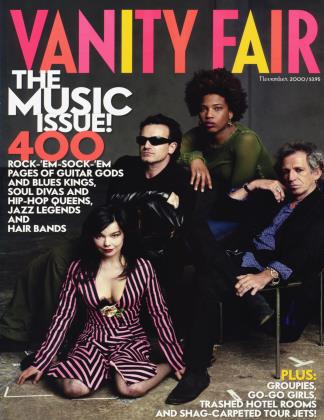
Sign In Not a Subscriber?Join NowCombine Woodstocks One, Two, and Three with a night at the Metropolitan Opera, another night at the Village Vanguard, showtime at the Apollo, and a side trip to Nashville. Toss in a visit to Total Request Live. Now you’re getting close. The triple-platinum lineup on the next 59 pages is an ultimate Who’s Who of hit-makers and chart breakers, rock legends and folk heroes, rappers and divas, photographed by Annie Leibovitz, David Bailey, Julian Broad, William Claxton, Michel Comte, Todd Eberle, Timothy Greenfield-Sanders, Sam Jones, David LaChapelle, Mary Ellen Mark, Michael O'Neill, Herb Ritts, Bruce Weber, and more. With captions by Aliyah Baruchin, Bruce Handy, Michael Hogan, David Kamp, and Jim Windolf
Combine Woodstocks One, Two, and Three with a night at the Metropolitan Opera, another night at the Village Vanguard, showtime at the Apollo, and a side trip to Nashville. Toss in a visit to Total Request Live. Now you’re getting close. The triple-platinum lineup on the next 59 pages is an ultimate Who’s Who of hit-makers and chart breakers, rock legends and folk heroes, rappers and divas, photographed by Annie Leibovitz, David Bailey, Julian Broad, William Claxton, Michel Comte, Todd Eberle, Timothy Greenfield-Sanders, Sam Jones, David LaChapelle, Mary Ellen Mark, Michael O'Neill, Herb Ritts, Bruce Weber, and more. With captions by Aliyah Baruchin, Bruce Handy, Michael Hogan, David Kamp, and Jim Windolf
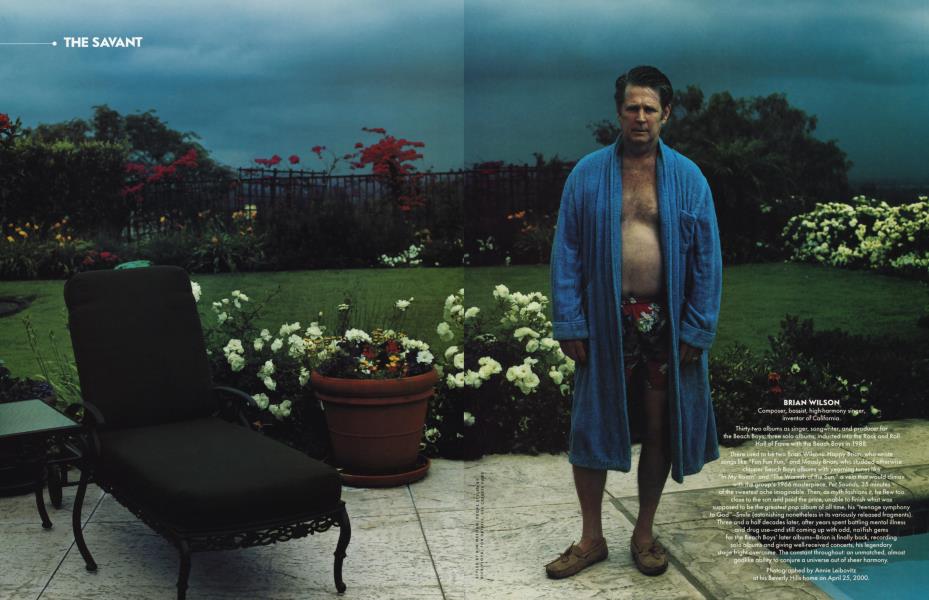
Thirty-two albums as singer, songwriter, and producer for the Beach Boys; three solo albums; inducted into the Rock and Roll Hall of Fame with the Beach Boys in 1988.
There used to be two Brian Wilsons: Happy Brian, who wrote songs like "Fun Fun Fun," and Moody Brian, who studded otherwise chipper Beach Boys albums with yearning tunes like "In My Room" and "The Warmth of the Sun," a vein that would climax with the group's 1966 masterpiece, Pet Sounds, 35 minutes of the sweetest ache imaginable. Then, as myth fashions it, he flew too close to the sun and paid the price, unable to finish what was supposed to be the greatest pop album of all time, his "teenage symphony to God "—Smile (astonishing nonetheless in its variously released fragments). Three and a half decades later, after years spent battling mental illness and drug use—and still coming up with odd, naifish gems for the Beach Boys' later albums—Brian is finally back, recording solo albums and giving well-received concerts, his legendary stage fright overcome. The constant throughout: an unmatched, almost godlike ability to conjure a universe out of sheer harmony.
Photographed by Annie Leibovitz at his Beverly Hills home on April 25, 2000.
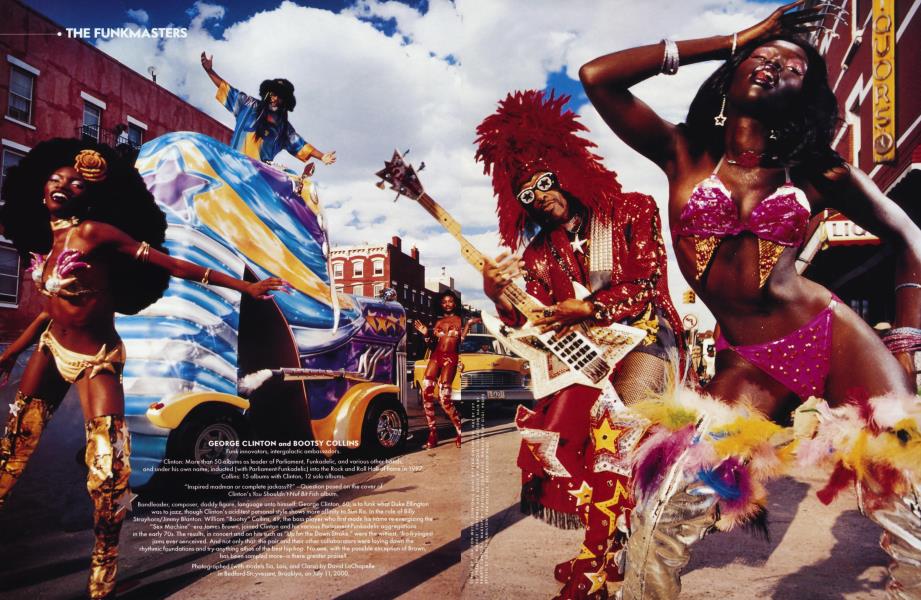
Clinton; More than 50 albums as leader of Parliament, Funkadelic, and various other bands and under his own name; inducted (with Parliament Funkadelic) into the Rock and Roll Hall of Fame in 1997
Collins: 15 albums with Clinton, 12 solo albums.
"Inspired madman or complete jackass??" —Question posed on the cover of Clinton's You Shouldn't Nuf Bit Fish album.
Bandleader, composer, daddy figure, language unto himself: George Clinton, 60, is to funk what Duke Ellington was to jazz, though Clinton's acid-test personal style shows more affinity to Sun Ra. In the role of Billy Strayhorn/Jimmy Blanton: William "Bootsy" Collins, 49, the bass player who first made his name re-energizing the "Sex Machine" era James Brown, joined Clinton and his various Parliament-Funkadelic aggregations in the early 70s. The results, in concert and on hits such as "Up for the Down Stroke," were the wittiest, 'fro-fryingest jams ever conceived. And not only that: the pair.and their other collaborators were laying down the rhythmic foundations and fry anything ethos of the best hip-hop. No one, with the possible exception of Brown, has been sampled more—is there greater praise?
Photographed (with models Tia, Lois, and Clara) by David LaChapelle in Bedford-Stuyvesant, Brooklyn, on July 11, 2000.
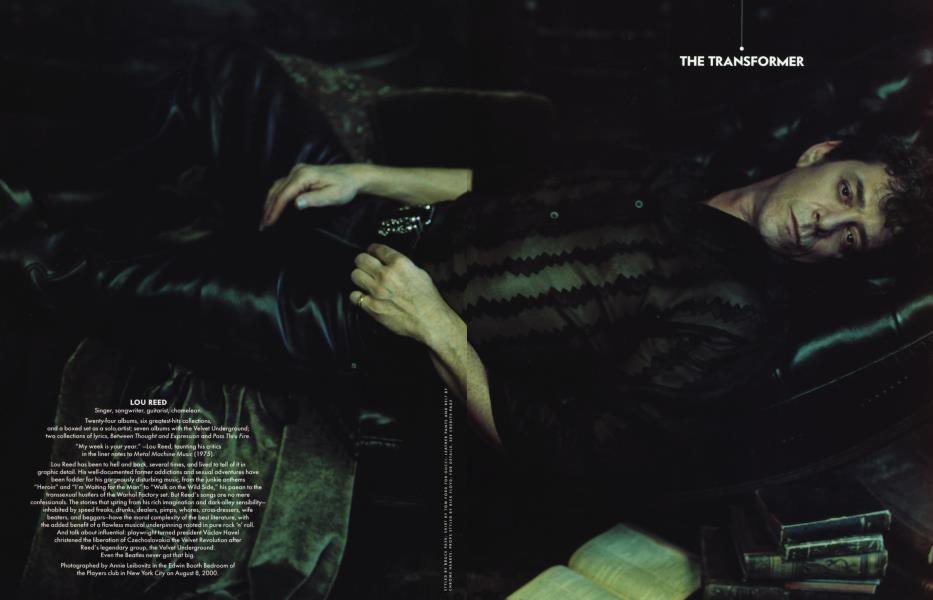
Twenty-four albums, six greatest-hits collections, and a boxed set as a solo artist; seven albums with the Velvet Underground; two collections of lyrics, Between Thought and Expression and Pass Thru Fire.
"My week is your year." —Lou Reed, taunting his critics in the liner notes to Metal Machine Music (1975).
Lou Reed has been to hell and back, several times, and lived to tell of it in graphic detail. His well-documented former addictions and sexual adventures have been fodder for his gorgeously disturbing music, from the junkie anthems "Heroin" and "I'm Waiting for the Man" to "Walk on the Wild Side," his paean to the transsexual hustlers of the Warhol Factory set. But Reed's songs are no mere confessionals. The stories that spring from his rich imagination and dark-alley sensibility—inhabited by speed freaks, drunks, dealers, pimps, whores, cross-dressers, wife beaters, and beggars—have the moral complexity of the best literature, with the added benefit of a flawless musical underpinning rooted in pure rock 'n' roll. And talk about influential: playwright turned president Vaclav Havel christened the liberation of Czechoslovakia the Velvet Revolution after Reed's legendary group, the Velvet Underground.
Even the Beatles never got that big.
Photographed by Annie Leibovitz in the Edwin Booth Bedroom of the Players club in New York City on August 8, 2000.
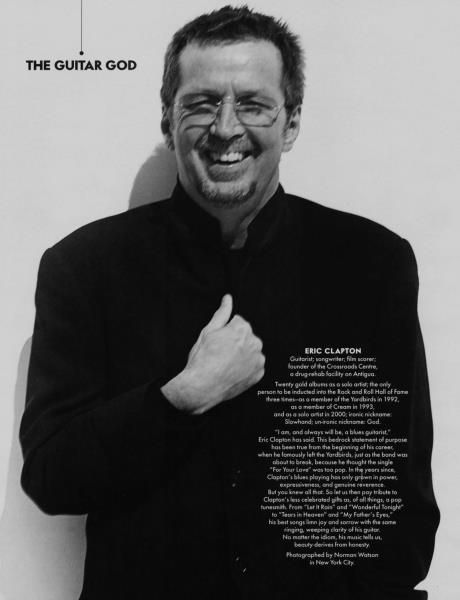
Twenty gold albums as a solo artist; the only person to be inducted into the Rock and Roll Hall of Fame three times—as a member of the Yardbirds in 1992, as a member of Cream in 1993, and as a solo artist in 2000; ironic nickname: Slowhand; un-ironic nickname: God.
"I am, and always will be, a blues guitarist," Eric Clapton has said. This bedrock statement of purpose has been true from the beginning of his career, when he famously left the Yardbirds, just as the band was about to break, because he thought the single "For Your Love" was too pop. In the years since, Clapton's blues playing has only grown in power, expressiveness, and genuine reverence.
But you knew all that. So let us then pay tribute to Clapton's less celebrated gifts as, of all things, a pop tunesmith. From "Let It Rain" and "Wonderful Tonight" to "Tears in Heaven" and "My Father's Eyes," his best songs limn joy and sorrow with the same ringing, weeping clarity of his guitar.
No matter the idiom, his music tells us, beauty derives from honesty.
Photographed by Norman Watson in New York City.
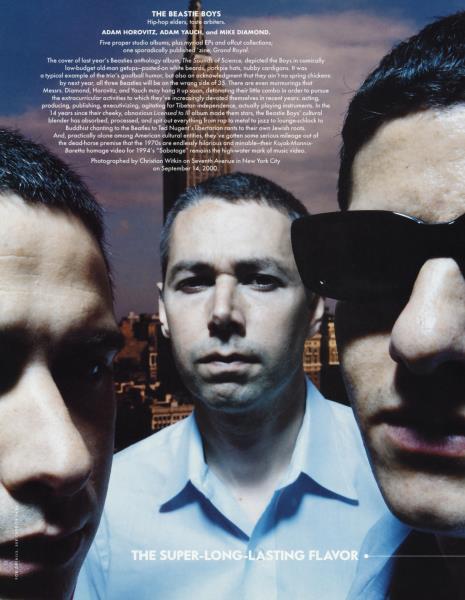
Five proper studio albums, plus myriad EPs and off-cut collections; one sporadically published zine, Grand Royal.
The cover of last year's Beasties anthology album, The Sounds of Science, depicted the Boys in comically low-budget old-man getups—pasted-on white beards, porkpie hats, nubby cardigans. It was a typical example of the trio's goofball humor, but also an acknowledgment that they ain't no spring chickens: by next year, all three Beasties will be on the wrong side of 35. There are even murmurings that Messrs. Diamond, Horovitz, and Yauch may hang it up soon, detonating their little combo in order to pursue the extracurricular activities to which they've increasingly devoted themselves in recent years: acting, producing, publishing, executivizing, agitating for Tibetan independence, actually playing instruments. In the 14 years since their cheeky, obnoxious Licensed to Ill album made them stars, the Beastie Boys' cultural blender has absorbed, processed, and spit out everything from rap to metal to jazz to lounge-schlock to Buddhist chanting to the Beatles to Ted Nugent's libertarian rants to their own Jewish roots.
And, practically alone among American cultural entities, they've gotten some serious mileage out of the dead-horse premise that the 1970s are endlessly hilarious and minable—their Kojak-Mann Baretta homage video for 1994's "Sabotage" remains the high-water mark of music video.
Photographed by Christian Witkin on Seventh Avenue in New York City on September 14, 2000.
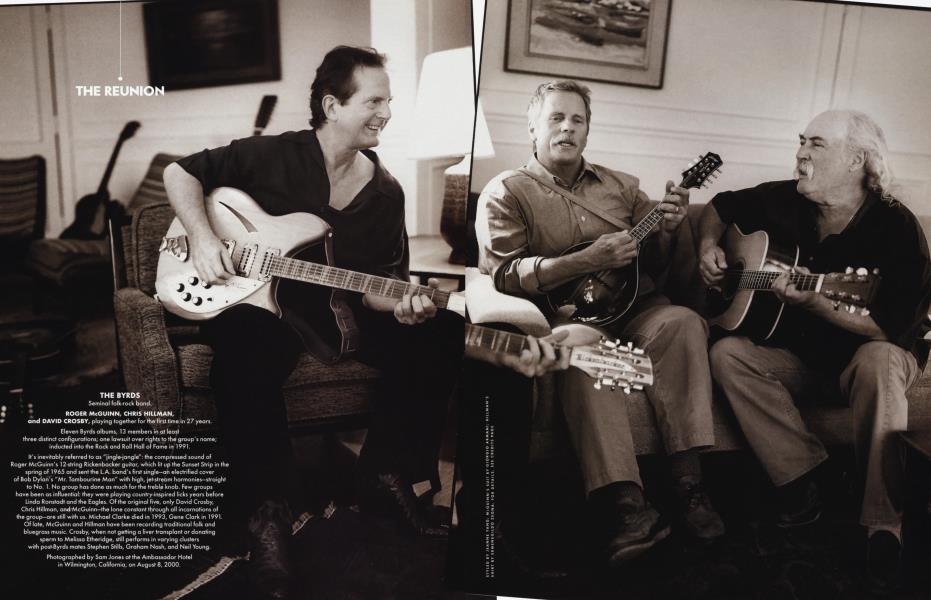
Eleven Byrds albums, 13 members in at least three distinct configurations; one lawsuit over rights to the group's name; inducted into the Rock and Roll Hall of Fame in 1991.
It's inevitably referred to as "jingle-jangle": the compressed sound of Roger McGuinn's 12-string Rickenbacker guitar, which lit up the Sunset Strip in the spring of 1965 and sent the L.A. band's first single—an electrified cover of Bob Dylan's "Mr. Tambourine Man" with high, jet-stream harmonies—straight to No. 1. No group has done as much for the treble knob. Few groups have been as influential: they were playing country-inspired licks years before Linda Ronstadt and the Eagles. Of the original five, only David Crosby, Chris Hillman, and McGuinn—the lone constant through all incarnations of the group—are still with us. Michael Clarke died in 1993, Gene Clark in 1991. Of late, McGuinn and Hillman have been recording traditional folk and bluegrass music. Crosby, when not getting a liver transplant or donating sperm to Melissa Etheridge, still performs in varying clusters with post-Byrds mates Stephen Stills, Graham Nash, and Neil Young.
Photographed by Sam Jones at the Ambassador Hotel in Wilmington, California, on August 8, 2000.
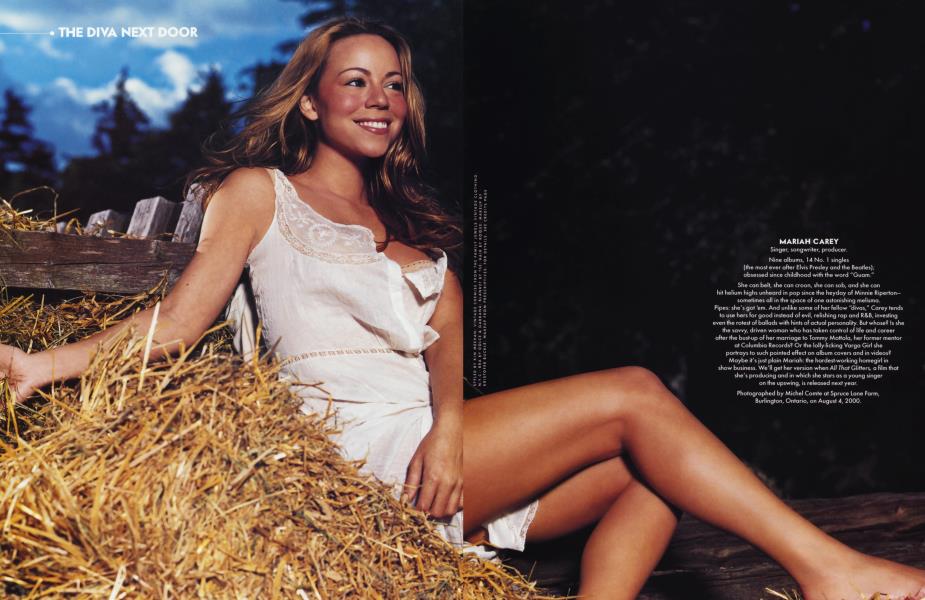
Nine albums, 14 No. 1 singles (the most ever after Elvis Presley and the Beatles); obsessed since childhood with the word "Guam."
She can belt, she can croon, she can sob, and she can hit helium highs unheard in pop since the heyday of Minnie Riperton—sometimes all in the space of one astonishing melisma.
Pipes: she's got 'em. And unlike some of her fellow "divas," Carey tends to use hers for good instead of evil, relishing rap and R&B, investing even the rotest of ballads with hints of actual personality. But whose? Is she the savvy, driven woman who has taken control of life and career after the bust-up of her marriage to Tommy Mottola, her former mentor at Columbia Records? Or the lolly-licking Varga Girl she portrays to such pointed effect on album covers and in videos? Maybe it's just plain Mariah: the hardest-working homegirl in show business. We'll get her version when All That Glitters, a film that she's producing and in which she stars as a young singer on the upswing, is released next year.
Photographed by Michel Comte at Spruce Lane Farm, Burlington, Ontario, on August 4, 2000.
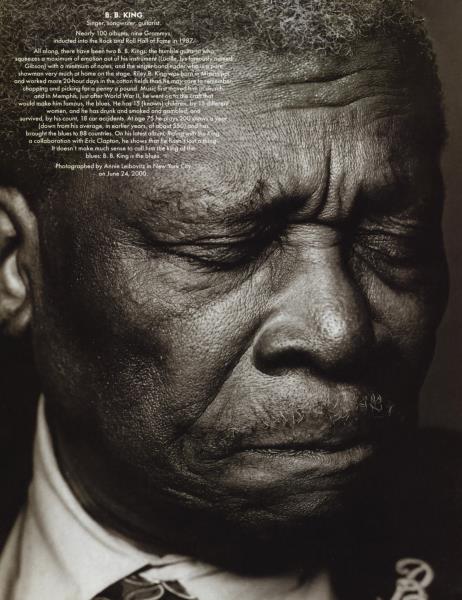
Nearly 100 albums, nine Grammys; inducted into the Rock and Roll Hall of Fame in 1987.
All along, there have been two B. B. Kings: te humble guitarist who squeezes a maximum of emotion out of his instrument (Lucille, his famously named Gibson) with a minimum of notes, and the singer-bandleader who is a pure showman very much at home on the stage. Riley B. King was born in Mississippi and worked more 20-hour days in the cotton fields than many care to remember, chopping and picking for a penny a pound. Music first moved him in church and in Memphis, just after World War II, he went on to the craft that would make him famous, the blues. He has 15 (known) children, by 15 different women, and he has drunk and smoked and gambled, and survived, by his count, 18 car accidents. At age 75 he plays 200 shows a year (down from his average, in earlier years, of about 350) and has brought the blues to 88 countries. On his latest album, Riding with the King, a collaboration with Eric Clapton, he shows that he hasn't lost a thing. It doesn't make much sense to call him the king of the blues: B. B. King is the blues.
Photographed by Annie Leibovitz n on June 24, 2000.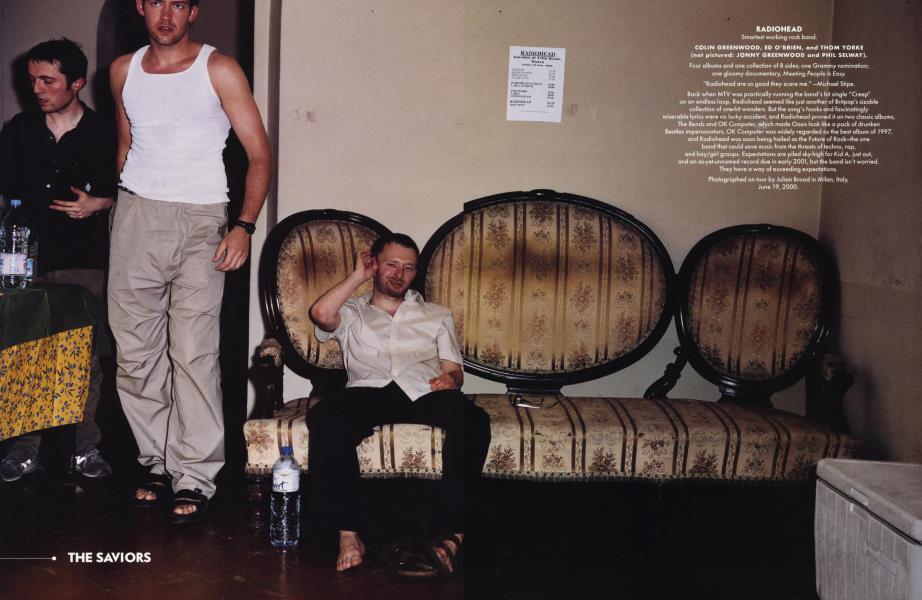
Four albums and one collection of B sides; one Grammy nomination; one gloomy documentary, Meeting People Is Easy.
"Radiohead are so good they scare me." —Michael Stipe.
Back when MTV was practically running the band's hit single "Creep" on an endless loop, Radiohead seemed like just another of Britpop's sizable collection of one-hit wonders. But the song's hooks and fascinatingly miserable lyrics were no lucky accident, and Radiohead proved it on two classic albums, The Bends and OK Computer, which made Oasis look like a pack of drunken Beatles impersonators. OK Computer was widely regarded as the best album of 1997, and Radiohead was soon being hailed as the Future of Rock—the one band that could save music from the threats of techno, rap, and boy/girl groups. Expectations are piled sky-high for Kid A, just out, and an as-yet-unnamed record due in early 2001, but the band isn't worried.
They have a way of exceeding expectations.
Photographed on tour by Julian Broad in Milan, Italy, June 19, 2000.
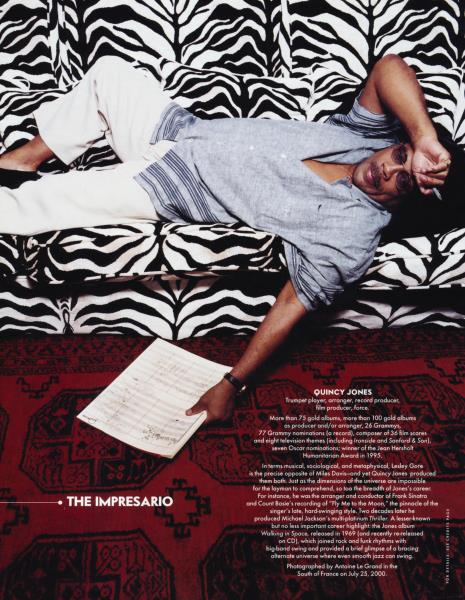
More than 75 gold albums, more than 100 gold albums as producer and/or arranger, 26 Grammys, 77 Grammy nominations (a record), composer of 36 film scores and eight television themes (including Ironside and Sanford & Son), seven Oscar nominations; winner of the Jean Hersholt Humanitarian Award in 1995.
In terms musical, sociological, and metaphysical, Lesley Gore is the precise opposite of Miles Davis—and yet Quincy Jones produced them both. Just as the dimensions of the universe are impossible for the layman to comprehend, so too the breadth of Jones's career. For instance, he was the arranger and conductor of Frank Sinatra and Count Basie's recording of "Fly Me to the Moon," the pinnacle of the singer's late, hard-swinging style. Two decades later he produced Michael Jackson's multi-platinum Thriller. A lesser-known but no less important career highlight: the Jones album Walking in Space, released in 1969 (and recently re-released on CD), which joined rock and funk rhythms with big-band swing and provided a brief glimpse of a bracing alternate universe where even smooth jazz can swing.
Photographed by Antoine Le Grand in the South of France on July 25, 2000.
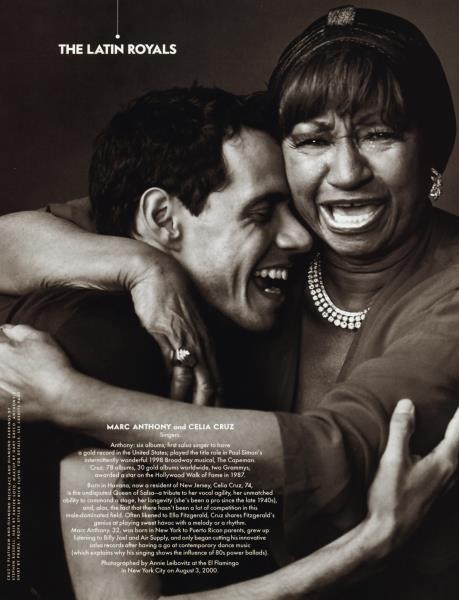
Anthony: six albums; first salsa singer to have a gold record in the United States; played the title role in Paul Simon's intermittently wonderful 1998 Broadway musical, The Capeman.
Cruz: 78 albums, 30 gold albums worldwide, two Grammys; awarded a star on the Hollywood Walk of Fame in 1987.
Born in Havana, now a resident of New Jersey, Celia Cruz, 74, is the undisputed Queen of Salsa—a tribute to her vocal agility, her unmatched ability to command a stage, her longevity (she's been a pro since the late 1940s), and, alas, the fact that there hasn't been a lot of competition in this male-dominated field. Often likened to Ella Fitzgerald, Cruz shares Fitzgerald's genius at playing sweet havoc with a melody or a rhythm.
Marc Anthony, 32, was born in New York to Puerto Rican parents, grew up listening to Billy Joel and Air Supply, and only began cutting his innovative salsa records after having a go at contemporary dance music (which explains why his singing shows the influence of 80s power ballads).
Photographed by Annie Leibovitz at the El Flamingo in New York City on August 3, 2000.
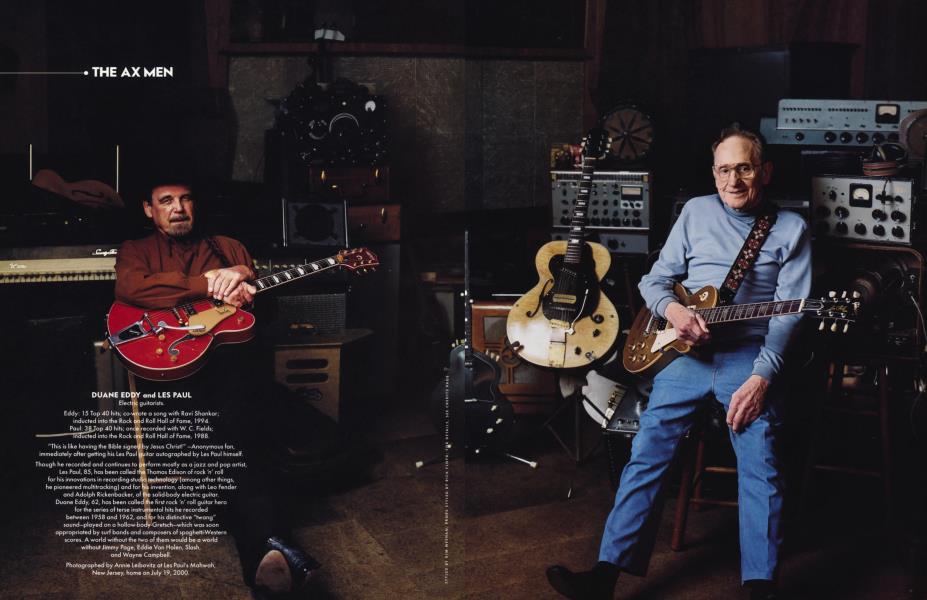
Eddy: 15 Top 40 hits; co-wrote a song with Ravi Shankar; inducted into the Rock and Roll Hall of Fame, 1994. Paul: 38 Top 40 hits; once recorded with W. C. Fields; Inducted into the Rock anti Roll Hall of Fame, 1988.
"This is like having the Bible signed by Jesus Christ!" —Anonymous fan, immediately after getting his Les Paul guitar autographed by Les Paul himself.
Though he recorded and continues to perform mostly as a jazz and pop artist, Les Paul, 85, has been called the Thomas Edison of rock 'n' roll for his innovations in recording-studio technology (among other things, he pioneered multi-tracking) and for lis invention, along with Leo Fender and Adolph Rickenbacker, of the solid-body electric guitar.
Duane Eddy, 62, has been called the first rock 'n' roll guitar hero for the series of terse instrumental hits he recorded between 1958 and 1962, and for his distinctive "twang" sound—played on a hollow-body Gretsch—which was soon appropriated by surf bands and composers of spaghetti-Western scores. A world without the two of them would be a world without Jimmy Page, Eddie Van Halen, Slash, and Wayne Campbell.
Photographed by Annie Leibovitz at Les Paul's Mahwah, New Jersey, home on July 19, 2000.
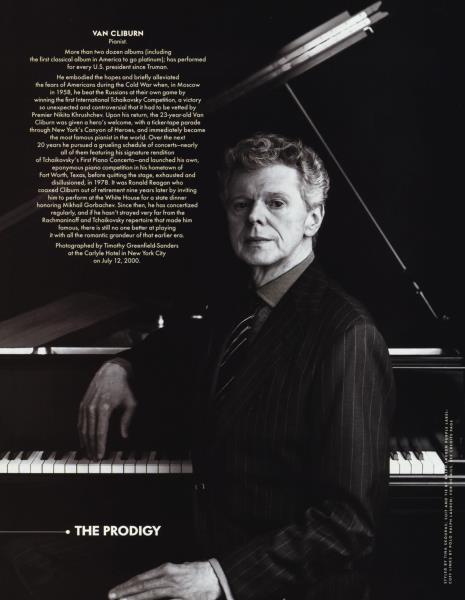
More than two dozen albums (including the first classical album in America to go platinum); has performed for every U.S. president since Truman.
He embodied the hopes and briefly alleviated the fears of Americans during the Cold War when, in Moscow in 1958, he beat the Russians at their own game by winning the first International Tchaikovsky Competition, a victory so unexpected and controversial that it had to be vetted by Premier Nikita Khrushchev. Upon his return, the 23-year-old Van Cliburn was given a hero's welcome, with a ticker-tape parade through New York's Canyon of Heroes, and immediately became the most famous pianist in the world. Over the next 20 years he pursued a grueling schedule of concerts—nearly all of them featuring his signature rendition of Tchaikovsky's First Piano Concerto—and launched his own, eponymous piano competition in his hometown of Fort Worth, Texas, before quitting the stage, exhausted and disillusioned, in 1978. It was Ronald Reagan who coaxed Cliburn out of retirement nine years later by inviting him to perform at the White House for a state dinner honoring Mikhail Gorbachev. Since then, he has concertized regularly, and if he hasn't strayed very far from the Rachmaninoff and Tchaikovsky repertoire that made him famous, there is still no one better at playing it with all the romantic grandeur of that earlier era.
Photographed by Timothy Greenfield-Sanders at the Carlyle Hotel in New York City on July 12, 2000.
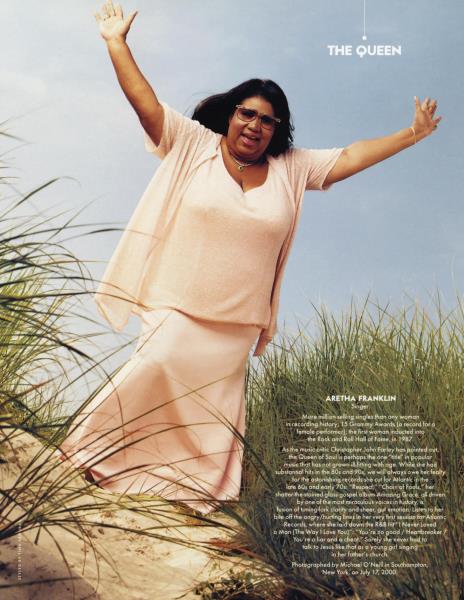
More million-selling singles than any woman in recording history; 15 Grammy Awards (a record for a female performer); the first woman inducted into the Rock and Roll Hall of Fame, in 1987.
As the musk critic Christopher John Farley has pointed out, the Queen of Soul is perhaps the one "title" in popular music that has not grown ill-fitting with age. While she had substantial hits in the 80s and 90s, we will always owe her fealty for the astonishing records she cut for Atlantic in the late 60s and early 70s. "Respect," "Chain of Fools," her shatter-the-stained-glass gospel album Amazing Grace, all drive by one of the most miraculous voices in history, a fusion of tuning-fork clarity and sheer, gut emotion. Listen to her bite off the angry/hurting lines in her very first session for Atlantic Records, where she laid down the R&B hit "I Never Loved a Man (The Way I Love You)": "You're no good / Heartbreaker / You're a liar and a cheat." Surely she never had to talk to Jesus like that as a young girl singing in her father's church.
Photographed by Michael O'Neill in Southampton, New York, on July 7, 2000.
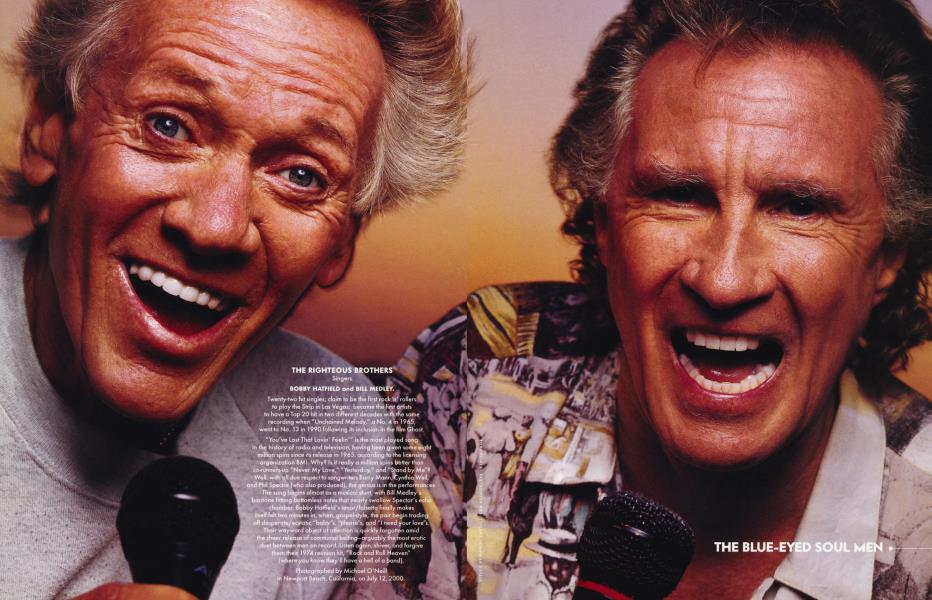
Twenty-two hit singles; claim to be the first rock 'n' rollers to play the Strip in Las Vegas; became the first artists to have a Top 20 hit in two different decades with the same recording when "Unchained Melody," a No. 4 in 1965, went to No. 13 in 1990 following its inclusion in the film Ghost.
"You've Lost That Lovin' Feelin'" is the most played song in the history of radio and television, having been given some eight million spins since its release in 1965, according to the licensing organization BMI. Why? Is it really a million spins better than co-runners-up "Never My Love," "Yesterday," and "Stand by Me"? Well, with all due respect to songwriters Barry Mann, Cynthia Weil, and Phil Spector (who also produced), the genius is in the performances. The song begins almost as a musical stunt, with Bill Medley's baritone hitting bottomless notes that nearly swallow Spector's echo chamber. Bobby Hatfield's tenor/falsetto finally makes itself felt two minutes in, when, gospel-style, the pair begin trading off desperate/ecstatic "baby's, "please"s, and "I need your love 's Their wayward object of affection is quickly forgotten amid the sheer release of communal belting-arguably the most erotic duet between men on record. Listen again, shiver, and forgive them their 1974 reunion hit, "Rock and Roll Heaven" (where you know they'll have a hell of a band).
Photographed by Michael O'Neill in Newport Beach, California, on July 12, 2000.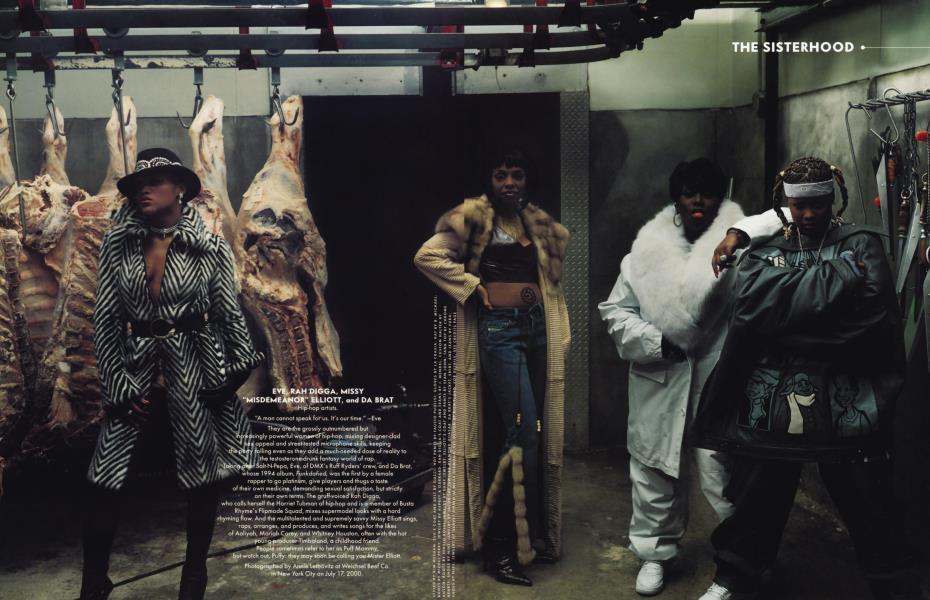
"A man cannot speak for us. It's our time." —Eve
They are the grossly outnumbered but increasingly powerful wo.m»#r6f hip-hop, mixing designer-dad appeal and street-tested microphone skills, keeping the pdirty rolling even as they add a much-needed dose of reality to the testosterone-drunk fantasy world of rap. Taking after Salt-N-Pepa, Eve, of DMX's Ruff Ryders' crew, and Da Brat, whose 1994 album, Funkdafied, was the first by a female rapper to go platinum, give players and thugs a taste of their own medicine, demanding sexual satisfaction, but strictly on their own terms. The gruff-voiced Rah Digga, who calls herself the Harriet Tubman of hip-hop and is a member of Busta Rhyme's Flipmode Squad, mixes supermodel looks with a hard rhyming flow. And the multitalented and supremely savvy Missy Elliott sings, raps, arranges, and produces, and writes songs for the likes of Aaliyah, Mariah Carey, and Whitney Houston, often with the hot young producer Timbaland, a childhood friend.
People sometimes refer to her as Puff Mommy, but watch out, Puffy: they may soon be calling you Mister Elliott.
Photographed by Annie Leibovitz at Weichsel Beef Co. in New York City on July 17, 2000.
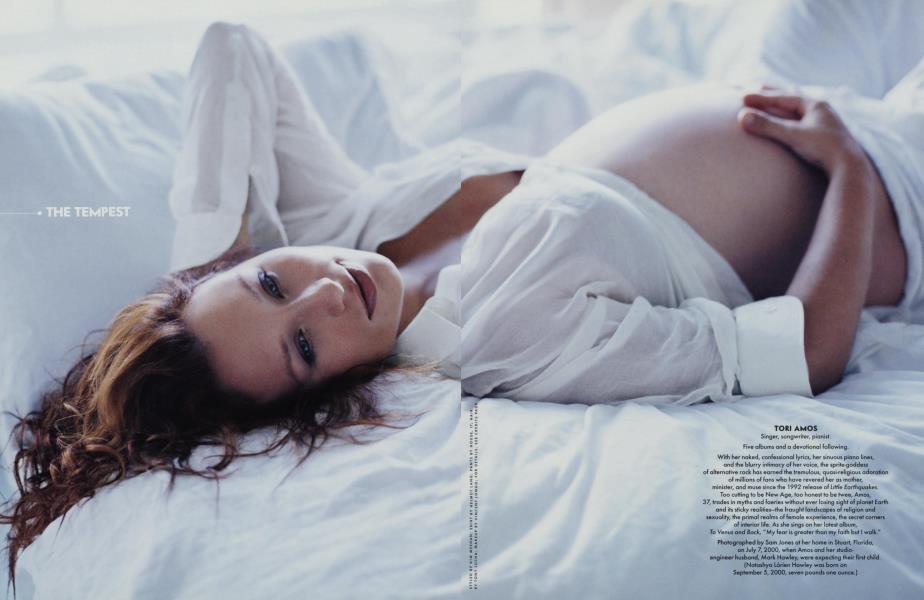
Five albums and a devotional following.
With her naked, confessional lyrics, her sinuous piano lines, and the blurry intimacy of her voice, the sprite-goddess of alternative rock has earned the tremulous, quasi-religious adoration of millions of fans who have revered her as mother, minister, and muse since the 1992 release of Little Earthquakes. Too cutting to be New Age, too honest to be twee, Amos, 37, trades in myths and faeries without ever losing sight of planet Earth and its sticky realities—the fraught landscapes of religion and sexuality, the primal realms of female experience, the secret corners of interior life. As she sings on her latest album, To Venus and Back, "My fear is greater than my faith but I walk."
Photographed by Sam Jones at her home in Stuart, Florida, on July 7, 2000, when Amos and her studio-engineer husband, Mark Hawley, were expecting their first child. (Natashya Lorien Hawley was born on September 5, 2000, seven pounds one ounce.)
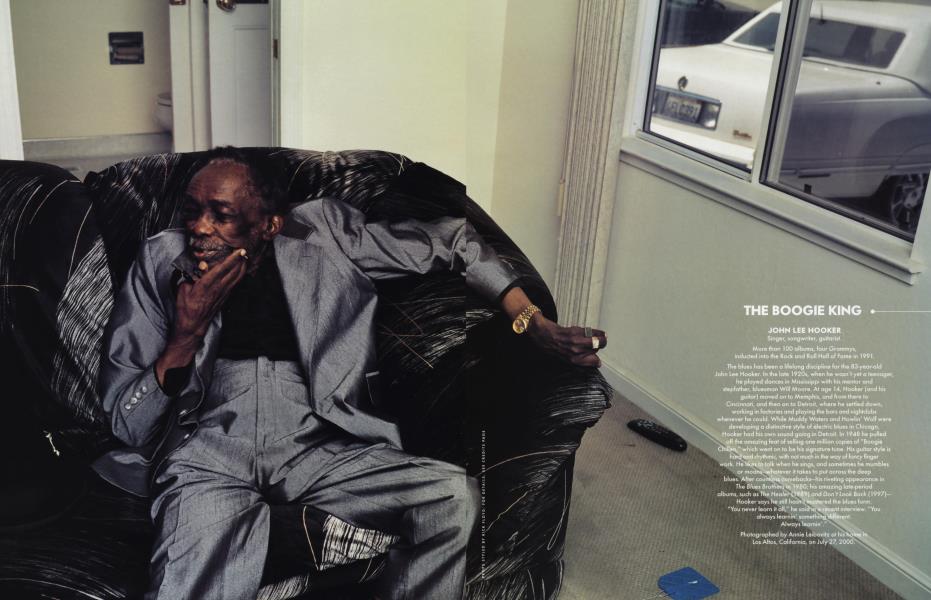
More than 100 albums, four Grammys, inducted into the Rock and Roll Hall of Fame in 1991.
The blues has been a lifelong discipline for the 83-year-old John Lee Hooker. In the late 1920s, when he wasn't yet a teenager, he played dances in Mississippi with his mentor and stepfather, bluesman Will Moore. At age 14, Hooker (and his guitar) moved on to Memphis, and from there to Cincinnati, and then on to Detroit, where he settled down, working in factories and playing the bars and nightclubs whenever he could. While Muddy Waters and Howlin' Wolf were developing a distinctive style of electric blues in Chicago, Hooker had his own sound going in Detroit. In 1948 he pulled off the amazing feat of selling one million copies of "Boogie Chillen," which went on to be his signature tune. His guitar style is hard and rhythmic, with not much in the way of fancy finger work. He likes to talk when he sings, and sometimes he mumbles or moans—whatever it takes to put across the deep blues. After countless comebacks—his riveting appearance in The Blues Brothers in 1980; his amazing late-period albums, such as The Healer (1989) and Don't Look Back (1997)—Hooker says he still hasn't mastered the blues form. You never learn it all," he said in a recent interview. "You always learnin' something different. Always learnin'."
Photographed by Annie Leibovitz at his home in Los Altos, California, on July 27, 2000.
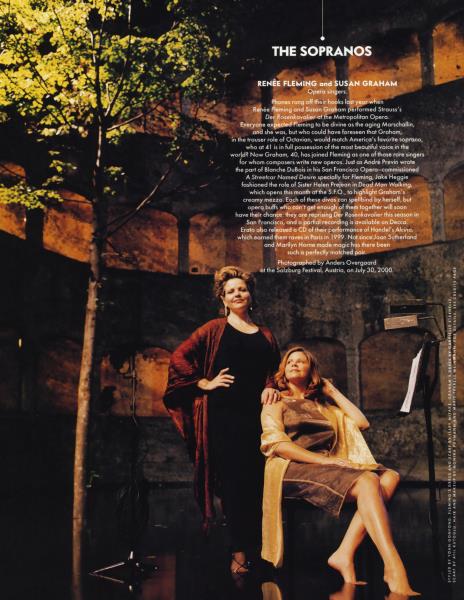
Phones rang off their hooks last year when Kenee Fleming and Susan Graham performed Strauss's Der Rosenkavalier at the Metropolitan Opera. Everyone expected Fleming to be divine as the aging Marschallin, and she was, but who could have foreseen that Graham, in the trouser role of Octavian, would match America's favorite soprano, who at 41 is in full possession of the most beautiful voice in the world? Now Graham, 40, has joined Fleming as one of those rare singers for whom composers write new operas. Just as Andre Previn wrote the part of Blanche DuBois in his San Francisco Opera-commissioned A Streetcar Named Desire specially for Fleming, Jake Heggie fashioned the role of Sister Helen Prejean in Dead Man Walking, which opens this month at the S.F.O., to highlight Graham's creamy mezzo. Each of these divas can spellbind by herself, but opera buffs who can't get enough of them together will soon have their chance: they are reprising Der Rosenkavalier this season in San Francisco, and a partial recording is available on Decca. Erato also released a CD of their performance of Handel's Alcina, which earned them raves in Paris in 1999. Not since Joan Sutherland and Marilyn Horne made magic has there been such a perfectly matched pair.
Photographed by Anders Overgaard at the Salzburg Festival, Austria, on July 30, 2000.
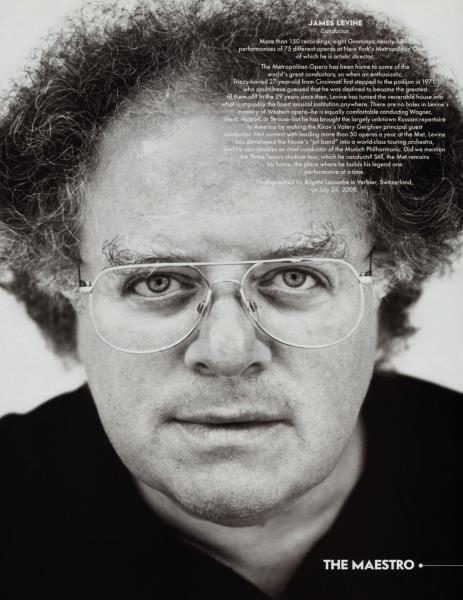
More than 150 recordings; eight Grammys; nearly 18,000 performances of 75 different operas at New York's Metropolitan Opera, of which he is artistic director.
The Metropolitan Opera has been home to some of the world's great conductors, so when an enthusiastic, frizzy-haired 27-year-old from Cincinnati first stepped to the podium in 1971, who could have guessed that he was destined to become the greatest of them all? In the 29 years since then, Levine has turned the venerable' house into what is arguably the finest musical institution anywhere. There are no holes in Levine's mastery of Western opera—he is equally comfortable conducting Wagner, Verdi, Mozart, or Strauss—but he has brought the largely unknown Russian repertoire to America by making the Kirov's Valery Gerghiev principal guest conductor. Not content with leading more than 50 operas a year at the Met, Levine has developed the house's "pit band" into a world-class touring orchestra, and he also doubles as chief conductor of the Munich Philharmonic. Did we mention the Three Tenors stadium tour, which he conducts? Still, the Met remains his home, the place where he builds his legend one performance at a time.
Photographed by Brigitte Lacombe in Verbier, Switzerland, on July 26, 2000.
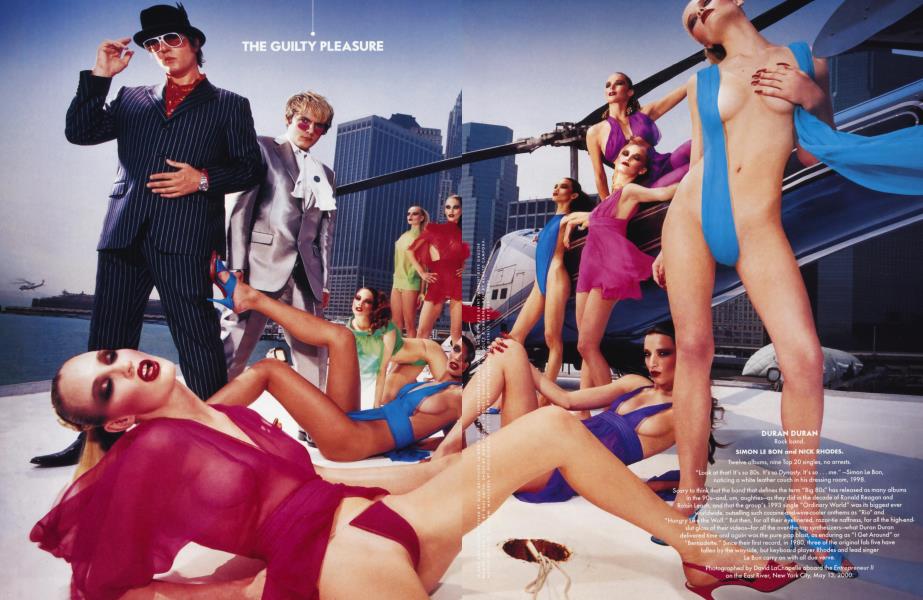
Twelve albums, nine Top 20 singles, no arrests.
"Look at that! It's so 80s. It's so Dynasty. It's so ... me." —Simon Le Bon, noticing a white leather couch in his dressing room, 1998.
Scary to think that the band that defines the term "Big 80s" has released as many albums in the 90s—and, um, aughties—as they did in the decade of Ronald Reagan and Robin Leach, and that the group's 1993 single "Ordinary World" was its biggest ever worldwide, outselling such cocaine-and-wine-cooler anthems as "Rio" and "Hungry Likf the Wolf." But then, for all their eyelinered, razor-tie naffness, for all the high-end-slut gloss of their videos—for all the over-the-top synthesizers—what Duran Duran delivered time and again was the pure pop blast, as enduring as "I Get Around" or "Bernadette." Since their first record, in 1980, three of the original fab five have fallen by the wayside, but keyboard player Rhodes and lead singer Le Bon carry on with all due verve.
Photographed by David LaChapelle aboard the Entrepreneur II on the East River, New York City, May 13, 2000.
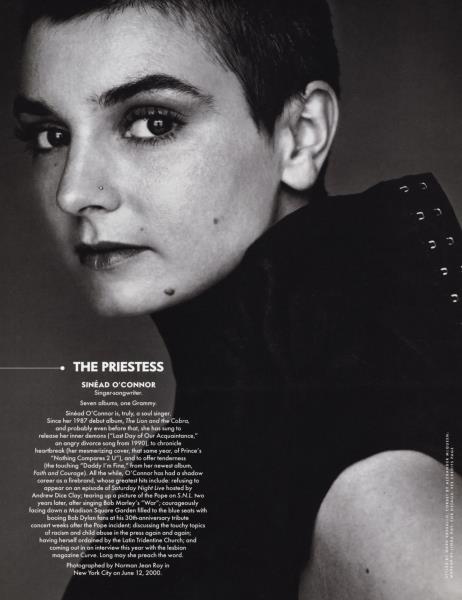
Seven albums, one Grammy.
Sinead O'Connor is, truly, a soul singer. Since her 1987 debut album, The Lion and the Cobra, and probably even before that, she has sung to release her inner demons ("Last Day of Our Acquaintance," an angry divorce song from 1990), to chronicle heartbreak (her mesmerizing cover, that same year, of Prince's "Nothing Compares 2 U"), and to offer tenderness (the touching "Daddy I'm Fine," from her newest album, Faith and Courage). All the while, O'Connor has had a shadow career as a firebrand, whose greatest hits include: refusing to appear on an episode of Saturday Night Live hosted by Andrew Dice Clay; tearing up a picture of the Pope on S.N.L. two years later, after singing Bob Marley's "War"; courageously facing down a Madison Square Garden filled to the blue seats with booing Bob Dylan fans at his 30th-anniversary tribute concert weeks after the Pope incident; discussing the touchy topics of racism and child abuse in the press again and again; having herself ordained by the Latin Tridentine Church; and coming out in an interview this year with the lesbian magazine Curve. Long may she preach the word.
Photographed by Norman Jean Roy in New York City on June 12, 2000.
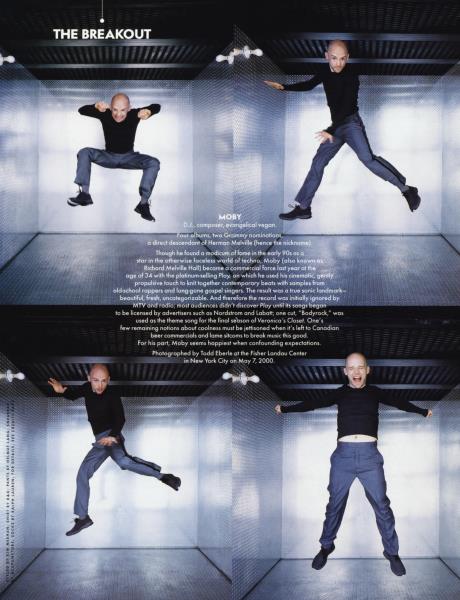
Four albums, two Grammy nominations, a direct descendent of Herman Melville (hence the nickname.)
Though he found a modicum of fame in the early 90s as a star in the otherwise faceless world techno, Moby (also known as Richard Melville Hall) became a commercial Force last year at the age of 34 with the platinum-selling Play, on which he used his cinematic, gently propulsive touch to knit together contemporary beats with samples from old-school rappers and long-gone gospel singers. The result was a true sonic landmark—beautiful, fresh, uncategorizable. And therefore the record was initially ignored by MTV and radio; most audiences didn't discover Play until its songs began to be licensed by advertisers such as Nordstrom and Labatt; one cut, "Bodyrock," was used as the theme song for the final season of Veronica's Closet. One's few remaining notions about coolness must be jettisoned when it's left to Canadian beer commercials and lame sitcoms to break music this good For his part, Moby seems happiest when confounding expectations.
Photographed by Todd Eberle at the Fisher Landau Center in New York City on May 7, 2000.
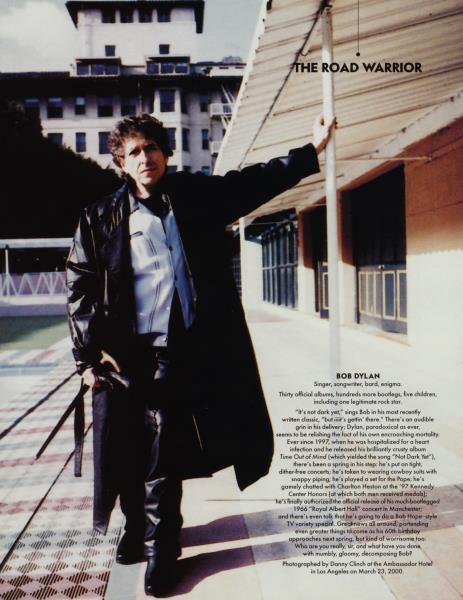
Thirty official albums, hundreds more bootlegs, five children, including one legitimate rock star.
"It's not dark yet," sings Bob in his most recently written classic, "but iiiit's gettin' there." There's an audible grin in his delivery; Dylan, paradoxical as ever, seems to be relishing the fact of his own encroaching mortality. Ever since 1997, when he was hospitalized for a heart infection and he released his brilliantly crusty album Time Out of Mind (which yielded the song "Not Dark Yet"), there's been a spring in his step: he's put on tight, dither-free concerts; he's taken to wearing cowboy suits with snappy piping; he's played a set for the Pope; he's gamely chatted with Charlton Heston at the '97 Kennedy Center Honors (at which both men received medals); he's finally authorized the official release of his much-bootlegged 1966 "Royal Albert Hall" concert in Manchester; and there's even talk that he's going to do a Bob Hope-style TV variety special. Great-news all around, portending even greater things to come as his 60th birthday approaches next spring, but kind of worrisome too:
Who are you really, sir, and what have you done with mumbly, gloomy, decomposing Bob?
Photographed by Danny Clinch at the Ambassador Hotel in Los Angeles on March 23, 2000.
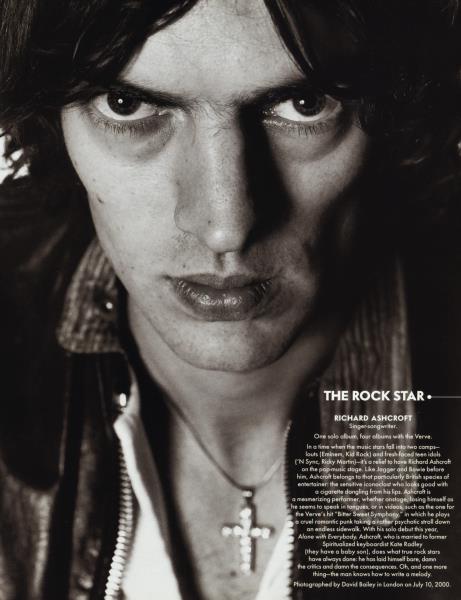
One solo album, four albums with the Verve.
In a time when the music stars fall into two camps—louts (Eminem, Kid Rock) and fresh-faced teen idols ('N Sync, Ricky Martin)—it's a relief to have Richard Ashcroft on the pop-music stage. Like Jagger and Bowie before him, Ashcroft belongs to that particularly British species of entertainer: the sensitive iconoclast who looks good with a cigarette dangling from his lips. Ashcroft is a mesmerizing performer, whether onstage, losing himself as he seems to speak in tongues, or in videos, such as the one for the Verve's hit "Bitter Sweet Symphony," in which he plays a cruel romantic punk taking a rather psychotic stroll down an endless sidewalk. With his solo debut this year, Alone with Everybody, Ashcroft, who is married to former Spiritualized keyboardist Kate Radley (they have a baby son), does what true rock stars have always done: he has laid himself bare, damn the critics and damn the consequences. Oh, and one more thing—the man knows how to write a melody.
Photographed by David Bailey in London on July 10, 2000.
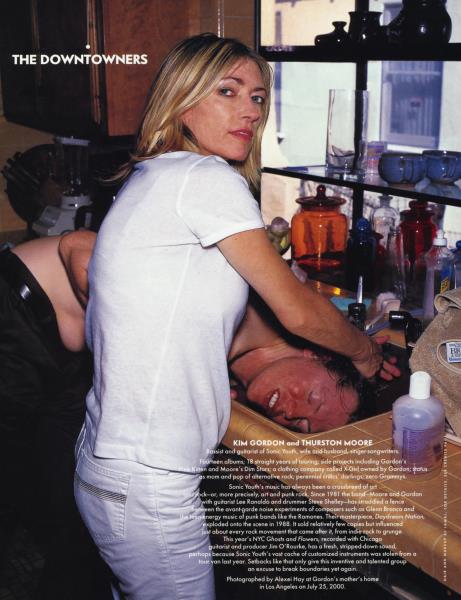
Fourteen albums; 18 straight years of touring; side projects including Gordon's Free Kitten and Moore's Dim Stars; a clothing company called X-Girl owned by Gordon; status as mom and pop of alternative rock; perennial critics' darlings; zero Grammys.
Sonic Youth's music has always been a crossbreed of art and rbck—or, more precisely, art and punk rock. Since 1981 the band-Moore and Gordon with guitarist Lee Ranaldo and drummer Steve Shelley—has straddled a fence between the avant-garde noise experiments of composers such as Glenn Branca and teern-energy music of punk bands like the Ramones. Their masterpiece, Daydream Nation, exploded onto the scene in 1988. It sold relatively few copies but influenced just about every rock movement that came after it, from indie rock to grunge.
This year's NYC Ghosts and Flowers, recorded with Chicago guitarist and producer Jim O'Rourke, has a fresh, stripped-down sound, perhaps because Sonic Youth's vast cache of customized instruments was stolen from a tour van last year. Setbacks like that only give this inventive and talented group an excuse to break boundaries yet again.
Photographed by Alexei Hay at Gordon's mother's home in Los Angeles on July 25, 2000.
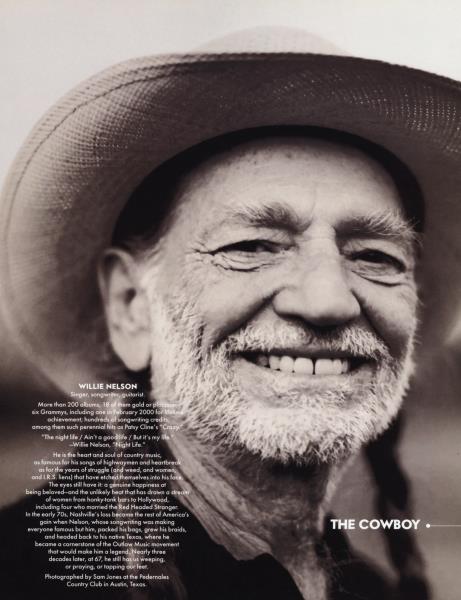
More than 200 albums, 18 of them gold or plenum; six Grammys, including one in February 2000 for lifetime achievement; hundreds of songwriting credits, among them such perennial hits as Patsy Cline's "Crazy."
"The night life / Ain't a good life / But it's my life. "—Willie Nelson, "Night Life."
He is the heart and soul of country music, as famous for his songs of highwaymen and heartbreak as for the years of struggle (and weed, and women, and I.R.S. liens) that have etched themselves into his fa The eyes still have it: a genuine happiness at being beloved—and the unlikely heat that has drawn a stream of women from honky-tonk bars to Hollywood, including four who married the Red Headed Stranger.
In the early 70s, Nashville's loss became the rest of America's gain when Nelson, whose songwriting was making everyone famous but him, packed his bags, grew his braids, and headed back to his native Texas, where he became a cornerstone of the Outlaw Music movement that would make him a legend. Nearly three decades later, at 67, he still has us weeping, or praying, or tapping our feet.
Photographed by Sam Jones at the Pedernales Country Club in Austin, Texas.
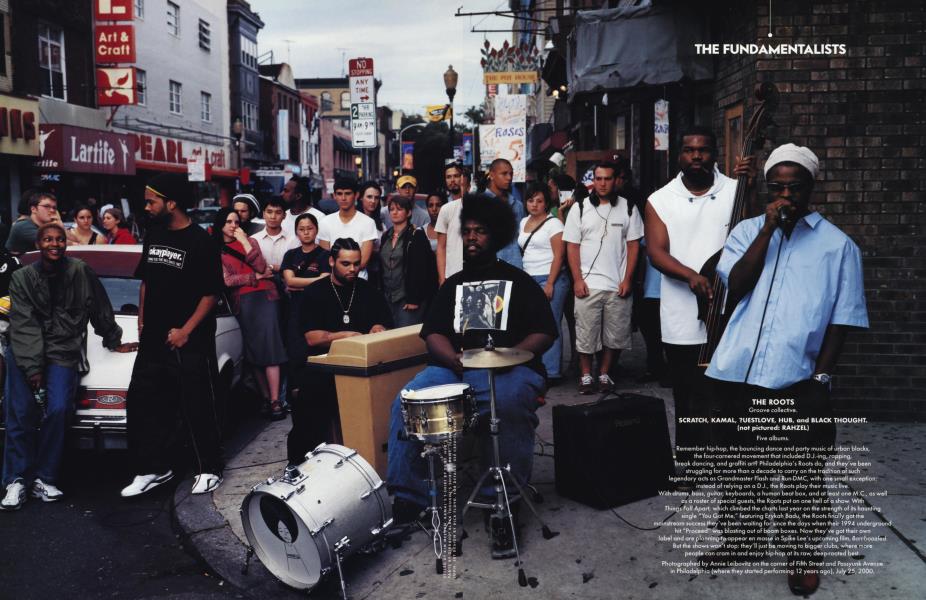
Five albums.
Remember hip-hop, the bouncing dance and party music of urban blacks, the four-cornered movement that included DJ.-ing, rapping, break dancing, and graffiti art? Philadelphia's Roots do, and they've been struggling for more than a decade to carry on the tradition of such legendary acts as Grandmaster Flash and Run-DMC, with one small exception: instead of relying on a D.J., the Roots play their music live.
With drums, bass, guitar, keyboards, a human beat box, and at least one M.C., as well as a roster of special guests, the Roots put on one hell of a show. With Things Fall Apart, which climbed the charts last year on the strength of its haunting single "You Got Me," featuring Erykah Badu, the Roots finally got the mainstream success they've been waiting for since the days when their 1994 underground hit "Proceed" was blasting out of boom boxes. Now they've got their own label and are planning to appear en masse in Spike Lee's upcoming film, Bamboozled. But the shows won't stop: they'll just be moving to bigger clubs, where more people can cram in and enjoy hip-hop at its raw, deep-rooted best.
Photographed by Annie Leibovitz on the corner of Fifth Street and Passyunk Avenue in Philadelphia (where they started performing 12 years ago), July 25, 2000.
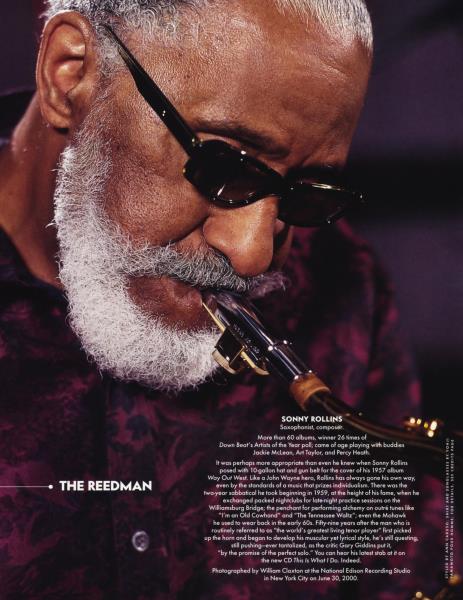
More than 60 albums, winner 26 times of Down Beat's Artists of the Year poll; came of age playing with buddies Jackie McLean, Art Taylor, and Percy Heath.
It was perhaps more appropriate than even he knew when Sonny Rollins posed with 10-gallon hat and gun belt for the cover of his 1957 album Way Out West. Like a John Wayne hero, Rollins has always gone his own way, even by the standards of a music that prizes individualism. There was the two-year sabbatical he took beginning in 1959, at the height of his fame, when he exchanged packed nightclubs for late-night practice sessions on the Williamsburg Bridge; the penchant for performing alchemy on outre tunes like "I'm an Old Cowhand" and "The Tennessee Waltz"; even the Mohawk he used to wear back in the early 60s. Fifty-nine years after the man who is routinely referred to as "the world's greatest living tenor player" first picked up the horn and began to develop his muscular yet lyrical style, he's still questing, still pushing—ever tantalized, as the critic Gary Giddins put it, "by the promise of the perfect solo." You can hear his latest stab at it on the new CD This Is What I Do. Indeed.
Photographed by William Claxton at the National Edison Recording Studio in New York City on June 30, 2000.
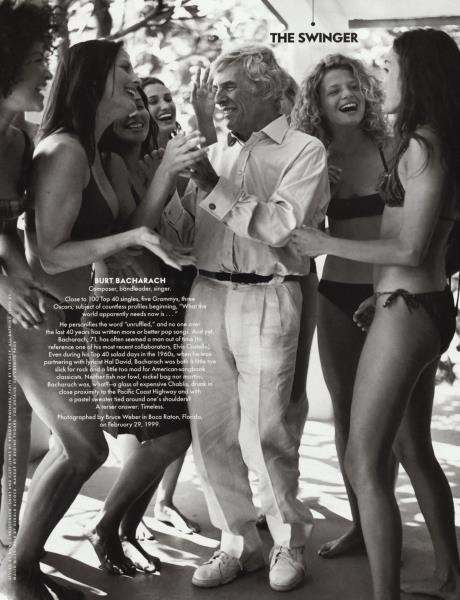
Close to 100 Top 40 singles, five Grammys, three Oscars; subject of countless profiles beginning, "What the world apparently needs now is ...
He personifies the word "unruffled," and no one over the last 40 years has written more or better pop songs. And yet, Bacharach, 71, has often seemed a man out of time (to reference one of his most recent collaborators, Elvis Costello). Even during his Top 40 salad days in the 1960s, when he was partnering with lyricist Hal David, Bacharach was both a little too slick for rock and a little too mod for American-songbook classicists. Neither fish nor fowl, nickel bag nor martini, Bacharach was, what?—a glass of expensive Chablis, drunk in close proximity to the Pacific Coast Highway and with a pastel sweater tied around one's shoulders? A terser answer: Timeless.
Photographed by Bruce Weber in Boca Raton, Florida, on February 29, 1999.
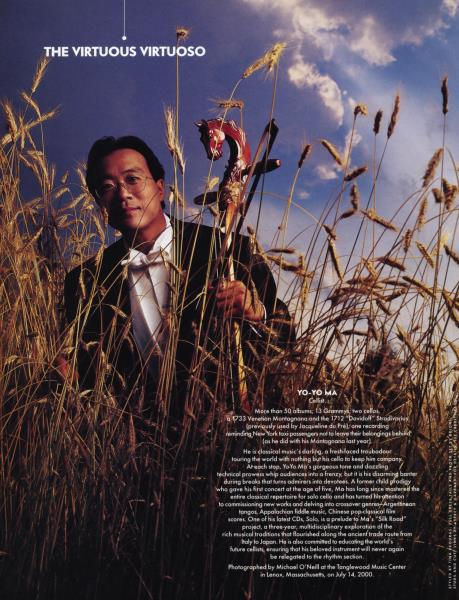
More than 50 albums; 13 Grammys; two cellos, a 1733 Venetian Montaganana and the 1712 "Davidoff" Stradivarius (previously used by Jacqueline du Pré); one recording reminding New York taxi passengers not to leave their belongings behind (as he did with Montaganana last year).
He is is classical classical music's music's darling, darling, a a fresh-faced fresh-faced troubadour troubadour touring the world with nothing but his cello to keep him company. At each stop, Yo-Yo Ma's gorgeous tone and dazzling / technical prowess whip audiences into a frenzy, but it is his disarming banter during breaks that turns admirers into devotees. A former child prodigy who gave his first concert at the age of five, Mo has long since mastered the entire classical repertoire for solo cello and has turned his attention to commissioning new works and delving into crossover genres—Argentinean tangos, Appalachian fiddle music, Chinese pop-classical film scores. One of his latest CDs, Solo, is a prelude to Ma's "Silk Road" project, a three-year, multidisciplinary exploration of the rich musical traditions that flourished along the ancient trade route from Italy to Japan. He is also committed to educating the world's future cellists, ensuring that his beloved instrument will never again be relegated to the rhythm section.
Photographed by Michael O'Neill at the Tanglewood Music Center in Lenox, Massachusetts, on July 14, 2000.
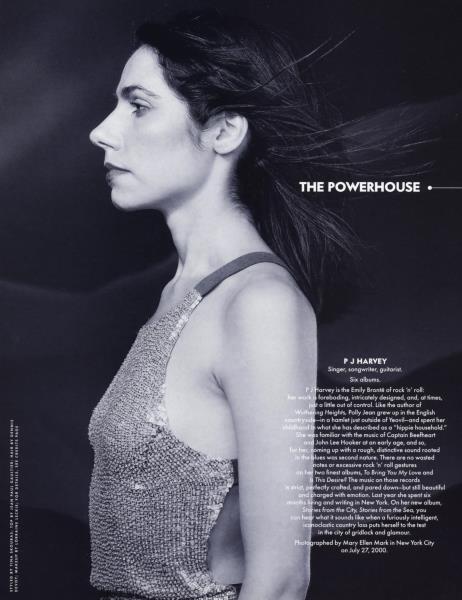
Six albums.
P J Harvey is the Emily Bronte of rock 'n' roll: her work is foreboding, intricately designed, and, at times, just a little out of control. Like the author of Wuthering Heights, Polly Jean grew up in the English countryside—in a hamlet just outside of Yeovil—and spent her childhood in what she has described as a "hippie household.' She was familiar with the music of Captain Beefheart and John Lee Hooker at an early age, and so, for her, coming up with a rough, distinctive sound rooted in the blues was second nature. There are no wasted notes or excessive rock 'n' roll gestures on her two finest albums, To Bring You My Love and Is This Desire? The music on those records is strict, perfectly crafted, and pared down—but still beautiful and charged with emotion. Last year she spent six months living and writing in New York. On her new album, Stones from the City, Stories from the Sea, you can hear what it sounds like when a furiously intelligent, iconoclastic country lass puts herself to the test I in the city of gridlock and glamour.
Photographed by Mary Ellen Mark in New York City on July 27, 2000.
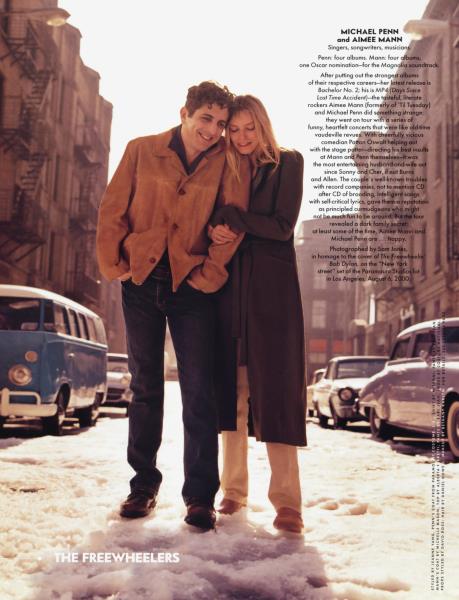
Penn: four albums.
Mann: four albums, one Oscar nomination—for the Magnolia soundtrack.
After putting out the strongest albums of their respective careers—her latest release is Bachelor No. 2; his is MP4 (Days Since Lost Time Accident)—the tasteful, literate rockers Aimee Mann (formerly of 'Til Tuesday) and Michael Penn did something strange: they went on tour with a series of funny, heartfelt concerts that were like old-time vaudeville revues. With cheerfully vicious comedian Patton Oswalt helping out with the stage patter—directing his best insults at Mann and Penn themselves—it was the most entertaining husband-and-wife act since Sonny and Cher, if not Burns and Allen The couple's well-known troubles with record companies, not to mention CD after CD of brooding, intelligent songs with self critical lyrics, gave them a reputation as principled curmudgeons who might not be much fun to be around. But the tour revealed a dark family secret: at least some of the time, Aimee Mann and Michael Penn are ... happy.
Photographed by Sam Jones, in homage to the cover of The Freewheelin' Bob Dylan, on the "New York street" set of the Paramount Studios lot in Los Angeles, August 6, 2000.
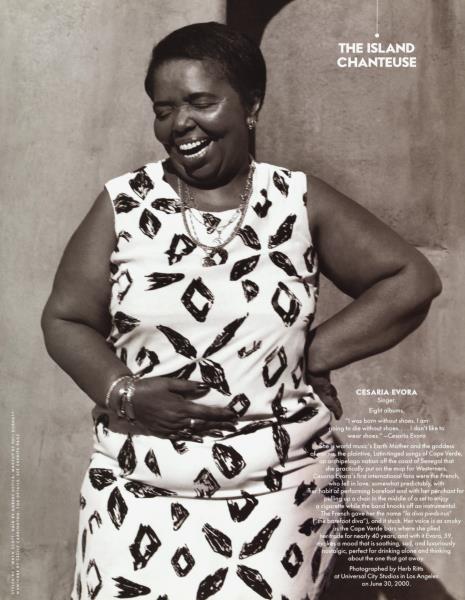
Eight albums.
"I was born without shoes. I am going to die without shoes.... I don't like to wear shoes." —Cesaria Evora
She is world music's Earth Mother and the goddess of morna, the plaintive, Latin-tinged songs of Cape Verde, an archipelago nation off the coast of Senegal that she practically put on the map for Westerners. Cesaria Evora's first international fans were the French, who fell in love, somewhat predictably, with her habit of performing barefoot and with her penchant for pulling up a chair in the middle of a set to enjoy pulling up a chair in the middle of a set to enjoy a cigarette while the band knocks off an instrumental. The French gave her the name "la diva pieds-nus" (the barefoot diva"), and it stuck. Her voice is as smoky as the Cape Verde bars where she plied trade for nearly 40 years, and with it Evora, 59, rocks a mood that is soothing, sad, and luxuriously nostalgic, perfect for drinking alone and thinking about the one that got away.
Photographed by Herb Ritts at Universal City Studios in Los Angeles on June 30, 2000.
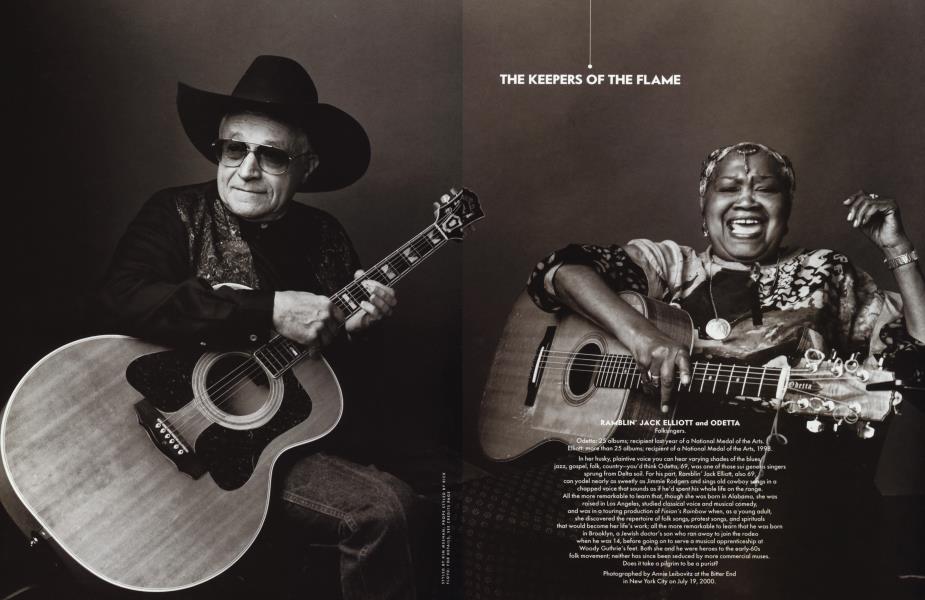
Odetta: 25 albums; recipient last year of a National Medal of the Arts.
Elliott: more than 25 albums; recipient of a National Medal of the Arts, 1998.
In her husky, plaintive voice you can hear varying shades of the blues/' jazz, gospel, folk, country—you'd think Odetta, 69, was one of those sui generis singers sprung from Delta soil. For his part, Ramblin' Jack Elliott, also 69, can yodel nearly as sweetly as Jimmie Rodgers and sings old cowboy songs in a chapped voice that sounds as if he'd spent his whole life on the range.
All the more remarkable to learn that, though she was born in Alabama, she was raised in Los Angeles, studied classical voice and musical comedy, and was in a touring production of Finian's Rainbow when, as a young adult, she discovered the repertoire of folk songs, protest songs, and spirituals that would become her life's work; all the more remarkable to learn that he was born in Brooklyn, a Jewish doctor's son who ran away to join the rodeo when he was 14, before going on to serve a musical apprenticeship at Woody Guthrie's feet. Both she and he were heroes to the early-60s folk movement; neither has since been seduced by more commercial muses.
Does it take a pilgrim to be a purist?
Photographed by Annie Leibovitz at the Bitter End in New York City on July 19, 2000.
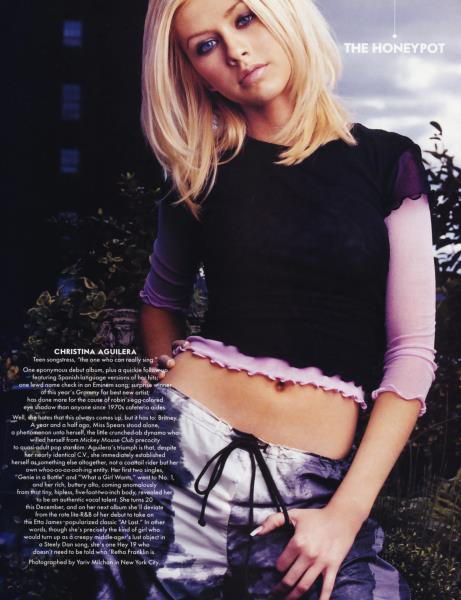
One eponymous debut album, plus a quickie followup featuring Spanish-language versions of her hits; one lewd name check in an Eminem song; surprise winner of this year's Grammy for best new artist; has done more for the cause of robin's-egg-colored eye shadow than anyone since 1970s cafeteria aides.
Well, she hates that this always comes up, but it has to: Britney., A year and a half ago, Miss Spears stood alone, a phenomenon unto herself, the little crunched-ab dynamo who willed herself from Mickey Mouse Club precocity to quasi-adult pop stardom. Aguilera's triumph is that, despite her nearly identical C.V., she immediately established herself as something else altogether, not a coattail rider but her own whoo-oo-oo-oah-ing entity. Her first two singles, "Genie in a Bottle" and "What a Girl Wants," went to No. 1, and her rich, buttery alto, coming anomalously from that tiny, hipless, five-foot-two-inch body, revealed her to be an authentic vocal talent. She turns 20 this December, and on her next album she'll deviate from the rote lite-R&B of her debut to take on the Etta James-popularized classic "At Last." In other words, though she's precisely the kind of girl who would turn up as a creepy middle-ager's lust object in a Steely Dan song, she's one Hey 19 who doesn't need to be told who 'Retha Franklin is.
Photographed by Yariv Milchan in New York City.
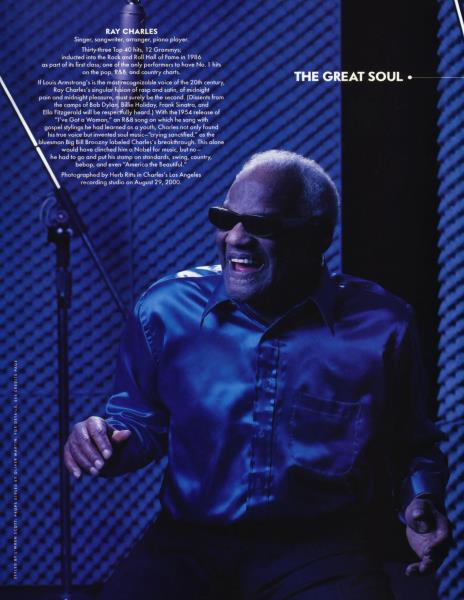
Thirty-three Top 40 hits, 12 Grammys; inducted into the Rock and Roll Hall of Fame in 1986 as part of its first class; one of the only performers to have No. 1 hits on the pop, R&B, and country charts.
If Louis Armstrong's is the most recognizable voice of the 20th century, Ray Charles's singular fusion of rasp and satin, of midnight pain and midnight pleasure, must surely be the second. (Dissents from the camps of Bob Dylan, Billie Holiday, Frank Sinatra, and Ella Fitzgerald will be respectfully heard.) With the 1954 release of "I've Got a Woman," an R&B song on which he sang with gospel stylings he had learned as a youth, Charles not only found his true voice but invented soul music—"crying sanctified," as the bluesman Big Bill Broozny labeled Charles's breakthrough. This alone would have clinched him a Nobel for music, but no—he had to go and put his stamp on standards, swing, country, bebop, and even "America the Beautiful."
Photographed by Herb Ritts in Charles's Los Angeles recording studio on August 29, 2000.
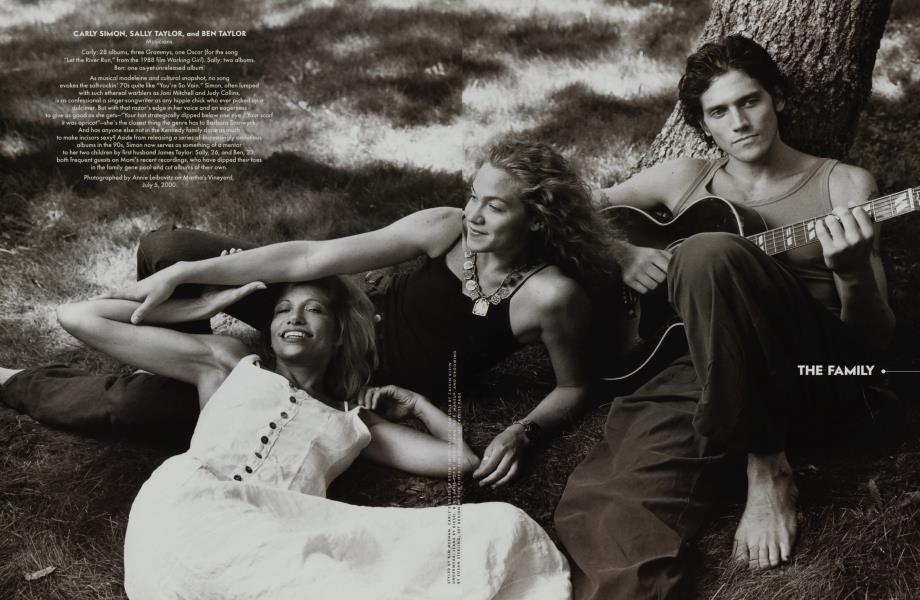
Carly: 28 albums, three Grammys, one Oscar (for the song "Let the River Run," from the 1988 film Working Girl). Sally: two albums.
Ben: one as-yet-unreleased album.
As musical madeleine and cultural snapshot, no song evokes the soft-rockin' 70s quite like "You're So Vain." Simon, often lumped with such ethereal warblers as Joni Mitchell and Judy Collins, is as confessional a singer-songwriter as any hippie chick who ever picked up a dulcimer. But with that razor's edge in her voice and an eagerness to give as good as she gets—"Your hat strategically dipped below one eye / Your scarf it was apricot"—she's the closest thing the genre has to Barbara Stanwyck.
And has anyone else not in the Kennedy family done as much to make incisors sexy? Aside from releasing a series of increasingly ambitious albums in the 90s, Simon now serves as something of a mentor to her two children by first husband James Taylor: Sally, 26, and Ben, 23, both frequent guests on Mom's recent recordings, who have dipped their toes in the family gene pool and cut albums of their own.
Photographed by Annie Leibovitz on Martha's Vineyard, July 5, 2000.
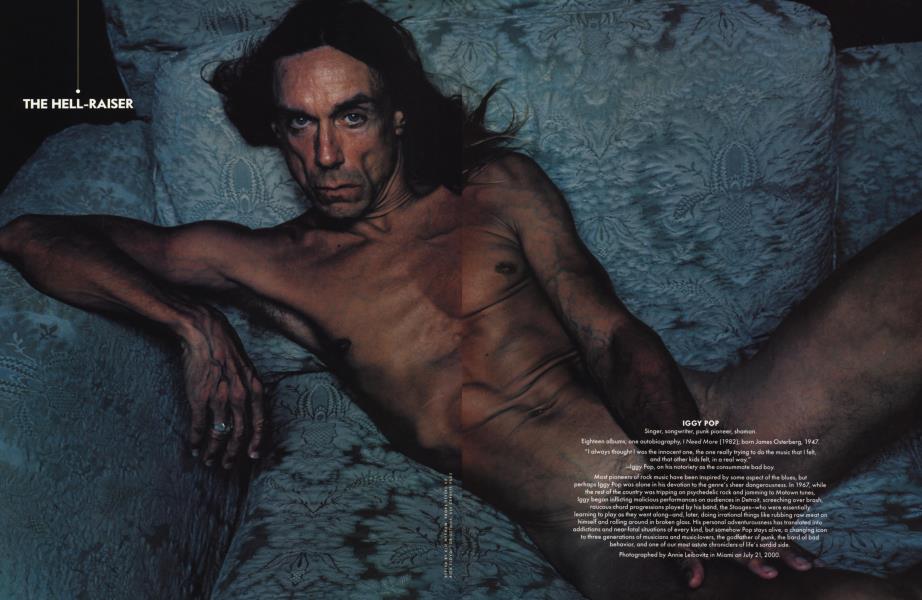
Eighteen albums; one autobiography, I Need More (1982); born James Osterberg, 1947.
"I always thought I was the innocent one, the one really trying to do the music that I felt, and that other kids felt, in a real way." —Iggy Pop, on his notoriety as the consummate bad boy.
Most pioneers of rock music have been inspired by some aspect of the blues, but perhaps Iggy Pop was alone in his devotion to the genre's sheer dangerousness. In 1967, while the rest of the country was tripping on psychedelic rock and jamming to Motown tunes,
Iggy began inflicting malicious performances on audiences in Detroit, screeching over brash, raucous chord progressions played by his band, the Stooges—who were essentially learning to play as they went along—and, later, doing irrational things like rubbing raw meat on himself and rolling around in broken glass. His personal adventurousness has translated into addictions and near-fatal situations of every kind, but somehow Pop stays alive, a changing icon to three generations of musicians and music-lovers, the godfather of punk, the bard of bad behavior, and one of our most astute chroniclers of life's sordid side.
Photographed by Annie Leibovitz in Miami on July 21, 2000.
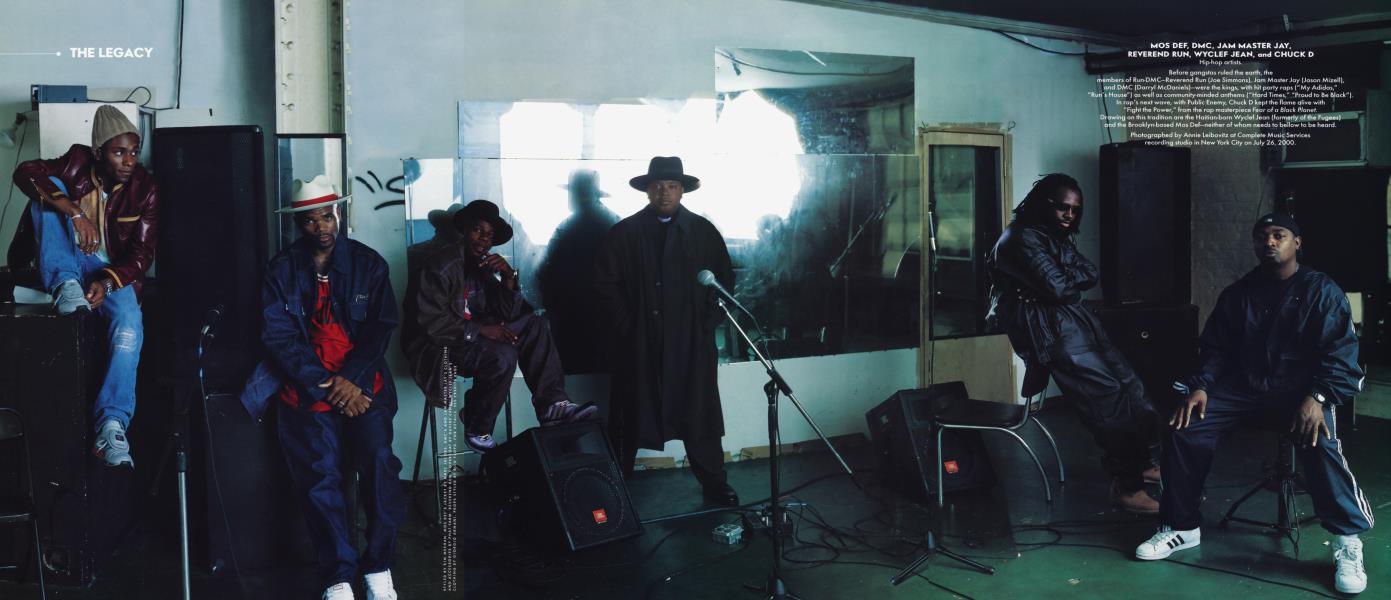
Before gangstas ruled the earth, the members of Run-DMC—Reverend Run (Joe Simmons), Jam Master Jay (Jason Mizell), and DMC (Darryl McDaniels)—were the kings, with hit party raps ("My Adidas," "Run's House") as well as community-minded anthems ("Hard Times," "Proud to Be Black"). In rap's next wave, with Public Enemy, Chuck D kept the flame alive with "Fight the Power," from the rap masterpiece Fear of a Black Planet.
Drawing on this tradition are the Haitian-born Wyclef Jean (formerly of the Fugees) and the Brooklyn-based Mos Def—neither of whom needs to bellow to be heard.
Photographed by Annie Leibovitz at Complete Music Services recording studio in New York City on July 26, 2000.
Subscribers have complete access to the archive.
Sign In Not a Subscriber?Join Now


