




Sign In to Your Account
Subscribers have complete access to the archive.
Sign In Not a Subscriber?Join NowTHE ARMANI TEATRO IS FAR MORE THAN AN EXQUISITE CATWALK. IT IS A MARK OF PERMANENCE IN THE GENERALLY TRANSITORY WORLD OF FASHION.
THE ARMANI TEATRO IS FAR MORE THAN AN EXQUISITE CATWALK. IT IS A MARK OF PERMANENCE IN THE GENERALLY TRANSITORY WORLD OF FASHION.
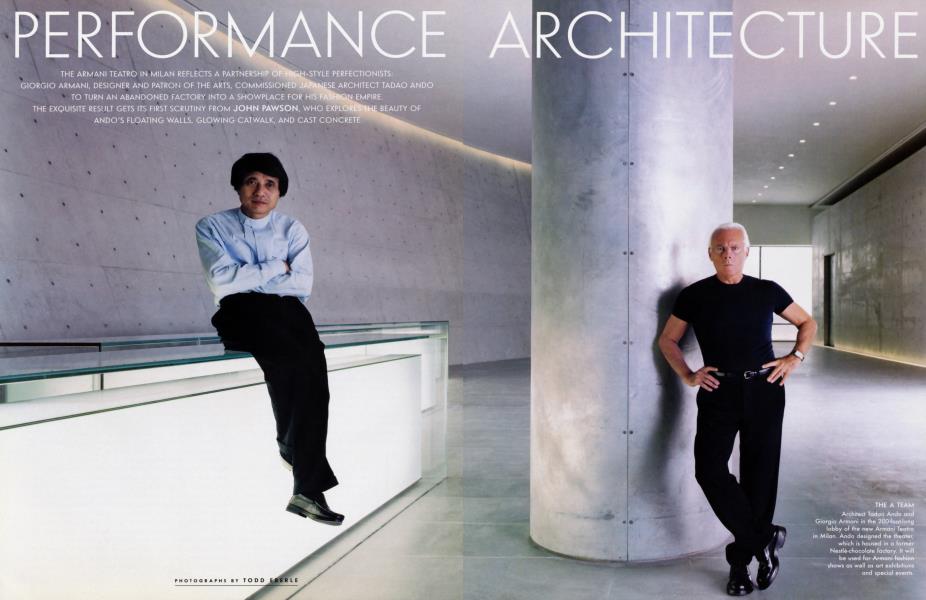
I think I was about 14 when I realized that architecture which makes you feel something is real architecture. Anything else is merely building. The Armani Teatro in Milan is, by this and any other definition, architecture—a series of masterstrokes executed by a true artist, Tadao Ando. It is also further confirmation of the significance of the power of Giorgio Armani in Milan—a fiefdom trumpeted by the vast EMPORIO ARMANI sign which dominates your arrival on the tarmac at Linate Airport.
Armani has become a patron of art in the great Italian tradition—he has commissioned store designs from architects such as Michael Gabellini, Claudio Silvestrin (my former partner), and Peter Marino—and the wisdom of his choice for this most recent commission is immediately evident. Armani got the best out of Tadao Ando, and Ando got the best out of the building, which will be used for fashion shows and, in between, for exhibitions. (There is also gallery space and office space.) This project is a great alliance between two profoundly private—yet very public—men whose businesses started within a few years of each other: Ando’s in 1969 and Armani’s in 1974. Both are perfectionists, obsessed with detail, whose work is characterized by a pristine modernism and an absence of cheap tricks.
The Armani Teatro, located in the Porta Genova canal district southwest of the city center, is far more than an exquisite catwalk. It is a mark of permanence in the generally transitory world of fashion, and a global stage for the Armani brand—a brand already reinforced by such diverse platforms as collaboration on films like American Gigolo and The Untouchables and on Jonathan Miller’s production of Cost Fan Tutte, and a groundbreaking show at the Guggenheim Museum in New York. Nor is it simply a work of marketing genius. Armani once said, “I always try to draw upon dreams ... this is where real fashion is made, for me.” He has succeeded in commissioning the perfect place in which to dream.
The building is Ando at his most refined and exciting. To enter is to leave behind the normal frames of experience. Here there is much that is familiar from his previous work—the architectural vocabulary of curved walls and freestanding columns; the palette of materials such as concrete perfectly cast in situ, limestone, glass, patinated zinc, stained wood, and the beautiful crushed-marble plaster called marmarino; the preoccupation with the way surfaces meet and walls contain. Alongside these familiar elements, however, there is an absolute and lyrical strangeness, a synthesis which is utterly new and which has to do with Ando’s rigorous approach to each successive commission—projects such as the Museum of Modern Art in Fort Worth, opposite the Kimbell Art Museum; the Church of Light, between Osaka and Kyoto; and the one I like the most, the Row House at Sumiyoshi, in the old red-light district in Osaka.
“The serious designer must question even the given requirements, and devote deep thought to what is truly being sought,” Ando has said. “This kind of inquiry will reveal the special character latent in a commission and cast sharp light on the vital role of an intrinsic logic, which can bring the architecture to realization. When logic pervades the design process the result is clarity of structure, or spatial order—apparent not only to perception, but also to reason.”
At the Armani Teatro, new architecture has been slipped inside the skin of what was formerly a Nestle factory, and the faint scent of chocolate still hangs about the place. When I arrived, I had a strong sense of a space in waiting, a place to which people will come to be seen, as they once went to the opera. I could imagine the cars drawing up in the wide, tree-lined street, the paparazzi waiting on the pavement to catch the stars as they ascend Ando’s upward-sloping lobby—the first grand place in the structure—like actors approaching the stage in Japanese Noh theater, the anticipation of the show brilliantly intensified by the architecture of this powerful entrance.
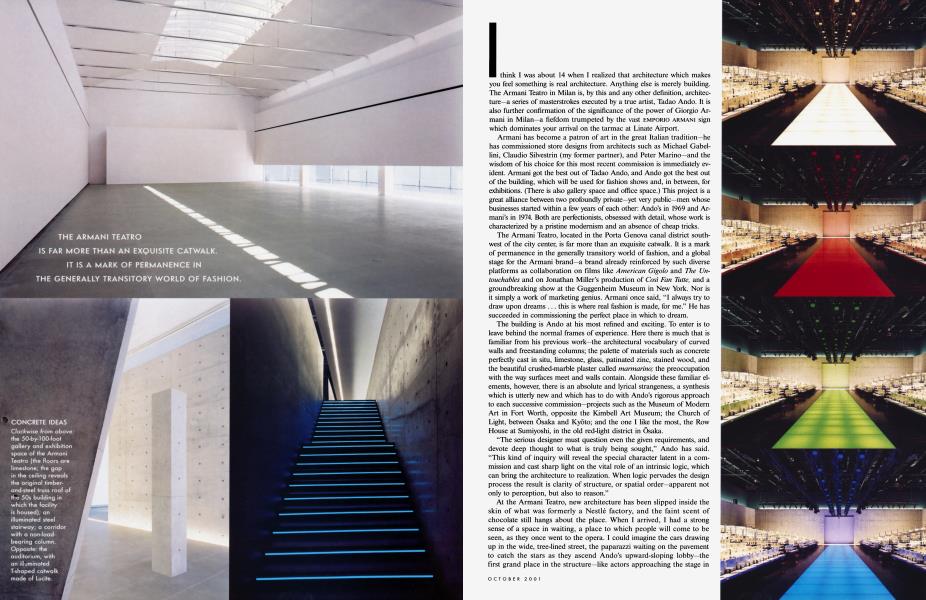
The scale of the lobby is breathtaking: 200 feet long, 12 feet high. A series of columns whose tops stop short of the ceiling punctuate the space. The corridor itself is shadowy, but there is light at its end, and one is drawn toward this rectangle of brightness marked with a dark cross. Light bands, set along the edges of the passage, cast a luminous haze upward across blocks of concrete, while threads of light catch in minute gaps between the floor slabs of Tuscan limestone. There is also a window beneath eye level which gives a glimpse of an interior courtyard’s reflecting pool.
The columns, like markers, continue beyond the threshold of a 20-foot atrium, dominated by a great curve of concrete which is canted like Richard Serra’s huge steel sculpture at this year’s Venice Biennale. This curve is unsupported, appearing as a fragment of some giant sphere resting on the floor. Everything is larger than life. Two massive, zinc-clad columns—vast totems— pierce the ceiling without appearing to touch it. Three huge, illuminated volumes of milky glass, set in clear glass boxes, seem to hover a little above the floor. At any of these light desks— reminiscent of the work of designer Shiro Kuramata, an iconic figure for Ando’s generation—coats are handed over, to disappear into one of three openings in a concrete curve, which also conceals the washrooms.
The blindingly white men’s room is particularly memorable, with its waterfall urinal, recalling Philip Johnson’s sculpture Water Wall near the Galleria shopping mall in Houston. It’s a facility which, I suspect, one will feel it something of a desecration to use. Throughout the building, the quality of the finishes and detailing is astonishing. The skill of Italian craftsmen is well known, and here they were up to the exacting standards of Ando, who a number of years ago had a license to box professionally and has been known to take a swing at a less than satisfactory workman.
From the atrium one passes into the theater itself, which has raked seating and an illuminated, T-shaped catwalk, designed to glow red, green, blue, or white as the models promenade.
The cathedral-like gallery, which will be used for art installations and as a venue for catered events, is my favorite of all five Armani Teatro spaces—50 by 100 feet of perfect proportions and white planes of crushed-marble plaster, it is the only place where you are reminded that this is new architecture in an old building. A gap in the center of the new ceiling vault affords a view of the original timber-and-steel truss roof. The gallery is, for me, the heart of Ando’s immaculate cocoon. Here is architecture which acts as a filter, refining the experience of being alive. Within this enclosed world, Ando allows us, in accordance with Japanese architectural conventions, to feel the presence of nature, but nature as a series of isolated elements rather than as landscape. A glazed slot running the length of the ceiling reveals a band of sky, while the west wall, which borders the enclosed courtyard, descends from the ceiling to just above eye level. Looking down you can see the reflective surface of the water in the interior-courtyard pool.
Spare, subtle, and rich, Armani Teatro is testament to the discipline of pushing simplicity and clarity to their limits. Part La Scala, part Milan Galleria, it has a little of Hadrian’s Villa and a lot of Japan, but its final achievement is in being exactly like nothing but itself, and, consequently, able to say something new about Ando, his patron, and perhaps even fashion itself. □
Subscribers have complete access to the archive.
Sign In Not a Subscriber?Join Now


