
Sign In to Your Account
Subscribers have complete access to the archive.
Sign In Not a Subscriber?Join NowRohmer Holiday
FANFAIR
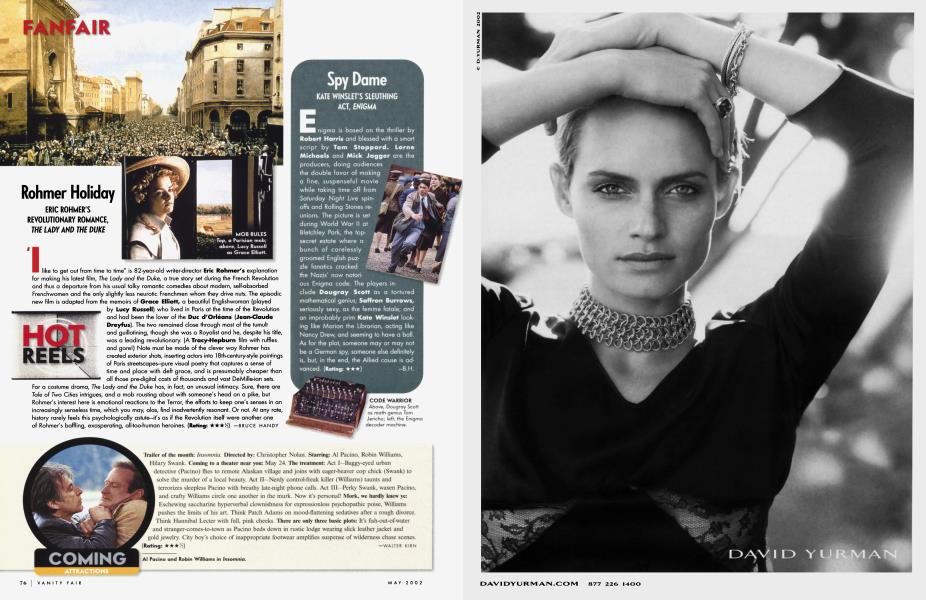
ERIC ROHMER'S REVOLUTIONARY ROMANCE, THE LADY AND THE DUKE
'I like to get out from time to time" is 82-year-old writer-director Eric Rohmer's explanation for making his latest film, The Lady and the Duke, a true story set during the French Revolution and thus a departure from his usual talky romantic comedies about modern, self-absorbed Frenchwomen and the only slightly less neurotic Frenchmen whom they drive nuts. The episodic new film is adapted from the memoirs of Grace Elliott, a beautiful Englishwoman (played by Lucy Russell) who lived in Paris at the time of the Revolution and had been the lover of the Due d'Orleans (Jean-Claude Dreyfus). The two remained close through most of the tumult and guillotining, though she was a Royalist and he, despite his title, was a leading revolutionary. (A Tracy-Hepburn film with ruffles and gore!) Note must be made of the clever way Rohmer has created exterior shots, inserting actors into 18th-century-style paintings of Paris streetscapes—pure visual poetry that captures a sense of time and place with deft grace, and is presumably cheaper than all those pre-digital casts of thousands and vast DeMille-ian sets. For a costume drama, The Lady and the Duke has, in fact, an unusual intimacy. Sure, there are Tale of Two Cities intrigues, and a mob rousting about with someone's head on a pike, but Rohmer's interest here is emotional reactions to the Terror, the efforts to keep one's senses in an increasingly senseless time, which you may, alas, find inadvertently resonant. Or not. At any rate, history rarely feels this psychologically astute—it's as if the Revolution itself were another one of Rohmer's baffling, exasperating, all-too-human heroines. (Rating: ★★★½)
BRUCE HANDY
Subscribers have complete access to the archive.
Sign In Not a Subscriber?Join Now