
Sign In to Your Account
Subscribers have complete access to the archive.
Sign In Not a Subscriber?Join NowTHE SHOCK OF THE OLD
JAMES WOLCOTT
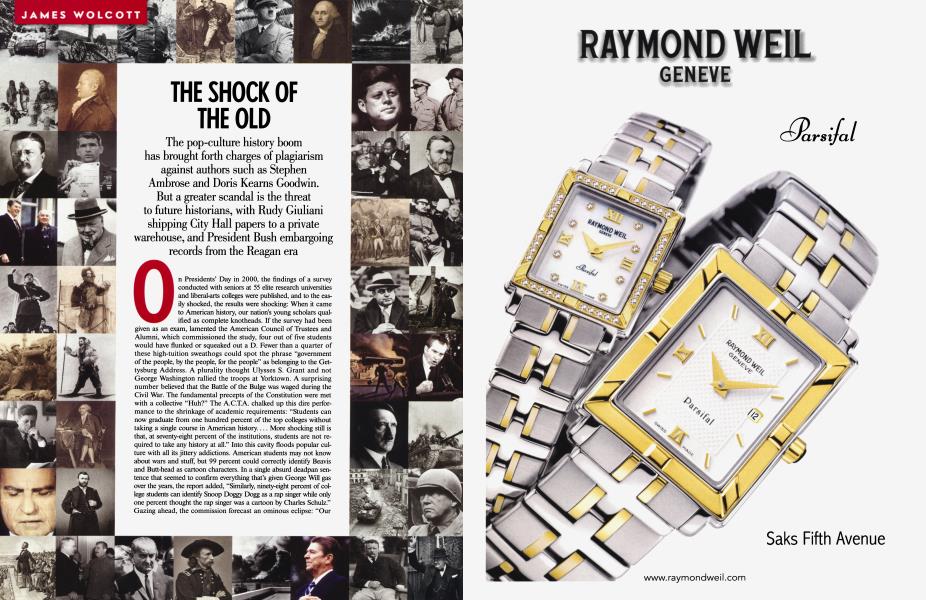
The pop-culture history boom has brought forth charges of plagiarism against authors such as Stephen Ambrose and Doris Kearns Goodwin. But a greater scandal is the threat to future historians, with Rudy Giuliani shipping City Hall papers to a private warehouse, and President Bush embargoing records from the Reagan era
On Presidents’ Day in 2000, the findings of a survey conducted with seniors at 55 elite research universities and liberal-arts colleges were published, and to the easily shocked, the results were shocking: When it came to American history, our nation’s young scholars qualified as complete knotheads. If the survey had been given as an exam, lamented the American Council of Trustees and Alumni, which commissioned the study, four out of five students would have flunked or squeaked out a D. Fewer than a quarter of these high-tuition sweathogs could spot the phrase “government of the people, by the people, for the people” as belonging to the Gettysburg Address. A plurality thought Ulysses S. Grant and not George Washington rallied the troops at Yorktown. A surprising number believed that the Battle of the Bulge was waged during the Civil War. The fundamental precepts of the Constitution were met with a collective “Huh?” The A.C.T.A. chalked up this dire performance to the shrinkage of academic requirements: “Students can now graduate from one hundred percent of the top colleges without taking a single course in American history.... More shocking still is that, at seventy-eight percent of the institutions, students are not required to take any history at all.” Into this cavity floods popular culture with all its jittery addictions. American students may not know about wars and stuff, but 99 percent could correctly identify Beavis and Butt-head as cartoon characters. In a single absurd deadpan sentence that seemed to confirm everything that’s given George Will gas over the years, the report added, “Similarly, ninety-eight percent of college students can identify Snoop Doggy Dogg as a rap singer while only one percent thought the rap singer was a cartoon by Charles Schulz.” Gazing ahead, the commission forecast an ominous eclipse: “Our future leaders are graduating with an alarming ignorance of their heritage—a kind of collective amnesia—and a profound historical illiteracy which bodes ill for the future of the republic.” It’ll be like having a ruling class composed of losers from the Weakest Link.
As usual, the pessimists and worst-case scenarioists are wrong. Far from being a memory eraser, pop culture has become the salvation of interest in history, its booster rocket. We are in the midst of a history boom that owes little to the higher academic institutions—which have increasingly abandoned the wide-screen canvas of civilization and classical studies for bacon strips of fad topics and theory with a capital Tand nearly everything to popularizers, amateur buffs, and professional historians unafraid of being readable, jargon-free instructors. From Gore Vidal’s periodic novels charting the course of the American empire to Garry Wills’s excursions into everything from Lincoln to Saint Augustine, from the best-seller reign of David McCullough’s mammoth biography of John Adams (a publishing sleeper if there ever was one) to the equally unpredictable success of Longitude, Salt: A World History, and Brunelleschi’s Dome, history has replaced poetry as the news that stays news. Edmund Morris bounced back from the debacle of Dutch, his semi-fictionalized biography of Ronald Reagan, where Morris dopily masqueraded as a Zelig figure, to redeem himself with the second installment of his biography of Theodore Roosevelt, Theodore Rex, a volume President Bush is said to have read, or at least lugged around. (Louis Auchincloss’s trim biography of Roosevelt, also published this year, is better-written, but can’t compete as a biceps-builder.)
The countless World War II battle sagas from the European theater have been fathered by popular historians such as John Keegan, Donald R. Burgett, and Stephen Ambrose (the overshadowed Pacific theater received welcome attention last year with Hampton Sides’s Ghost Soldiers)', showman filmmakers such as Steven Spielberg (who reteamed with Saving Private Ryan star Tom Hanks to present the HBO mini-series based on Ambrose’s Band of Brothers)', NBC anchorman Tom Brokaw, whose The Greatest Generation was a gesture of gratitude that triggered a memorial stampede; and the stockpile footage of the History Channel, whose familiar grainy montages of artillery barrages and Luftwaffe strafings have led some jokers to label it “the Hitler Channel.” The more sedate PBS is home to the banjo-twangy, vintage-photograph-scanning, critically acclaimed documentary epics of Ken and Ric Burns, which have gone on to become video-library essentials.
Every boom seeds its own excesses and scandals (as the shareholders and employees of Enron and Global Crossing can bitterly attest), and so far 2002 has seen a bumper crop: allegations of fabricated sourcing lodged against Michael Bellesiles, author of the award-winning Arming America; the baring of Joseph Ellis, Pulitzer Prize-winning author of Founding Brothers, as a fibber who had concocted a Vietnam resume as a paratrooper and staff aide to General Westmoreland; and a cluster bomb of plagiarism cases against a number of marquee historians, Stephen Ambrose being nabbed as the most egregious burglar. To some, this outbreak was proof that fat advances and speaking fees lead inevitably to sloppy haste, clip-job recycling, and reckless opportunism. To me, however, these black marks are indicators of rude vitality and healthy momentum, not decadence; individual flameouts, not systemic meltdown. It’s in those arenas of ideas where the energy and stakes are highest that you get drama, debate, toupee-pulling wrestling matches, and sudden topples of reputation. Controversy that brings out the fight in opponents and the Sherlock Holmes in skeptics is better than a consensus that leaves a dull, lifeless finish.
Pop culture has become the salvation of interest in history, its booster rocket.
If I could nominate one soul for civic sainthood, it would be Brian Lamb, the chairman and chief host of C-SPAN, the publicaffairs network. For the last two decades he has overseen C-span’s emergence as the video custodian of American history and governmental affairs, the Keeper of the Cassettes. Many in the media dismiss Lamb as bland, square. They’re not hip to his deep game. With his Zen calm, pale-moon presence, android productivity, and guilelessness in asking blank-slate questions (C-SPAN-ers cherish the moment when he quizzed Winston Churchill biographer Martin Gilbert, “Why was he accused of buggery and what is it?,” causing a baffled Gilbert to stammer, “You don’t know what buggery is?”), Brian Lamb is the Andy Warhol of white noise, an alchemist who can transform boredom into rapt fascination and package it for consumption. Like Warhol films such as Sleep and his eight-hour ode to the Empire State Building, C-span’s fixed-gaze videos of congressional hearings, panel discussions, political rallies, and think-tank conferences are real-time, editless, minimalist, discount productions set in a talky purgatory—yet weirdly narcotic to the converted. (On Seinfeld, Kramer once dashed off to catch C-span’s coverage of the Canadian Parliament.) The surface verisimilitude is something of an optical illusion as far as Lamb himself is concerned. On the air, he can seem mild, unassuming, even superficial, but when you check the transcripts later, his questions read as far more incisive, dogged, and methodical than they sounded. He’s a stealth inquisitor.
Under his captaining, C-SPAN has established itself as a national educator and built a loyal following with its series American Presidents: Life Portraits and American Writers: A Journey Through History, guided tours of presidential libraries, re-enactment of the Lincoln-Douglas debates, and retracing of Alexis de Tocqueville’s steps in Democracy in America, and with its best-selling publishing spin-offs (such as Lamb’s Booknotes, whose launch he marked by visiting the printing plant and watching copies roll off the presses, like a proud dad in the delivery room). The network’s biggest boon to history consumers came in 1998 when sister channel C-SPAN 2 expanded its weekend “Book TV” nonfiction programming to 48 hours. Each weekend, literate viewers can now test their couch-potato powers of endurance (masochismo, I believe, is the technical term) by tuning in to local book-club discussions that maunder on like sewing bees for the slow-minded, lengthy dispatches from literary festivals that look as festive as an airport layover, workshop panels on career opportunities in children’s literature. Those supply the yawns for the path that leads to the bubbling oases of “Book TV” ’s weekend lineup, its three-hour “In Depth” interviews with distinguished historians, which provide them an unsurpassed platform to expound, delve into detail, and relate their own personal history without being interrupted every other breath. The “In Depth” with John Lukacs, the urbane, droll author of Five Days in London and Budapest 1900, was a master tutorial in 20thcentury history. I’m convinced that a contributing factor to the groundswell for John Adams was the “In Depth” with McCullough, a promotional godsend. (And destined for the time capsule, too, was the sit-down with professor, activist, and groove master Cornel West, who bopped his head as the C-SPAN host played a hot cut from his pseudo-rap CD, getting jiggy with his own syncopated gospel.)
The Nazis were ruthless, murderous and highly perverted. Examine the bizarre sexual escapades of the Nazis and the undercover—or under the covers—methods that U.S. and British intelligence employed to ferret vital information from them. Learn how the U.S. tried to get inside the mind of Hitler and whether the allegations that Hitler had a close relationship with his niece were true.
—Promotional listing for the History Channel’s Sex and the Swastika.
On the History Channel, it’s pictures rather than words gushing from an open spigot. Since its debut in 1995, the History Channel has defined itself as the illustrated storybook of war, industrial might, and brute force, a supercollage of Civil War cannons, Cherokee warriors, Chicago mobsters, W.W. I trenches, strutting dictators, armament buildups, jungle guerrilla fighting, night-raid searchlights, burning ships, exuberant armistices, refugees returning to rubbled cities whose streets have been reduced to rows of jagged teeth. Although Abbe Raven, the general manager of the History Channel, takes pains to point out that only 20 percent of its schedule is devoted to things that go boom, the combination of hardware and heroics, strategic genius and tragic folly, has made the channel a strong draw for men, who account for 70 percent of the viewership. “It’s the favorite channel of Tony Soprano,” noted Broadcasting & Cable magazine, and as we all know, Tony is the epitome of pure pork sausage. Me, I’ve OD’d on W.W. II documentaries (it may have been the one on Hitler’s favorite chanteuse that did me in), preferring to park it in front of programs about recent upheavals, whose material is crisper because the footage hasn’t been repeated again and again until the texture and impact have been bleached thin. One of the smarter recent additions to the lineup is the series History vs. Hollywood, where each week a movie is screened and chewed over by historical experts trying not to look aghast at some of the liberties taken by the heirs of Cecil B. DeMille with the ascertainable truth. (The lesson: Give Hollywood a gray area and it goes Technicolor.)
It’s become harder for historians to play snob with Hollywood’s trespasses, given the skeletons being dug up in their own backyard. The first stink was raised by Fred Barnes’s cover story for the January 14 issue of The Weekly Standard, called “Stephen Ambrose, Copycat,” which exposed Ambrose's extended liftings from Thomas Childers’s Wings of Morning for his own book about W.W. II bomber crews, The Wild Blue. Ambrose apologized for appropriating Childers’s words without proper citation and said he would correct future editions, mollifying Barnes, who, in a brief follow-up, wrote, “Historian Stephen Ambrose did the right thing and did it graciously.” (A professor at the University of Pennsylvania, Childers was less lenient after he learned Ambrose had abused other sources, announcing that he was dropping Ambrose’s works from his syllabus.) Had this been an isolated instance, the Ambrose book factory would have suffered only a minor burp. But Forbes.com jumped aboard with a piece called “Ambrose Has Done It Before,” accusing the author of dittoing passages from Jay Monaghan’s Custer: The Life of General George Armstrong Custer in his own treatment of the subject, Crazy Horse and Custer. Another historian claimed that Ambrose also had sticky fingers in the Custer book regarding James C. Olson’s Red Cloud and the Sioux Problem. Widening its net, Forbes.com then claimed Ambrose had helped himself to sentences from David Lavender’s The Great Persuader for his best-selling book about railroad building. Nothing Like It in the World. The rap sheet began to bulge. This was no longer a case of a historian dozing over his file cards and mixing up a few three-by-fives. This, said his critics, was a clear pattern of theft.
It's become harder for historians to play snob with Hollywood's trespasses.
Nor was Ambrose a lone perpetrator. Doris Kearns Goodwin, a biographer of Lyndon Baines Johnson and one of the most sensible, informed regulars on the pundit circuit (appearing everywhere from PBS’s The NewsHour with Jim Lehrer to MSNBC’s The News with Brian Williams to the Don Imus-Tim Russert-Chris Matthews axis of ego), copped to cribbing passages from Lynne McTaggart’s Kathleen Kennedy: Her Life and Times for her own contribution to Camelot lore, The Fitzgeralds and the Kennedys, and making a payment to McTaggart to settle the dispute. At first this admission stirred a smaller tempest than the Ambrose affair because Goodwin is genuinely liked by her media and academic colleagues, appeared blushingly mortified by what she’d done (whereas Ambrose became more crustacean as the flak intensified), and had a plausible if not acceptable explanation for her errors (working pre-word processing, she had gotten bollixed up sifting through the accumulated blizzard of notes). But, like Ambrose, Goodwin proved to be a bigger looter than first suspected. As the full scope of her borrowings came to light, the hammer dropped: She took an indefinite leave as a commentator for The NewsHour with Jim Lehrer; her publisher announced it was destroying inventory copies of The Fitzgeralds and the Kennedys (hearing this, I couldn’t help flashing to the scene in Hud where the tainted cattle are herded into a pit and shot); the University of Delaware withdrew its invitation for her to speak at commencement; and an editorial in The Harvard Crimson urged her to resign from the university’s board of overseers. Although Goodwin’s plagiarism seems confined largely to one book, the piling-on has been harsher on her than it has on Ambrose, a multiple offender. Could it be because Goodwin is (a) a liberal and (b) a woman?
Ambrose and Goodwin are just the most famous self-inflicters thus far. “In the latest allegation of what might be called ‘Stephen Ambrose flu,’ Montgomery College historian Robert M. Bryce has accused the director emeritus of Boston’s Museum of Science of lifting vast chunks of text, facts, syntax and even errors from Bryce’s 1997 biography of polar explorers Robert Peary and Frederick Cook” (The Washington Post, February 4). SUNY CLASSICS PROFESSOR IS ACCUSED OF PLAGIARISM (headline in The New York Times, February 22). One historian regurgitating another in a daisy chain of shame. The most cockeyed explanation I’ve encountered about this epidemic was put forth in The American Prospect by columnist Wendy Kaminer, who reasoned, “Originality is not much valued in our consumer culture, which is fueled by the urge to conform.” You’d think we were back in the 50s, organization men in their gray flannel suits marching like lemmings off the cliff of the New Haven train platform. Plagiarism has a rich, colorful track record that pre-dates our consumer culture (no literary movement put greater premium on originality than the Romantic, yet Thomas De Quincey and Samuel Taylor Coleridge fobbed off reams of German philosophy as their own). No, the psychological roots and shabby delusions of plagiarism are probably what they’ve always been: a risky desire to try to outfox the reader, like a con artist passing a fbiged check; a masochistic compulsion to be caught, humiliated, drummed out of the corps; a diseased vanity about being crowned “creative,” as if every idea, image, and trope had sprung virgin from one’s brow (look, Ma, no quotation marks).
Like Ambrose, Goodwin proved to be a bigger looter than first suspected.
Plagiarism is seldom excusable and should be censured and its culprits disciplined according to degree, but at least Ambrose and company wrote the walloping majority of their words. I think a larger affront is committed by those so-called authors who write practically none of the words inside the covers, such as the Beltway’s viceroy of traditional values, William Bennett, who slaps his brand name on books assembled by a team of Keebler elves who do the backstage research and ghostwriting. Future historians who hit pay dirt may be tempted to follow the Bennett model and farm out all that pesky paperwork so that they can have more time tanning on Larry King Live. Ambrose is already on that glide path, presiding over a business operation whose officers include his son, daughter, and son-in-law. “The family company, Ambrose-Tubbs Inc. ... was originally set up in 1993 so Mr. Ambrose could get a tax write-off on his car,” The Wall Street Journal reported last year. “Now, the company brings in roughly $3 million in annual revenue from book and film advances, royalty payments and speaking fees.” It also sponsors the Stephen Ambrose Historical Tours. According to the same article, Ambrose remains a hard worker, rising at four A.M. most days to write. The Stephen Ambroses of tomorrow may choose to sleep late and delegate.
The real threat to history from this country doesn’t come from the low end of the totem pole, but from the top—from C.E.O.’s compelling subordinates to sign nondisclosure contracts (leaving them the exclusive rights to peddle their business-porn memoirs), politicians seeking to bulletproof their legacies by hoarding material. On February 5, New York’s Daily News revealed that the departed mayor of New York City, Rudy Giuliani, had shipped a mother lode of City Hall papers to a private warehouse. “Backed by an unprecedented agreement signed a week before he left office, Giuliani carted away more than 2,000 boxes of memos, pictures and phone logs—material that other modern-day mayors have handed over directly to the city—and placed them in a state-ofthe-art storage facility at his own expense. While the agreement says the city ‘retains ownership’ and ‘ultimate control’ over the boxes’ contents, it also grants Giuliani the right to withhold from the public any document he considers of ‘personal interest.’” To some historians, this is taking privatization a bit too far.
An even greater act of anal retention was committed by President Bush, who signed a surprise executive order on November 1, 2001, that effectively rescinded the 1978 Presidential Records Act, which stipulated that sensitive presidential papers be made available to the public 12 years after he or she leaves office, thereby stalling the imminent release of the material being held by the Ronald Reagan Presidential Library. (The 1978 Presidential Records Act was a post-Watergate reform intended to make sure executive privilege didn’t apply in perpetuity.) Presidential historians, political scientists, and even some Republican lawmakers deplored this embargo tactic, none more vehemently than Nixon and J.F.K. biographer Richard Reeves, who accused Bush of using his presidential pen to stab history in the back. Others conjectured that the decision was a retroactive ass-covering maneuver since Bush’s father served as Reagan’s vice president and a number of Reagan aides are highly placed in the Bush II administration-something fishy, perhaps, in the Iran-contra files? Bush will probably be able to skate free on this because the terrorism war provides ample smoke cover and disgruntled historians aren’t exactly a menacing lobbying group. What are they going to do, throw scrolls?
Nevertheless, Bush’s fiat shouldn’t be permitted to stand. The tragic revelation of Michael Beschloss’s Reaching for Glory, based on secret recordings in the Oval Office, was that a soul-sick President Johnson felt the Vietnam War was unwinnable as early as 1965 and yet futilely continued the escalation, digging himself and both countries a deeper, wider grave. Imagine how the river of events might have been altered had we known that then. Revoking or emasculating the Presidential Records Act would prevent works such as Reaching for Glory or the nasty jolts we’ve gotten from the Nixon-library tapes from being possible in the future, which may be in the interest of the executive branch but is unconscionable in a representative democracy. Lies in office—that we’re used to. It’s the price we pay for being able to learn the real score later, no matter whose legacy is jeopardized. We don’t need former leaders fashioning themselves as pharaohs.
Subscribers have complete access to the archive.
Sign In Not a Subscriber?Join Now


