



Sign In to Your Account
Subscribers have complete access to the archive.
Sign In Not a Subscriber?Join NowNeal Pollack's Passage to Iraq
THE WORLD'S GREATEST LIVING WRITER
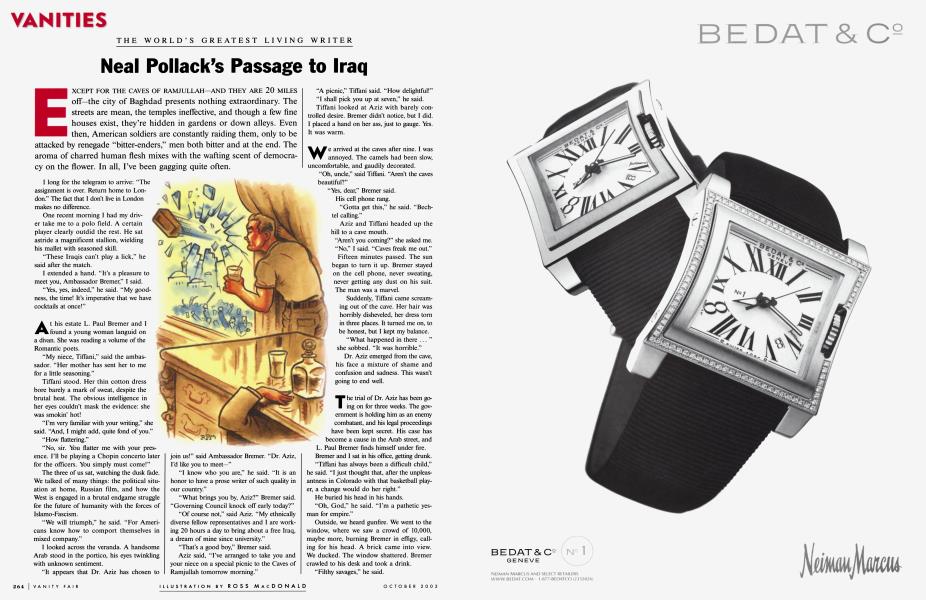
EXCEPT FOR THE CAVES OF RAMJULLAH—AND THEY ARE 20 MILES off—the city of Baghdad presents nothing extraordinary. The streets are mean, the temples ineffective, and though a few fine houses exist, they're hidden in gardens or down alleys. Even then, American soldiers are constantly raiding them, only to be attacked by renegade "bitter-enders," men both bitter and at the end. The aroma of charred human flesh mixes with the wafting scent of democracy on the flower. In all, I've been gagging quite often.
I long for the telegram to arrive: "The assignment is over. Return home to London." The fact that I don't live in London makes no difference.
One recent morning I had my driver take me to a polo field. A certain player clearly outdid the rest. He sat astride a magnificent stallion, wielding his mallet with seasoned skill.
"These Iraqis can't play a lick," he said after the match.
I extended a hand. "It's a pleasure to meet you, Ambassador Bremer," I said.
"Yes, yes, indeed," he said. "My goodness, the time! It's imperative that we have cocktails at once!"
At his estate L. Paul Bremer and I found a young woman languid on a divan. She was reading a volume of the Romantic poets.
"My niece, Tiffani," said the ambassador. "Her mother has sent her to me for a little seasoning."
Tiffani stood. Her thin cotton dress bore barely a mark of sweat, despite the brutal heat. The obvious intelligence in her eyes couldn't mask the evidence: she was smokin' hot!
"I'm very familiar with your writing," she said. "And, I might add, quite fond of you."
"How flattering."
"No, sir. You flatter me with your presence. I'll be playing a Chopin concerto later for the officers. You simply must come!"
The three of us sat, watching the dusk fade. We talked of many things: the political situation at home, Russian film, and how the West is engaged in a brutal endgame struggle for the future of humanity with the forces of Islamo-Fascism.
"We will triumph," he said. "For Americans know how to comport themselves in mixed company."
I looked across the veranda. A handsome Arab stood in the portico, his eyes twinkling with unknown sentiment.
"It appears that Dr. Aziz has chosen to join us!" said Ambassador Bremer. "Dr. Aziz, I'd like you to meet—"
"I know who you are," he said. "It is an honor to have a prose writer of such quality in our country."
"What brings you by, Aziz?" Bremer said. "Governing Council knock off early today?"
"Of course not," said Aziz. "My ethnically diverse fellow representatives and I are working 20 hours a day to bring about a free Iraq, a dream of mine since university."
"That's a good boy," Bremer said.
Aziz said, "I've arranged to take you and your niece on a special picnic to the Caves of Ramjullah tomorrow morning."
"A picnic," Tiffani said. "How delightful!" "I shall pick you up at seven," he said. Tiffani looked at Aziz with barely controlled desire. Bremer didn't notice, but I did. I placed a hand on her ass, just to gauge. Yes. It was warm.
We arrived at the caves after nine. I was annoyed. The camels had been slow, uncomfortable, and gaudily decorated.
"Oh, uncle," said Tiffani. "Aren't the caves beautiful?"
"Yes, dear," Bremer said.
His cell phone rang.
"Gotta get this," he said. "Bechtel calling."
Aziz and Tiffani headed up the hill to a cave mouth.
"Aren't you coming?" she asked me. "No," I said. "Caves freak me out." Fifteen minutes passed. The sun began to turn it up. Bremer stayed on the cell phone, never sweating, never getting any dust on his suit. The man was a marvel.
Suddenly, Tiffani came screaming out of the cave. Her hair was horribly disheveled, her dress torn in three places. It turned me on, to be honest, but I kept my balance.
"What happened in there ..." she sobbed. "It was horrible."
Dr. Aziz emerged from the cave, his face a mixture of shame and confusion and sadness. This wasn't going to end well.
The trial of Dr. Aziz has been going on for three weeks. The government is holding him as an enemy combatant, and his legal proceedings have been kept secret. His case has become a cause in the Arab street, and L. Paul Bremer finds himself under fire. Bremer and I sat in his office, getting drunk. "Tiffani has always been a difficult child," he said. "I just thought that, after the unpleasantness in Colorado with that basketball player, a change would do her right."
He buried his head in his hands.
"Oh, God," he said. "I'm a pathetic yesman for empire."
Outside, we heard gunfire. We went to the window, where we saw a crowd of 10,000, maybe more, burning Bremer in effigy, calling for his head. A brick came into view. We ducked. The window shattered. Bremer crawled to his desk and took a drink.
"Filthy savages," he said.
Subscribers have complete access to the archive.
Sign In Not a Subscriber?Join Now