




Sign In to Your Account
Subscribers have complete access to the archive.
Sign In Not a Subscriber?Join NowTHE SPY GAME
LETTERS
Valerie Plame’s laughable chance for justice; Senator Murkowski steps up to Ms. Sischy; a mixed verdict on Gitmo; Bush and the Brits; Viggo Mortensen-profound or just barefoot?; and more
My uncle Sidney Glazier was much less the fundraiser and every bit the oldschool New York movie producer [“Producing The Producers, ” by Sam Kashner, January]. He chose projects based on his passion, not on their box-office potential—because they embodied some quirky slice of life, some left-of-center story, as seen in The Twelve Chairs (Mel Brooks), Quackser Fortune Has a Cousin in the Bronx (Gene Wilder), or Take the Money and Run (Woody Allen). Sidney’s movies embodied today’s “indie” film sensibility and have consequently stood the test of time.
Also, I want to say for the record that I spoke with Sidney at his nursing home after Mel Brooks had made his generous Tonyacceptance speech acknowledging Sidney’s impact in the creation of The Producers. He told me he had watched the Tonys with the nurses and a few others at the home. He was very proud and deeply moved by Mel’s speech. He loved Mel Brooks. In spite of their tempestuous relationship, they were soul mates. I remember as a young girl seeing a photograph hanging proudly in Sidney’s apartment of Sidney and Mel with the inscription “To My Father and My Son, Love Mel.” Whatever Sidney said the following morning to his daughter regarding Mel must be taken in the proper context. Your journalist fails to mention that he was feeling the effects of old age and was occasionally disoriented. Sadly, he passed away only a few months later.
Sid Glazier was larger than life in so many ways. An avid reader of fiction with a deep and abiding love of theater and film, he left a legacy that has impacted our entire family, most especially my brother, Mitch Glazer, who grew up to become a Hollywood screenwriter, and me, a theater director, and film and theater professor.
LEAKER’S DEN
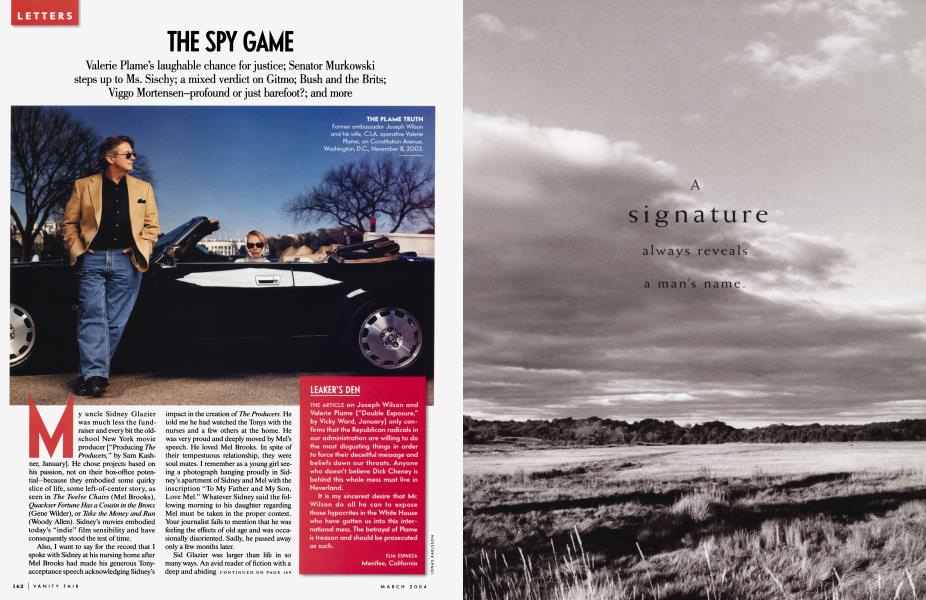
THE ARTICLE on Joseph Wilson and Valerie Plame ["Double Exposure," by Vicky Ward, January] only confirms that the Republican radicals in our administration are willing to do the most disgusting things in order to force their deceitful message and beliefs down our throats. Anyone who doesn't believe Dick Cheney is behind this whole mess must live in Neverland.
It is my sincerest desire that Mr. Wilson do all he can to expose those hypocrites in the White House who have gotten us into this international mess. The betrayal of Plame is treason and should be prosecuted as such.
ELIA ESPARZA Menifee, California
CONTINUED ON PAGE 169
CONTINUED FROM PAGE 162
AMY GLAZER Oakland, California
MUCH AS I ENJOYED the life history of Mel Brooks et al., the summary of his career was missing several milestones, such as his collaboration with Carl Reiner in the “Two-ThousandYear-Old Man” vignettes, which always struck me as some of the most original and funniest narratives. It is somewhat typical of these two great talents that many of the episodes were reported to be impromptu.
DAVID L. ADLER North Falmouth, Massachusetts
JERRY RAGE
YOUR FULL-PAGE photo of Gerald Levin makes a spectacular cover for our dartboard [“The Taking of Time Warner,” by Nina Munk, January]. Thanks— we needed that! Wonder how long it will take to recoup our 401 (k) losses with dartgame winnings?
ANN SIMONSEN
Littleton, Colorado
THE COLD FACTS
INGRID SISCHY’S article “The Smithsonian’s Big Chill” [December] leaves an implicit impression that development of the oil and gas reserves in the coastal plain of the Arctic National Wildlife Refuge will lead to destruction of the environment and wildlife of the region. President Carter’s foreword to Subhankar Banerjee’s book, Arctic National Wildlife Refuge: Seasons of Life and Land, is quoted: “It will be a grand triumph for America if we can preserve the Arctic Refuge in its pure, untrammeled state.”
The former president is mistaken. The idea that the coastal plain remains pure and untrammeled by man is a myth. As the article points out, Mr. Banerjee secured the services of a local guide from the village of Kaktovik. Kaktovik is located within the boundaries of ANWR, on the coastal plain. Native Alaskans were there long before the Arctic refuge was created, even before the Territory of Alaska was purchased from Russia, in 1867. Do the footsteps of Kaktovik’s 210 residents and the homes in which they live not constitute habitation by humans?
Furthermore, when Congress passed the Alaska National Interest Lands Conservation Act of 1980, which created ANWR, it never intended the coastal plain to be untrammeled. The coastal plain, comprising 1.5 million acres within ANWR, was set aside by Congress in recognition of the oil and gas potential and the benefit that development represents for America; the rest of ANWR’S 19.5 million acres will remain untouched as either wilderness areas or refuge.
The legislation to open ANWR would limit the impact on the environment to a minuscule 2,000 acres. The national debate is about an area that is only slightly larger than the mall between the Capitol and the Lincoln Memorial, and that could produce up to 16 billion barrels of oil. Our nation’s policies are out of balance when we will not allow development, with strict environmental safeguards, to impact such a small area.
There are some who suggest that caring for Alaska’s environment and promoting growth in Alaska’s resource-based economy are mutually exclusive. As Alaska’s history shows, we can respect the land and produce oil and gas at the same time. Alaska has yielded more than 13 billion barrels of oil since production began nearly 30 years ago, with little adverse impact on the environment and wildlife of the Prudhoe Bay region. In fact, the caribou that migrate through Prudhoe Bay have flourished and grown in number since oil development. With the proper safeguards and employment of the latest technology, the environment and development can coexist. I will continue to work to achieve that balance so that Alaskans can have good jobs as they raise their families and so we all can enjoy the beauty and splendor of our great state.
LISA MURKOWSKI U.S. senator Anchorage, Alaska
AMERICAN GULAG
I WAS DISTURBED by David Rose’s article “Guantanamo Bay on Trial” [January], I concluded that in its war against terrorism the Bush administration is resorting to autocratic methods that are thinly disguised as aboveboard and legal, and that such actions are sure to infuriate thoughtful people around the world. The war on terror cannot be used to justify a drastic diminution of legal standards for defendants. I applaud Vanity Fair for this article. Please don’t let up on the Bush administration—we need to know what our top officials are doing.
MICHAEL HAMILL
Cincinnati, Ohio
DAVID ROSE CHOOSES to portray the Guantanamo Bay prisoners as innocent farmers and misunderstood abductees. Maybe he’s right. With trials due to start this year, we’ll find out about Moazzam Begg and the rest soon enough. Until then, I just don’t care if they’re “gloomy” and that their clothes are “sweaty,” and I sure won’t lose any sleep if prisoners from landlocked Afghanistan and Zambia are deprived of ocean views.
Here is a suggestion for Professor Matthews: if he finds it “hard to imagine a more highly stressed group of people” than the Gitmo prisoners, let him ponder for a moment the victims on those planes and in those buildings on 9/11.
DAVID RILEY Albany, New York
DAVID ROSE’S ADMIRABLE REPORT on Guantanamo Bay hinted briefly at the failure of Tony Blair’s government to protest the treatment of the nine detained Britons. It has made almost no effort to get them repatriated. In fact, Blair and other ministers have reportedly resisted repatriation for fear that a British court would acquit them. It took the government 18 months to discover why the men had been detained.
In the old days, British governments sent gunboats to protect Britons overseas from injustice and wrong. The current one has conceded to the Bush administration an unlimited right to detain Britons for as long as it likes, in any conditions it likes, to try them in any way it likes, and to condemn them to death on bad evidence.
It is an act of appeasement, and a particularly offensive one.
RICHARD HELLER London, England
DURING WORLD WAR II, the U.S. government confined people of Japanese lineage in internment camps, as it felt that these people might pose a threat to national security. That was the 1940s, and today many Americans look back at this decision by their government as an atrocity. How could a civilized nation in the 20th century allow such a violation of human rights?
However, when one compares the situation at Guantanamo Bay to the internment camps, it is difficult to see any difference. People once again are being held without any legal rights or any hope of a fair trial. Neither group was innocent until proved guilty—each was simply guilty. Perhaps the reason we see them in a different light now is that it is Muslims who are being held in prison, not Japanese.
Being a Muslim, I found David Rose’s article nothing less than jarring. Since 9/11,1 have not been blind to the latent racism in America toward the Islamic world, but nothing prepared me for the blatant acts committed by the U.S. government in Guantanamo Bay.
ZUBAIR KHAN East Granby, Connecticut
UNACCEPTABLE LOSSES
VANITY FAIRIS TO be commended for bringing attention to the issue of poverty in America—particularly rural poverty. [“How the Poor Live Now,” by Howard Dean, December]. We agree with Dr. Dean that solutions exist to fight it. Afterschool programs play a critical role in combating the shortand long-term effects of poverty on our nation’s children, including the 2.5 million often “forgotten” ones who live in poor, isolated, rural areas where poverty rates are highest. Without resources offered by afterschool programs, these children are more likely to drop out of school, or not graduate from high school. Few will ever see a college campus, and the majority will have limited career opportunities to realize their full potential. With a heavy emphasis on reading and writing, Save the Children’s inschool and afterschool programs offer children living in some of the poorest areas of the country a chance to break down the barriers of poverty by improving reading levels, obtaining higher grades, and building greater self-esteem and, ultimately, a better future for themselves and their communities.
MARK K. SHRIVER Save the Children Washington, D.C.
CONTINUED ON PAGE 172
CONTINUED FROM PAGE 170
INDONESIA IN THE BALANCE
I SUPPOSE CHRISTOPHER HITCHENS has tried very hard not to allow his rightwing arrogance any intrusion into his writing about Indonesia and Islam, but sometimes he just can’t help himself [“A Prayer for Indonesia,” January]. When the fellow he meets on the street says to him that Hitchens is his enemy because he admits to being American, Hitchens’s smug reply is “Well, that’s rather up to you.” No, Mr. Hitchens, it is not entirely up to him. If the U.S. commits crimes in another fellow’s land, then America becomes his enemy, and for a moment one might consider that that was what the young man meant. America’s support for Sukarno and Suharto made it complicit in their crimes, and if Mr. Hitchens wants young men in Indonesia not to view him as the enemy, perhaps an acknowledgment of U.S. behavior is all it would take, instead of the patronizing comments he is given to.
HOOMAN MAJD New York, New York
CHRISTOPHER HITCHENS RESPONDS: The names “Sukarno” and “Suharto” are admittedly easy to confuse, but that’s no excuse for Hooman Majd to get this so completely wrong. The United States did not support Sukarno—rather the reverse—and, though it did indeed support Suharto, the main crimes of the Suharto era (the bloodbath in 1965 and the mass murder in East Timor) were strongly endorsed by the sort of right-wing Muslim militant to whom I was being more polite than perhaps was warranted.
PLAINSPOKEN BUT HIGHMAINTENANCE
I FOUND your Editor’s Letter about Mr. Bush’s visit to London very interesting [“Quite a Production,” by Graydon Carter, January]. All that you say about the “guest from hell,” shut up in his security bubble, is true. We also hear that his helicopters and guards damaged the gardens at Buckingham Palace, which was not the best way to win friends and influence people.
I was among the huge crowd demonstrating against the visit. I would like to emphasize that we are not anti-American. We just strongly disapprove of the actions of the Bush government. We are also evenhanded, and strongly disapprove of the Blair government’s leading us into an unjustified war.
Your young men and women and ours have been killed unnecessarily. I send my sympathies to their families.
PAT PARKIN-MOORE Croft, England
I DO NOT SUBSCRIBE to Vanity Fair in order to read about whom Graydon Carter dines with in Beverly Hills and to be subjected to his whining that President Bush’s extra security during his high-risk trip to London affected the poor Queen’s television recep-
a tion. What American president ever traveled light—even before terrorists declared war on the United States? Mr. Carter needs to remember that not all of those who help pay for his jet-setting lifestyle hold his liberal, Hollywood, leftist-pinko political views. Perhaps Mr. Carter should become the editor of the Dixie Chicks’ newsletter instead of Vanity Fair and move to England, where they appreciate pompous whiners.
CHERI WARD ROMAN San Antonio, Texas
CONTRARY TO YOUR BELIEF that “the English themselves can’t stand [Bush],” a poll from the left-of-center Guardian newspaper found that 43 percent of Britons welcomed him, while 6 out of 10 believe that the U.S. is, generally speaking, a force for good, not evil, in the world.
Even Tony Blair’s political opponents concede that his support for both Bush and Clinton before him stems from his deeply held conviction that the AngloAmerican relationship has been of crucial importance in maintaining global peace, stability, and prosperity in the last 50 years. For you to characterize Blair’s support for Bush as a “schoolboy’s crush” misrepresents British popular opinion, debases political discourse, and casts a poor reflection on the outstanding journalistic traditions of Vanity Fair.
DAVID MILES Cheshire, England
YOU ARE CORRECT in describing George W. Bush’s state visit to Great Britain as being as “wrongheaded as it was costly.” The same words describe the invasion of Iraq and its aftermath. You have no idea how reassuring it is for Canadians and other nationals who opposed the invasion to know that there is an American voice stating what we believe to be obvious. While Canada stands with the United States in the war against terror in Afghanistan and elsewhere, it never accepted the rationale for invading Iraq. As our prime minister goes into retirement, he can list our non-involvement as one of his achievements.
ANNE BAKER Saint John, New Brunswick
LA DOLCE VIGGO
HOLLYWOOD HAS TOO LONG overlooked Viggo Mortensen as the best actor America has to offer [“Finding Viggo,” by Alex Kuczynski, January]. He also happens to be a most beautiful human beingintelligent, humble, and fascinating. As a fellow photographer and artist, I appreciate his depth and mystery. I, too, spent my childhood walking in solitude in forests.
ROBBIE ZIMMERMAN Walla Walla, Washington
EVER SINCE VIGGO MORTENSEN and Demi Moore beat the stuffing out of each other in G.I. Jane, I have known he was a force of nature. Not many men could pull that off and still come across as sympathetic to women. He is just as impressive in real life as he is on film. The only disappointing thing I discovered was that his most recent girlfriend, illustrious as her name and background are, is just 23 years old.
As a 42-year-old woman born just three years after Viggo, I’d like to say this: Perhaps if you would look for companionship in your own age group you would find that women of a certain age can offer intellectual and sensual delights that a child of 23 cannot begin to fathom. Why waste all you have to offer on someone too young and callow to appreciate it?
KEN DA L. COOK Bonney Lake, Washington
WHEN I TOOK MY 10-YEAR-OLD son to see Part Two of The Lord of the Rings, he insisted that he and his friends be allowed to sit in a separate section since Mommy and her friend were making complete asses of themselves whenever Viggo appeared.
Attention, all ladies, go see his new movie, Hidalgo, and send a clear, resounding message to Hollywood that they finally got it right.
M. J. SALINGER Leonia, New Jersey
BAREFOOT, CAKED WITH MUD, and dating a 23-year-old daughter of a bohemian artist says all too much about Viggo. I can sum him up in one word: eye candy.
LISA GENESTA Laguna Beach, California
“HE KISSES ME hello on the cheek. My vision goes blurry for a second ...” Please, send it in to Teen Beat.
SIOBHAN O’KEEFE Vancouver, British Columbia
ALEX KUCZYNSKI wants to paint Viggo Mortensen as a unique, creative individual and freethinker, but he sounds like almost every other actor who wants to be a political pundit.
I find his remarks that the actions of his government represent “the very bottom of humanity” typical of the liberal herd mentality that permeates Hollywood. His illformed and ridiculous comments raise this question: if the Bush administration resides at the bottom of humanity, where do Saddam Hussein and the minions of Osama bin Laden dwell?
A. J. MURPHY Mendham, New Jersey
HEAD IN THE STARS
WHEN I GET MY COPY of Vanity Fair, the first thing I do is open the back cover and look for the Planetarium column.
It wasn’t there. I looked in the table of contents—no listing. I was in a panic. I always read the column with my friend. I called her, and she couldn’t find it, either. What gives? After putting the magazine down and picking it up again a few days later, I discovered the column buried in the middle. I’m very happy to have found it, and hope that it stays around a long time, but why did you do it?
LOUIE SLOVES New York, New York
EDITOR’S REPLY: Vanity Fair is pleased to be running the recently redesigned Planetarium in Fanfair, where we think it fits perfectly among the section’s other regular features.
Letters to the editor should be sent electronically with the writer’s name, address, and daytime phone number to letters@vf.com. Letters to the editor will also be accepted via fax at 212-286-4324. All requests for back issues should be sent to FAIR@neodata.com. All other queries should be sent to vfmail@vf.com. The magazine reserves the right to edit submissions, which may be published or otherwise used in any medium. All submissions become the property of Vanity Fair.
Subscribers have complete access to the archive.
Sign In Not a Subscriber?Join Now


