
Sign In to Your Account
Subscribers have complete access to the archive.
Sign In Not a Subscriber?Join NowWhile America embraces gay-themed TV shows such as The L Word, Queer as Folk, and Will & Grace, real-life homosexuals are under political attack. If tolerance and prosperity go hand in hand—as one groundbreaking study suggests—homophobia isn't just a morality issue: it's the economy, stupid
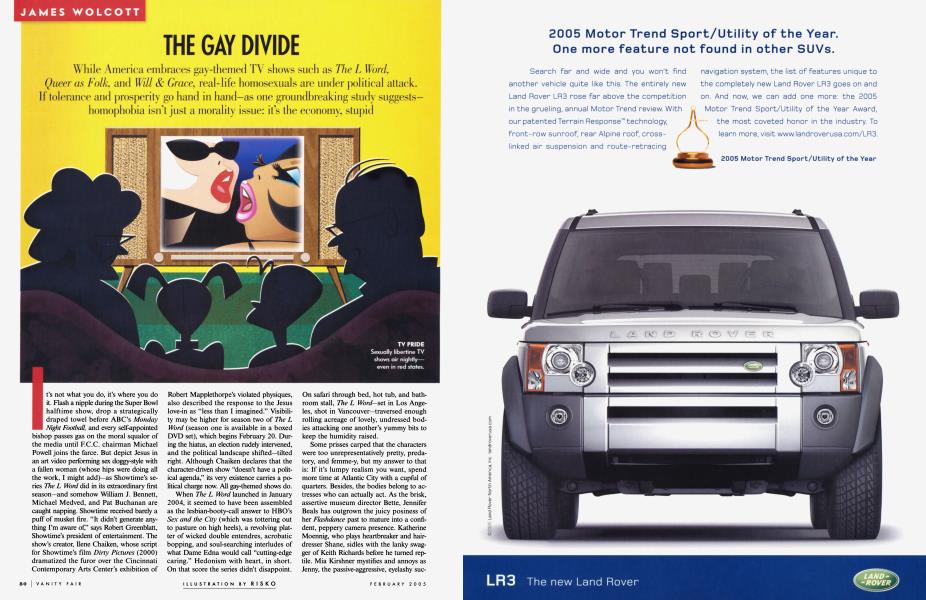
While America embraces gay-themed TV shows such as The L Word, Queer as Folk, and Will & Grace, real-life homosexuals are under political attack. If tolerance and prosperity go hand in hand—as one groundbreaking study suggests—homophobia isn't just a morality issue: it's the economy, stupid
It's not what you do, it's where you do it. Flash a nipple during the Super Bowl halftime show, drop a strategically draped towel before ABC's Monday Night Football, and every self-appointed bishop passes gas on the moral squalor of the media until F.C.C. chairman Michael Powell joins the farce. But depict Jesus in an art video performing sex doggy-style with a fallen woman (whose hips were doing all the work, I might add)—as Showtime's series The L Word did in its extraordinary first season—and somehow William J. Bennett, Michael Medved, and Pat Buchanan are caught napping. Showtime received barely a puff of musket fire. "It didn't generate anything I'm aware of," says Robert Greenblatt, Showtime's president of entertainment. The show's creator, Ilene Chaiken, whose script for Showtime's film Dirty Pictures (2000) dramatized the furor over the Cincinnati Contemporary Arts Center's exhibition of Robert Mapplethorpe's violated physiques, also described the response to the Jesus love-in as "less than I imagined." Visibility may be higher for season two of The L Word (season one is available in a boxed DVD set), which begins February 20. During the hiatus, an election rudely intervened, and the political landscape shifted—tilted right. Although Chaiken declares that the character-driven show "doesn't have a political agenda," its very existence carries a political charge now. All gay-themed shows do.
When The L Word launched in January 2004, it seemed to have been assembled as the lesbian-booty-call answer to HBO's Sex and the City (which was tottering out to pasture on high heels), a revolving platter of wicked double entendres, acrobatic bopping, and soul-searching interludes of what Dame Edna would call "cutting-edge caring." Hedonism with heart, in short. On that score the series didn't disappoint. On safari through bed, hot tub, and bathroom stall, The L Word— set in Los Angeles, shot in Vancouver—traversed enough rolling acreage of lovely, undressed bodies attacking one another's yummy bits to keep the humidity raised.
Some prisses carped that the characters were too unrepresentatively pretty, predatory, and femme-y, but my answer to that is: If it's lumpy realism you want, spend more time at Atlantic City with a cupful of quarters. Besides, the bodies belong to actresses who can actually act. As the brisk, assertive museum director Bette, Jennifer Beals has outgrown the juicy posiness of her Flashdance past to mature into a confident, peppery camera presence. Katherine Moennig, who plays heartbreaker and hairdresser Shane, sidles with the lanky swagger of Keith Richards before he turned reptile. Mia Kirshner mystifies and annoys as Jenny, the passive-aggressive, eyelashy succubus seducing men and women alike only to pout boohoo as if she were the one seduced. An aspiring fiction writer who's literary in the worst way (she writes a story about the manatee), Jenny is an enigma to her many fans and detractors—is she a talented phony or simply a pretentious twaddler? (Season two, where superbitch Sandra Bernhard plays her writing teacher, should dislodge clues.) Even familiar faces brought pop-up surprise to their guest-star performances: Kelly Lynch, scarily dapper as a dagger-thin rockabilly "drag king" whose gypsy-pirate look recalls punk-era singer Mink DeVille; Anne Archer, finally allowed to be funny (she usually plays the Loyal, Fretful Wife holding vigil at the French windows) as a ditsy actress; Lolita Davidovich, wearing her tight jeans like a threat to swift-kick any woman fool enough to stake a claim on her mate, the sultry Marina (Karina Lombard, whose leggy stroll could be bottled as motion lotion).
From the outset The L Word smuggled larger ambitions in its overnight kits. It pursued not just fleshly pleasure but also mind-blowing ecstasy. With cool incision and keen appetite, the show trespassed and transgressed into the danger zone where art, sex, and religion play dirty, not so much shattering taboos as opening them up to see what was ticking inside. Season one's most controversial story arc pitted Bette, who acquired the Jesus video for exhibition ("Look at her face," marvels Bette, while the model, crouching on all fours, grimaces, "it's like she's longing for faith"—uh, O.K.), against a conservative pressure group led by a harpy (Helen Shaver) whose crusader zeal shrieked sexual hysteria. One orgasm and her coiled springs would pop like Slinkys. The dispute over blasphemy escalated from the artwork itself to character assassination of all those sickos and perverts who presume to flaunt their gay lifestyles in the privacy of their backyard pools. (After Bette and her friends are arrested at a protest rally that degenerates into a near riot, the show treats us to a caged-heat episode of what appears to be telepathic lesbian jail-cell mutual masturbation. I'm clearly not keeping up with the latest trends.)
NOVEMBER 2 WAS NOT A GOOD DAY FOR MILLIONS OF MAMMALS, BUT GAYS BORE THE RED BRUNT OF THE BACKLASH.
The larger social conflict in The L Word overarches the romantic complications of one-night stands, relationships stuck in neutral, quests for the perfect sperm donor, and sexual-persona crises (a straight man so lesbian-identified he calls himself Lisa and totes a dildo, only to be dumped by his bisexual lover, who vents, "I don't want a lesbian boyfriend!"). It arises from the shock revelation of gays' and lesbians' leaving their inhibitions back home with Mom and savoring the stretchy freedom of working and partying and forming families in a like-minded community—only to have homophobia mount a major comeback tour right smack in their faces. The hate and prejudice they thought were receding were simply hibernating, resting for the spring offensive—growing their claws. The show's cliff-hanger episodes—organized fundamentalists armed with smear tactics swamping a small band of freedom fighters—provided an eerie, prophetic metaphor for the fall election.
No, November 2 was not a good day for gays. It wasn't a good day for millions of other mammals, but gays bore the red brunt of the backlash. Surveying the charred ruins of the election returns, gay activist and playwright Larry Kramer interpreted them as an extermination order hand-delivered from the heartland. Speaking at Cooper Union, in Manhattan, he said, "I hope we all realize that, as of November 2nd, gay rights are officially dead. And that from here on we are going to be led even closer to the guillotine." Lighten up, wrote Andrew Sullivan in his blog. "I'm very fond of Larry, but understatement is not his strong suit." New York Times columnist Frank Rich, studying the returns through a pop-cultural prism, argued that, regardless of Karl Rove's puppet-master machinations, blue-state values still prevailed:
Everything about the election results—and about American culture itself—confirms an inescapable reality: John Kerry's defeat notwithstanding, it's blue America, not red, that is inexorably winning the culture war, and by a landslide. Kerry voters who have been flagellating themselves since Election Day with a vengeance worthy of The Passion of the Christ should wake up and smell the Chardonnay. The blue ascendancy is nearly as strong among Republicans as it is among Democrats.
Those on the winning side had no time for fancy-pants nuance. They were too busy inflating their chests like Al Capp's Jubilation T. Cornpone and doing an end-zone dance. They found the poll results emphatic, unambiguous, and God-approved. With the second coronation of George W. Bush, America had issued marching orders to its elected crooks: it was time to roll back the headlong rush into Sodom and Gomorrah and return the country to the Sunday-school values it once held dear, before all those homos got uppity. Let the Inquisition begin! James Dobson, founder of a media ministry, adviser to the Bush re-election team, advocate of corporal punishment, and as ambitious a sack of packaged goods as Fundamentalism has yet produced, recently told a sea of shining faces at Oklahoma Christian University, "Homosexuals are not monogamous. They want to destroy the institution of marriage. It will destroy marriage. It will destroy the Earth." Bush now had a mandate to satisfy his evangelical supporters and drive the sodomites from the wedding chapel, and Dobson intended to keep close tabs.
At stake is a demographic that's affluent, entertainment-savvy and starving for greater representation on television. Analyst firm Witeck-Combs wrote that the estimated 15 million gays and lesbians in the United States enjoyed a 2003 buying power of $485 billion.
—Television Week, October 25, 2004.
Culture and politics are locked in a herky-jerky, hokey-pokey dance where breakthroughs in movies and TV are met with legal and political countermoves from the religious right, the boundaries being pushed even as the ground underfoot gives way. Wary optimists see the cultural forces riding such a long, upward wave that social and political acceptance will eventually triumph, just as the civil-rights movement did after decades of struggle. The saturation effect will soften resistance no matter how barren the walnut brains of our overseers. Gay TV is setting up shop across the dial. Soon there will be three gay cable channels, Logo, Here, and Q; Queer as Folk, looking forward to its fifth season, has established a successful niche on Showtime; Ellen DeGeneres hosts a hit daytime talk show where the bubbly chat blends with the set's soothing, tasteful pastels; Gay and Lesbian Pride Month is celebrated with special programming on PBS and various cable networks; Will & Grace is syndicated across the country, shown during the dinner hour without reports of fainting spells. In the 100th episode of TV's No. 1 drama, CBS's C.S.I., forensics guru Gil Grissom (William Petersen), the most inspirational avatar of logic, reason, and skeptical understatement since Mr. Spock, investigated the gruesome deaths of Vegas-showgirl transgenders with nonjudgmental tact and sympathy. Taking on a subject that would have been unthinkable a decade ago, it was the highest-rated episode in the show's history.
To pessimists, these pop-cult distractions are window dressing in a gulag cell, little more than ghettoizing gays as licensed jesters in the entertainment playpen as every real-world advance achieved thus far is eroded or revoked. Watching bunny-cute gay characters caper across their plasma screens enables Americans to feel good about themselves while they sit and do nothing to halt the threshing of gay rights. Larry Kramer: "Straight people say, 'My, how much progress gay people are making. Isn't that Will & Grace wonderful.' If it's so wonderful, why am I scared to death?" Because, to Kramer, media images are no match for raw power. Future gay-pride parades, he foresees darkly, will resemble the bedraggled columns of a defeated army, the ranks thinned by H.I.V. and crystal meth. If gays go under en masse, millions of other hopes will dive with them.
It is more than a matter of basic justice that gays be accorded the same rights granted to the average heterosexual goober. It is socially, economically, and technologically vital in preventing the U.S. from sinking on its ham hocks into stagnation. In his groundbreaking study, The Rise of the Creative Class (2002), urban-studies theorist Richard Florida charted and enumerated the momentous demographic shift that helped explain why some cities flourish and attract whiz kids of all ages, while others board up store windows and empty out, their once bustling streets haunted by junkies and jailbirds and whores so wasted they can barely stand ... grimsville, baby. Prosperous development, contends Florida, depends upon the three Ts: Technology, Talent, and Tolerance. They all fit together. "In a nutshell, we found that creative people are attracted to, and high-tech industry takes root in, places that score high on our basic indicators of diversity— the Gay, Bohemian, and other indexes." The Gay Index, on which cities such as San Francisco, Seattle, and Boston score high (and Buffalo, Oklahoma City, and Detroit flunk), is a signifier of broader acceptance. "To some extent, homosexuality represents the last frontier of diversity in our society, and thus a place that welcomes the gay community welcomes all kinds of people." As a journalist friend of Florida's sums it up, "Where gay households abound, geeks follow." And where geeks follow, venture capital flocks. Homophobia is bad for business, and boring to the taste buds.
THE COUNTRY IS EVOLVING INTO A MULTI-RACIAL, MULTI-ETHNIC, MULTI-FAITH, OMNISEXUAL CREAMY RAINBOW SWIRL.
The Republicans have the federal government—for now. But we've got Seattle, Portland, San Francisco, Chicago, Los Angeles, San Diego, New York City (Bloomberg is a Republican in name only), and every college town in the country. We're everywhere any sane person wants to be. Let them have the shitholes, the Oklahomas, Wyomings, and Alabamas. We'll take Manhattan.
—Dan Savage, The Portland Mercury (November 11, 2004).
Near the end of his book, Florida sounds a cautionary note. Progress isn't a smooth upward slope but a jagged line that can become a fissure if left unmended. "I fear we may well be splitting into two distinct societies with different institutions, different economies, different incomes, ethnic and racial makeups, social organizations, religious orientations and politics. One is creative and diverse_The other is a more close-knit, church-based, older civic society of working people and rural dwellers. The former is ascendant and likely to dominate the nation's economic future." But not necessarily the political future, if evolutionary throwbacks continue to get their grubby way, and Florida's recent articles ring alarm bells. In an essay called "Revenge of the Squelchers," he writes, "While we've not planned it this way, our findings have an eerie resonance in contemporary American society's impassioned debate over gay marriage. Massachusetts, the first state to attempt to legalize gay marriage, ranks first both on my Creativity Index and on the Milken Institute's most recent ranking of high-tech states, while San Francisco and Seattle, perennial leaders on virtually every listing of high-tech hot spots, boast the same distinction. States and cities that have already or are currently trying to restrict gay rights tend to rank at the very bottom of such lists." And on November 2 many of those states dug themselves deeper bottoms, if you'll excuse the innuendo, by overwhelmingly ratifying referenda against gay marriage. Reflecting the political-climate change, Florida's next book is titled The Flight of the Creative Class. But there are only so many places to flee.
Fight or flight, the next few years could get hairy as the Great Divider grinds through his second term. t no matter how sword-drawn the battle lines, how hard pundits and preachers exploit polarization, how outnumbered Maureen Dowd feels at Thanksgiving dinner by jeering Bushies, the country is evolving into a multi-racial, multi-ethnic, multi-faith, omnisexual creamy rainbow swirl. "As long as this country's existed, we've been blurring these boundaries," says Ilene Chaiken, and the future will bring more flux and fluidity as generations brought up on MTV and video games perceive themselves as shape-shifters, dissolving into and out of new roles, new anatomies. The truth is that The L Word, Will & Grace, Queer as Folk, and other gay shows aren't so much homosexual as pansexual. Butch, femme, leather, flannel, hirsute, shaven, bottom, top, dom, switch, chubby-chaser, tanning-booth beef jerky, pale sylph, motorcycle mama, feather-boa queen, down-low brother, closeted Republican—every variety has its moment under the cabaret spotlight. It's what's happening outside the cabaret you have to worry about. Well, after November 2, we can't say we weren't warned.

Subscribers have complete access to the archive.
Sign In Not a Subscriber?Join Now

