

Sign In to Your Account
Subscribers have complete access to the archive.
Sign In Not a Subscriber?Join NowJeffrey Katzenberg and Meg Whitman are poised to launch a unique (and risky) new streamer
Jeffrey Katzenberg and Meg Whitman are poised to launch a unique (and risky) new streamer
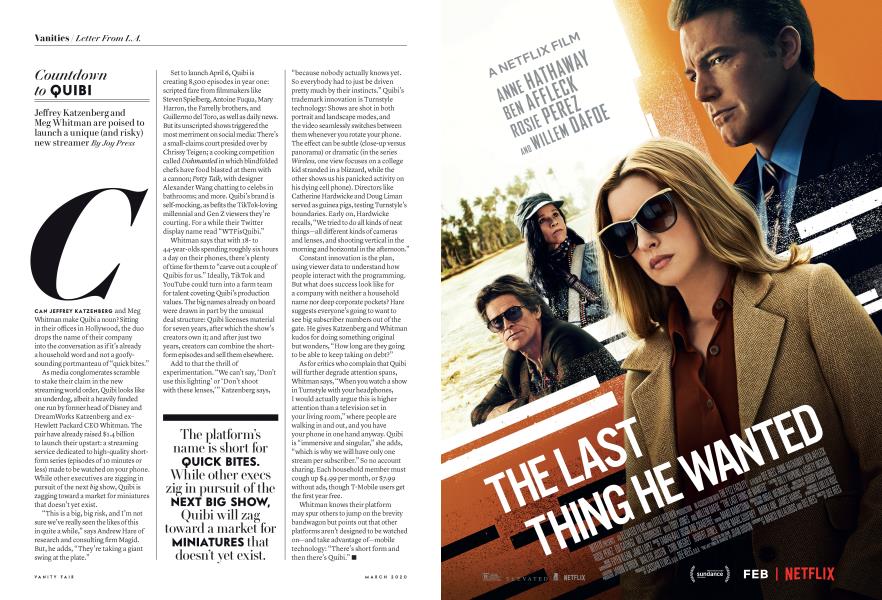
Can Jeffrey Katzenberg and Meg Whitman make Quibi a noun? Sitting in their offices in Hollywood, the duo drops the name of their company into the conversation as if it's already a household word and not a goofy-sounding portmanteau of "quick bites."
As media conglomerates scramble to stake their claim in the new streaming world order, Quibi looks like an underdog, albeit a heavily funded one run by former head of Disney and DreamWorks Katzenberg and ex-Hewlett Packard CEO Whitman. The pair have already raised $1.4 billion to launch their upstart: a streaming service dedicated to high-quality shortform series (episodes of 10 minutes or less) made to be watched on your phone. While other executives are zigging in pursuit of the next big show, Quibi is zagging toward a market for miniatures that doesn't yet exist.
"This is a big, big risk, and I'm not sure we've really seen the likes of this in quite a while," says Andrew Hare of research and consulting firm Magid. But, he adds, "They're taking a giant swing at the plate."
Set to launch April 6, Quibi is creating 8,500 episodes in year one: scripted fare from filmmakers like Steven Spielberg, Antoine Fuqua, Mary Harron, the Farrelly brothers, and Guillermo del Toro, as well as daily news. But its unscripted shows triggered the most merriment on social media: There's a small-claims court presided over by Chrissy Teigen; a cooking competition called Dishmantled in which blindfolded chefs have food blasted at them with a cannon; Potty Talk, with designer Alexander Wang chatting to celebs in bathrooms; and more. Quibi's brand is self-mocking, as befits the TikTok-loving millennial and Gen Z viewers they're courting. For a while their Twitter display name read "WTFisQuibi."
Whitman says that with 18- to 44-year-olds spending roughly six hours a day on their phones, there's plenty of time for them to "carve out a couple of Quibis for us." Ideally, TikTok and YouTube could turn into a farm team for talent coveting Quibi's production values. The big names already on board were drawn in part by the unusual deal structure: Quibi licenses material for seven years, after which the show's creators own it; and after just two years, creators can combine the shortform episodes and sell them elsewhere.
The platform's name is short for QUICK BITES. While other execs zig in pursuit of the NEXT BIG SHOW, Quibi will zag toward a market for MINIATURES that doesn't yet exist.
Add to that the thrill of experimentation. "We can't say, 'Don't use this lighting' or 'Don't shoot with these lenses,' " Katzenberg says, "because nobody actually knows yet. So everybody had to just be driven pretty much by their instincts." Quibi's trademark innovation is Turnstyle technology: Shows are shot in both portrait and landscape modes, and the video seamlessly switches between them whenever you rotate your phone. The effect can be subtle (close-up versus panorama) or dramatic (in the series Wireless, one view focuses on a college kid stranded in a blizzard, while the other shows us his panicked activity on his dying cell phone). Directors like Catherine Hardwicke and Doug Liman served as guinea pigs, testing Turnstyle's boundaries. Early on, Hardwicke recalls, "We tried to do all kinds of neat things—all different kinds of cameras and lenses, and shooting vertical in the morning and horizontal in the afternoon."
Constant innovation is the plan, using viewer data to understand how people interact with the programming. But what does success look like for a company with neither a household name nor deep corporate pockets? Hare suggests everyone's going to want to see big subscriber numbers out of the gate. He gives Katzenberg and Whitman kudos for doing something original but wonders, "How long are they going to be able to keep taking on debt?"
As for critics who complain that Quibi will further degrade attention spans, Whitman says, "When you watch a show in Turnstyle with your headphones, I would actually argue this is higher attention than a television set in your living room," where people are walking in and out, and you have your phone in one hand anyway. Quibi is "immersive and singular," she adds, "which is why we will have only one stream per subscriber." So no account sharing. Each household member must cough up $4.99 per month, or $7.99 without ads, though T-Mobile users get the first year free.
Whitman knows their platform may spur others to jump on the brevity bandwagon but points out that other platforms aren't designed to be watched on—and take advantage of—mobile technology: "There's short form and then there's Quibi."
Subscribers have complete access to the archive.
Sign In Not a Subscriber?Join Now