







Sign In to Your Account
Subscribers have complete access to the archive.
Sign In Not a Subscriber?Join NowTHE NEW LATE NIGHT
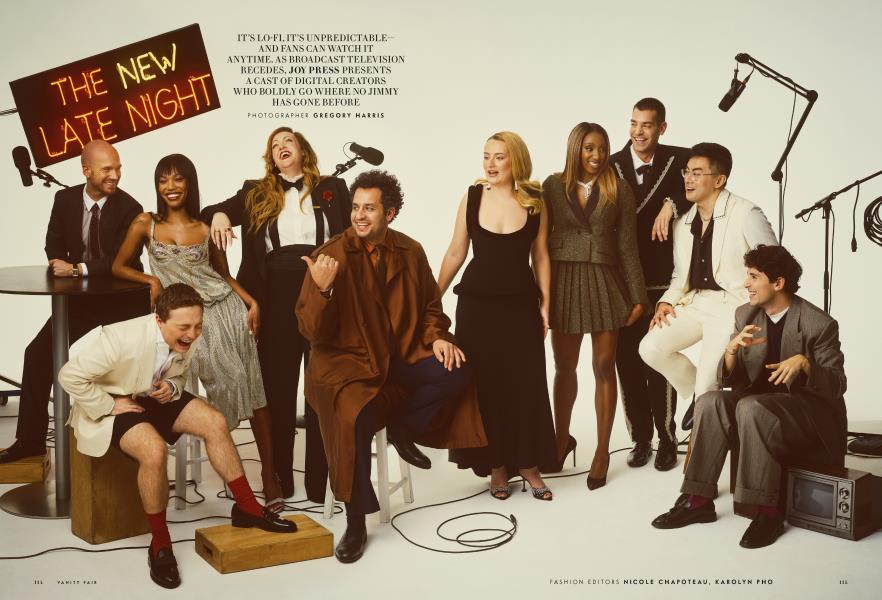
IT'S LO-FI, IT'S UNPREDICTABLE— AND FANS CAN WATCH IT ANYTIME. AS BROADCAST TELEVISION RECEDES, JOY PRESS PRESENTS A CAST OF DIGITAL CREATORS WHO BOLDLY GO WHERE NO JIMMY HAS GONE BEFORE
JOY PRESS
The talk show is alive and well, and living online. It's Jennifer Lawrence sobbing convulsively as the effects of Hot Ones's spicy wings kick in, Rosalia musing about the lives of the saints while riding New York City transit on Subway Takes, Tina Fey reading Bowen Yang the riot act on Las Culturistas. It's Lorde going deep on panic attacks and body shame with Therapuss host Jake Shane and Keke Palmer explaining why she envies rocks: "They seem like they've got it easy," she tells Chicken Shop Date's Amelia Dimoldenberg. "Even if somebody steps on them, they win, because it hurts that person."
For decades, cheeky daddy figures from Jack Paar and Johnny Carson to Jimmys Fallon and Kimmel sat atop the Hollywood food chain. They were industry gatekeepers, presiding over essential press tour pit stops and thresholds where an up-and-comer could become a household name overnight. Carson's final episode of The Tonight Show reached 50 to 55 million Americans. Today's network late-night shows struggle to get even a 10th of that audience. Because who's sitting around at 11:35 watching TV anymore—if you even have a TV ?
This newer, more democratized model, where digital influencers wield more clout than many traditional "stars," relies on realness. "I don't want rehearsed talking points and guests going through the motions," says Royal Court creator Brittany Broski. "The whole point of these internet-based shows is people crave a real parasocial connection with their favorite celebrity. There used to be this barrier between celebrities and the average person, and that has kind of dissolved." New late-night hosts are not smooth professionals but stand-ins for the viewer: an awkward, enthusiastic fan rubbing up against a celebrity caught in the raw.
*lncludes followers on multiple platforms (Instagram, TikTok, YouTube, etc.) for both each creator and their tentpole show.
AMELIA DIMOLDENBERG
Chicken Shop Date
FOLLOWER COUNT: 16.3 million*
When Dimoldenberg pitched her idea for Chicken Shop Date to a few British broadcasters, one advised her to wear tighter dresses. "I nodded along, and I just went away from the meetings thinking: That's not me at all," she says. Instead Dimoldenberg embraces extreme awkwardness as she performs date-style interviews with Andrew Garfield, SZA, and Cher in greasy fast-food environs. "It humbles everyone," she says. "No one would go on a first date there. That's why it's funny."
FOR DETAILS, GO TO VF.COM/CREDITS.
THESE HOSTS AREN'T JOURNALISTS, AND THEY DON'T PRETEND TO BE— THEY'D RATHER ESTARLISH A MUTUALLY BENEFICIAL RELATIONSHIP THAN CHALLENGE GUESTS. THEY DON'T INTERROGATE; THEY COLLAR.
The digital natives remixing showbiz's oldest format grew up marinating in YouTube, Instagram, and TikTok content. Broski got famous in 2019 thanks to a meme of her trying kombucha. Quenlin Blackwell of YouTube series Feeding Starving Celebrities hit the big time at 14 after posting a Vine of a cheerleading stunt gone wrong.
Sean Evans is a pioneer of this wave. When his YouTube talk show Hot Ones premiered in 2015, stars were hesitant to let down their guard while tasting nuclear-hot sauces: "They were like, I'm a huge A-lister. What am I doing on YouTube eating chicken wings?" Evans says older celebs now agree to go on either because their kids are fans or because of the show's massive cultural reach. He beams as he recalls Glen Powell calling the show a Hollywood rite of passage. "I think sometimes guests look at Hot Ones as the official internet interview of record. It's a deposit in the meme economy."
Talk shows have always been performative, conjuring an illusion of intimacy between strangers surrounded by lights, cameras, and a studio audience. The new crop of celebrity interviewers have found their own ways to short-circuit the artificiality and elicit real human moments: knocking guests off guard with the flirty discomfort of a date, as Dimoldenberg does on Chicken Shop Date, or the indignity of dressing up in medieval garb, a la Royal Court. Dimoldenberg sees her show more as "a performance between two people" than an interview. "It's blurring the lines, which is what I really like about it, and what I think the audience likes about it too, because they really do want me to fall in love. " And unlike the quick-hit segments of yore, podcasts like Therapuss and Las Culturistas often spend an hour or more going deep with a single guest.
These hosts aren't journalists, and they don't pretend to be— they'd rather establish a mutually beneficial relationship than challenge guests. They don't interrogate; they collab. "Why make someone uncomfortable? It'sjust notworth it," says Shane. "I never come in with an agenda. " When interviewing actor Lea Michele, he elected not to ask about an old rumor that the Broadway star is illiterate. "I'm not gonna sit here and ask her if she can read. Obviously she can read! " he says, giggling. "But then she brought it up, and we got there, which was great. That's how I approach things."
Likewise, says Blackwell, "I talk to my guest like I'm interviewing someone to be my friend." This is the aim of so many current shows—something Amy Poehler announced up front in the title of her own podcast, Good Hang With Amy Poehler. The political edge of the traditional talk show has largely vanished from the new late-night projects, though it lives on in content made by partisan streamers like Hasan Piker and Nick Fuentes.
Ziwe is a dramatic exception to the no-controversy vibe. Part comedian and part provocateur, she exposes cultural nerves in her entertainingly squirmy interviews. "Why do you hate women?" she bluntly asks movie star Kevin Hart, needling him about rarely working with female film directors. Ziwe started out doing interviews on YouTube, then had a late-night interview and sketch comedy series on Showtime. Now she's back on YouTube with Ziwe: You'd Be an Iconic Guest, where she slyly asked New York mayor Eric Adams about corruption and challenged body-positive Lizzo to say something nice about Senator Mitch McConnell's physique. Watching Dick Cavett's 1969 interview with James Baldwin about segregation impressed upon her that a talk show could be important. "That is actually American history," Ziwe says. "I want to create American history. I want to be part of this greater discourse."
Traditional late-night TV always struggled with its white man problem, i.e., its inability to sustain a franchise not hosted by a white man. Over the past decade or so, networks, cable channels, and streamers launched shows by Larry Wilmore, Samantha Bee, Amber Ruffin, Desus & Mero, Lilly Singh, and, of course, Ziwe herself—but few of them made it past a few seasons. "For the longest time there's been this cookie-cutter idea of what a late-night host is," says Broski. "Online, you're not beholden to anyone. It's like a free-for-all." At VFs new-late-night photo shoot in Los Angeles, Broski never stops laughing as she and her compatriots gossip about spiders, romances, and blocking people online. "How amazing to look at all this talent coming out of the woodwork," she says, "and see there's room for everyone at the table."
CLOCKWISE FROM TOP LEFT:
BRITTANY BROSKI
Royal Court
FOLLOWER COUNT: 20.1 million
After her kombucha video went viral—and, she says, got her fired from her job at a bank—Broski parlayed her internet notoriety into a fandom she calls "Broski Nation." In 2023, inspired by Game of Thrones and talk shows like Hot Ones, she created Royal Court. She wants the show to have the vibe of a "medieval sleepover," coaxing guests to dress in period garb. It's all about "breaking down that wall of illusion" between star and stan: "You're not this ethereal being, you're just like me, and I really want to hang out with you."
JULIAN SHAPIRO-BARNUM
Recess Therapy
FOLLOWER COUNT: 8.6 million
Shapiro-Barnum was in a quarantine pod with family when he decided to create an online talk show. Then he hit on the idea of Recess Therapy, in which he and celebrities like Zoe Kravitz and Rihanna talk to young children about everything from love of corn to the life of Shakespeare. This year Shapiro-Barnum is embarking on an ambitious new project: Outside Tonight, a late-night show shot in front of a live audience in the streets of New York City. He's excited to spend more time interviewing grown-ups because, as he says, "I do have to be pretty careful how I act around kids. I hope to show more depth in front of the camera with this new project."
JAKE SHANE
Therapuss
FOLLOWER COUNT: 5.7 million
Shane's TikTok handle is octopusslover8—a reference to his favorite maritime delicacy. On Therapuss, he ditches cephalopods for guests like Selena Gomez, Rene6 Rapp, and Ed Sheeran, engaging them in a free-form hang-slash-therapy session. Now 26, Shane is excited to expand his traditional entertainment footprint—he's developing an autobiographical series for Hulu—but plans to keep Therapuss on the front burner too. "You're good at it, and people like it," he remembers one celebrity guest saying of the podcast. "Never forget about what's working well."
KAREEM RAHMA
Subway Takes
FOLLOWER COUNT: 5.3 million
After working for Vice and The New York Times, Rahma struck out on his own to make Subway Takes. Public transportation is "a great equalizer," he says, which makes it the perfect spot for everyone from Spike Lee to Jane Goodall to let loose their unvarnished opinions. But nonfamous guests are also crucial to the show, says Rahma. Ultimately, he chooses them based on the beer test—selecting only those he'd enjoy hanging out with IRL.
The table is going to need an extension; the number of newbies moving into the video and podcast space only keeps climbing. But Subway Takes creator Kareem Rahma says the climate doesn't feel aggressive, because unlike network television hosts, "we're not all competing for the same damn time slot." Viewers can watch these shows at any hour on a multitude of platforms.
Streamers are neck and neck with broadcast and cable TV networks these days, and YouTube ranks as America's most watched streaming service, consistently beating out Netflix. In October viewers watched more than 700 million hours of YouTube podcasts on their living room devices, up from 400 million the year before. Netflix is fighting back, recently signing deals with iHeartMedia, Barstool Sports, and Spotify to create its own heavy-hitting video podcast slate.
QUENLIN BLACKWELLFeeding Starving Celebrities FOLLOWER COUNT: 22.2 million
Blackwell started posting videos at the age of nine. Her tentpole series combines cooking, comedy, frenetic editing, and interviews with guests like Addison Rae and Lil Nas X. Blackwell dreams of being "a multihyphenate," name-checking Oprah Winfrey and Martha Stewart as idols. When meeting with her talent agent at the end of the year, she brought a 12-page agenda with questions, ideas, and notes on what she wanted to achieve. "If you look at Hollywood since forever, everyone's a fame whore," Blackwell says with a smile. "But there's a way to do it that has depth."
YouTube, with its billions of monthly logged-in users, is eager to mark its territory as a champion of the new talk show. When the company's execs heard that Recess Therapy's Julian Shapiro-Barnum was planning to launch a new weekly talk show this spring, he says they made it clear that "they were incredibly interested in the future of late night being on YouTube."
Shapiro-Barnum grew up loving Conan O'Brien and the like but feels the genre still hasn't fully transitioned into the modern era. Lots of people now exclusively watch Fallon's or Kimmel's shows in the form of YouTube snippets, "but that is network TV packaged to look like a YouTube video. I thought: How can I make late night that is literally for a YouTube audience?" A year ago he hatched the idea of Outside Tonight: "I'm taking all the strippeddown DIY craziness and honesty of internet shows, doing it in a very formalized, classic late-night fashion. But we're not doing it in the studio, and there's no network notes."
"I THINK SOMETIMES GUESTS LOOK AT HOT ONES AS THE OFFICIAL INTERNET INTERVIEW OF RECORD," SAYS SEAN EVANS. "IT'S A DEPOSIT IN THE MEME ECONOMY"
CLOCKWISE FROM TOP LEFT:
SEAN EVANS
Hot Ones
FOLLOWER COUNT: 30.1 million
Although he started out as a journalist, some of Evans's fondest early memories revolve around watching David Letterman with his dad. That irreverence seeped into the groundwater of Hot Ones, which merges classic late night with gonzo internet culture; his guest list has boasted names like Channing Tatum, Scarlett Johansson, Bad Bunny, and Ariana Grande. He's also hosted fellow talk show hosts, like Conan O'Brien and Jimmy Kimmel. "That same feeling that I got, I can now pass down," says Evans. "And maybe I'll see little pieces of myself in the next wave of things."
ZIWE
Ziwe: You'd Be an Iconic Guest
FOLLOWER COUNT: 2.6 million
Ziwe first created a space for her hilariously no-holds-barred interviews back in 2017 with the YouTube (and then Instagram Live) show Baited With Ziwe. After two seasons of the Showtime series Ziwe, she's back online with Ziwe: You'd Be an Iconic Guest, where she goes toe to toe with figures as varied as rapper Vince Staples and scammer Anna Delvey. An admirer of The Colbert Report and Zach Galifianakis's Between Two Ferns, Ziwe sees her interviewees as scene partners: "I'm as dependent on them to say something interesting and captivating and honest as they are on me to ask them the craziest thing that comes to mind, which I always do."
BOWEN YANG and MATT ROGERS
Las Culturistas
FOLLOWER COUNT (combined): 2 million
When Yang and Rogers launched Las Culturistas a decade ago, it was just an excuse for a regular playdate between BFFs. The show kept serving that function as their separate careers took off—Rogers as a comedian and actor, Yang on SNL and in films. It's also served as a springboard for an annual awards show. "I think what really works for us is to not have too many ambitions and just follow the good feelings," says Rogers. "We've really benefited from just going with the flow." Although they've hosted a cavalcade of divas, they still have one dream guest, according to Yang: "We're keeping our fingers crossed for Céline Dion."
Such freedom is both exhilarating and exhausting, since it places all the creative and financial burdens on individual hosts. Royal Court has been going for almost three years, but Broski says it's only recently become profitable; before that she was subsidizing her show with brand deals and other internet income streams. She now has about 3 0 people working for "Broski Inc. " and on the show, as compared to the 2 0 0 staffers employed by The Late Show With Stephen Colbert—some ofwhom have worked at the Ed Sullivan Theater since the David Letterman days. A lot of new late-night shows operate on even more of a shoestring. Blackwell says she's turned down offers to buy a stake in her shows; she dreams of buying a house but won't do it at the expense of losing control over Feeding Starving Celebrities. "Em 24.1 don't need to sell everything so soon! The audience feels how much I care about it, and I want to keep it that way. "
Instead of worrying about ratings, the new late-night creators are directly beholden to their viewers. "I look at every comment, every chart placement. I'm very, very obsessive about it," says Shane. He admits that this makes him anxious. Butwhen he comes across something positive? "It's like a drug! It makes all the pain worth it. "
"After hustling and grinding so hard to make a name for yourself, you get to a point where you stop and you go, Oh my God, I've actually become a product here," says Dimoldenberg. "It can be a bit disorientating. " Which is why, in an ironic twist, she and some of her cohort are hilling with the traditional entertainment world. Blackwell recently appeared as an influencer on the Gen Z-focused HBO comedy I Love LA; Shane had a recurring role as a "social media girlie" oxiHacks and is developing a series for Hulu; Rahma made an indie him called Or Something; Dimoldenberg is working on a rom-com as well as a show for the BBC. "It's a real relief to submerge myself in proj ects that are creatively fulfilling that I'm actually notm" she says, hashing an impish grin.
Las Culturistas cohost Bowen Yang, who recently departed SNL and has a thriving career in movies and TV, grows rehective at the thought of the traditional late-night format vanishing altogether— and with it the power to speak to a wide range of Americans all at once. "I feel very protective of it. Especially after Kimmel, especially after Colbert," he says, referring to the network hosts who have been directly attacked by the Trump administration for their political monologues. Last fall Kimmel was temporarily yanked off the air after ABC was threatened by FCC chairman Brendan Carr; last summer Colbert's show was canceled, purportedly for financial reasons, right around the same time its parent company was seeking Trump's approval for a merger.
"It's clear there's a nerve that's being hit," says Yang. Even beyond the political tensions, the old late night faces increasingly intense financial pressure, and the ad revenue from online platforms can be much higher than what linear television once brought in.
Recess Therapy's Shapiro-Barnum originally dreamed that his online projects would serve as an entrée into the mainstream entertainment world. Now, he says, "I have drunk the Kool-Aid of the internet. I do genuinely believe in the power of being able to produce something myself. I have really fallen in love with the freedom. So I will probably continue to make things online, as long as there is an online to make things on."
Subscribers have complete access to the archive.
Sign In Not a Subscriber?Join Now


