




Sign In to Your Account
Subscribers have complete access to the archive.
Sign In Not a Subscriber?Join NowTHEY BEG HIS PARDON
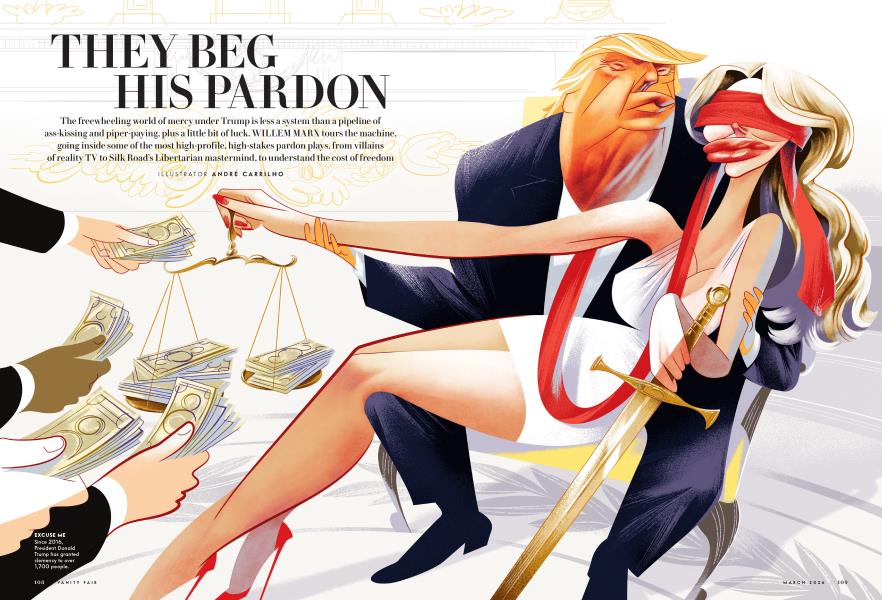
The freewheeling world of mercy under Trump is less a system than a pipeline of ass-kissing and piper-paying, plus a little bit of luck. WILLEM MARX tours the machine, going inside some of the most high-profile, high-stakes pardon plays, from villains of reality TV to Silk Road's Libertarian mastermind, to understand the cost of freedom
WILLEM MARX
As President Donald Trump's first term neared its violent denouement on the morning of January 6, 2 021, in a hushed corner suite several blocks away, a Republican lobbyist placed a call to Stephanie Grisham, the first lady's chief of staff. He needed a favor. Awaiting the inspection of White House counsel Pat Cipollone was a batch of critical files, —this lobbyist told Grisham, that were key to the future freedom of Greg Lindberg, an insurance mogul convicted in March 2020 of conspiracy to commit wire fraud and bribery, for trying to influence a North Carolina politician. This lobbyist had already asked senior officials to examine Lindberg's pardon application, then pass it to the president for approval. Now, just days before Trump would leave office, the lobbyist really needed Grisham to chase down that request. "No problem," she reportedly responded. "Happy to do it."
By the end of the day, as history knows, the West Wing, where Cipollone worked, was in chaos. Grisham, who had been working from home, had resigned from her job by that night. In the days that followed, Trump granted a flurry of pardons, but Lindberg's was not among them. Grisham told VFshe didn't remember the incident—that day was "crazy." An attorney for Lindberg said, "Pardons should be given when the facts of the case warrant it," and that a pardon "is appropriate here—not just to address the lasting harm to him but also his family and the many people who have worked with him." Cipollone did not respond to a request for comment.
Nearly five years on, with Trump back in office, the convicted, then released, then reconvicted Lindberg has spent big to wipe his slate clean, with advisers such as Alan Dershowitz, who joined Trump's own legal team during his first impeachment, and the advocacy efforts of Keith Schiller, Trump's former personal bodyguard. Through a web of companies Lindberg controlled, prosecutors have alleged he defrauded insurance fii'ms and thousands of policyholders, deceived regulators, and improperly financed a "lavish lifestyle." In May2024 ajury convicted Lindberg of conspiracy to commit honest services wire fraud and bribery involving federally funded programs; and in November 2024 he pleaded guilty to two other offenses. Schiller's firm recently listed "executive pardon" in a disclosure form. (Schiller did not respond to a request for comment.)
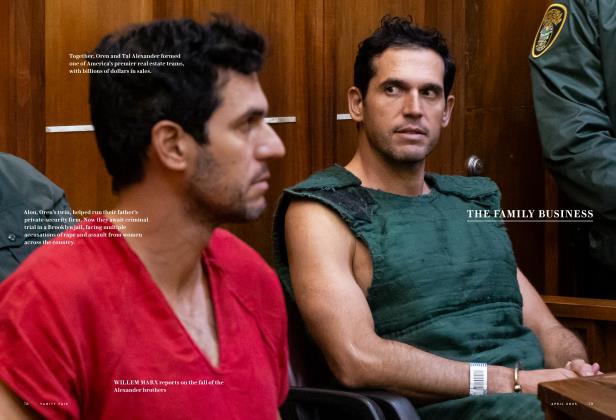
Lindberg is far from the onlyjailbird supplicant, though others have succeeded where he, so far, has not. High-profile pardons or sentence reductions have flowed relatively freely from the White House, absolving many felonious power players, including Ross Ulbricht, the founder of darknet marketplace Silk Road (sentenced to life in prison for a criminal enterprise that conspired to distribute narcotics, and for conspiracies involving computer hacking and money laundering); reality TV star Todd Chrisley (sentenced to 12 years for charges like bank fraud and tax evasion); Binance crypto king Changpeng Zhao (who pleaded guilty for failing to maintain an effective anti-money laundering program); and disgraced New York congressman George Santos (how much time do you have?); along with the more than 1,500 January 6 protesters Trump pardoned only hours after resuming office. Otherwould-be pardonees, whose prospects of freedom vary, read like a hit list from the greatest scandals of this century: Elizabeth Holmes; Sam Bankman-Fried (whose parents have taken up his cause); the Alexanders (three brothers accused of a slew of horrifying sex crimes, which they have denied); and, of course, Ghislaine Maxwell.
THE GIULIANI AIDE TOLD KIRIAKOU, A FORMER CIA AGENT, THAT THE FEE WOULD BE $2 MILLION. HE LAUGHS TELLING ME NOW.
HAVE MERCY Trump's roster of clemency recipients includes a range of convicted January 6 rioters, disgraced politicians, rappers, and reality television stars.
One senior Republican congressman, James Comer, told associates he'd needed to persuade Trump that pardoning Maxwell was a bad idea. Comer's office did not respond to multiple emails seeking comment. Maxwell's onetime criminal attorney David Markus, when told by Vanity Fair about Comer's efforts to dissuade Trump not to pardon Maxwell, responded with a single word: "Wow." The White House pointed EFto two videos, one from Reuters in which the president says, "I don't rule it in or out, I don't even think about it," and another on the White House's YouTube channel in which press secretary Karo line Leavitt says, "We have a very thorough review process here that moves with the Department of Justice and the White House Counsel's office. There's a whole team of qualified lawyerswho look at every single pardon request." For the hopeful, who seek indulgences from Trump like Renaissance crooks to their pope—desirous of either pardons that entirely forgive, or commutations that shorten prison time and erase fines—Trump's willingness to reimagine the pardon and commutation processes has fueled a cottage industry. It's also prompted an urgent debate over what many see as America's two-tiered justice system, where the rich ride out their legal woes on a raft of cash. Supporters say he has offered Hail Marys to those whom the justice system has failed.
"Guys, I'm just not going to do this." John Kiriakou claims that's how Barack Obama reacted to his pardon request. "It's him or Manning," said the president, meaning Chelsea, the whistleblower convicted for violating the Espionage Act, who was imprisoned from 2010 to 2017, when Obama commuted her sentence. (Obama did not respond to a request for comment for this story.)
Kiriakou, a former intelligence officer, had pleaded guilty to disclosing the identity of a covert CIA officer involved in the Bush administration's controversial extraordinary rendition program; he served a 23-month sentence. After his 2015 release, he lost his government pension. Just before Obama left office, Kiriakou says that some wealthy Greek Americans tried to intervene on his behalf, via Vice President Joe Biden. As a senator, Biden had voted against the 1982 Intelligence Identities Protection Act, under which Kiriakou was convicted. According to the Greek Americans (according to Kiriakou), Biden had "gone to the mat" following a dinner at the White House. It didn't work.
A few years later, under a different administration, Kiriakou said that former NYPD commissioner Bernard Kerik—himself a Trump pardonee—suggested talking to Rudy Giuliani. (Trump granted Giuliani a largely symbolic pardon—though he never faced federal charges for it, Giuliani was accused of trying to overturn the 2020 election.) The moment Kiriakou and his attorney broached the subject of clemency, during a meeting at what was the Trump Hotel in DC (now the Waldorf Astoria), Giuliani inexplicably dashed off to the restroom. "His chief of staff said, 'You never talk to Rudy about a pardon. You talk to me about a pardon, and I talk to Rudy,' " according to Kiriakou. The Giuliani aide told him that the fee would be $2 million, says Kiriakou, who laughed at the aide then, and laughs again now. "I said, 'Look, I don't have $2 million. I'm never going to have $2 million. And even if I did, why would I spend $2 million to recover a $700,000 pension?' " Kiriakou stoodup, shook hands, and left. America's mayor was still in the bathroom. (Kerik passed away in May. A spokesperson for Giuliani did not comment.)
AS TRUMP DINED ON WELL-DONE STEAK WITH KETCHUP AND DIET COKE, THE GROUP DISCUSSED FENTANYL, CANNARIS, AND FISCAL POLICY. THEN MCARDLE, IN A COLD, NERVOUS SWEAT, MADE HER ASK.
Joe Arpaio had better luck. As Maricopa County, Arizona, sheriff for 24 years, Arpaio earned a national reputation for hard-line policies. He forced inmates to wear pink boxer shorts and work in chain gangs, and encouraged deputies to sniff out pretexts to detain people and examine their immigration status—a Fourth Amendment violation he touted in press releases and on TV. Eventually, Justice Department lawyers, including trial attorney John Keller, decided there was sufficient evidence to prosecute Arpaio for criminal contempt—an unusual charge for a public officeholder. In late July 2017, then 85-year-old Arpaio was convicted of willfully disregarding a judge's order.
One Friday evening a few weeks after the trial ended, Keller checked his phone as he emerged from the DC Metro. Trump, having teased the possibility several times, had gone ahead and pardoned Arpaio before he was even sentenced.
I guess this is how this administration is going to operate, Keller recalls thinking. "There was no process. There was no consultation with the prosecution team. It was clearly and blatantly because of a political alliance between the public figure who was convicted and the president."
It was also the first time someone Keller had prosecuted received a pardon, and the first pardon he knew of granted before sentencing. Green Beret Mathew Golsteyn, accused of killing an unarmed Afghan man (whom he believed was a Taliban bomb maker), has since received clemency before sentencing; so did Michael Flynn, Trump's former national security adviser, for lying to the FBI, and Steve Bannon, charged with conspiracy to commitwire fraud and conspiracy to commit money laundering. "In retrospect," says Keller, Arpaio was "a canary in the coal mine."
On January 20,2021, the final day of Trump's first term, Trump pardoned Republican fundraiser Elliott Broidy, whom Keller had prosecuted for violating foreign lobbyist rules. Senior Department of Justice officials had initially instructed the prosecuting team to pursue a lighter sentence against Broidy, says Keller. (The DOJ did not respond to a request for comment.)
In January of Trump's second term, Keller had become acting chief of the public integrity section, which focuses on corruption cases involving public officeholders. But within weeks, Keller disagreed with the dismissal of corruption charges against then New York mayor Eric Adams, and he resigned. Since the start of 2025, the once-vaunted public integrity team has shrunk from some 30 prosecutors to just a handful.
THE ROOMS WHERE IT HAPPENED
Alexander Hamilton encouraged the framers to enshrine the concept of mercy in the Constitution. Many presidents have used Article II powers judiciously. John Adams pardoned participants in Fries's Rebellion of 1800. During the Civil War, Abraham Lincoln pardoned many Union deserters; after it, Andrew Johnson blanket pardoned nearly all Confederate soldiers.
Lincoln appointed a dedicated "pardon clerk" to deal with the huge flood of petitions stemming from the Civil War. "There was a whole cottage industry of people who sprang up and were charging fees to get people pardons from President Lincoln because he was perceived to be a soft touch," says Samuel Morison, a lawyer specializing in clemency cases. "In those days, you could actually get a meeting with the president himself—it wasn't that hard to do."
And so things went for the next century or so, until Gerald Ford preemptively pardoned Richard Nixon. Then, George H.W. Bush pardoned former defense secretary Caspar Weinberger, who had been indicted for his role in the Iran-Contra affair. Then, Bill Clinton offered 11 th-hour reprieves to his half brother Roger and Democrat superdonor Marc Rich.
In the roughly quarter century since, the Office of the Pardon Attorney has employed a dedicated staff with a relatively established workflow. Those requesting a pardon have been required to wait five years after their conviction or sentence completion before submitting letters from at least three supporters and a long application. FBI background checks involve family members, neighbors, employers—"equivalent to what you would need to get a top secret security clearance," as one former pardon attorney put it.
By the time Obama took office, the DOJ tightly controlled the process, says Morison, who served 13 years in the pardon office, until 2010. He says fellow bureaucrats stalled, sometimes hid, and occasionally lied about pardon applications. A couple of years after a 2012 report in The Washington Post highlighted such obfuscations, Obama launched a new "clemency initiative"—focused on long sentences for drug-related offenses—that led to more than 1,700 commutations. Yet in many states, the lives of convicted felons remain difficult when they receive only a commutation rather than a full pardon. Like millions of other formerly incarcerated people, they still live with what are known as civil disabilities. In certain states, some cannot earn a real estate license or work as a beautician; others struggle to open investment accounts.
GIMME GIMME MORE
The vast funds funneled into America's health care system each year through Medicare and Medicaid make the sprawling, complex, and fragmented industry uniquely susceptible to abuse. But even so, the scale of the $1.3 billion fraud scheme Philip Esformes perpetrated over more than a decade was breathtaking. He dispensed bribes liberally: to doctors sending patients to his facilities for occasionally inadequate care or unnecessary treatments; to a Florida state official who gave a heads-up on inspections; and, according to prosecutors, to a former University of Pennsylvania basketball coach who helped his son get into college. He lived in 11,000 square feet on Miami Beach, hired sex workers, lounged in luxury hotels, flew private, and cruised around in a $ 1.6 million Ferrari Aperta, wearing a $360,000 Greubel Forsey watch.
"We had hours and hours of recordings," says Allan Medina, a prosecutor who oversaw Esformes's prosecution. "The guy was just abusive." Convicted on 20 of an original 28 counts, Esformes was sentenced in September 2019 to 20 years, and had to forfeit more than $38 million to the federal government, and another $5.5 million in restitution to Medicare.
Following his indictment, his family started donating tens of thousands of dollars to a Miami-based Jewish nonprofit called the Aleph Institute that advocates for prisoners' rights. Soon after his sentencing, the institute rallied support for a clemency campaign, and an Aleph-affiliated rabbi unsuccessfully asked the judge to let Esformes be placed in alternative supervision. (An Aleph spokesperson says its "advocacy for an alternative sentence for Mr. Esformes is among many hundreds of similar appeals," and that Aleph had returned the family's donations.)
CONTINUED ON PAGE 128
CONTINUED FROM PAGE 113
With help from Dershowitz and support from other well-connected lawyers, including former Republican attorneys general Edwin Meese and Michael Mukasey, Esformes's campaign lasted little more than a year. By late December 2020, Medina, the prosecutor, was at his in-laws' Massachusetts home for the holidayswhen a colleague messaged. A White House statement declared that Esformes would receive a commutation, shaving a decade off his sentence. "I couldn't believe what had happened," Medina tells VF. "It was a punch in the gut."
"This was a culmination of a lot of my career," he explains. "Itwasjust disgusting."
"ELL DO IT. I'LL FREE HIM."
In the weeks after the storming of the Capitol, Ahmed Baset worked close to 18-hour days at the FBI's Washington field office to help convict several of the most violent rioters. He later oversaw the contentious conviction of two DC police officers, indicted on second-degree murder, conspiracy, and obstruction charges for a suspect's death in a high-speed chase. A fellow former prosecutor described that case as a "total shit show" for the bad blood it created among local law enforcement.
After Trump resumed office in 2025, a DOJ colleague texted Baset: "Didyou read this email? I'm really sorry." Hundreds of prosecutors had received a note from the new interim US attorney for DC, Edward Martin, proudly announcing Trump had suddenly pardoned the two cops Baset had prosecuted: "What a great act by the President to protect our colleagues in these efforts to make D.C. safe," it read. (Martin's official biography noted an internship on Pope John Paul IPs staff. He tweeted after one pardon "No MAGA left behind," then struggled to obtain Senate confirmation for the top prosecuting job in DC after several senators accused him of committing "serious violations of professional conduct" that "undermines the integrity of our justice system." Former Fox News host Jeanine Pirro got the role instead.)
Oyer was ejected from the Department of Justice after refusing to recommend reinstating gun rights that Mel Gibson had lost after a domestic violence conviction.
Baset sat down in shock—"I was astounded"—as he read Martin's missive. The decisionwas designed to blunt criticism of Trump, Baset reasons, who had just two days earlier pardoned some of the cop-bashing Capitol rioters. But irony offered no consolation. "Four years of work and effort, in large respect, was just kind of wiped out with a couple signatures." The cops were not wealthy, but as law enforcement causes c61ebres they'd attracted MAGA attention. Pardoning them re-upped the president's pro-cop persona. "It's a question of what does the person have that Trump wants?" according to Nick Akerman, who helped prosecute the Watergate burglars in the 1970s. "That's definitely the avenue that's being pursued in a lot of these cases."
ByNovember, Martin was DOJ's official pardon attorney as he tweeted out dozens more grants, including for Giuliani, presidential senior adviser Boris Epshteyn, and another for former Trump lawyer Sidney Powell, ending what he called a "grave national injustice" done to their efforts to overturn the 2020 election. The January 6 rioters—and the advocates who pushed to void their convictions—seem to serve as a template for presidential loyalty, according to both supporters and critics.
"The pardons were sort of the trial balloon, in a sense, that he put up there to see what does that then trigger," says Baset, who'd helped convict several far-right Oath Keepers militia members for assaulting police personnel and amassing a weapons arsenal as part of a "quick reaction force." If you have my back, if you're loyal to me, like these J6 people—as Baset imagines Trump thinking—you could beat up cops and I will go to bat for you.
The Republican lobbyist who worked unsuccessfully to push Greg Lindberg's clemency applicationforward under Trump 1.0 hadn't given up at the start of 2.0. The advice he's heard from administration officials involved in processing petitions today is simple: "Do not relitigate your case." Better, he says, to focus on prosecutors' "weaponization" of the law—it will likely resonate with this president. "If you have evidence, for lack of a better word, or justification for the idea that your entire case only existed because they were on a political witch hunt," he told me, "that's different."
Ross Ulbricht was a Texan, Eagle Scout, physics graduate, and Ron Paul supporter who built and secretly ran Silk Road, the sprawling global dark web bazaar. In 2015 he received two life sentences plus a further 40 years for narcotics trafficking, among other charges, and was ordered to forfeit around $ 180 million. The presiding judge suggested Ulbricht's punishment should deter criminality in a new era of online commerce. But many supporters considered it draconian, pointing to the comparatively mild treatment of Sinaloa cartel boss Joaquin "El Chapo " Guzman, who received just a single life sentence plus 3 0 years, in 2019. "How do you make sense of one life sentence for that man but two for Ross?" asked Martha Bueno, a Florida Libertarian outraged by Ulbricht's treatment.
Not long after the sentencing, Bueno began helping Ulbricht's mother, Lyn, a septuagenarian retiree plunging "headfirst into saving her son." Lyn became like "Frodo Baggins from Lord of the Rings, " Bueno says, traveling the country pleading for mercy with congressmen, senators, and business leaders. "Her case was never 'This is wrong because the United States government is wrong,' " Bueno told VF. "It was always 'My son doesn't deserve to be there, he's already repented during his trial.' " Over the years, whenever Ulbricht was transferred to a new prison, Lyn moved to a nearby city.
Ulbricht's clemency petition moved close to Trump's desk during his first term but never received a final sign-off, according to Bueno. "Lynwas devastated, absolutely devastated. She had put all of her hope into Trump pardoning her son. He didn't do it, and she spent the next four years trying to find any way into the Biden administration." But Biden's team had "no interest whatsoever," despite the best efforts of Ulbricht's pardon attorneys; slews of letters, including from lawmakers; and hundreds of thousands of signatures from supporters, including Bitcoin advocates and libertarians. "They just locked this guy up, made him sound like a supervillain," says Angela McArdle, a former chair of the US Libertarian Party. "The sentence was terrifying. "
But by November 2023, hope glimmered again when McArdle received a surprise call from Richard Grenell, Trump's former director of national intelligence, asking what Libertarians thought of the twice-impeached former president who was once more mulling a run. The two agreed to meet, and at a restaurant in Austin, Trump called Grenell's cell phone and spoke with McArdle for some 45 minutes. "As the chair of another political party, I can't literally endorse you," she says she told him. "But I can help you figure out how to appeal to Libertarians and try to get the broader Libertarian vote.' " The following month, McArdle was at Mar-a-Lago to meet Trump in person: "I walked in with an index card and a book for him to autograph."
Trump arrived late, having flown down from New York, where he'd spent the day testifying in his civil fraud trial. He hugged McArdle before sitting down to dinner with her, her husband, a couple of staffers, and Grenell, who had counseled her to negotiate the terms of any political support. As Trump dined on well-done steak with ketchup and Diet Coke, the group discussed fentanyl, cannabis, and monetary policy. Then McArdle, in a cold, nervous sweat, made her ask. Though she knew it might doom her own future with Libertarian Party members, she suggested Trump attend their convention the following year. "If you come, and you walk out onstage, and you agree to freeing Ross Ulbricht," she told him, "everyone is going to scream, they're going to lose their minds, and they're all going to vote for you." Trump responded by asking "Who's Ross Ulbricht?" before assenting. "I'll do it. I'll free him."
As one clemency advocate advises of the traditional pardon process: "If you can afford itjust fucking skip it "
McArdle kept this plan secret for months, then extended official convention invitations to both Trump and Biden (whose team acknowledged receipt but who did not attend). Trump marched out to a smattering of boos, but when he mentioned Ulbricht, the boos, as promised, turned to hysterical cheers. "In every picture you see of Trump at that convention, you saw a Free Ross sign somewhere in it," recalls Bueno.
Onjust his second day of his second term, Trump announced on social media that he called Lyn Ulbricht to confirm her son's pardon. The pardon attorney's team had no official paperwork to show Ulbricht's prison warden he should be freed.
EVERYTHING IS A NAIL
High-profile clemency lobbyists have seen a hugely profitable business develop since then, to the shock of those who support a traditional process. "It's just a feeding frenzy," former pardon attorney Liz Oyer tells VF. "Clemency has been a way that numerous people who are in Trump's inner circle and beyond have been able to enrich themselves. They're dealing with people who are often really pretty desperate to be considered for clemency, and so they have the ability to charge huge sums of money just based on promises of the possibility of clemency—without any guarantees." Oyer, pardon attorney until early 2025, was ejected from the Department of Justice after refusing to obey what she considered an inappropriate instruction from a political appointee: to recommend reinstating gun rights Mel Gibson had lost after a misdemeanor domestic violence conviction. (Mel Gibson's gun rights were restored in spring of 2025).
For certain defendants, a pardon is not just about avoiding prison. Some owe millions of dollars in restitution payments or asset forfeiture, and will spend big to have a flick of the presidential pen cancel those debts. For Carlos Watson, founder of once buzzy digital start-up Ozy Media, that meant about a million dollars up front for his appeal, bail pending appeal, and a clemency package to be handled by the New York law firm of Arthur Aidala, who has represented Harvey Weinstein, Anthony Weiner, and Roger Ailes.
In July 2024 the feds convicted Watson of wire fraud and securities fraud conspiracies, as well as defrauding investors through identity theft—his COO had impersonated a YouTube executive on a due-diligence call with Goldman Sachs. Together with Ozy as a corporate defendant, Watson was ordered to pay approximately $37 million in restitution to victims and nearly $60 million in forfeiture to the US government. Aidala and other attorneys helped craft the clemency application package. Two people familiar with Watson's case say Aidala's team sought help from high-profile individuals like Steve Bannon, another Aidala client. (Trump pardoned Bannon, his former chief strategist, in the final moments of his first term, forcing federal prosecutors to drop thencase against him. The Manhattan district attorney later filed charges against Bannon for skimming funds raised during a campaign to build a wall on the Mexican border. In that case, Aidala advised Bannon to plead guilty to a single felony count, thus avoiding prison time. Aidala declined to comment.)
But for Watson, time was short, with a 10-year sentence in a California prison slated to start last March. Soon after Trump returned to the White House, advocates for Watson's clemency realized the pardon attorney's office needed bypassing. "If it's not in the White House, it's just not real, it's not happening," says one person who agreed to help Watson. "When you look at paperwork and you see 'United States government' against you, you can't match that energy," this person tells VF. "There's a reason they rarely ever lose." Prosecutors, the supporter believes, work in a culture that's taught them "being a hammer and recognizing everything as a nail is the approach that will get them rewarded careerwise."
Hoping to flood the zone, the same supporter contacted previous pardon recipients. "The more hooks you have in the water, the more fish you're going to end up catching." They spent money boosting messages about Watson on X to users tweeting about "lawfare" and "justice." The messages were written—thanks to ChatGPT—"in language that matches President Trump's rhetoric about these issues," this person tells VF. "The gift my mother gave me, I guess, is the ability to read people and figure out where power lives and how to motivate power in the right direction. How do you get to Bannon? How do you get to Dershowitz?"
Dershowitz, who'd consulted on Esformes's case, was useful since his work during Trump's first impeachment had endeared him to the president.
"One of the jobs of a lawyer is to understand how the process works in each particular administration at any given time, and that's what I've been advising clients on," Dershowitz tells VF. "Every administration looks at the executive clemency decision somewhat differently: Some have more formal processes, some have less formal processes." By late March, the cogswere turning in Watson's favor, though the outcome remained uncertain. He flew from D C to California to surrender himself, then, just 90 minutes away from prison, he received what one person involved in the clemency effort termed a "commutation plus"—he'd avoid serving time but also skip out on the $96 million in restitution and forfeiture. Months later, the Securities and Exchange Commission also dropped its separate civil enforcement action against Watson.
Thanks to its constitutional provenance, presidential pardon power faces little legal circumscription and minimal disclosure requirements for clemency advocacy efforts. There are also no federal laws that prohibit individuals, including presidential associates or advisers, from accepting money in return for pardon lobbying. As one clemency advocate advises of the traditional pardon process: "If you can afford it—just fucking skip it."
If the president himself received explicit offers of personal payment, that might justify an investigation into potential bribery law violations, legal experts say. But after a 2024 Supreme Court decision made official presidential acts safe from prosecution, impeachment remains the only—unlikely, given the current Congress—consequence.
"He couldjust openly say, you know, '$50 million into my bank account, and I'll give you a pardon,' " jokes Peter Zeidenberg, an attorney who's recently worked with The Fugees' Pras Michel and once helped prosecute I. Lewis "Scooter" Libby (who once worked on Marc Rich's case). "The Supreme Court has basically said, 'Yeah, you got immunity.' " In her dissenting opinion, Justice Sonia Sotomayor highlighted how a president's receipt of bribes in return for pardons would—as an official duty—be rendered immune. It made the president, she wrote, "king above the law."
Only a constitutional amendment could now circumscribe the pardon power, according to Barbara McQuade, a former federal prosecutor and now University of Michigan law professor. But such a bipartisan act is unthinkable. As a prosecutor, McQuade says she always equated presidential pardons with forgiveness. Just before Trump left office in 2021, he commuted the sentence of former Detroit mayor Kwame Kilpatrick, whom McQuade had convicted on 24 counts, including wire fraud, mail fraud, and racketeering. It didn't feel like a decision driven by compassion. It struck her "as an insult to the public."
In the pardon context, she says, the "discrepancy between the haves and the have-nots" was typically the quality of their applications—with the wealthy pointing to charitable donations and public good works. "What feels different now is an appearance that people are actually buying access."
Princeton law professor Deborah Pearlstein agrees it's becoming a sales job. "We're going to set up a pardon vending machine, and if you put the right gold coin in it, you can get one."
"FREE AND CLEAN"
Reality TV performer Todd Chrisley, star of USA Network's Chrisley Knows Best, was showering at the Beverly Hills Four Seasons in August 2019 when his wife, Julie, interrupted to hand him a cell phone with his attorneys on the line. He was being indicted.
Chrisley finished his shower, then flew with Julie to Atlanta, where deputy US marshals photographed the surrendering pair in the Fulton County courthouse, then escorted them upstairs to a judge's chambers. Prosecutors initially argued bail should be denied—the Chrisleys were so rich, they might flee. They ultimately requested a bond of just $250,000 for him, such a low amount, Chrisley recalls thinking, it surely undermined claims about their abundant wealth. (He bonded at $ 100,000.)
What started with an approximately $3 million tax evasion accusation in Georgia and a raid on a warehouse Tiled with Chrisley family furniture had by then metastasized into an IRS case that drew in the US attorney's office for Georgia's Northern District. According to Chrisley, a former judge told his legal team that the prosecutor had been "looking for a big fish to catch in Georgia, and that the Chrisleys were the biggest fish that Georgia had at that time." The couple eventually owed less than $100,000 in unpaid taxes to the Georgia Department of Revenue. They filed a civil lawsuit against that department's special investigator. The department settled, and acknowledged aspects of its initial investigation had been unethical and against policy.
However, the Chrisleys' former business manager turned against them and their accountant was shown to be less than accomplished. Chrisley says federal prosecutors threatened to indict two of their young adult children, as well as his 70-something-yearold mother, if he did not accept a plea deal. "Julie was devastated," Chrisley tells VF "I had started to become pissed off." Both husband and wife were eventually sentenced to 12 and 7 years, respectively. "We had been together for 30 years and had never spent a night away from each other," recalls Chrisley, who didn't speak to Julie by phone for more than two years but still found that first night apart the hardest. "I was so angry at God because I kept saying, 'God wouldn't allow this to happen.'And I cried myself to sleep."
After the verdict, his daughter Savannah spent $460,000 to hire Alex Little, from the Tennessee law firm of Litson, to navigate an appeal and potential pardon petition. Having previously worked at the International Criminal Court and former president Jimmy Carter's peace initiatives in Africa, with a brief stint as a CIA analyst, Little was not an obvious choice to build a powerful network among MAGA Republicans. But his work on a case involving Amazon had seemingly impressed Jim Trusty, who later defended Trump against charges of mishandling classified documents. And during Little's defense of Brian Kelsey, a Tennessee state senator charged with violating campaign finance laws, he encountered David Warrington, who also worked for Kelsey and subsequently became Trump's White House counsel. After Trump resumed power, Little submitted a clemency petition for Kelsey, who was pardoned just weeks after his sentence began. Little, long an appeals lawyer, quickly became a pardon-focused attorney, telling VFthe "real problems" in Chrisley's original conviction appeared unusual in such a high-profile prosecution. "Going into the appellate argument, we had very, very strong cases on multiple fronts."
"As we sort of click off the contingencies, it's like being a pilot," explains Little. "Where's the first place you're going to land? If that place doesn't work, where's the second place you're going to land? If you got to land in a field, you got to land in a field, but we're going to get you home safe."
But Todd Chrisley's appeal looked set to drag on, and Savannah grew impatient. She started working the phones, pleading her parents' innocence, even speaking at the 2024 Republican National Convention about "rogue prosecutors" and "the Democrats' corruption." After more than two years in prison and $4.2 million in legal fees, Chrisley himself grew used to his life inside. He secretly used multiple cell phones, enjoyed a large commissary account, and thanks to his influence and education, developed an intense desire to push back against the capriciousness, incompetence, and occasional cruelty of prison authorities.
Eventually, Savannah's appeals to Trump bore fruit. A video from late last May shows Trump on an Oval Office speakerphone, informing her that within a day her parents would be "free and clean" after their "harsh treatment." Hours later, the legal nightmare that began for Chrisley at a luxury Los Angeles hotel ended in a Pensacola, Florida, prison. He handed other prisoners all his spare gear—"You're only allowed to have two pairs of tennis shoes; I had seven. You're only allowed to have two sweat suits; I had 11. You're only allowed to spend $360 a month on commissary; I spent $2,000"— and walked out.
While inside, he'd pushed to see his prison camp shuttered, and he now says improving inmate conditions and reducing America's recidivism rate has provided him with "a purpose-driven life." The presidential pardon power can "right a wrong" and "gives those that are incarcerated hope," Chrisley told VF "President Trump has been the answer to a lot of people's hope in this country."
The fact that his pardoner is himself a convicted felon helps too.
Subscribers have complete access to the archive.
Sign In Not a Subscriber?Join Now


