Sign In to Your Account
Subscribers have complete access to the archive.
Sign In Not a Subscriber?Join NowCALIFORNIA: The Overlord's Underdog
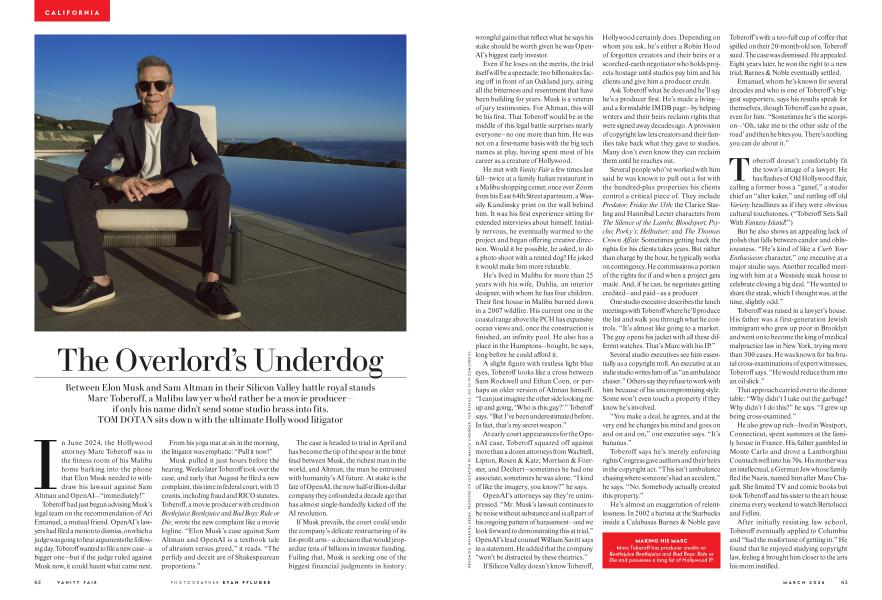
Between Elon Musk and Sam Altman in their Silicon Valley battle royal stands Marc Toberoff, a Malibu lawyer who'd rather be a movie producer— if only his name didn't send some studio brass into fits. TOM DOTAN sits down with the ultimate Hollywood litigator
TOM DOTAN
In June 2024, the Hollywood attorney Marc Toberoff was in the fitness room of his Malibu home barking into the phone that Elon Musk needed to withdraw his lawsuit against Sam Altman and OpenAI—"immediately!"
Toberoff had just begun advising Musk's legal team on the recommendation of Ari Emanuel, a mutual friend. OpenAI's lawyers had Hied a motion to dismiss, onwhich a judge was going to hear arguments the following day. Toberoff wanted to file a new case—a bigger one—but if the judge ruled against Musk now, it could haunt what came next.
From his yoga mat at six in the morning, the litigator was emphatic: "Pull it now!"
Musk pulled it just hours before the hearing. Weeks later Toberoff took over the case, and early that August he filed a new complaint, this time in federal court, with 15 counts, including fraud and RICO statutes. Toberoff, a movie producer with credits on Beetlejuice Beetlejuice and Bad Boys: Ride or Die, wrote the new complaint like a movie logline. "Elon Musk's case against Sam Altman and OpenAI is a textbook tale of altruism versus greed," it reads. "The perfidy and deceit are of Shakespearean proportions."
The case is headed to trial in April and has become the tip of the spear in the bitter feud between Musk, the richest man in the world, and Altman, the man he entrusted with humanity's AI future. At stake is the fate of OpenAI, the now half-trillion-dollar company they cofounded a decade ago that has almost single-handedly kicked off the AI revolution.
If Musk prevails, the court could undo the company's delicate restructuring of its for-profit arm—a decision that would jeopardize tens of billions in investor funding. Failing that, Musk is seeking one of the biggest financial judgments in history: wrongful gains that reflect what he says his stake should be worth given he was OpenATs biggest early investor.
Even if he loses on the merits, the trial itselfwill be a spectacle: two billionaires facing off in front of an Oakland jury, airing all the bitterness and resentment that have been building for years. Musk is a veteran of jury testimonies. For Altman, this will be his first. That Toberoff would be in the middle of this legal battle surprises nearly everyone—no one more than him. He was not on a first-name basis with the big tech names at play, having spent most of his career as a creature of Hollywood.
He met with Vanity Fair a few times last fall—twice at a family Italian restaurant in a Malibu shopping center, once over Zoom from his East 64th Street apartment, a Wassily Kandinsky print on the wall behind him. It was his first experience sitting for extended interviews about himself. Initially nervous, he eventually warmed to the project and began offering creative direction. Would it be possible, he asked, to do a photo shoot with a rented dog? He joked it would make him more relatable.
He's lived in Malibu for more than 25 years with his wife, Dahlia, an interior designer, with whom he has four children. Their first house in Malibu burned down in a 2007 wildfire. His current one in the coastal range above the PCH has expansive ocean views and, once the construction is finished, an infinity pool. He also has a place in the Hamptons—bought, he says, long before he could afford it.
A slight figure with restless light blue eyes, Toberoff looks like a cross between Sam Rockwell and Ethan Coen, or perhaps an older version of Altman himself. "I can just imagine the other side looking me up and going, 'Who is this guy?' " Toberoff says. "But I've been underestimated before. In fact, that's my secret weapon."
At early court appearances for the OpenAI case, Toberoff squared off against more than a dozen attorneys from Wachtell, Lipton, Rosen & Katz, Morrison & Foerster, and Dechert—sometimes he had one associate, sometimes he was alone. "I kind of like the imagery, you know?" he says.
OpenAI's attorneys say they're unimpressed. "Mr. Musk's lawsuit continues to be noise without substance and is all part of his ongoing pattern of harassment—and we look forward to demonstrating this at trial," OpenAI's lead counsel William Savitt says in a statement. He added that the company "won't be distracted by these theatrics."
If Silicon Valley doesn't know Toberoff, Hollywood certainly does. Depending on whom you ask, he's either a Robin Hood of forgotten creators and their heirs or a scorched-earth negotiator who holds projects hostage until studios pay him and his clients and give him a producer credit.
Ask Toberoff what he does and he'll say he's a producer first. He's made a living— and a formidable IMDB page—by helping writers and their heirs reclaim rights that were signed away decades ago. A provision of copyright law lets creators and their families take back what they gave to studios. Many don't even know they can reclaim them until he reaches out.
Several people who've worked with him said he was known to pull out a list with the hundred-plus properties his clients control a critical piece of. They include Predator; Friday the 13th; the Clarice Starling and Hannibal Lecter characters from The Silence of the Lambs; Bloodsport; Psycho; Porky's; Hellraiser; and The Thomas Crown Affair Sometimes getting back the rights for his clients takes years. But rather than charge by the hour, he typically works on contingency. He commissions a portion of the rights fee if and when a project gets made. And, if he can, he negotiates getting credited—and paid—as a producer.
One studio executive describes the lunch meetings with Toberoff where he'll produce the list and walk you through what he controls. "It's almost like going to a market. The guy opens his jacket with all these different watches. That's Marc with his IP."
Several studio executives see him essentially as a copyright troll. An executive at an indie studio writes him off as "an ambulance chaser." Others say they refuse to work with him because of his uncompromising style. Some won't even touch a property if they know he's involved.
"You make a deal, he agrees, and at the very end he changes his mind and goes on and on and on," one executive says. "It's bananas."
Toberoff says he's merely enforcing rights Congress gave authors and their heirs in the copyright act. "This isn't ambulance chasing where someone's had an accident," he says. "No. Somebody actually created this property."
He's almost an exaggeration of relentlessness. In 2002 a barista at the Starbucks inside a Calabasas Barnes & Noble gave Toberoff's wife a too-full cup of coffee that spilled on their 20-month-old son. Toberoff sued. The case was dismissed. He appealed. Eight years later, he won the right to a new trial; Barnes & Noble eventually settled.
Emanuel, whom he's known for several decades and who is one of Toberoff's biggest supporters, says his results speak for themselves, though Toberoff can be a pain, even for him. "Sometimes he's the scorpion—'Oh, take me to the other side of the road' and then he bitesyou. There's nothing you can do about it."
Toberoff doesn't comfortably fit the town's image of a lawyer. He has flashes of Old Hollywood flair, calling a former boss a "ganef," a studio chief an "alter kaker," and rattling off old Variety headlines as if they were obvious cultural touchstones. ("Toberoff Sets Sail With Fantasy Island'. ")
But he also shows an appealing lack of polish that falls between candor and obliviousness. "He's kind of like a Curb Your Enthusiasm character," one executive at a major studio says. Another recalled meeting with him at a Westside steak house to celebrate closing a big deal. "He wanted to share the steak, which I thought was, at the time, slightly odd."
Toberoff was raised in a lawyer's house. His father was a first-generation Jewish immigrant who grew up poor in Brooklyn and went on to become the king of medical malpractice law in New York, trying more than 300 cases. He was known for his brutal cross-examinations of expert witnesses, Toberoff says. "He would reduce them into an oil slick."
That approach carried over to the dinner table: "Why didn't I take out the garbage? Why didn't I do this?" he says. "I grew up being cross-examined."
He also grew up rich—lived in Westport, Connecticut, spent summers at the family house in France. His father gambled in Monte Carlo and drove a Lamborghini Countachwell into his 70s. His mother was an intellectual, a German Jew whose family fled the Nazis, named him after Marc Chagall. She limited TV and comic books but took Toberoff and his sister to the art house cinema every weekend to watch Bertolucci and Fellini.
After initially resisting law school, Toberoff eventually applied to Columbia and "had the misfortune of getting in." He found that he enjoyed studying copyright law, feeling it brought him closer to the arts his mom instilled.
Emanuel admits Toberoff can be a pain, even for him. "Sometimes he's the scorpion—'Oh, take me to the other side of the road' and then he bites you. There's nothing you can do about it."
After passing the bar, he took a grueling job with storied New York law firm Kelley Drye & Warren. Once, after pulling an all-nighter, he got into an argument with a partner and was bred.
"He was giving me problems," Toberoff says. "I don't do well with authority."
Following a stint at an entertainment law firm, Toberoff realized he wanted to work in the movie industry. He wrote a letter to director Robert Altman, pitching himself for a job. The auteur took him on to handle business affairs in New York, but it was a disaster. When a screaming match nearly ended in a fistfight—the director was famously into drugs, booze, and gambling at the time—Toberoff quit.
Still wanting to make movies, he went to the New York Public Library and researched producers' names, landing on Elliott Kastner, the prolific producer behind Elms like The Long Goodbye. Toberoff again wrote a letter: Dear Mr. Kastner, Attached is my illustrious resume. Teach me how to make movies. TH cut your legal bills in half.
He got the job and spent the next few years as Kastner's gofer—picking him up at the airport, answering phones, and hanging around sets as '80s stars like Mickey Rourke and Lisa Bonet drifted through.
It soon became clear why Kastner had answered his letter: The producer was drowning in lawsuits from people claiming he'd double-crossed them or owed them money.
Next he tried his hand at producing an indie film—Sons, with Jennifer Beals and directed by her then husband. To find a distributor, he went to Cannes during the film festival and paid kids to plaster the Croisette with posters at 4 a.m. Toberoff says the movie got distribution—barely.
He then moved out to Los Angeles with Dahlia. One day while walking on the treadmill and looking at the back of The Hollywood Reporter for a place to rent, he saw a listing from the son of a famous writer who was seeking a manager.
Toberoff reached out. The son—a hippie who told the lawyer he used to drop acid but quit when he saw Neil Armstrong land on the moon—handed him a messy box of papers from his father. The old man, it turned out, had cowrote the Marx Brothers' A Day at the Races and I Married a Witch, which influenced the TV series Bewitched.
Leafing through the papers, Toberoff saw he'd also created Combat!, a 1960s World War II TV series about GIs. In the box was a letter saying the writer was owed $327 related to something called "separated rights."
Scanning deeper, Toberoff discovered a provision in the Writers Guild collective bargaining agreement that says writers who create original TV series automatically retain certain rights—including film rights— that supersedes any other agreement.
By pure coincidence, a week later he read a story in Variety that Capital Cities/ ABC was making a Combat! movie starring Bruce Willis. He fired off a letter to the studio on newly created stationery telling them they didn't have the theatrical film rights. Their lawyers responded with a longer letter including the full contract and pointing to the paragraph where his client's father had waived his separated rights.
"I've since learned that the hardest thing to get is the old contract. And a little information goes a longway with me," Toberoff says.
He told the lawyers that the paragraph showed a concerted effort by the studio to circumvent the WGA contract by pressuring his client's father to waive his separated rights in order to get the job, which violated the collective bargaining agreement. And besides, his client's father couldn't waive those rights anyway because he was only a beneficiary of the guild contract, not a party to it—the only partieswere the studio and the guild—so only the guild could waive the rights, and the guild never had, which meant the separated rights reverted to his client. The studio's lawyers told him to come in for a meeting.
Toberoff put on a suit and tie and showed up at a Century City legal office where the studio offered to settle. Toberoff countered and, when he saw in their eyes that they were going to take it, quickly added that he wanted to be a producer.
"They go, 'Wait a minute, you're a lawyer. You can't b e a pro ducer. ' And I go, 'No, it's the other way around. I had to go to law school. ' " But anyone, it turns out, can be a producer.
Combat! never got made—Saving Private Ryan was greenlit around the same time, sinking the competing WWII project—but Toberoff's career as a producer-copyright attorney was born.
He developed a system. He tracked the rights of old TV shows and films from eras when creators often retained rights. He'd cold-call the writers of properties like My Favorite Martian—ox track down their heirs. He'd offer to examine their contracts, looking for angles. When he found an in, he'd pitch revival projects around town, and, when a studio said yes, take a cut. In Hollywood, no one had really done what he had done with copyright law, multiple agents and producers agree.
Sometimes writers would come to him. In 2004 he got a call from Gy Waldron, creator of The Dukes of Hazzard, after Warner Bros, announced it was going to make it into a movie starring Jessica Simpson. The studio assumed they had the rights sewn up. Toberoff discovered that before it was a series, it had been a movie called Moonrunners, which he argued gave Waldron part of the rights.
Toberoff asked them to settle for a million and a quarter, but they waved him away and went ahead with production. He sued and got a judge to take the almost unheard-of action of issuing a preliminary injunction ahead of the release. Facedwith the possibility of federal marshals seizing film canisters, Warner Bros, agreed to settle.
He told the studio's general counsel his number: "I want two chai. Which either means I want your two firstborn children, or it means 36." In Hebrew numerology chai means life and equals 18, so two chai by his math is $36 million.
Warner Bros, reportedly settled for $ 17.5 million, or just about one chai.
"The first line of Variety was, 'Chalk one up for the little guy,' " Toberoff says. "That case made me known at all the studios."
He's gotten involved in even more entangled pieces of IP, including working with the descendants of the creators of Superman, Jerry Siegel and Joe Shuster. The two had created the character as teenagers but parted with the rights in 1938. When they tried in court to reclaim them in 1947, they lost.
"Mr. Musk's lawsuit continues to be noise without substance and is all part of his ongoing pattern of harassment," an OpenAI lawyer tells Vanity Fair, "and we look forward to demonstrating this at trial."
"They lived their lives in the shadow of Superman," Toberoff says. "The daughter described how they used to eat Spam for dinner and didn't partake in any of the profits. Everybody else became filthy rich."
Toberoff took on the case in the early 2000s and won back Siegel's half of the Superman copyright for his family. Warner Bros, countersued Toberoff personally, claiming he stood to gain as a financial participant in the Superman copyright. That case was dismissed, but the litigation between the Shuster heirs and the studio is ongoing.
He's also worked for the family of Jack Kirby, one of the key early artists for Marvel Comics. After losing rulings in lower courts, Toberoff petitioned the Supreme Court, which he says was on the verge of taking on a case that would have reexamined work for hire under the Copyright Act of 1909. Disney settled for an undisclosed amount in 2014. That obsessiveness has become his defining trait.
"He's literally The Rockford Files. This guy, sitting out there in Malibu," says Stuart Manashil, a talent manager and producer who's worked with Toberoff on projects like an upcoming remake of 1988's cult classic martial arts film Bloodsport, an adaptation of the book the 1987 psychological thriller Angel Heart WAS based on, and a TV series, Crystal Lake, based on the Friday the 13 th movies. "He's not in a trailer—but he's in an office and it's him and an assistant. And he'll just keep going."
"When I originally started doing this with IP in Hollywood, it was like, 'Toberoff, you're a bottom-feeder.' And I would say, 'Yeah, I'll see you down there,' " he says, adding that he has a full team working for him.
Things changed as the streaming era took off and companies loaded up on wellknown properties. His ability to untangle the rights for content, allowing it to be made, became a valuable currency. Producersand writers increasingly viewed Toberoff as a resource in a complicated legal landscape.
"When he started doing it, it was like, total outsider," says Manashil. "I think that more and more places now see the value in dealing with him, evidenced by the number of deals he has. They need the IP." Or, as Toberoff puts it: "It went from 'bottom-feeder' to 'Toberoff, player, what do you got? Let's make a deal.' "
A few years ago he secured the US rights to 1988's Beetlejuice for one of the Hirn's living cowriters and the estate of the other. He then reached out to Mike Simpson, agent for director Tim Burton.
Burton, who'd been waffling for years on whether to make a sequel, agreed to do it, followed by original cast members including Michael Keaton, Winona Ryder, and Catherine O'Hara. Beetlejuice Beetlejuice (2024) made more than $400 million at the box office, with Toberoff credited as a producer.
"It drives these studios crazy. They just can't believe that there's this guy out there that can actually impact them that much," Simpson says. "From the artist's point of view, he's a godsend."
To the studios, he's something else entirely. "Terrorist," one executive suggests.
Toberoff's maximalist negotiating style makes working with him impossible, multiple executives say. Despite Toberoff having clients who control desirable properties like A Nightmare on Elm Street, some would rather not make a movie than work with him.
Sometimes when a studio wants to remake an old movie or TV show and the business affairs team discovers his name attached to one of the parties, the train screeches to a halt.
"In many places it dies right there," one executive explains. "Phone conversation over. Pursuit of it over."
Few from the studios would go on the record discussing Toberoff. As one put it, "Life's too short. " They say their frustration isn't about paying rights holders—studios expect that. What galls them is Toberoff's tooth-and-nail negotiations and his insistence on becoming a producer himself, complete with credit and fees. "It's not the first time we've seen this kind of desire for people who really want to be in show business," one executive says. "It's then-way in."
Manashil sees the studio resistance differently. As Hollywood's traditional power structure has weakened, he argues, Toberoff's leverage has only grown. The pushback, he believes, stems from executives' anxiety about their diminishing control and having to pay the creators for whom Toberoff is getting the rights.
"Everybody in Hollywood's insecure. As a studio exec, a huge part of the job is to exploit the library of IP. And then there's Marc, who can stand in the way. Of course they're not gonna like that."
Still, even Manashil admits Toberoff can be exhausting. "He has that litigator thing where everything is a fight and sometimes you're like, 'Dude, let's just take the deal.' But he's proven me wrong onmultiple occasions and gotten better terms."
Toberoff shrugs at the studio backlash. "When they have rights, they exploit every inch of those rights and even sue each other over those rights," he says. "So it's all about whose rice bowl is getting pissed in. "
Emanuelwas more emphatic about studio complaints over Toberoff's demand to be a pro ducer: ' 'There's a lot of fucking pro ducers that don't deserve credit. Who gives a shit?"
In early 2024 Toberoff got a call from Emanuel. It was about Elon Musk. Emanuel hadbeenfriendswiththe Tesla CEO for more than 15 years, since buying an early Roadster. "I just don't like driving a Prius," he says.
In February, Musk filed a lawsuit against Altman and OpenAI through the firm Irell & Manella, citing breach of contract. One Saturday he called Emanuel while the agent was at the Riviera Country Club in the Pacific Palisades and the two chatted about the case. Musk wanted a second opinion, and Emanuel told him to bring Toberoff on. "He looks at things differently than other lawyers," Emanuel says. "When you're not billing hourly, you get really creative about how to think about the law." Refiled with Toberoff running legal strategy, the lawsuit now frames the OpenAI story as a shared vision turned secret betrayal.
One studio executive describes the lunch meetings with Toberoff where hell produce the list and walk you through what he controls. "It's almost like going to a market. The guy opens his jacket with all these different watches. That's Marc with his IP."
In 2015 Altman pitched Musk on creating Open AI as a nonprofit "Manhattan Project" for AI to counter Google's dominance. Musk, who'd been publicly warning about AI as an existential threat to humanity, agreed to fund it. He contributed more than $44 million over five years and recruited key talent, including its chief scientist, Ilya Sutskever, the lawsuit says.
By 2017, Altman and cofounder Greg Brockman had suggested converting to a for-profit to raise outside money. Musk refused. "Either go do something on your own or continue with OpenAI as a non-profit," he wrote to them, according to the lawsuit. "I will no longer fund OpenAI until you have made a firm commitment to stay or I'm just being a foolwho is essentially providing free funding to a start-up."
Altman reassured him they remained "enthusiastic about the non-profit structure." But in 2019 they created a for-profit arm, with Altman as CEO, and raised $1 billion from Microsoft. In the succeeding years OpenAI would raise billions of dollars, release ChatGPT, raise tens of billions more, fire and then reinstate Altman over five days, redo the board with members that were allied with the CEO, and reach a half-trillion-dollar valuation.
Meanwhile, Musk launched a competitive AI firm called xAI, but his feelings over the fallout with Altman nagged at him. The core of his allegation is that the CEO built a company ostensibly as a nonprofit with his money and then conspired against him with Brockman by turning it into a for-profit for their personal gain. Key to their argument are personal files that Brockman kept where he jotted down his private thoughts about Musk, the company, and the nonprofit conversion. They were obtained as part of legal discovery.
"Ok, so what do I *really* want?" Brockman writes in one entry, according to court documents, mulling over his goals and potential for the company. Later, he adds: "This is the only chance we have to get out from Elon. Is he the 'glorious leader' that I would pick? We truly have a chance to make this happen. Financially, what will take me to $ 1 (billion)?"
In another note: "cannot say that we are committed to the non-profit, don't wanna say that we're committed, if three months later we're doing b-corp then it was a lie. "
Toberoff, who calls the files "Brockman's diary," says they are "basically a confessional as to everything we're saying."
OpenAI's version is that Altman, Brockman, and Musk all agreed that the company needed a for-profit structure, with Musk even suggesting they attach Tesla to the company as its "cash cow," according to an OpenAI legal filing. When that plan fell through, Musk stormed out—not over the nonprofit issue, OpenAI argues, but because he believed its chance of reaching superintelligence was zero.
"OpenAI is on a path of certain failure relative to Google," Musk wrote in an email in January 2018, a part of the court documents. "There obviously needs to be immediate and dramatic action or everyone except for Google willbe consigned to irrelevance." He resigned from the board a month later.
In March 2019, OpenAI created its capped-profit subsidiary. The company's legal rebuttal says Toberoff s case cherry-picks key information, leaving out important context showing that Musk was aware of and endorsed a conversion. The rest is just bitterness on the Tesla founder's part once the company became a rocket ship without him.
Altman has laid out his response on X: "I helped turn the thing you left for dead into what should be the largest non-profit ever. You know as well as anyone a structure like what openai has now is required to make that happen."
Privately the two tried to mend fences for a time. In a February 2023 email revealed during discovery, Altman pleaded with Musk to stop attacking the company: "i remember seeing you in a tv interview a long time ago (maybe 60 minutes?) where you being [MC] attacked by some guys, and you said they were heroes of yours and it was really tough, well, you're my hero and that's what it feels like when you attack openai. "
Musk responded: "I hear you and it is certainly not my intention to be hurtful, for which I apologize, but the fate of civilization is at stake."
Toberoff says he was drawn to the case partly on moral grounds that Altman really had defrauded a charity. He also was concerned about the existential threat of AI. But he admits he wanted to be closer to the AI world as the technology swept through Hollywood. Then, of course, there was the drama.
"They say Hollywood is like high school with money. And I quickly realized that Silicon Valley is like high school with a lot more money," Toberoff says.
He describes himself as coming from an ultraliberal background, which would put him at odds with Musk politically. But during a visit to Tesla's headquarters he saw a different side of the man, surrounded by his company's Optimus robots. "These robots would be pacing the halls and you would stop and talk to them and they talk to you because they are connected to AI," Toberoff says. "That's where he belongs in that world. That's where he excels. He was just bouncing around."
Since taking over, the lawyer has thrown everything at stopping OpenAI's attempt to restructure into a for-profit entity. He's worked hard at spinning the press. He told Reuters that while the case Musk's original legal team had filed was a "goldfish," this federal suit was "a great white."
In January 2025 Toberoff called me while Iwas at The Wall Street Journal, having read a story I cowrote about Altman's increasing conflicts as an investor and his role at OpenAI.
Talking to Toberoff in this period was chaotic. On calls, I would hear the ringtone from Signal, the secure messaging app popular with reporters, going off endlessly in the background. He once sent me a text that was probably intended for a New York Times reporter. Then immediately followed up with: Ignore that last message.
"When I'm in these lawsuits, I'm at my desk at nine o'clock, and I have dinner at 9:30 p.m. And I probably would have dinner later if my wife didn't keep calling me," Toberoff later said for this story.
As with his Hollywood work, he tried to wrest back control of the process with a close reading of the law. Last February he submitted yet another letter, this one to the attorneys general of California and Delaware, which governs nonprofits in their state, saying they have a duty to ensure that if a company is converting to a for-profit, the charity's assets are priced at fair market value. They didn't respond, he says.
A few weeks later Toberoff tried to force a determination of that value by bidding on it. xAI announced it was submitting a $97.4 billion bid to buy OpenAI that was backed by Musk along with several other investors, including Valor Equity Partners, Emanuel, and other frequent partners in his financial adventurism.
Altman rejected the offer in a post on X: "No thank you but we will buy twitter for $ 9.74 billion if you want.''Musk, replying to another commenter, called him "Scam Altman." In May OpenAI changed tacks. It announced it was no longer going to convert the entire company into a for-profit entity but instead just transition its for-profit arm into a public benefit corporation. That could still allow them to give investors equity and potentially go public.
The company insists it had nothing to do with Toberoff s tactics. "Mr. Musk's fake bid did not factor into the company's plans whatsoever," Savitt says. In October the campaign to stop the restructuring was dealt a blow when the attorneys general in California, where OpenAI is headquartered, and in Delaware, where it's incorporated, approved its new structure. Some nonprofit groups have planned ballot initiatives in California that would undo the AG's decision.
The battle lines seem to be forming along industry and geography. Altman has gotten overwhelming support and sympathy from the tech industry, says one person close to OpenAI. (OpenAI and FFpublisher Condé Nast have a multiyear contract that will allow the former to use the latter's content.)
"Most of LA world is super Elonpilled," this person says. "These guys just do whatever Elon wants." OpenAI has tried multiple times to have the suit dismissed. In January federal judge Yvonne Gonzalez Rogers—an Obama appointee with a pro-consumer record—denied OpenAFs latest motion to dismiss and sent the case to trial. Opening arguments begin in late April in Oakland.
Toberoff was jubilant after the decision. "We kicked ass today!!!!" he messaged me.
The next day he sent me a link to a CNBC video clip where David Faber discussed the win for Musk's team. In it Faber read a triumphant statement from Toberoff that the hearing had confirmed their claims about Altman's character. "Now their false faces must hide what their false hearts doth know," Faber read on the air. Once again Toberoff couldn't resist the Shakespeare, though he seemed in on the joke this time. "It's Saturday Night Live, " he messaged me.
Nonprofit experts are mixed on the case. "He seems to be arguing that the failure to advance the nonprofit purpose is a failure to him rather than a failure to the public," says Jill Horwitz, a law professor at Northwestern who's followed the case closely. "If OpenAI isn't advancing its nonprofit purpose, that's a harm to the public, not to Elon Musk."
The preferred outcome, Toberoff says, would be for the court to force OpenAI to remain a true nonprofit—a result that would effectively unwind its corporate structure andjeopardize tens of billions in investor funding.
Failing that, they're seeking disgorgement of wrongful gains that reflect what his stake should be worth given he was OpenAFs cofounder and primary original investor. Based on their expert analysis, that comes to as much as $ 134 billion from OpenAI and Microsoft combined, according to their filing. It would be one of the largest damage awards in legal history—roughly 7,400 chai.
The money obviously doesn't matter too much to the richest men in the world. The real victory might be the trial itself, where Musk, along with Altman, Brockman, Microsoft CEO Satya Nadella, and others will testify about the origins of this company and the question at the heart of Toberoff's complaint: altruism versus greed. And whether the two can ever truly be separated.
A few days after the judge's ruling, Toberoff calls me. The high from the OpenAI victory has subsided and instead he is in a righteous fury about another case he is working on. A Hollywood one.
He's been representing Shaun Gray, a young screenwriter who says he did uncredited work writing action scenes for Top Gun: Maverick, working with his cousin—one of the movie's cowriters. Initially Gray was only seeking credit from Paramount. When Toberoff took the case, he sued for a share of the profits.
But they'd just suffered a huge blow. A federal judge had dismissed Gray's copyright claims entirely, ruling his scenes were derivative works based on Paramount's IP. Worse, Paramount's fraud and copyright infringement counterclaims—alleging Gray deliberately hid his participation (which Gray denies)—were greenlit for trial.
By countersuing, Paramount was pressuring them to drop the case entirely. There was little for him to gain financially, and with the Musk case now ramping up and billions at stake, he had no time.
"They're counting on me just folding. That can never happen," Toberoff says. "I can't bend to this kind of thing. It's, it's—it's literally disgusting."
So he'll appeal his case while defending against Paramount's countersuit. Which means he'll go to trial against the studio while he's deep in preparations for the Musk case. He said it's against the advice of his friends and family.
"Every case I've had has to do with upholding the rights of creators. The fact that I make a good living at it, that doesn't mean that I'm still not doing that. Because I am doing that."
The contradiction, if there is one, Toberoff has never really explained. Maybe there's nothing to explain. Maybe he's already won.
Subscribers have complete access to the archive.
Sign In Not a Subscriber?Join Now


