Sign In to Your Account
Subscribers have complete access to the archive.
Sign In Not a Subscriber?Join NowThe Barstool Sports brand is known for its bro-ish excess, but the company has a woman to thank for driving its $550 million sale: CEO Erika Ayers Badan
The Barstool Sports brand is known for its bro-ish excess, but the company has a woman to thank for driving its $550 million sale: CEO Erika Ayers Badan
Erika Ayers Badan kicked off her heels and sank into the quiet of her Connecticut home. It was the run-up to the spring sprint for Barstool Sports, the company she’s run for seven years. There was the Super Bowl, March Madness. And then there was the deal with Penn Entertainment, a casino and racetrack company, to fully acquire Barstool, after buying a third of the business years earlier, with plans to take on the whole thing in 2023. She knew it was coming, but these last few weeks were filled with the minutiae of it. She paid visits to all of the cable business channels to field questions about what this would mean for the company, which, since its founding, revolutionized the way media companies build community and make actual money and step in shit by being unapologetically themselves. (Barstool being itself meant being relentlessly chaotic and behaviorally tricky.) She led town halls with hundreds of employees. She recorded episodes 260 and 261 of her podcast, Token CEO (on Barstool, of course). She bought David Portnoy a bottle of wine from 2003—the year he founded Barstool as a free hometown subway newspaper in Boston, backed by $25,000 from his parents, for other Red Sox bros commuting. “The people at Barstool Sports are a bunch of average Joes, who, like most guys, love sports, gambling, golfing,” he wrote in his first issue, “and chasing short skirts.”
Ayers Badan, who recently remarried and changed her name (dropping the Nardini she’d been known by), is an advertising vet from her Microsoft and AOL days. One of the highest ranking women in sports media, she had won the Barstool gig over 74 male candidates. Back then, they were working out of an old dentist’s office in Milton, Massachusetts, with a squirrel living in the radiators and eating their internet cables, trash that no one would take out piling up in the corner. The only way people communicated was through text message. There was one bathroom and no payroll. Portnoy paid his staff with personal checks, which sometimes competed with his gambling losses.
Now, on this February day in 2023, the Penn deal closed for $550 million. Barstool won’t comment on how much Ayers Badan personally made from the sale, but on an episode of Logan Paul’s podcast, Portnoy revealed: “I probably made around $100 million on the sale, me total. Stock. Yes [Erika too]. All our early Milton guys will be millionaires.” “What are you doing to celebrate?” she texted Portnoy and Gaz (first employee Paul Gulczynski) once she finally sat down that night. Nothing, they responded. What was she doing to celebrate, they asked. Nothing, she replied. There were things to feel proud of and exhausted by, sure. And, if she was being honest, a little grief too. “It felt like the end of an era, this challenger brand that came out of nowhere,” she said, “that never should have made it, and yet here we were, true to ourselves, making it.”
As Ayers Badan points out, M&As of this size aren’t everyday events in media right now. And the success of Barstool Sports was largely due to her efforts. “Erika is a true magician,” Peter Chernin, whose media investment firm sold its majority stake in Barstool to Penn, told me. “What she achieved at Barstool is one of the great achievements in media or digital in the last decade.”
What most people know about Barstool is Portnoy. He goes by El Presidente—or “El Pres”—for starters, which easily enough leaves the impression that he’s calling the shots. He is a god to cancel-culture-bemoaning, pizza-loving, red-blooded Robinhood traders. He’s Donald Trump without the politics (so, really, Donald Trump) for the Everyman in the internet age and has described Barstool Sports as “a localized Maxim” for “young middle-class white guys who like sports.”
But the Barstool of today has ballooned well past his lead and wildest intentions. By the numbers, Barstool has more than 100 podcasts, YouTube shows, and social media series; 95 personalities; 65 advertisers; 17 content verticals; countless merchandise sold; and more than 230 million followers across social media. Its 1.2 million annual pieces of content and 5 billion monthly video views reach a third of 18-to-34-year-olds. Where it stands to really level up, as far as Penn saw it: online gaming, a $63.53 billion industry, among competitors like DraftKings, now a publicly traded company worth around $14.11 billion.
“Everyone is all focused with their mouths hanging open over what Dave Portnoy’s doing,” Ayers Badan told me from behind the desk in her office in midtown Manhattan, pushing up the sleeves on her white blouse to reveal the tattoos dotting her arms, her perfect white teeth sparkling, “and I’m over here building a business.”
That she found her footing monetizing fandom was her birthright. Ayers Badan grew up in Gilford, New Hampshire, the daughter of a vocational school teacher and a superintendent who saw no need for television in the house. On the first of each month, she would call the cable company to try to set up an account in her parents’ name. “I’d be like, ‘Hi, my husband made me cancel my TV, and I’d like to bring it back this month,’ ” she told me. “My mom would figure it out, and then I’d just do the whole thing over again.”
She describes her young self as “supercompetitive”: Each day, she counted the number of steps between home and school; the next day, she would try to make it in fewer. She cut her teeth in a handful of big marketing jobs at Fidelity, Microsoft, Yahoo, Demand Media, and AOL but hit a ceiling. When she heard that Barstool was hiring a CEO, she pounced. She had been a massive fan for years, as a New England girl who rocked a few Barstool T-shirts, which she pursued despite the fact that she had to buy them on “this horrendously janky website where your credit card was 100 percent going to get stolen.” She begged a Barstool consultant she knew for a meeting with Portnoy, which he believed was a spontaneous run-in. He’s already met with dozens of what she called “white guys in vests and blue button-ups with an MBA.” She turned up to the meeting in an Isabel Marant dress with cutouts and kitten heels.
“All of the prior candidates were turning me and our guys off because they were coming in and saying, ‘Here’s what you’re doing wrong,’ and we didn’t really think we were,” Portnoy told me. “She said that she loved what we’re doing, but, my God, there’s so much more here. Who knows what direction you could go in.”
The problem was no one currently knew the answer. They basically just had one ad deal with a local beer company and a handful of bloggers whose only edicts were to post every 30 minutes. They never actually talked, they often weren’t paid, and they all seemed to actually kind of hate each other. “It was like a rock band that should have broken up,” Ayers Badan noted. Devlin D’Zmura—Barstool’s first intern in the Milton office, which makes him “Milton-tough,” he reminds me from his new perch in Barstool’s far posher midtown offices, where he now works as a senior director—put it as, “It was just all stubborn assholes, all working on their own thing. And then Dave at the top, who was poor and fat and not the guy you know today.”
Ayers Badan read early on that if she could listen to Portnoy and all of the Barstool guys and understand the core of what they were thinking, she could make it happen. But if she told them they couldn’t do it, that was certain death. “Dave could be the alpha,” she said. “I didn’t need to be the alpha. I didn’t want to be the alpha. What I could do is say, Oh, you want to go do this? Then I’m going to build it.”
She put cameras everywhere and figured out whatever platform du jour would give audiences a front-row seat. Things started to work, and the company moved down to New York, in a midtown office that housed everyone in one big, loud room. Some of them ended up living on Ayers Badan’s couches—in her office and her home—when they first moved, because they couldn’t afford to live on their own. D’Zmura, who’d left the company, applied to come back once he saw what Ayers Badan was doing to shift the business. “A lot of it was seeing how different Dave seemed to be,” he told me. “He could untether himself to do even more crazy shit because the stuff he wasn’t good at was being taken care of.” At that point, D’Zmura was working for $500 a week, still wearing the hand-me-down Cole Haan loafers and shorts Portnoy had cast off on him five years earlier. The shoes essentially had no soles left. Ayers Badan pulled him aside one day and asked for his shoe size. She ordered him three pairs on the spot and went into their new merch closet to give him a stack of new sweatpants. “It was some Andrew Carnegie vibes or something,” he said. “It made me work even harder and be more committed and believe in this place more.”
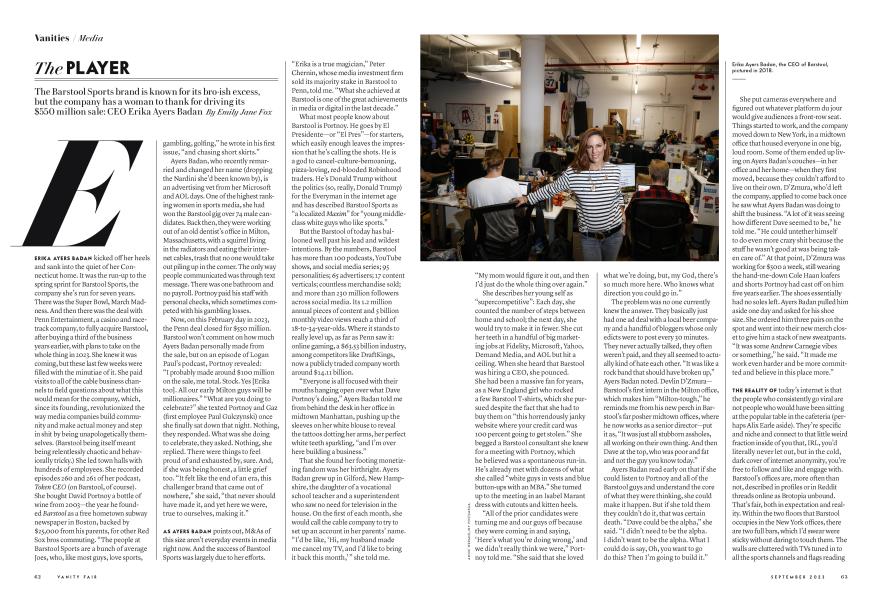
The reality of today’s internet is that the people who consistently go viral are not people who would have been sitting at the popular table in the cafeteria (perhaps Alix Earle aside). They’re specific and niche and connect to that little weird fraction inside of you that, IRL, you’d literally never let out, but in the cold, dark cover of internet anonymity, you’re free to follow and like and engage with. Barstool’s offices are, more often than not, described in profiles or in Reddit threads online as Brotopia unbound. That’s fair, both in expectation and reality. Within the two floors that Barstool occupies in the New York offices, there are two full bars, which I’d swear were sticky without daring to touch them. The walls are cluttered with TVs tuned in to all the sports channels and flags reading “viva la Stool” and “Saturdays are for the boys.” There’s a room with eight saggy leather chairs that scream that they’ve seen some things, each with a microphone at its feet, all arranged stadium style in front of about a trillion TV screens. To the right of them is a fist-size hole in the wall, a relic from the time one of the guys punched through it during a playoff game. In the bullpen, there are dozens of desks that have what seem like a minimum of 900 tchotchkes on them—college sports flags or hometown T-shirts or plastic hamburgers. Every single person I came in contact with during my visit encouraged me to “take anything I wanted” off any desk, which felt as much like a generous offering as it did a plea for help as it did a dare. There are cameras rolling everywhere all the time in that place. Everything is content.
I passed Joey Camasta, the cohost of Barstool’s Out & About, going live at his desk to test out a new glitter eye shadow. There had been a big uproar earlier in the morning because, after the long Memorial Day weekend, Barstool personality Frank the Tank had come into the office to find one of his specialty sodas—a limited-edition Mountain Dew—was missing, and everyone in the office was pointing fingers and no one was safe. Ayers Badan walked into her office to find pajamas and a blanket on her couch, making it abundantly clear that someone had been sleeping in her office over the weekend. She barely shrugged. No space, no privacy, no boundary can’t be pushed (D’Zmura still eats half of her leftover lunch every day. “Sometimes she has lobster!” he told me).
When I sat down with Kate Mannion, the Afghanistan war vet who cohosts their military podcast Zero Blog Thirty, she pulled up her Phillies T-shirt to show me that she was holding her jeans together with a hair tie. She’s a few months pregnant with her second son and refusing to buy maternity pants. “I can’t believe I’m showing this to a Vanity Fair reporter,” she confessed. Mannion came to Barstool as so many hopefuls do—by way of a photo she tweeted remarking that the calzone she’d ordered looked remarkably like a vagina. The tweet picked up steam, and people started tagging Uncle Chaps, a Marine and Barstool host who happened to have a running feature centered around objects that resembled genitals. “We ended up talking about how I was in the military and he invited me on his show, and then it just grew from there. It was the calzone that launched my whole everything.”
She came into the Barstool office for the first time in an LC Lauren Conrad for Kohl’s shirt with shoulder pads and her résumé. Everyone was in basketball shorts, she remembered. No one looked at her printout. “If Chaps says you’re good, you’re good,” she remembers Portnoy telling her. She started guesting on Zero Blog Thirty and blogging until they hired her full-time. Until then, she’d read stories about the misogyny within and around Barstool. People warned her. Google warned her. After a few weeks, she says, “I was like, Oh, this isn’t the land of sports bros. This is the land of misfits. This is the land of dorks and nerds like me, who, yes, are super-passionate sports fans who all seem like douchebags. They just do. But they’re authentic. It’s a bunch of creative weirdos who want to make their own content, a million of us with a million very weird personalities.”
Everyone has their “MOUTHS HANGING OPEN over what Dave Portnoy’s doing,” says Ayers Badan, “and I’m over here BUILDING A BUSINESS.”
The Barstool stamp means big business for its stars. Once they make it onto the network, and particularly once they’re tweeted out from the Barstool main account, it’s on. If they understand their audience and if they churn out the kind of content that works at a clip, it’s a rocket ship. That’s what happened with Call Her Daddy, the once unbelievably raunchy sex podcast launched by Barstool in 2018 by two young, hot best friends named Sofia Franklyn and Alex Cooper. Barstool got them cheap and put them front and center. Within about two seconds, the show exploded. Episodes would launch on Wednesday at midnight, and by 1 a.m., there were all sorts of anomalies with download data from Spotify and Apple, because users on college campuses share IP addresses, so everything would short out, Ayers Badan told me. “It broke everything.” The cohosts ultimately had a public falling out. Portnoy publicly sided with Cooper, who signed on with Barstool and retained the podcast. Last year, she made a $60 million deal with Spotify, which Ayers Badan said she deserves every cent of. “I’d rather have an Alex Cooper that screws you at the end, every day of the week. Because you know what? She worked for us, we worked for her, we taught her a lot, she taught us a lot. It’s like a sports team. It’s like you have a star quarterback and her contract is up, and she went to the big leagues.”
With a fan base this rabid, coupled with a command of the media, a punishing publishing cadence, and control of all of the back-end data and publishing, Barstool is one of the more powerful advertising platforms.
Joanne Bradford, who had hired Ayers Badan at Microsoft and Yahoo, became her customer once she was at Barstool. At that point, she was working as the president of Honey, the online coupon business, which became one of the biggest advertisers on Call Her Daddy, which she said was one of the most effective ad buys they ever had. “Erika really, really trusts the authenticity of that fan base and understood the power of Dave’s army in order to build Barstool into the antithetical voice of corporate marketing,” she said. “She built infrastructure for that voice to break through and to get advertisers. And while it’s certainly not for the bluest of chips, for people that want performance and want to really be a part of a community, advertising with Barstool Sports gives you that.”
It may not be for the bluest of chips because, at any moment, someone at Barstool, from Portnoy on down to any of the hundreds of people who appear on the platform each week, could say or do something that will turn the internet and advertisers against them. Portnoy, to his core, is a self-immolating executive whose devotees get off on his flames. His ascent happened despite, or perhaps because of, the fact that his offensiveness was destined for internet stardom. Like when he wouldn’t take down photos from the blog that showed Tom Brady’s child’s penis until the police literally came knocking, or used the N-word (among other racist behavior), or said that a woman in tight pants “kind of deserved to be raped.” This summer, after rumors of Brady chatting with Kim Kardashian at a party swirled, Portnoy drew a line: Brady shouldn’t deign to date someone like the successful beautiful reality mogul, but he could “fuck her in a motel.” In 2021, Insider published a report in which three women alleged that sexual encounters with Portnoy had turned violent and humiliating. A follow-up story last year reported that a handful of women alleged that Portnoy filmed them without their consent during sex. Portnoy and Barstool denied the claims, and Portnoy sued the publication, its editor, CEO, and the reporters. A federal judge dismissed the lawsuit for lack of evidence of “actual malice.” Portnoy filed an appeal but ultimately dropped it. Portnoy declined requests to comment on this. He framed the reports as a witch hunt, urging Stoolies to fight against the tide. If they supported him and wanted to “beat cancel culture,” then everyone buy as many Barstool-branded frozen pizzas that Walmart carried. Fans flocked to the stores.
Ayers Badan released a podcast at the time defending Portnoy. In our interview, Ayers Badan said that she’s protective of him “to this day, though Dave doesn’t need protecting. I love him. I really do.” They were never perfect, she added. They never said they were. They showed every flaw. The office is The Truman Show. “The DNA is unapologetic, highly authentic, real, fallible, totally human. Everybody here fucks up all the time.” Portnoy said he couldn’t have predicted the amount of backlash they would get over the years. “She doesn’t back down. And if she did, we would’ve been probably dead in the water a long time ago. There’s no way for us or me to have known that she would’ve had the same exact backbone that we do and I do,” he said. Like when she got shit on Twitter for wearing a shirt during an interview that read “Feminine,” which a commenter thought read “Feminist” and took great offense to, given Barstool’s point of view. Ayers Badan responded to that critique: “It’s cashmere, bitch.” A poster of the phrase hangs above her desk.
Penn, after all, EXISTS for betting. And it’s just made a half-billion-dollar bet that Barstool will be a KEY PLAYER in what is projected to be a QUARTER-TRILLION-DOLLAR market.
“It’s certainly very noisy where I live,” she said when I brought this up. “It also shows that we’re doing something that’s relevant. And I would choose relevance for Barstool every day.”
The question is whether or not Penn will make the same choice. The company’s stock took a hit the day the Insider story about Portnoy came out. It took another dip when, earlier this year, one of the Barstool personalities used a racial slur in reciting a rap lyric on the air. He was fired immediately (though Portnoy later hired him for a non-Barstool affiliated watch brand he’s toying with launching). Penn, after all, exists to bet. And it’s just made a half-billion-dollar bet that Barstool will be a key player in what is projected to be a quarter-trillion-dollar market, bringing its insatiable audience in as new gamblers to dominate its competitors.
But sports betting is one of the most highly regulated industries across the country, controlled state by state. Regulators have long been wary of keeping organized crime out and trying to get around the appearance that it is preying on vulnerable populations, so scrutiny over who’s in charge of these companies—their legal liabilities, debts, general conduct—has been hawkish. Since the Supreme Court opened up organized sports betting in 2018, some gambling companies, including Penn, have been able to operate before going through the full licensing review, and Portnoy himself has been able to avoid review because Penn has argued that he is not running the betting business.
That doesn’t mean his words and actions and history as a betting man couldn’t blow the whole thing up. Earlier this year, The New York Times ran a feature detailing Portnoy’s own gambling debts, citing industry watchdogs when claiming that he, “perhaps more than anyone else in the United States, is encouraging recklessness among his legions of followers.” (Portnoy, unsurprisingly, derided the story as a “hit piece.”)
Ayers Badan is more focused on retaining the DNA of the company she helped build. “Part of my job is to be vigilant about keeping Barstool, keeping the heart of this place,” she said. “I think Barstool is so many things to so many people, but really, it’s just a way of thinking and doing things. That’s what binds everybody here, which I think most people miss at first glance.”
Subscribers have complete access to the archive.
Sign In Not a Subscriber?Join Now


