




Sign In to Your Account
Subscribers have complete access to the archive.
Sign In Not a Subscriber?Join NowFrankly Brilliant
The return of author Frank Conroy
DAVID HALBERSTAM
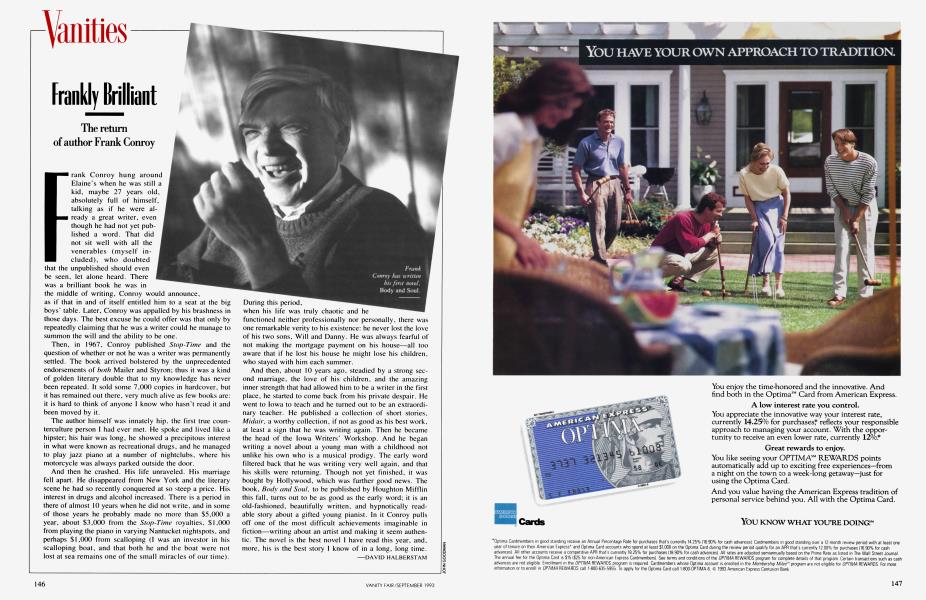
Frank Conroy hung around Elaine's when he was still a kid, maybe 27 years old, absolutely full of himself, talking as if he were al ready a great writer, even though he had not yet pub lished a word. That did not sit well with all the
venerables (myself inH eluded), who doubted i that the unpublished should even be seen, let alone heard. There was a brilliant book he was in the middle of writing, Conroy would announce, as if that in and of itself entitled him to a seat at the big boys' table. Later, Conroy was appalled by his brashness in those days. The best excuse he could offer was that only by repeatedly claiming that he was a writer could he manage to summon the will and the ability to be one.
Then, in 1967, Conroy published Stop-Time and the question of whether or not he was a writer was permanently settled. The book arrived bolstered by the unprecedented endorsements of both Mailer and Styron; thus it was a kind of golden literary double that to my knowledge has never been repeated. It sold some 7,000 copies in hardcover, but it has remained out there, very much alive as few books are: it is hard to think of anyone I know who hasn't read it and been moved by it.
The author himself was innately hip, the first true counterculture person I had ever met. He spoke and lived like a hipster; his hair was long, he showed a precipitous interest in what were known as recreational drugs, and he managed to play jazz piano at a number of nightclubs, where his motorcycle was always parked outside the door.
And then he crashed. His life unraveled. His marriage fell apart. He disappeared from New York and the literary scene he had so recently conquered at so steep a price. His interest in drugs and alcohol increased. There is a period in there of almost 10 years when he did not write, and in some of those years he probably made no more than $5,000 a year, about $3,000 from the Stop-Time royalties, $1,000 from playing the piano in varying Nantucket nightspots, and perhaps $1,000 from scalloping (I was an investor in his scalloping boat, and that both he and the boat were not lost at sea remains one of the small miracles of our time).
During this period, when his life was truly chaotic and he
functioned neither professionally nor personally, there was one remarkable verity to his existence: he never lost the love of his two sons. Will and Danny. He was always fearful of not making the mortgage payment on his house—all too aware that if he lost his house he might lose his children, who stayed with him each summer.
And then, about 10 years ago, steadied by a strong second marriage, the love of his children, and the amazing inner strength that had allowed him to be a writer in the first place, he started to come back from his private despair. He went to Iowa to teach and he turned out to be an extraordinary teacher. He published a collection of short stories. Midair, a worthy collection, if not as good as his best work, at least a sign that he was writing again. Then he became the head of the Iowa Writers' Workshop. And he began writing a novel about a young man with a childhood not unlike his own who is a musical prodigy. The early word filtered back that he was writing very well again, and that his skills were returning. Though not yet finished, it was bought by Hollywood, which was further good news. The book, Body and Soul, to be published by Houghton Mifflin this fall, turns out to be as good as the early word; it is an old-fashioned, beautifully written, and hypnotically readable story about a gifted young pianist. In it Conroy pulls off one of the most difficult achievements imaginable in fiction—writing about an artist and making it seem authentic. The novel is the best novel I have read this year, and, more, his is the best story I know of in a long, long time.
Subscribers have complete access to the archive.
Sign In Not a Subscriber?Join Now