



Sign In to Your Account
Subscribers have complete access to the archive.
Sign In Not a Subscriber?Join NowFINDING HER LUX
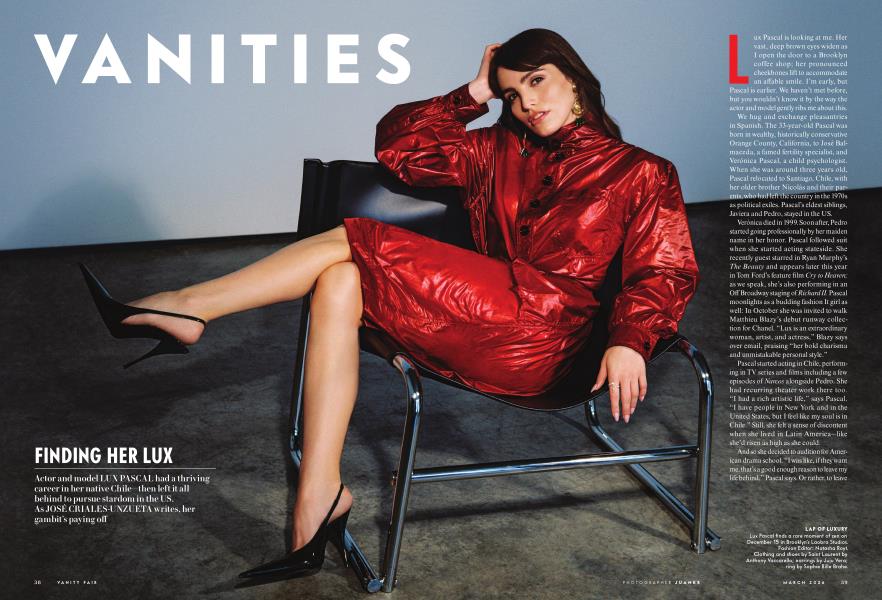
Actor and model LUX PASCAL had a thriving career in her native Chile—then left it all behind to pursue stardom in the US. As JOSÉ CRIALES-UNZUETA writes, her gambit's paying off
JOSÉ CRIALES-UNZUETA
VANITIES
Lux Pascal is looking at me. Her vast, deep brown eyes widen as I open the door to a Brooklyn coffee shop; her pronounced cheekbones lift to accommodate an affable smile. I'm early, but Pascal is earlier. We haven't met before, but you wouldn't know it by the way the actor and model gently ribs me about this.
We hug and exchange pleasantries in Spanish. The 33-year-old Pascal was born in wealthy, historically conservative Orange County, California, to José Balmaceda, a famed fertility specialist, and Veronica Pascal, a child psychologist. When she was around three years old, Pascal relocated to Santiago, Chile, with her older brother Nicolas and their parents, who had left the country in the 1970s as political exiles. Pascal's eldest siblings, Javiera and Pedro, stayed in the US.
Veronica died in 1999. Soon after, Pedro started going professionally by her maiden name in her honor. Pascal followed suit when she started acting stateside. She recently guest starred in Ryan Murphy's The Beauty and appears later this year in Tom Ford's feature him Cry to Heaven; as we speak, she's also performing in an Off Broadway staging of Richard II Pascal moonlights as a budding fashion It girl as well: In October she was invited to walk Matthieu Blazy's debut runway collection for Chanel. "Lux is an extraordinary woman, artist, and actress," Blazy says over email, praising "her bold charisma and unmistakable personal style."
Pascal started acting in Chile, performing in TV series and Hirns including a few episodes of Narcos alongside Pedro. She had recurring theater work there too. "I had a rich artistic life," says Pascal. "I have people in New York and in the United States, but I feel like my soul is in Chile." Still, she felt a sense of discontent when she lived in Latin America—like she'd risen as high as she could.
And so she decided to audition for American drama school. "Iwas like, if they want me, that's a good enough reason to leave my life behind," Pascal says. Or rather, to leave behind one life and begin another. "I was leading a life that I wasn't necessarily happy with," she says, relaxing into her chair. "I don't want to get too deep into that, but I wanted to start over. And I did."
The unspoken element here is Pascal's transition, which she revealed publicly on Instagram in early 2021. In New York, she's built a life unencumbered by past definitions of herself—even if most Americans know her best as Pedro's little sister. But that, too, will change soon.
At the Juilliard School, Pascal was challenged to unlearn some of the training she'd gotten in Chile. One instructor gave her a transformative piece of advice: "Just do less." Pascal's taken it to heart. "I don't think I had ever felt so alive while acting," she says, her soft-pink acrylic nails fidgeting with a gray wool scarf by Acne Studios. "Just letting things happen instead of doing it. "
The night I saw RichardII, claims Pascal, was not a good show for her. "I was como desconectada nomas," she says—"a little out of it." I found her captivating, an assessment shared by her costar Michael Urie. "Onstage, Lux is thrilling to play opposite," he tells me. "Every night is like the first night or the last night: vital and alive."
The crowd seemed charmed by her too—including London-based, New York-born designer Conner Ives, who's known for cutting the kinds of slinky, fabulous dresses that intensify the beauty of women like Pascal. He gained mainstream recognition last year for an agenda-setting T-shirt he made, emblazoned with an instantly viral slogan: "Protect the Dolls." Ives created the shirt as a "love letter" to the many trans women in his life, whom he considers his muses, and to protest rising political hostility and legislative attacks on trans people; all its proceeds are donated to Trans Lifeline, a trans-led charity.
"I first saw Lux in the way you see most people in the 21st century, online," Ives tells me later. They became Instagram friends, then IRL ones. "I remember being absolutely transfixed by her," he says. "I don't use the term star quality lightly, but she was just so inviting."
Last year Pascal also starred in Miss Carbon (Queen of Coal), a Spanish Argentinian film about Carla Antonella Rodriguez: a trans woman who became the first female miner in Patagonia. She's remarkable in the lead role—strong, nuanced, emotionally charged. "I know who this woman is," says Pascal. "This is a person who survived, and who, because of survival, learned that life is worth living if you remain a little elegant. Poised."
It would be easy, reductive, to think that Pascal is also referring to herself here. I ask her if she hesitated at all to make a transition story.
"Yes, because I did not want to put myself in a box," she says. "But I read the story, and I saw the opportunity of playing the lead in a movie, and that was a challenge worth taking." Pascal also saw an opportunity to offer a perspective that does not anchor Rodriguez's story solely on her trans-ness: "She's always been a woman." Instead, Pascal wanted to focus on Rodriguez as "a force of nature, an impeccable hard worker, and someone who opened the door for women in that workplace, period. "
A week later I follow the sound of "Vanished" by Crystal Castles into a Brooklyn photo studio to meet Pascal once more. She's at home in front of the camera; she's a fresh face, but she's not really new.
Pascal's inspired by photos of her mother from the '70s, when she lived in Chile, and from after her move to the US, when she still "preserved her Chilean-ness." Films from her teenage years helped inform her identity as well. Pascal has a deep connection to The Virgin Suicides, which stars Kirsten Dunst as Lux Lisbon. Pascal didn't name herself after the character, at least not solely. As she reminds me, lux means "light" in Latin. "It's so much of what acting is about, and being onstage, and being on the runway," Pascal says, those brown eyeswide. "Finding your light. "
Subscribers have complete access to the archive.
Sign In Not a Subscriber?Join Now

