



Sign In to Your Account
Subscribers have complete access to the archive.
Sign In Not a Subscriber?Join NowLETTER FROM LONDON: HELLO, KITTY
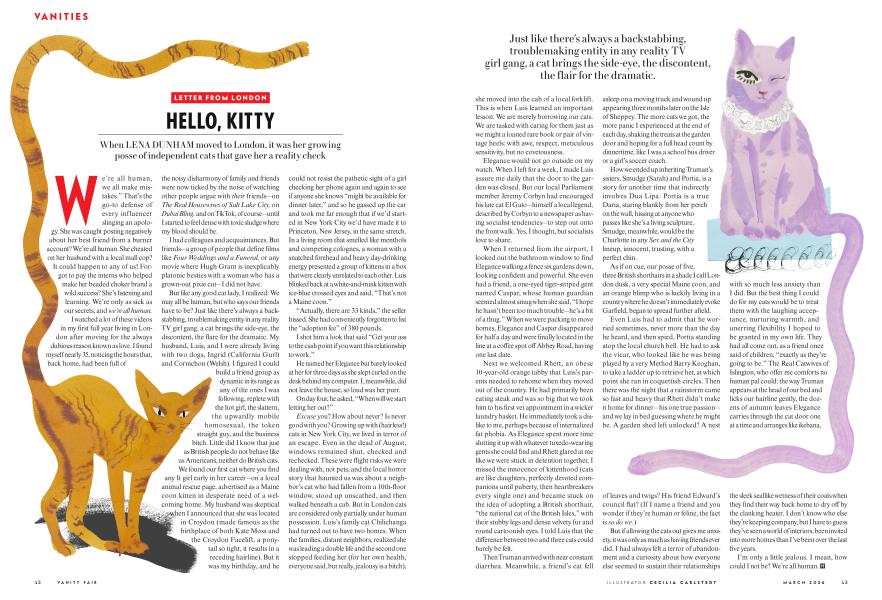
When LENA DUNHAM moved to London, it was her growing posse of independent cats that gave her a reality check
LENA DUNHAM
VANITIES
We're all human, we all make mistakes." That's the go-to defense of every influencer slinging an apology. She was caught posting negatively about her best friend from a burner account? We're all human. She cheated on her husband with a local mall cop? It could happen to any of us! Forgot to pay the interns who helped make her beaded choker brand a wild success? She's listening and learning. We're only as sick as our secrets, and we're all human. I watched a lot of these videos in my first full year living in London after moving for the always dubious reason known as love. I found myself nearly 35, noticing the hours that, back home, had been full of the noisy disharmony of family and friends were now ticked by the noise of watching other people argue with their friends—on The Real Housewives of Salt Lake City, on Dubai Bling, andonTikTok, of course—until I started to feel dense with toxic sludge where my blood should be.
I had colleagues and acquaintances. But friends—a group of people that define films like Four Weddings and a Funeral, or any movie where Hugh Grant is inexplicably platonic besties with a woman who has a grown-out pixie cut—I did not have.
But like any good cat lady, I realized: We may all be human, but who says our friends have to be? Just like there's always a backstabbing, troublemaking entity in any reality TV girl gang, a cat brings the side-eye, the discontent, the flare for the dramatic. My husband, Luis, and I were already living with two dogs, Ingrid (California Guri) and Cornichon (Welsh). I figured I could build a friend group as dynamic in its range as / any ones iwas following, replete with the hot girl, the slattern, ' the upwardly mobile homosexual, the token straight guy, and the business bitch. Little did I know that just as British people do not behave like us Americans, neither do British cats. We found our first cat where you find any It girl early in her career—on a local animal rescue page, advertised as a Maine coon kitten in desperate need of a welcoming home. My husband was skeptical when I announced that she was located in Croydon (made famous as the birthplace of both Kate Moss and the Croydon Facelift, a ponytail so tight, it results in a receding hairline). But it was my birthday, and he could not resist the pathetic sight of a girl checking her phone again and again to see if anyone she knows "might be available for dinner later," and so he gassed up the car and took me far enough that if we'd started in New York City we'd have made it to Princeton, New Jersey, in the same stretch. In a living room that smelled like menthols and competing colognes, a woman with a snatched forehead and heavy day-drinking energy presented a group of kittens in a box thatwere clearly unrelated to each other. Luis blinked back at a white-and-mink kitten with ice-blue crossed eyes and said, "That's not a Maine coon."
"Actually, there are 33 kinds," the seller hissed. She had conveniently forgotten to list the "adoption fee" of 380 pounds.
I shot him a look that said "Get your ass to the cash point if you want this relationship to work."
He named her Elegance but barely looked at her for three days as she slept curled on the desk behind my computer. I, meanwhile, did not leave the house, so loud was her purr.
On day four, he asked, "When will we start letting her out?"
Excuse you? How about never? Is never good with you? Growing up with (hairless!) cats in New York City, we lived in terror of an escape. Even in the dead of August, windows remained shut, checked and rechecked. These were flight risks we were dealing with, not pets, and the local horror story that haunted us was about a neighbor's cat who had fallen from a lOth-floor window, stood up unscathed, and then walked beneath a cab. But in London cats are considered only partially under human possession. Luis's family cat Chilichanga had turned out to have two homes. When the families, distant neighbors, realized she was leading a double life and the second one stopped feeding her (for her own health, everyone said, but really, jealousy is a bitch), she moved into the cab of a local forklift. This is when Luis learned an important lesson: We are merely borrowing our cats. We are tasked with caring for them just as we might a loaned rare book or pair of vintage heels: with awe, respect, meticulous sensitivity, but no covetousness.
Just like there's always a backstabbing, troublemaking entity in any reality TV girl gang, a cat brings the side-eye, the discontent, the flair for the dramatic.
Elegance would not go outside on my watch. When I left for a week, I made Luis assure me daily that the door to the garden was closed. But our local Parliament member Jeremy Corbyn had encouraged his late cat El Gato—himself a local legend, described by Corbyn to a newspaper as having socialist tendencies—to step out onto the front walk. Yes, I thought, but socialists love to share.
When I returned from the airport, I looked out the bathroom window to find Elegance walking a fence six gardens down, looking confident and powerful. She even had a friend, a one-eyed tiger-striped gent named Caspar, whose human guardian seemed almost smugwhen she said, "I hope he hasn't been too much trouble—he's a bit of a thug." When we were packing to move homes, Elegance and Caspar disappeared for half a day and were finally located in the line at a coffee spot off Abbey Road, having one last date.
Next we welcomed Rhett, an obese 10-year-old orange tabby that Luis's parents needed to rehome when they moved out of the country. He had primarily been eating steak and was so big that we took him to his first vet appointment in a wicker laundry basket. He immediately took a dislike to me, perhaps because of internalized fat phobia. As Elegance spent more time slutting it up with whatever tuxedo-wearing gents she could find and Rhett glared at me like we were stuck in detention together, I missed the innocence of kittenhood (cats are like daughters, perfectly devoted companions until puberty, then heartbreakers every single one) and became stuck on the idea of adopting a British shorthair, "the national cat of the British Isles," with their stubby legs and dense velvety fur and round cartoonish eyes. I told Luis that the difference between two and three cats could barely be felt.
Then Truman arrived with near constant diarrhea. Meanwhile, a friend's cat fell asleep on a moving truck and wound up appearing three months later on the Isle of Sheppey. The more cats we got, the more panic I experienced at the end of each day, shaking the treats at the garden door and hoping for a full head count by dinnertime, like I was a school bus driver or a girl's soccer coach.
Howwe ended up inheriting Truman's sisters, Smudge (Sarah) and Portia, is a story for another time that indirectly involves Dua Lipa. Portia is a true Daria, staring blankly from her perch on the wall, hissing at anyone who passes like she's a living sculpture. Smudge, meanwhile, would be the Charlotte in any Sex and the City lineup, innocent, trusting, with a perfect chin.
As if on cue, our posse of five, three British shorthairs in a shade I call London dusk, a very special Maine coon, and an orange blimp who is luckily living in a country where he doesn't immediately evoke Garfield, began to spread further afield.
Even Luis had to admit that he worried sometimes, never more than the day he heard, and then spied, Portia standing atop the local church bell. He had to ask the vicar, who looked like he was being played by a very Method Barry Keoghan, to take a ladder up to retrieve her, at which point she ran in coquettish circles. Then there was the night that a rainstorm came so fast and heavy that Rhett didn't make it home for dinner—his one true passion— and we lay in bed guessing where he might be. A garden shed left unlocked? A nest of leaves and twigs? His friend Edward's council flat? (If I name a friend and you wonder if they're human or feline, the fact is so do we.)
But if allowing the cats out gives me anxiety, it was only as much as having friends ever did. I had always felt a terror of abandonment and a curiosity about how everyone else seemed to sustain their relationships with so much less anxiety than I did. But the best thing I could do for my cats would be to treat them with the laughing acceptance, nurturing warmth, and unerring flexibility I hoped to be granted in my own life. They had all come out, as a friend once said of children, "exactly as they're going to be." The Real Catwives of Islington, who offer me comforts no human pal could: the way Truman appears at the head of our bed and licks our hairline gently, the dozens of autumn leaves Elegance carries through the cat door one at a time and arranges like ikebana, the sleek seallike wetness of their coats when they find their way back home to dry off by the clanking heater. I don't know who else they're keeping company, but I have to guess they've seen a world of interiors, been invited into more homes than I've been over the last five years.
I'm only a little jealous. I mean, how could I not be? We're all human.
Subscribers have complete access to the archive.
Sign In Not a Subscriber?Join Now
