



Sign In to Your Account
Subscribers have complete access to the archive.
Sign In Not a Subscriber?Join NowNEW MEDIA: For the Sake of Argument
Charlie Kirk did it. So did Mehdi Hasan and Candace Owens. Why are the internet's loudest voices making videos for Jubilee Media? CHRIS MURPHY looks inside a controversial internet success story
CHRIS MURPHY
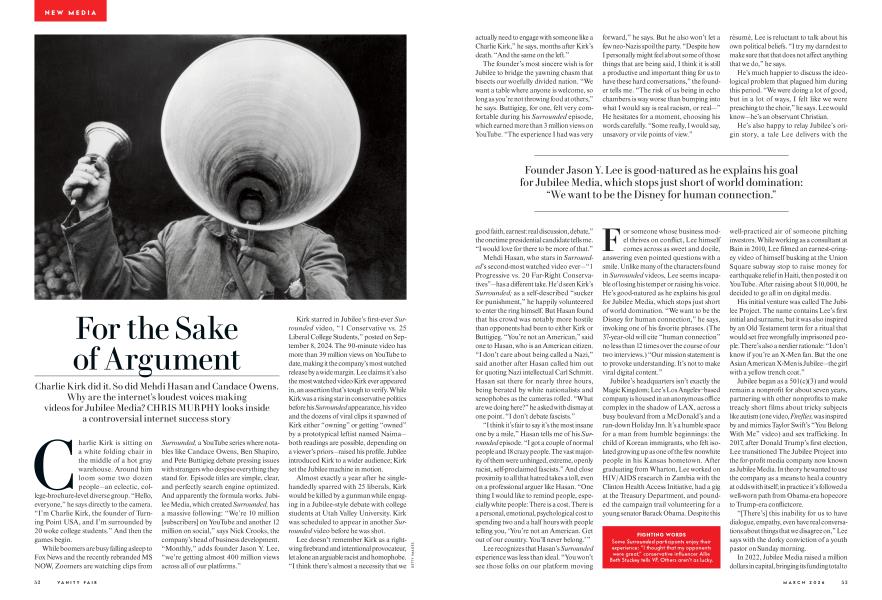
Charlie Kirk is sitting on a white folding chair in the middle of a hot gray warehouse. Around him loom some two dozen people—an eclectic, college-brochure-level diverse group. "Hello, everyone," he says directly to the camera. "I'm Charlie Kirk, the founder of Turning Point USA, and I'm surrounded by 20 woke college students." And then the games begin.
While boomers are busy falling asleep to Fox News and the recently rebranded MS NOW, Zoomers are watching clips from Surrounded, a YouTube series where notables like Candace Owens, Ben Shapiro, and Pete Buttigieg debate pressing issues with strangers who despise everything they stand for. Episode titles are simple, clear, and perfectly search engine optimized. And apparently the formula works. Jubilee Media, which created Surrounded, has a massive following: "We're 10 million [subscribers] on YouTube and another 12 million on social," says Nick Crooks, the company's head of business development. "Monthly," adds founder Jason Y. Lee, "we're getting almost 400 million views across all of our platforms."
Kirk starred in Jubilee's first-ever Surrounded video, "1 Conservative vs. 25 Liberal College Students," posted on September 8, 2024. The 90-minute video has more than 39 million views on YouTube to date, making it the company's most watched release by a wide margin. Lee claims it's also the most watched video Kirk ever appeared in, an assertion that's tough to verify. While Kirk was a rising star in conservative politics before his Surrounded appearance, his video and the dozens of viral clips it spawned of Kirk either "owning" or getting "owned" by a prototypical leftist named Naima— both readings are possible, depending on a viewer's priors—raised his profile. Jubilee introduced Kirk to a wider audience; Kirk set the Jubilee machine in motion.
Almost exactly a year after he singlehandedly sparred with 25 liberals, Kirk would be killed by a gunman while engaging in a Jubilee-style debate with college students at Utah Valley University. Kirk was scheduled to appear in another Surrounded video before he was shot.
Lee doesn't remember Kirk as a rightwing firebrand and intentional provocateur, let alone an arguable racist and homophobe. "I think there's almost a necessity that we actually need to engage with someone like a Charlie Kirk," he says, months after Kirk's death. "And the same on the left."
Founder Jason Y. Lee is good-natured as he explains his goal for Jubilee Media, which stops just short of world domination: "We want to be the Disney for human connection."
The founder's most sincere wish is for Jubilee to bridge the yawning chasm that bisects our woefully divided nation. "We want a table where anyone is welcome, so long as you're not throwing food at others," he says. Buttigieg, for one, felt very comfortable during his Surrounded episode, which earned more than 3 million views on YouTube. "The experience I had was very good faith, earnest: real discussion, debate," the onetime presidential candidate tells me. "I would love for there to be more of that."
Mehdi Hasan, who stars in Surrounded's second-most watched video ever—" 1 Progressive vs. 20 Far-Right Conservatives"—has a different take. He'd seen Kirk's Surrounded; as a self-described "sucker for punishment," he happily volunteered to enter the ring himself. But Hasan found that his crowd was notably more hostile than opponents had been to either Kirk or Buttigieg. "You're not an American," said one to Hasan, who is an American citizen. "I don't care about being called a Nazi," said another after Hasan called him out for quoting Nazi intellectual Carl Schmitt. Hasan sat there for nearly three hours, being berated by white nationalists and xenophobes as the cameras rolled. "What are we doing here?" he asked with dismay at one point. "I don't debate fascists."
"I think it's fair to say it's the most insane one by a mile," Hasan tells me of his Surrounded episode. "I got a couple of normal people and 18 crazy people. The vast majority of them were unhinged, extreme, openly racist, self-proclaimed fascists." And close proximity to all that hatred takes a toll, even on a professional arguer like Hasan. "One thing I would like to remind people, especially white people: There is a cost. There is a personal, emotional, psychological cost to spending two and a half hours with people telling you, 'You're not an American. Get out of our country. You'll never belong.' "
Lee recognizes that Hasan's Surrounded experience was less than ideal. "You won't see those folks on our platform moving forward," he says. But he also won't let a few neo-Nazis spoil the party. "Despite how I personally might feel about some of those things that are being said, I think it is still a productive and important thing for us to have these hard conversations," the founder tells me. "The risk of us being in echo chambers is way worse than bumping into what I would say is real racism, or real—" He hesitates for a moment, choosing his words carefully. "Some really, I would say, unsavory or vile points of view."
For someone whose business model thrives on conflict, Lee himself comes across as sweet and docile, answering even pointed questions with a smile. Unlike many of the characters found in Surrounded videos, Lee seems incapable of losing his temper or raising his voice. He's good-natured as he explains his goal for Jubilee Media, which stops just short of world domination. "We want to be the Disney for human connection," he says, invoking one of his favorite phrases. (The 37-year-old will cite "human connection" no less than 12 times over the course of our two interviews.) "Our mission statement is to provoke understanding. It's not to make viral digital content."
Jubilee's headquarters isn't exactly the Magic Kingdom; Lee's Los Angeles-based company is housed in an anonymous office complex in the shadow of LAX, across a busy boulevard from a McDonald's and a run-down Holiday Inn. It's a humble space for a man from humble beginnings: the child of Korean immigrants, who felt isolated growing up as one of the few nonwhite people in his Kansas hometown. After graduating from Wharton, Lee worked on HIV/AIDS research in Zambia with the Clinton Health Access Initiative, had a gig at the Treasury Department, and pounded the campaign trail volunteering for a young senator Barack Obama. Despite this résumé, Lee is reluctant to talk about his own political beliefs. "I try my darndest to make sure that that does not affect anything that we do," he says.
He's much happier to discuss the ideological problem that plagued him during this period. "We were doing a lot of good, but in a lot of ways, I felt like we were preaching to the choir," he says. Lee would know—he's an observant Christian.
He's also happy to relay Jubilee's origin story, a tale Lee delivers with the well-practiced air of someone pitching investors. While working as a consultant at Bain in 2010, Lee filmed an earnest-cringey video of himself busking at the Union Square subway stop to raise money for earthquake relief in Haiti, then posted it on YouTube. After raising about $ 10,000, he decided to go all in on digital media.
His initial venture was called The Jubilee Project. The name contains Lee's first initial and surname, but itwas also inspired by an Old Testament term for a ritual that would set free wrongfully imprisoned people. There's also a nerdier rationale: "I don't know if you're an X-Men fan. But the one Asian American X-Men is Jubilee—the girl with a yellow trench coat."
Jubilee began as a 501(c)(3) and would remain a nonprofit for about seven years, partnering with other nonprofits to make treacly short films about tricky subjects like autism (one video, Fireflies, was inspired by and mimics Taylor Swift's "You Belong With Me" video) and sex trafficking. In 2017, after Donald Trump's first election, Lee transitioned The Jubilee Project into the for-profit media company now known as Jubilee Media. In theory hewantedtouse the company as a means to heal a country at odds with itself; in practice it's followed a well-worn path from Obama-era hopecore to Trump-era conffictcore.
"[There's] this inability for us to have dialogue, empathy, even have real conversations about things that we disagree on," Lee says with the dorky conviction of a youth pastor on Sunday morning.
In 2022, Jubilee Media raised a million dollars in capital, bringing its funding total to $3.25 million, and signed with talent agency WME. Though hard numbers aren't publicly available—and Lee and Crooks won't give me any specifics—some estimates say that the media company pulls in anywhere from $ 100 millionto $250 million annually. Lee says that Jubilee is profitable, and that most of the money comes from programmatic revenue—YouTube ads, basically. But Crooks and company are looking to "flip that model on its head" in the near future. "We need to do a better job of getting to the market and showing that we can drive growth through direct revenue as opposed to programmatic," says Crooks.
On Jubilee's website you can find all 37 employees smiling in childhood portraits—a cutesy touch that also obscures their adult identities. In a fit of anachronistic enthusiasm for multiculturalism, Lee stresses that the Jubilee team is as intentionally diverse as the casts oftheir videos—racially, ethnically, politically, ideologically. And their numbers are growing. Jubilee's revenue has doubled in the past year, says Crooks. "Next year we look to double again."
Before his death, Kirk expressed a single frustration with his Surrounded video. Jubilee had allegedly told Kirk that his opponents would be amateurs. In reality, Kirk claimed on The George Janko Show, "half of them were college kids. Half of them were professional TikTok debaters." Lee contradicts this characterization: He insists the "highly vetted" participants on Surrounded are all regular, nonfamous individuals, chosen by Jubilee's four-person casting team and paid "a very small amount"—the SAG day rate, Lee believes—to shoot the videos.
Casting, Lee maintains, is "the secret sauce" that makes Jubilee videos stand out in a crowded media field. "We are able to bring together prominent or really incredible laypeople who will demonstrate and share their anecdotes, their stories, their experiences really honestly and vulnerably."
While reporting this story I surreptitiously applied to appear in a Jubilee video featuring single men. (I was not selected; perhaps relatedly, I'm not single.) The application asked detailed questions about race, sexual orientation, gender identity, and religious preference, providing a bevy of possibilities for each category. Further down, you could type in your political affiliation, social media handles, and submit two photos. Below all that, there was a deceptively simple query that reached beyond identity: "Would anything of concern be found if we performed a background check on you?" You could respond yes or no.
An apparent neo-Nazi who says he participated in Hasan's episode must have checked no. After the video premiered, a Florida native who goes by Chaotichermes online posted a photo of himself sitting in one of the show's signature white folding chairs with the caption, "I didn't go up during jubilee because Hassan [sic] smelled like shit. " His social media presence reveals Chaotichermes as an unabashed Nazi sympathizer: He's posted hundreds of white nationalist and racist memes on the platforms that haven't banned him. In a since-deleted Reddit post, Jubilee viewers wondered whether Chaotichermes was telling the truth about appearing in Hasan's video—and if he was so overtly racist that he was ultimately cut out of the episode. In an interview on The Bulwark, Hasan addressed the controversy and Chaotichermes's claim: "I can't reveal what happened in terms of the taping and editing, but that's fundamentally untrue," said Hasan. (Chaotichermes did not respond to a request for comment; Hasan didn't respond to a follow-up question about Chaotichermes.)
A source close to Jubilee confirms that Chaotichermes did appear in Hasan's episode but was edited out of it. According to the source, Jubilee was not aware of Chaotichermes's hundreds of white nationalist posts; the source says Chaotichermes would not have been cast if it had been.
Lee maintains that Jubilee's casting process has been "evolving" since its inception, and that everyone's safety on set is the company's first priority. He says that Jubilee has security screenings before cameras begin to roll, and that not everyone sails through them; the company has had to ask people who weren't being cooperative to leave the set.
"We are trying to improve the way thatwe do content so that it is a place for good-faith debate and productive conversation," Lee says when asked about Hasan's episode. He then backpedals to his favorite topic: human connection, which is "not a perfect process," he says. "The question that I would go back to is, what is the perspective that we would try to push or frame?" Lee sounds uncharacteristically frustrated, but he's still smiling. "Why would we hire actors?" he says after I ask him about a persistent internet rumor claiming the debaters in Jubilee aren't authentic. "There is not one [reason], That'swhy it's hard for me to fathom that question."
Three of the surroundees I spoke to— all of whom Jubilee offered to connect me with—had no issue with any of the people Jubilee chose for their debate. But leftwing commentator Sam Seder, whom I reached independently, felt differently. He told me that he was surprised to find out that some of the people he debated in a video called " 1 Progressive vs. 20 Trump Supporters" were "unabashed Christian nationalists"—and claimed that the final edit of his episode had left out some of their most outrageous behavior. "Some were fascistic and white supremacists out and out, unashamed," says Seder. "There was one that they cut out that was even more overthe-top than what you saw."
The issue with Jubilee, some participants argue, isn't that it might hire a wannabe actor from time to time, or that it platforms controversial public figures. It's that Jubilee also gives people like Chaotichermes a seat at the table—and, tacitly, a permission structure to spread thenextremist views. Allowing white supremacists to spew thenhate, then editing them out of the final product, is a very 2026 way of trying to have it both ways.
"I think it's important to say we don't think that we're a perfect company," Lee tells me. "We are inherently doing something that's very, very human, that involves a lot of humans. And I think part of the experience is growth and learning and changing. "
Good faith or bad, Jubilee's reach is undeniable. "It was very striking—not just the number of people who saw it, but the people who saw it were often people who didn't see the other things I did," says Buttigieg. "This is during a month when I might have done a dozen or more major TV appearances. Some young people would come up to me and say, T saw you on this thing' in away that made it clear to me that they hadn't seen any of those [others]."
But even now, the former transportation secretary says, elected officials and strategists give him a blank look when he asks if they've heard of Jubilee. "They say no, and I say, 'Well, I didn't either. And it turns out it's got way more viewership than a lot of TV shows that you do know.' "
As one may expect, Jubilee primarily reaches young people. Gen X'ers who participate in Surrounded often say that they had no idea what Jubilee was before they agreed to make content for it. "I got this request to do it," says Seder. "My daughter was home for Christmas break. She's a college student. And I'm like, 'Have you ever heard of this Jubilee thing?' And she's like, 'You have to do it.' "
"I think young people are so interested and invested in Jubilee because a lot of what they see around them is not that," says Lee. "Everything from politics to even shows and other things—it's so scripted or it's so controlled. And I think that that's something that we're really excited about." Jubilee also practices what it preaches. Lee estimates that the team is primarily composed of Zoomers, while Crooks says the average age for employees is 24 years old.
Detractors accuse Jubilee of memeifying political discourse by posting transparent rage-bait—content designed not to build bridges, but rather to feed an insatiable algorithm that thrives on conflict. Surrounded videos, they say, are created with the intention of inflaming emotions and sowing division—all for clicks and cash.
Lee doesn't see it that way.
"Certainly the algorithm has a part to play," he says. "But we think that the problem and the root is far deeper. And part of it is the lost ability to have discourse. We've lost the ability or the courage to sit in discomfort, even. But ifwe think about the human experience, we have to bump into each other."
Lee means that literally. He thinks the company's future is in live events, like a recent in-person "dating experience" at UCLA that drew almost a thousand students. He expects Jubilee to produce its first live Surrounded, complete with studio audience, in the next 12 to 18 months. "I suspect that [by] end of spring, we'll do an entire college tour," Lee says. Kirk lost his life on just such a tour, but Lee doesn't seem overly concerned about the potential safety issues. "We want to create content, experiences, even technology that brings people together," he says. In moments like this, he sounds a lot like Mark Zuckerberg—another founder with purportedly earnest aims. We all know how that's turned out.
Seder, too, is skeptical—not of the live-event strategy, but Lee's theory of human connection. "I think this country is polarized, and I don't think people will be brought together by YouTube," he says. And while his own experience was positive-ish, he's not surewhether he'drecommend another commentator work with Jubilee in the wake of Hasan's episode. The casting is a real problem, he says. Making another video with Lee's company is "not impossible for me to imagine—but I would need assurances about the vetting."
"Potentially, I would be up for doing it again," says Buttigieg. "For all of the thousands of interviews that I've done, this was a pretty formative one in terms of my understanding of the new media landscape—and one that has stuck with me as one of the most important and interesting that I did in that entire political cycle."
Perhaps he should be careful what he wishes for. Lee tells me Jubilee already has eyes on the 2028 election and hopes that his company will moderate an actual, realdeal debate among White House hopefuls. "I think there's a reason why young people are no longer tuning in to these presidential debates," he says. "People value politicians who can engage and speak clearly, directly to their audiences. And I think that that's why Jubilee is really well poised, and the perfect partner."
"That's hilarious," Hasan says when I tell him this. But he knows too much to laugh too loud, or for too long. "I mean, look: We live in America," he says. "It could happen. I wouldn't be surprised."
Subscribers have complete access to the archive.
Sign In Not a Subscriber?Join Now


