



Sign In to Your Account
Subscribers have complete access to the archive.
Sign In Not a Subscriber?Join NowNEW MONEY: You Bet Your Life
Prediction markets like Kalshi and Polymarket entice enterprising nerds to make (and lose) fortunes by wagering on everything from politics to the weather. ZOË BERNARD explains why they're unstoppable—and only getting more powerful
ZOË BERNARD
Jack Deschenes was doing serious volume on the pope market. Deschenes is 25 years old and, by his own account, knows next to nothing about the papal conclave. Yet in May 2025— as cardinals locked themselves inside the Sistine Chapel to decide who would inherit the throne of Saint Peter after the death of Pope Francis—Deschenes was on a website called Kalshi, buying and selling contracts worth some $30,000 on the various outcomes of who might win the papacy.
These odds were driven less by Vatican intrigue than by straightforward mathematical calculation. For most of the conclave, "the Chicago guy"—the future Pope Leo XIV—"was trading between like one and five cents," says Deschenes. To predict the odds of various cardinals becoming pope, Deschenes was not even using particularly "fancy math," he tells me. "This is math you can find on Wikipedia."
Deschenes had become so consumed by papal market making that he was falling behind on his studies at Princeton, where he was writing a thesis on game theory. Still, it seemed financially irresponsible to devote any time at all to classwork, given that Deschenes could net some $ 10,000 on the pope market alone in a single week. In a single year on Kalshi, Deschenes estimates he's made $1.5 million.
I met Deschenes in the summer of 2025 at a Kalshi happy hour held at a dimly lit pub in Greenwich Village. The predictionmarket start-up, newly flush with venture cash, had invited its most active users—or as one organizer kept calling them, "all the top dorks"—to swap trading tips over beer and sliders. These were dressed-down guys in T-shirts, mostly in their early 20s, who were earning fortunes on a marketplace that, until recently, had existed in a legal gray zone. Many were making thousands a week speculating on highly specific fixations: whether the temperature would tick up by a single degree in Colorado next weekend, who would win the Coney Island hot dog eating contest, the gender of celebrity babies.
"Why would you work at Goldman when you can work at Kalshi?" asked a communications adviser who works with the company. "This is the next generation of finance "
It may sound silly, but many of the hardcore nerds at the center of this movement saw something larger taking shape: an experiment in collective intelligence with the potential to upend not only Wall Street but the inner workings of American democracy.
Yet only one person there mentioned the dirty word that everyone else had so carefully avoided. A little guy in the corner with especially large teeth, a thick Eastern European accent, and a few sparse hairs attempting to cloak his balding forehead had been swirling a glass of ice and cryptically dodging my basic questions—for instance, what his name was. I'd been rifling about prediction markets with him when he leaned in close, his mouth full of cheeseburger.
"You're writing about this, but you have no idea what this meeting is, do you?"
"What is it?" I asked, leaning back to avoid his spittle.
"This," he said, taking in the barroom of traders, "is just the latest Gamblers Anonymous meeting."
Back in 2016, just about everyone on Wall Street wanted exposure to two things: Trump winning the election and Brexit. At the time Tarek Mansour, an MIT grad with a perpetual five-o'clock shadow, was working as an analyst at Goldman Sachs and creating bundles of stock options that attempted to predict what might happen if Trump won or Brexit passed. This, as it turned out, was the financial equivalent of reading tea leaves through a Bloomberg terminal.
The clumsiness of this exercise sparked Mansour to wonder: What if we create a financial market that prices questions about the future the same way you price a stock? Not long after, Mansour began sketching out an idea for a new kind of financial market—a cleaner, more direct version of the one he'd been simulating inside Goldman. It would do what markets, at their best, have always done: distill collective belief into a price. If it worked, Mansour reasoned that it stood to become the most consequential market ever built, because it would be concerned with questions that preoccupy everyone. The stock market prices corporate futures. Mansour wanted to build a market that priced the future itself.
The result was Kalshi, a company he launched in July 2021 with his cofounder, Brazilian-born fellow MIT grad and former ballerina Luana Lopes Lara—a marketplace that would make truth tradable.
There was, however, one minor obstacle. The kind of market Kalshi wanted to build was illegal, at least according to the US Commodity Futures Trading Commission. So Mansour and Lopes Lara did what any enterprising start-up founders might do: They sued the federal government.
Thus began a slog of bureaucratic skirmishes that unfolded over the course of three years. The decisive blow came in October 2024, when Kalshi won the right to host an election market weeks before the nation's next presidential vote. This development, more than any other, vaulted prediction markets into the national conversation, bringing in more than $ 100 million in wagers. On Polymarket, another prediction market and Kalshi's crypto-based competitor, traders put up a staggering $3.2 billion in wagers. Suddenly what had seemed like a niche experiment was becoming a financial reality.
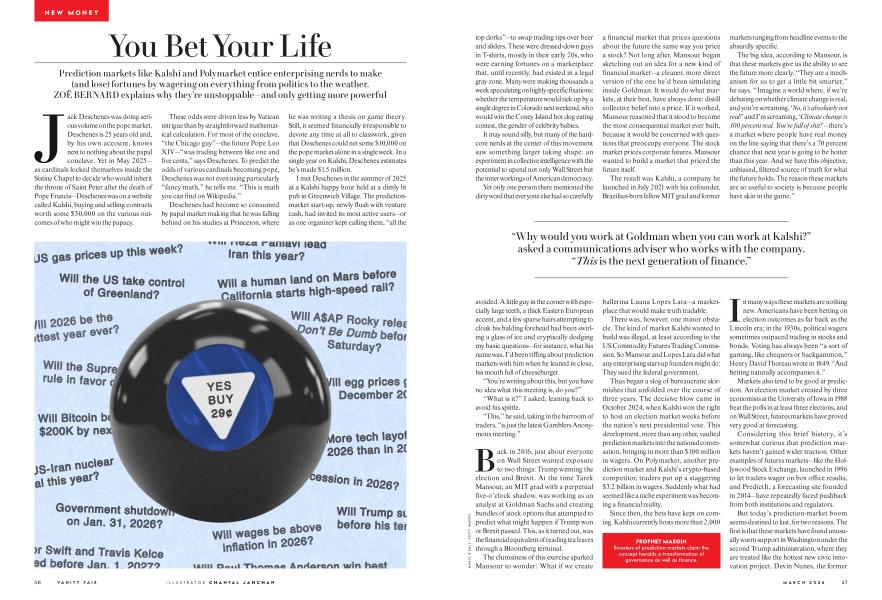
Since then, the bets have kept on coming. Kalshi currently hosts more than2,000 markets ranging from headline events to the absurdly specific.
The big idea, according to Mansour, is that these markets give us the ability to see the future more clearly. "They are a mechanism for us to get a little bit smarter," he says. "Imagine a world where, if we're debating on whether climate change is real, and you're screaming, 'No, it's absolutely not real!' and Tm screaming, 'Climate change is 100 percent real. You 're full of shit!'—there,'s a market where people have real money on the line saying that there's a 70 percent chance that next year is going to be hotter than this year. And we have this objective, unbiased, filtered source of truth for what the future holds. The reason these markets are so useful to society is because people have skin in the game."
In many ways these markets are nothing new. Americans have been betting on election outcomes as far back as the Lincoln era; in the 1930s, political wagers sometimes outpaced trading in stocks and bonds. Voting has always been "a sort of gaming, like chequers or backgammon," Henry David Thoreau wrote in 1849. "And betting naturally accompanies it."
Markets also tend to be good at prediction. An election market created by three economists at the University of Iowa in 1988 beat the polls in at least three elections, and on Wall Street, futures markets have proved very good at forecasting.
Considering this brief history, it's somewhat curious that prediction markets haven't gained wider traction. Other examples of futures markets—like the Hollywood Stock Exchange, launched in 1996 to let traders wager on box office results, and Predictlt, a forecasting site founded in 2014—have repeatedly faced pushback from both institutions and regulators.
But today's prediction-market boom seems destined to last, for two reasons. The first is that these markets have found unusually warm support in Washington under the second Trump administration, where they are treated like the hottest new civic innovation project. Devin Nunes, the former congressman and current CEO of Trump Media & Technology Group, has described them as tools that "empower everyday Americans to harness the wisdom of the crowd.'' Donald Trump Jr. serves as a special adviser to both Kalshi and Polymarket, and in October, Truth Social announced plans to launch a prediction market of its own called Truth Predict.
The second reason is subtler. Prediction markets are gaining momentum in an era when experts have burned through their authority, institutional knowledge is almost universally scorned, and shared reality is splintering into an algorithmic hall of mirrors. The pollsters miss the polls, the networks can't agree on the facts, and Trump's government is backpedaling on two centuries' worth of scientific consensus.
Perhaps these problems can be solved by putting a price on truth and turning it into a commodity. "It's a very elegant, very free market-based approach," says Mansour. "We're giving a financial incentive, rewarding people that have valuable information for society to bring into the marketplace."
Already these markets are viewed as a convincing barometer for truth. Saul Munn, a 22-year-old who studies philosophy at Berkeley and hosts forecasting events at universities, tells me that when he wants to know what's going on in the world, he is more likely to check the odds on Kalshi than watch CNN. "The [traders] make a lot ofmoney from being right," he says. "One guy is incentivized to get clicks. The other guy is incentivized to make money." Never mind that prediction markets often rely on reporting from CNN to settle their bets.
While boosters promise tidy yes-or-no wagers, in practice, traders sometimes spend days parsing ambiguous contracts in Kalshi's and Polymarket's Discord servers. Perhaps the most famous example of this was a bet on Polymarket that asked whether Volodymyr Zelenskyy would wear a suit by a certain date. When the Ukrainian president stepped out in a tailored-looking outfit, traders tore one another apart debating the definition of the word suit. The market, which ultimately determined its outcome through what the company described as "credible reporting," resolved to "no"—to no one's lasting satisfaction.
Despite all the ambiguity, prediction markets' biggest backers—Silicon Valley venture capitalists—remain undeterred. It used to be that the medium was the message. In Silicon Valley, the line has been updated: "The markets are the message," says one venture communications executive. That gospel has set off a frenzy. "Since the election, so many people have started building prediction markets," says Arad Gishri, an investor based in Portugal. Some of these people are founders whose "products didn't catch on, and so they pivoted to prediction. It's like dozens and dozens and dozens. Like, really. A lot. And it's still happening. " Gishri, too, has caught the bug: Earlier this year he left his job as a venture capitalist to start his own prediction market called Lightcone Labs.
According to prototypes I've seen and conversations I've had with dozens of traders and founders, the future of these markets looks something like this: Every news story will come with a Trade button beside it. Podcasts will let listeners bet live as the hosts talk. NFL broadcastswill flash odds on whether the next pass will be caught. Even reality dating shows will come with tickers predicting which couples are most likely to find love. In other words, every conviction will have a price.
Boosters believe prediction markets could also double as a kind of idiosyncratic insurance for an increasingly unstable world. If you booked a beach vacation in Florida, for instance, and worried a hurricane might ruin it, you could hedge the risk by betting on the storm and recouping your losses on the weather market. If traditional insurerswon't touch your California home, you could still place a sizable wager on the odds of a wildfire creeping into your neighborhood.
"This is going to be as big as equity markets, commodity markets, derivatives markets," says Toni Gemayel, who has worked at both Kalshi and Polymarket. "I think of them as opinion markets, and everybody has an opinion on something." The issue with both Kalshi and Polymarket, Gemayel says, is that they generate their own markets—built around news cycles, elections, sporting events, and the occasional trader suggestion. Gemayel plans to solve for this by, yes, building his own prediction market called The Clearing Company, which gives anyone the ability to create any kind of market they can imagine.
According to Gemayel, The Clearing Company will be far better than any kind of futures markets that currently exist on Wall Street. Years ago Gemayel met a guy in Seattle who got so good at modeling the weather that he now wins 95 percent ofweather markets. To do so, he built a bespoke network of weather stations. "Good luck to somebody at Citadel who wants to trade against this guy, because he will beat them," Gemayel says. "This, to me, is the cool thing about prediction markets. Everyone has an area of deep expertise, something that they're way more interested in than somebody on Wall Street ever would be. And it's just really hard to compete against that."
The prediction-market boom has already cracked open a strange new world of opportunity that rewards obsession, precision, and niche expertise. In the months I reported this story, I met a stay-at-home mom in Alabama who studied meteorology in college and made $20,000 betting on oneand two-degree temperature swings in Denver. Today, she's known as Weather Shannon and works as an operations specialist for Kalshi. I met young men in their early 20s who quit their jobs as Wall Street quants to create market-making firms. ("Why would you work at Goldman when you can work at Kalshi?" asked a communications adviser who works with the company. "This is the next generation of finance.") But the most successful of all was a former poker player, based in Las Vegas, who tells me he's cleared $2.8 million this year betting on politics. His strategy involves watching C-SPAN 16 hours a day.
We are entering a brave new world in which every headline, celebrity scandal, and twist of global politics can—will—be bought, sold, and wagered on. The downstream effects are already well on their way. In December, Kalshi struck a deal with CNN and CNBC to broadcast live tickers on air, turning the news into a realtime market with the Kalshi logo attached. In January, the Golden Globes featured a Polymarket integration, with announcers frequently mentioning the odds of various races as a ticker flashed onscreen.
The cultural shift is so seismic that the venture firm Andreessen Horowitz believes it is poised to become the single organizing principle of the next era. " 'Prediction' is now the entire game," writes the firm's editor-at-large Alex Banco in a company blog post. "It is the movement and meta-aesthetic that defines our main branch of society going forward.... Prediction is as significant a concept as modernism and postmodernism. It's the defining reframe of our generation, andwe'd better understand it."
Their most zealous supporters envision prediction markets as a new framework for governing. In Silicon Valley, this idea is having a moment thanks to Robin Hanson, a prickly economist who years ago introduced the concept of "futarchy," a system that would route government decisions through the cool logic of betting markets. In a paper that he first released in 2000, Hanson laid out a blueprint for a government that passes laws only when markets predict they will increase national welfare. The major problem of modern government, he argues, is that countries and democracies fail "largely by not aggregating available information."
One of the first people who mentions the idea of futarchy to me is a pseudonymous programmer in San Francisco who goes only by the name Proph3t. He is a self-described "super-anon" crypto type; when he does make public appearances, he typically uses a voice distorter and wears a bronze cyborgian mask with two glowing blue eyes. Lately, he's slightly relaxed the anonymity: On the day we speak over the phone, he is not using a voice distorter. He sounds exactly how I expected him to: like a nerdy white guy in his late 20s or early 30s.
About three years ago Proph3t launched a company called MetaDAO, which he describes as "civilization's first futarchy." The company relies on markets to reach all of its key decisions, like whether it should seek outside investment. Like other futarchy evangelists, Proph3t believes that markets are a sleek, superior upgrade to the clunky machinery of government. "This is not democracy," he says. "It's a new thing. It's better." While democracy has been an improvement on other forms of governing, "it's still pretty structurally flawed," Proph3t continues. "And markets don't have that problem, right? People that work in markets know all these intricate, finegrain details about the companies they're analyzing because they can make money by having that information."
Proph3t's vision might sound fringe, but it's closer to the center of power than it appears. It's the same logic that animates one of the industry's rising stars: Shayne Coplan, the curly-haired founder of Polymarket, who has retained a kind of industry-bad-boy allure ever since federal agents raided his apartment after Polymarket correctly called the presidential race in November 2024. (No legal action was taken against Coplan or Polymarket.)
"Futarchy is one of my favorite ideas that exists," Coplan tells me over a Zoom call last summer. "It is a difficult sell, but the idea of using markets to aid decision-making in pursuit of optimizing for some final variable that is a metric that represents what people want or what's good for the body that's being governed is super exciting."
When I ask if he thinks we are on a path to futarchy becoming a tool of governance, he doesn't hesitate.
"I wouldn't be doingwhat I'm doing if I didn't think we were."
It's seductive to see prediction markets as creating a gleaming world through pooled information and the cold clarity of bets. This vision posits that we all might be better off in a meritocratic republic of sharpshooters, placing elegant little wagers on the truths that will supposedly steer us toward a greater public good.
The reality is more human and a lot stupider. These markets are "kind of janky," Jon Oberlander, who trades on Kalshi, tells me. Aside from a bunch of markets "that aren't that liquid," there are the usual teething pains of fast-growing start-ups: glitchy sites, outages, weird edge-case complaints that happen when you build something that was barely legal a few years ago.
Then there are the complaints that cut directly against the high-minded mission prediction markets like to project. For all the talk of surfacing truth and harnessing collective intelligence, most of the volume on these sites comes from one of the oldest forms of gambling there is: sports betting.
Nearly 90 percent of volume on prediction markets comes directly from sports contracts, and the sector has grown quickest in states that prohibit it, thanks to a convenient regulatory workaround. "The cynical take is, 'Wow, they came up with the word prediction markets to now offer gambling forthe 50 stateswho didn't really sign up for this,' " says Oberlander. "They have to do all sorts of theatrics to get the regulation and the tax treatment they want. But everyone who's invested in it can see what's happening here."
When I ask Mansour if Kalshi might just be a more polished spin on gambling, he says that he disagrees with the question's premise. "We don't think it's gambling," he says. "We just don't." And in the places where it really does look like gambling, what Kalshi provides is actually an ethical upgrade, according to Mansour. On sports books, users bet against the house; on Kalshi, they bet against each other. Sure, Kalshi skims a transaction fee off the top of any trade. But "we don't have any incentive for you to lose money," he says. (Whether regulators buy that argument is another question. In late November, Kalshi was hit with a class-action lawsuit accusing the company of running misleading, unlicensed sports gambling. )
Then again, what are financial markets if not nation-size gambles dressed up in spreadsheets? For believers like Gemayel, prediction markets aren't a deviation so much as a cleaner, smarter upgrade. "Derivatives, in my mind, is just a fancy word for gambling," says Gemayel. "You know, a lot of what Wall Street is doing is a lot closer to betting than I think the average American realizes."
Subscribers have complete access to the archive.
Sign In Not a Subscriber?Join Now


