Sign In to Your Account
Subscribers have complete access to the archive.
Sign In Not a Subscriber?Join NowLONDON'S MUSICAL SHOWS
As With the Serious Drama, this Season's Lighter Plays Owe Much to American Sources
F. S. THOMAS
London, Sept, 1
THE production of musical comedy at Daly's Theatre has always stood for perfection — for the very best to be achieved by a judicious combination of beauty, talent, scenery, and costume. Mr. George Edwardes, who is responsible for this high standard, has never allowed expenditure to hamper spectacular result and he has personally supervised every detail of his productions, inspecting the costumes of the most insignificant members of the cast with the same scrupulous attention that are given to the stars. This infinite pains taken to get every ounce of effect from each particular type of beauty has always resulted in an exquisite color scheme, and has given to Daly's the reputation of presenting a faultless ensemble of kaleidoscopic charm.
"Gypsy Love" which played to delighted audiences for many, months was succeeded in May by "The Marriage Market" a rather more conversational and less lyric production than usually occupies the Daly stage. The dialogue however, is so bright and sparkling, that the audience is consoled for the absence of the "Vienna Waltz," which held sway for so many seasons in London.
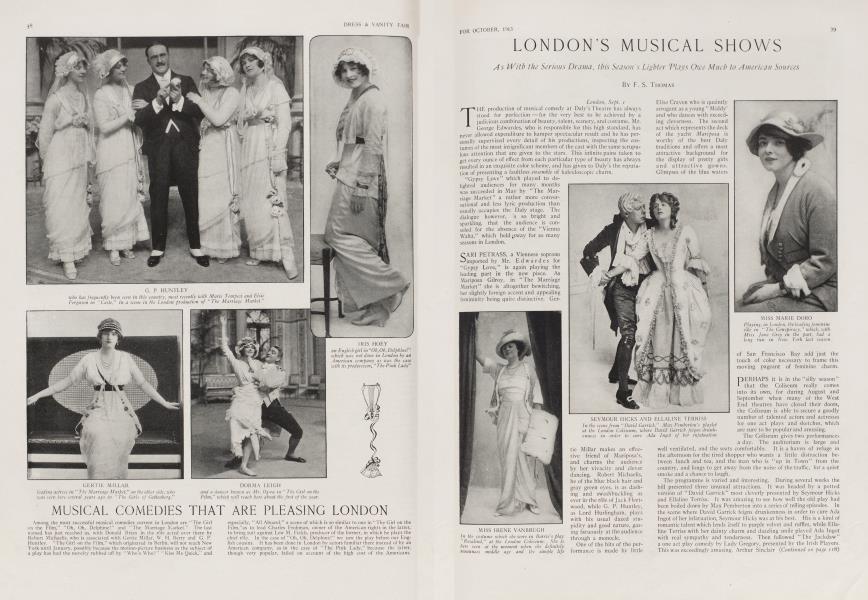
SARI PETRASS, a Viennese soprano imported by Mr. Edwardes for "Gypsy Love," is again playing the leading part in the new piece. As Mariposa Gilroy, in "The Marriage Market" she is altogether bewitching, her slightly foreign accent and appealing femininity being quite distinctive. Gertie Millar makes an effective friend of Mariposa's, and charms the audience by her vivacity and clever dancing. Robert Michaelis, he of the blue black hair and gray green eyes, is as dashing and swashbuckling as ever in the role of Jack Fleetwood, while G. P. Huntley, as Lord Hurlingham, plays with his usual dazed stupidity and good nature, gazing fatuously at the audience through a monocle.
One of the hits of the performance is made by little Elise Craven who is quaintly arrogant as a young " Middy' and who dances with exceeding cleverness. The second act which represents the deck of the yacht Mariposa is worthy of the best Daly traditions and offers a most attractive background for the display of pretty girls and attractive gowns. Glimpses of the blue waters of San Francisco Bay add just the touch of color necessary to frame this moving pageant of feminine charm.
PERHAPS it is in the "silly season" that the Coliseum really comes into its own, for during August and September when many of the West End theatres have closed their doors, the Coliseum is able to secure a goodly number of talented actors and actresses for one act plays and sketches, which are sure to be popular and amusing.
The Coliseum gives two performances a day. The auditorium is large and well ventilated, and the seats comfortable. It is a haven of refuge in the afternoon for the tired shopper who wants a little distraction between lunch and tea, and the man who is "up in Town" from the country, and longs to get away from the noise of the traffic, for a quiet smoke and a chance to laugh.
The programme is varied and interesting. During several weeks the bill presented three unusual attractions. It was headed by a potted version of "David Garrick" most cleverly presented by Seymour Hicks and Ellaline Terriss. It was amazing to see how well the old play had been boiled down by Max Pemberton into a series of telling episodes. In the scene where David Garrick feigns drunkenness in order to cure Ada Ingot of her infatuation, Seymour Hicks was at his best. His is a kind of romantic talent which lends itself to purple velvet and ruffles, while Ellaline Terriss with her dainty charm and dazzling smile played Ada Ingot with real sympathy and tenderness. Then followed "The Jackdaw" a one act play comedy by Lady Gregory, presented by the Irish Players. This was exceedingly amusing, Arthur Sinclair playing the part of Michael Cooney, the cautious brother of the afflicted Mrs. Broderick. The comedy hingeing upon the gift of ten pounds by Michael Cooney to his sister to save her from being sold up. Fearing she may come down upon him for future aid, he gives the money to Joseph Nester, trusting that he may devise some means of conveying it to the widow anonymously. The inspired Nester hits upon the idea of pretending that a rich stranger is in the village in search of jackdaws, and that during the widow Broderick's absence at court he has sold her jackdaw for ten pounds. At this news the whole village turns itself into bird catchers and the incidents involved in their new employment offer many amusing situations adapted to the peculiar art of the Irish Players.
(Continued on page 118)
(Continued from Page 39)
THE third attraction on the bill was "Rosalind," a comedy by Sir James Barrie, in which Irene Vanbrugh was delicious in the role of the weary actress who decides to flee from the boards and try the charms of middle age and a simple life in the country.
It is a searching bit of analysis, this one act study of a woman's moods, and Miss Vanbrugh knows how to adjust the value of each situation. When the curtain rose she appeared in a drab negligee with all worldly wile carefully concealed under a sober aspect of humdrum middle age. She informed her landlady that she was the mother of a gay daughter who was on the stage and who was her chief anxiety. The conversation was interrupted by the arrival of a young man, who, drenched by a sudden shower, sought shelter. Mrs. Page, for such is the name the actress affected, feigned sleep, and the young man was permitted to come to the fire. On the mantel was a photograph supposed to be Mrs. Page's daughter, which he instantly fell upon and kissed passionately. Curiosity leads Mrs. Page to open an eye and begin a conversation with the young man whom she has already recognized as her London admirer. Charles does not know the fascinating actress in her frumpy attire, and she encourages him to rave of his beloved Beatrice to whom he is engaged. Suddenly weary of playing the part of Mother she reveals her real identity and her age. He is stunned. At this moment a telegram is brought to Mrs. Page. It is a summons for her to return at once to London to play the part of Rosalind. At the summons her whole manner changes. She flees to her room to. dress, while Charles reviews the past and broods over the future. Through the closed door he tells her that he intends to stick to his engagement. The shock of her changed appearance may have temporily stunned him, but he is not a cad. He will stand by her. She makes a hasty toilette while she calls encouragement to her perplexed suitor through the door. Suddenly the door is flung open — through it steps a vision of youth, vitality, fascination and deviltry—Beatrice Page! Clad in a clinging white charmeuse gown, over which she wore a short loose jacket of white chiffon embroidered in red with ermine collar, topped by a ravishing black velvet turban adorned with a black aigrette, Miss Vanbrugh appeared the veritable daughter of her earlier mood and Charles torn between rapture and despair has only time to pick up his hat and fly with her to London, while she seriously explains to him that an actress has neither a real age nor a real identity.
COME OVER HERE," at the London Opera House, has won its sparkling way straight into the English heart. It is the breeziest kind of nonsense, covering all quarters of the globe and arousing pleasing but not too deep emotions. A succession of star attractions has been introduced into the regular performance
Such well known specialists as "Polaire" the French emotional eccentricity Anna Held of the jewelled stockings and rebellious eyes, Cleo de Merode, and May Yohe whose voice has lost some of its fog horn properties, have each played a short engagement.
The Swiss sports scene has especially appealed to the British public. Alfred and Siegfried Naess, the fancy skaters, added interest to the really beautiful and reaiistic setting of ice and snow, where fur clad maidens pelted the tobogganers of the opposite sex, and bob sleds flew down the winding ice run.
The Sumurun Scene came in for much admiration, introducing as it did the fascinating colors of the East in the costumes of the harem beauties. After this a special attraction was offered by Mile. Mado Minty and others in the Spider's Web — across the stage was stretched a huge web, in which Mile. Minty disported herself in real spider-like contortions, clad in black tights relieved by white markings. By her fantastic fascination she attracts a first prize blue bottle fly, a part most cleverly danced by Sadrene Storri.
THE plot of "Come Over Here" hinges on the elopement of Billy Horringer with Perle St. Leger and the mad chase for them instituted by Billy's father. The race between the train in which the young couple escape and the motor car containing the infuriated parent, one of the most exciting scenes presented in the Revue, was lifted bodily by the English producers from last year's New York Winter Garden show, "The Honeymoon Express," where the idea originated Throughout the piece the dancing is Original and excellent.
THE "Girl in the Taxi," another importation from New York, where it was produced in October, 1910, at the Astor Theatre, had a remarkable run of 383 performances and drew full houses continually to the Lyric.
THE Girl on the Film" is a breezy musical. farce which has met with pronounced success at the Gaiety. It gives plenty of scope for extravagant mirth and yet retains enough plot to prove interesting to those who like to follow a story.
OH! OH! DELPHINE" ran to 176 performances, at the Shaftesbury, where delighted audiences crowded nightly to applaud the beautiful and magnetic Yvonne Arnaud.
THE Empire includes many beauties in its programme of "All the Winners," and also presents some interesting turns. The most taking of the dancers was without doubt the fascinating Russian Lydia Kyasht, who fairly captivated the audience by her cleverness and grace. The vogue of the Russian dancers seems destined to continue, for they please by reason of their extreme originality in both dances and costumes, and the verve and abandon of their art.
AT THE Palace, the star attraction this season, as in so many preceding seasons was the matchless Pavlowa. Her initimable dancing has captured London and no newcomer can shake her reputation as Russia's foremost dancer. In the Butterfly, La Bacchante, and the Swan, the latter of which she dances to Saint-Saen's exquisite fragment "Le Cygne," she seems like some bewitching, ethereal wraith whose restless spirit has found its way to earth. She is the veritable expression of music, its soul and the heart of its illusion.
Subscribers have complete access to the archive.
Sign In Not a Subscriber?Join Now
