Sign In to Your Account
Subscribers have complete access to the archive.
Sign In Not a Subscriber?Join NowLONDON'S NEW PLAYS ARE MOSTLY OLD ONES
Interest Centers Upon the Revival of Old Successes by Barrie and Shaw, and the Production of Winchell Smith's "Fortune Hunter" and "L'Assaut" by Bernstein
F. S. Thomas
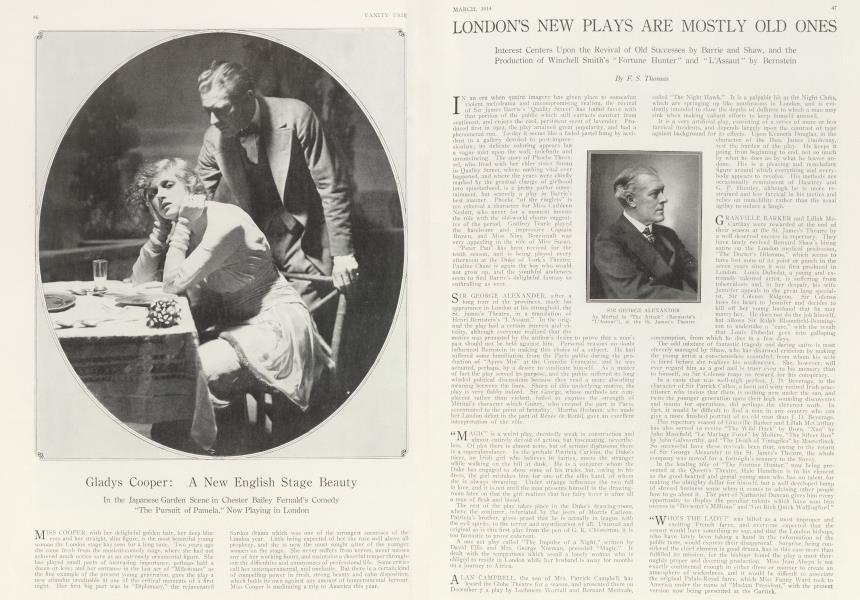
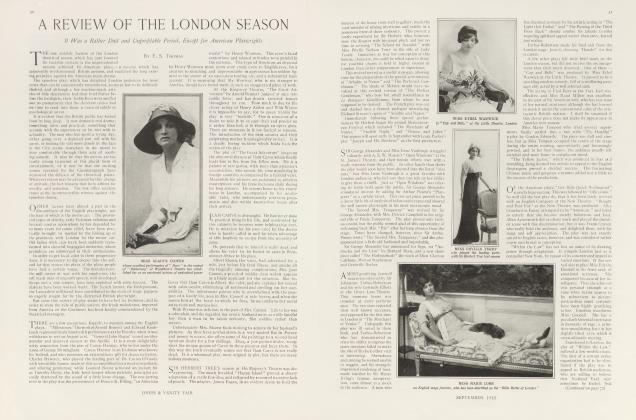
IN an era when quaint imagery has given place to somewhat violent melodrama and uncompromising realism, the revival of Sir James Barrie's "Quality Street" has found favor with that portion of the public which still extracts comfort from sentiment, and enjoys the cool, persistent scent of lavender. Produced first in 1902, the play attained great popularity, and had a phenomenal run. To-day it seems like a faded pastel hung by accident in a gallery devoted to post-impressionism; its delicate coloring appears but a vague mist upon the wall, indefinite and unconvincing. The story of Phoebe Throssel, who lived with her elder sister Susan in Quality Street, where nothing vital ever happened, and where the years were chiefly marked by the gradual change of girlhood into spinsterhood, is a pretty parlor entertainment, but scarcely a play in Barrie's best manner. Phoebe "of the ringlets" is too ethereal a character for Miss Cathleen Nesbitt, who never for a moment invests the role with the old-world charm suggestive of the period. Godfrey Tearle played the handsome and impressive Captain Brown, and Miss Nina Boucieault was very appealing in the rôle of Miss Susan.
"Peter Pan" has been revived for the tenth season, and is being played every afternoon at the Duke of York's Theatre. Pauline Chase is again the boy who would not grow up, and the youthful audiences seem to find Barrie's delightful fantasy as enthralling as ever.
SIR GEORGE ALEXANDER, after a long tour of the provinces, made his appearance in London at his stronghold, the St. James's Theatre, in a translation of Henri Bernstein's "L'Assaut." In the original the play had a certain interest and vitality, although everyone realized that the motive was prompted by the author's desire to prove that a man's past should not be held against him. Personal reasons no doubt influenced Bernstein in making this choice of a subject. He had suffered some humiliation from the Paris public during the production of "Apres Moi" at the Comedie Française, and he was actuated, perhaps, by a desire to vindicate himself. As a matter of fact the play served its purpose, and the public suffered its long winded political discussions because they read a more absorbing meaning between the lines. Shorn of this underlying motive, the play is very flabby indeed. Sir George, whose methods are complacent rather than violent, failed to express the strength of Mental's character which Guitry, who created the part in Paris, accentuated to the point of brutality. Martha Hedman, who made her London debut in the part of Renee de Rould, gave an excellent interpretation of the role.
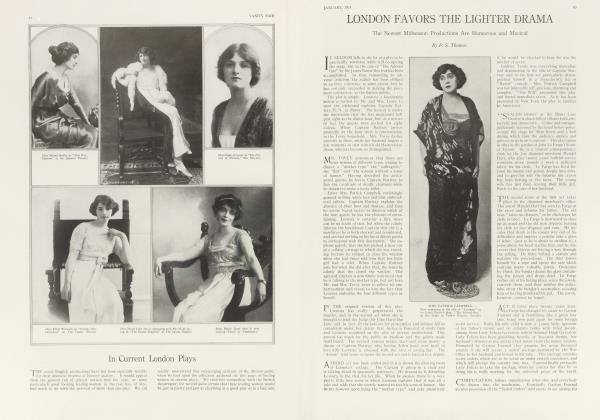
"MAGIC" is a weird play, decidedly weak in construction and almost entirely devoid of action, but fascinating, nevertheless. Of plot there is almost none, but of serious discussion there is a superabundance. In the prelude Patricia Carleon. the Duke's niece, an Irish girl who believes in fairies, meets the stranger while walking on the hill at dusk. Pie is a conjurer whom the Duke has engaged to show some of his tricks, but. owing to his dress, the girl mistakes him for one of the elfin band, of whom she is always dreaming. Under strange influences the two fall in love, and it is not until the man presents himself in the drawingroom later on that the girl realizes that her fairy lover is after all a man of flesh and blood.
The rest of the play takes place in the Duke's drawing-room, where the conjurer, infuriated by the jeers of Morris Carleon. Patricia's brother, gives proof that he is actually in league with the evil spirits, to the terror and mystification of all. Unusual and original as is this first play from the pen of G. K. Chesterton, it is too fantastic to prove coherent.
A one act play called "The Impulse of a Night," written by David Ellis and Mrs. George Norman, preceded "Magic." It dealt with the temptations which assail a lonely woman who is obliged to reside in London while her husband is away for months on a journey to Africa.
ALAN CAMPBELL, the son of Mrs. Patrick Campbell, has leased the Globe Theatre for a season, and presented there on December 7 a play by Lechmere Worrall and Bernard Merivale, called "The Night Hawk." It is a palpable hit at the Night Clubs, which are springing up like mushrooms in London, and is evidently intended to show the depths of dullness to which a man may sink when making valiant efforts to keep himself amused.
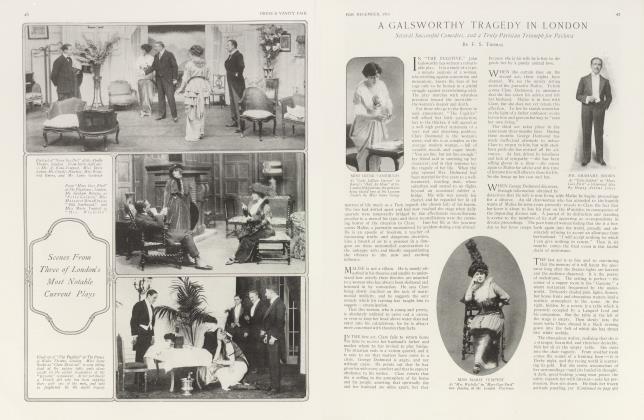
It is a very artificial play, consisting of a series of more or less farcical incidents, and depends largely upon the contrast of type against background for its effects. Upon Kenneth Douglas, in the character of the Hon. James Daubenay, rest the burden of the play. He keeps it going from beginning to end, not so much by what he does as by what he leaves undone. His is a pleasing and nonchalant figure around which everything and everybody appears to revolve. His methods are occasionally reminiscent of Hawtrey and G. P. Huntley, although he is more restrained and less farcical in his tactics and relies on immobility rather than the usual agility to induce a laugh.
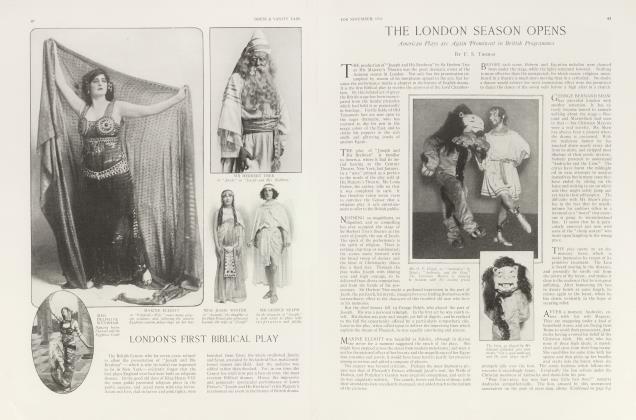
GRANVILLE BARKER and Lillah McCarthay were rewarded at the end of their season at the St. James's Theatre by a well deserved success in repertory. They have lately revived Bernard Shaw's biting satire on the London medical profession, The Doctor's Dilemma," which seems to have lost none of its point or punch in the seven years since it was first produced in London. Louis Dubedat, a young and extremely talented artist, is suffering from tuberculosis and, in her despair, his wife Jennifer appeals to the great lung specialist, Sir Colenso Ridgeon. Sir Colenso loses his heart to Jennifer and decides to kill off her young husband that he may marry her. He does not do the job himself, but allows Sir Ralph Bloomfield-Bonnington to undertake a "cure," with the result that Louis Dubedat goes into galloping goes consumption, from which he dies in a few days.
The odd mixture of fantastic tragedy and daring satire is most cleverly managed by Shaw, who has disarmed criticism by making the young artist a conscienceless scoundrel from whom his wife is freed before she realizes his weaknesses. She, however, will ever regard him as a god and is truer even to his memory than to himself, so Sir Colenso reaps no reward for his conspiracy.
In a caste that was well-nigh perfect, J. D. Beverage, in the character of Sir Patrick Cullen, a keen and witty retired Irish practitioner who insists that there is nothing new under the sun, and twits the younger generation upon their high sounding discoveries and mania for operations, did perhaps the cleverest work. In fact, it would be difficult to find a man in any country who can give a more finished portrait of an old man than J. D. Beverage.
This repertory season of Granville Barker and Lillah McCarthay has also served to revive "The Wild Duck" by Ibsen. "Nan" by John Masefield, "Le Mariage Force" by Moliere, "The Silver Box" by John Galsworthy, and "The Death of Tintagiles" by Maeterlinck. So successful have these revivals been that, owing to the return of Sir George Alexander to the St. James's Theatre, the whole company was moved for a fortnight's tenancy to the Savoy.
In the leading role of "The Fortune Hunter," now being presented at the Queen's Theatre. Hale Hamilton is in his element as the good-hearted and genial young man who has no talent for making the almighty dollar for himself, but a well developed bump of shrewd business sense when it comes to advising other people how to go about it. The part of Nathaniel Duncan gives him every opportunity to display the peculiar talents which have won him success in "Brewster's Millions" and "Get Rich Quick Wallingford."
WHO'S THE LAD'S?" was billed as a most improper and exciting French farce, and everyone expected that the censor would have something to say, and that the London bishops, who have lately been taking a hand in the reformation of the public taste, would express their disapproval. Surprise, being considered the chief element in good drama, has in this case more than fulfilled its mission, for the bishops found the play a most thoroughly proper and diverting production. Miss Jean Alwyn is not exactly continental enough in either dress or manner to create an atmosphere of wickedness, and it would be difficult to associate the original Palais-Royal farce, which Miss Fanny Ward took to America under the name of "Madam President," with the present version now being presented at the Garrick.
Subscribers have complete access to the archive.
Sign In Not a Subscriber?Join Now