Sign In to Your Account
Subscribers have complete access to the archive.
Sign In Not a Subscriber?Join NowA DUCAL STAGE MANAGER
The Duke of Saxe-Meiningen, Who Did More to Advance Shakespearian Productions than Any Man of Our Time
James L. Ford
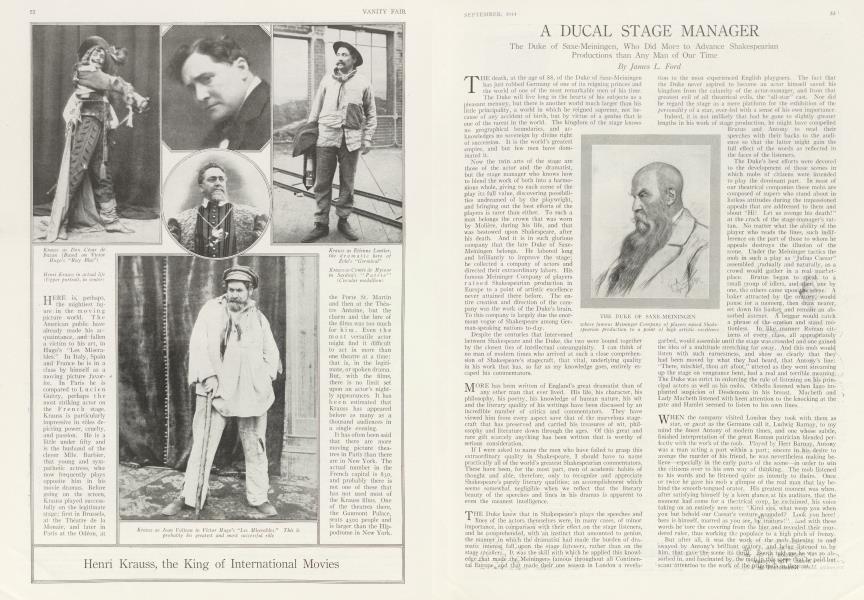
THE death, at the age of 88, of the Duke of Saxe-Meiningen has just robbed Germany of one of its reigning princes and the world of one of the most remarkable men of his time. The Duke will live long in the hearts of his subjects as a pleasant memory, but there is another world much larger than his little principality, a world in which he reigned supreme, not because of any accident of birth, but by virtue of a genius that is one of the rarest in the world. The kingdom of the stage knows no geographical boundaries, and acknowledges no sovereign by divine right of succession. It is the world's greatest empire, and but few men have dominated it.
Now the twin arts of the stage are those of the actor and the dramatist, but the stage manager who knows how to blend the work of both into a harmonious whole, giving to each scene of the play its full value, discovering possibilities undreamed of by the playwright, and bringing out the best efforts of the players is rarer than either. To such a man belongs the crown that was worn by Molière, during his life, and that was bestowed upon Shakespeare, after his death. And it is in such glorious company that the late Duke of SaxeMeiningen belongs. He labored long and brilliantly to improve the stage; he collected a company of actors and directed their extraordinary labors. His famous Meininger Company of players raised Shakespearian production in Europe to a point of artistic excellence never attained there before. The entire creation and direction of the company was the work of the Duke's brain. To this company is largely due the enormous vogue of Shakespeare among German-speaking nations to-day.
Despite the centuries that intervened between Shakespeare and the Duke, the two were bound together by the closest ties of intellectual consanguinity. I can think of no man of modern times who arrived at such a close comprehension of Shakespeare's stagecraft, that vital, underlying quality in his work that has, so far as my knowledge goes, entirely escaped his commentators.
MORE has been written of England's great dramatist than of any other man that ever lived. His life, his character, his philosophy, his poetry, his knowledge of human nature, his wit and the literary quality of his writings have been discussed by an incredible number of critics and commentators. They have viewed him from every aspect save that of the marvelous stagecraft that has preserved and carried his treasures of wit, philosophy and literature down through the ages. Of this great and rare gift scarcely anything has been written that is worthy of serious consideration.
If I were asked to name the men who have failed to grasp this extraordinary quality in Shakespeare, I should have to name practically all of the world's greatest Shakespearian commentators. These have been, for the most part, men of academic habits of thought and able, therefore, only to recognize and appreciate Shakespeare's purely literary qualities; an accomplishment which seems somewhat, negligible. when we reflect that the literary beauty of the speeches and lines in his dramas is apparent to even the meanest intelligence.
THE Duke knew that in Shakespeare's plays the speeches and lines of the actors themselves were, in many cases, of minor importance, in comparison with their effect .on the stage listeners, and he comprehended, with an instinct that amounted to genius, the manner, in which the dramatist' had made the burden of dramatic interest fall upon the stage. listeners,, rather than on the stage speakers. It was the skill with which he applied this knowledge That made The Meiningers. famous throughout all Continental Europe and that made their one season in London a revela-
tion to the most experienced English playgoers. The fact that the Duke never aspired to become an actor himself saved his kingdom from the calamity of the actor-manager, and from that greatest evil of all theatrical evils, the "all-star" cast. Nor did he regard the stage as a mere platform for the exhibition of the personality of a star, over-fed with a sense of his own importance.
Indeed, it is not unlikely that had he gone to slightly greater lengths in his work of stage production, he might have compelled Brutus and Antony to read their speeches with their backs to the audience so that the latter might gain the full effect of the words as reflected in the faces of the listeners.
The Duke's best efforts were devoted to the development of those scenes in which mobs of citizens were intended to play the dominant part. In most of our theatrical companies these mobs are composed of supers who stand about in listless attitudes during the impassioned appeals that are addressed to them and shout "Hi! Let us avenge his death!" at the crack of the stage-manager's rattan. No matter what the ability of the player who reads the lines, such indifference on the part of those to whom he appeals destroys the illusion of the scene. Under the Meininger tactics the mob in such a play as "Julius Caesar" assembled gradually and naturally, as a crowd would gather in a real marketplace. Brutus began to speak to a small group of idlers, and one by one, the others came upon the scene A baker attracted by the oratory, would pause for a moment, then draw nearer, set down his basket and remaian absorbed listener. A beggar would catch a phrase of the oration and stand motionless. In like manner Roman citizens of every class, all appropriately garbed, would assemble until the stage was crowded and one gained the idea of a multitude stretching far away,.. And this mob would listen with such earnestness, and show so clearly that they had been moved by what they had heard, that Antony's line: "There, mischief, thou art afoot," uttered as they went streaming up the stage on vengeance bent, had a real and terrible meaning; The. Duke was strict in enforcing the rule of listening on principal actors as well as his mobs. Othello listened when lago implanted suspicion of Desdemona in his breast. Macbeth and Lady Macbeth listened with keen attention to the knocking at the gate and Hamlet seemed to listen to his own lines...
WHEN the company visited London they took with them as star, or guest as the. Germans call it, Ludwig Barnay, to my mind the finest Antony of modern times, and one whose subtle, finished interpretation of the great Roman patrician blended perfectly with the work of the mob. Played by Herr Barnay, Antony was a man acting a part within a part;, sincere in,,desire to avenge the murder of his friend, he was nevertheless making believe—especially in the early parts of the scene—in order to win the citizens over to his own way of thinking. The mob listened to his words and he listened quite as intently to theirs. Once or twice he gave his mob a glimpse of the real man That lay behind the smooth-tongued orator. His greatest moment was when, after satisfying himself by a keen glance, at his auditors, that the moment had come for a theatrical coup, he..exclaimed, his voice taking on an entirely new note: "Kind sirs, what weep you when you but behold our Caesar's vesture aunded? Look you here! here is himself, marred as you see, by traitors!". And with these words he tore the covering from the bier, and revealed, their murdered ruler, thus working the populace to a high pitch of frenzy.
But after all, it was the work of the mob listening to and swayed by Antony's brilliant oratory, and being listend to by him, that gave the scene its Booth told me he was so absorbed in, and fascinated that he paid but scant attention to the work of the principals in there cast
Subscribers have complete access to the archive.
Sign In Not a Subscriber?Join Now