Sign In to Your Account
Subscribers have complete access to the archive.
Sign In Not a Subscriber?Join NowNew York Opera Audiences
Certain Fatal Results of Their Tolerance
PITTS SANBORN
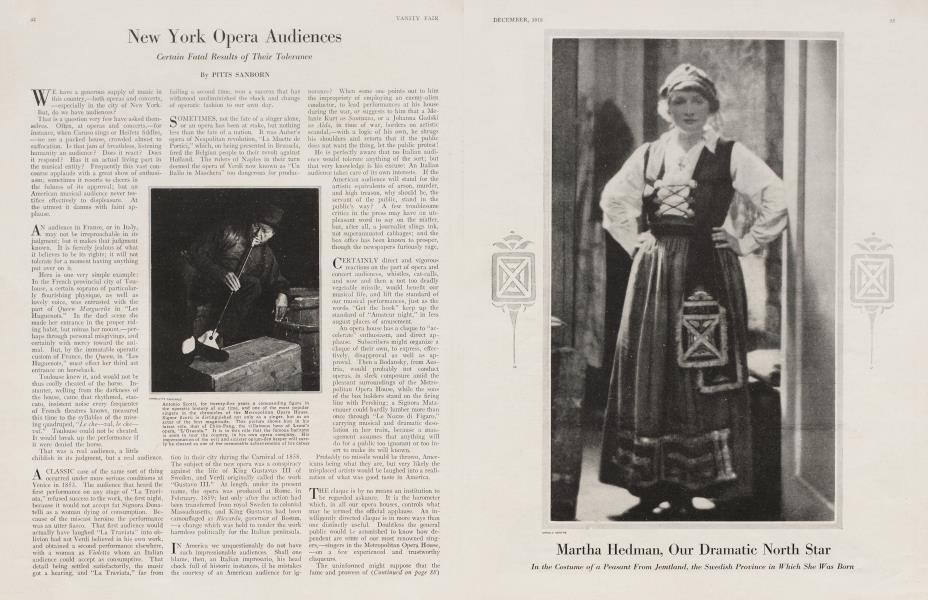
WE have a generous supply of music in this country,—both operas and concerts, —especially in the city of New York.
But, do we have audiences?
That is a question very few have asked themselves. Often, at operas and concerts,—for instance, when Caruso sings or Heifetz fiddles, —we see a packed house, crowded almost to suffocation. Is that jam of breathless, listening humanity an audience? Does it react? Does it respond? Has it an actual living part in the musical entity? Frequently this vast concourse applauds with a great show of enthusiasm; sometimes it resorts to cheers in the fulness of its approval; but an American musical audience never testifies effectively to displeasure. At the utmost it damns with faint applause.
AN audience in France, or in Italy, may not be irreproachable in its judgment; but it makes that judgment known. It is fiercely jealous of what it believes to be its rights; it will not tolerate for a moment having anything put over on it.
Here is onevery simple example: In the French provincial city of Toulouse, a certain soprano of particularly flourishing physique, as well as lovely voice, was entrusted with the part of Queen Marguerite in "Les Huguenots." In the duel scene she made her entrance in the proper riding habit, but minus her mount,—perhaps through personal misgivings, and certainly with mercy toward the animal. But, by the immutable operatic custom of France, the Queen, in "Les Huguenots," must effect her third act entrance on horseback.
Toulouse knew it, and would not be thus coolly cheated of the horse. Instanter, welling from the darkness of the house, came that rhythmed, staccato, insistent noise every frequenter of French theatres knows, measured this time to the syllables of the missing quadruped, "Le che—val, le che— val." Toulouse could not be cheated. It would break up the performance if it were denied the horse.
That was a real audience, a little childish in its judgment, but a real audience.
A CLASSIC case of the same sort of thing occurred under more serious conditions at Venice in 1853. The audience that heard the first performance on any stage of "La Traviata," refused success to the work, the first night, because it would not accept fat Signora Donatelli as a woman dying of consumption. Because of the miscast heroine the performance was an utter fiasco. That first audience would actually have laughed "La Traviata" into oblivion had not Verdi believed in his own work, and obtained a second performance elsewhere, with a woman as Violetta whom an Italian audience could accept as consumptive. That detail being settled satisfactorily, the music got a hearing, and "La Traviata," far from failing a second time, won a success that has withstood undiminished the shock and change of operatic fashion to our own day.
SOMETIMES, not the fate of a singer alone, or an opera has been at stake, but nothing less than the fate of a nation. It was Auber's opera of Neapolitan revolution, "La Muette de Portici," which, on being presented in Brussels, fired the Belgian people to their revolt against Holland. The rulers of Naples in their turn deemed the opera of Verdi now known as "Un Ballo in Maschera" too dangerous for production in their city during the Carnival of 1858. The subject of the new opera was a conspiracy against the life of King Gustavus III of Sweden, and Verdi originally called the work "Gustavo III." At length, under its present name, the opera was produced at Rome, in February, 1859; but only after the action had been transferred from royal Sweden to colonial Massachusetts, and King Gustavus had been camouflaged as Riccardo, governor of Boston, —a change which was held to render the work harmless politically for the Italian peninsula.
IN America we unquestionably do not have such impressionable audiences. Shall one blame, then, an Italian impresario, his head chock full of historic instances, if he mistakes the courtesy of an American audience for ignorance? When some one points out to him the impropriety of employing an enemy-alien conductor, to lead performances at his house during the war, or suggests to him that a Melanie Kurt as Santuzza, or a Johanna Gadski as Aïda, in time of war, borders on artistic scandal,—with a logic of his own, he shrugs his shoulders and retorts that if the public does not want the thing, let the public protest!
He is perfectly aware that no Italian audience would tolerate anything of the sort; but that very knowledge is his excuse: An Italian audience takes care of its own interests. If the American audience will stand for the artistic equivalents of arson, murder, and high treason, why should he, the servant of the public, stand in the public's way ? A few troublesome critics in the press may have an unpleasant word to say on the matter, but, after all, a journalist slings ink, not superannuated cabbages; and the box office has been known to prosper, though the newspapers furiously rage.
CERTAINLY direct and vigorous reactions on the part of opera and concert audiences, whistles, cat-calls, and now and then a not too deadly vegetable missile, would benefit our musical life, and lift the standard of our musical performances, just as the words "Get the hook" keep up the standard of "Amateur night," in less august places of amusement.
An opera house has a claque to "accelerate" enthusiasm, and direct applause. Subscribers might organize a claque of their own, to express, effectively, disapproval as well as approval. Then a Bodansky, from Austria, would probably not conduct operas, in sleek composure amid the pleasant surroundings of the Metro-, politan Opera House, while the sons of the box holders stand on the firing line with Pershing; a Signora Matzenauer could hardly lumber more than once through "Le Nozze di Figaro," carrying musical and dramatic desolation in her train, because a management assumes that anything will do for a public too ignorant or too inert to make its will known.
Probably no missile would be thrown, Americans being what they are, but very likely the misplaced artists would be laughed into a realization of what was good taste in America.
THE claque is by no means an institution to be regarded askance. It is the barometer which, in all our opera houses, controls what may be termed the official applause. An intelligently directed claque is in more ways than one distinctly useful. Doubtless the general public would be astonished to know how dependent are some of our most renowned singers,—singers in the Metropolitan Opera House, —on a few experienced and trustworthy claqueurs.
The uninformed might suppose that the fame and prowess of such a singer and his or her ability to stir vast throngs would suffice to keep him in nerve. But no. From the knowledge that a few tried claquers are on hand to bolster him with applause at the point where he craves it, he has the same feeling of assurance that a confirmed ocean traveller has from the presence in his cabin of a life preserver.
Continued on page 88
Continued from page 32
Then there are further and more general uses for the claque. To the leader of the claque, our renowned New York impresario may say: "Bring so many of your veteran troops, with trusted lieutenants, to-morrow night. I want a round of applause for the conductor, on his entrance; two recalls for the prima donna after her first solo, three curtain calls at the end of the first act, five at the end of the second," and so on.
Of course, not curtain calls but box office returns register popular success; but the former can powerfully help the latter on, by creating an atmosphere of success.
NOW, the public, by banding together, could, in its turn, by means of applause and hisses, make effective its pleasure and displeasure. We should not listen helplessly to the vocal and instrumental wooings of uninterned aliens, we should not put up, week after week, with the ministrations of a mastodonic contralto in a role designed for a light and graceful soprano. We should, in short, have a public opinion in musical matters—not an infallible public opinion, but at least a vigorous and wholesome opinion.
IT has been difficult to explain to distinguished French and Italian visitors to our shores, some of the phenomena of our musical performances during the war. They do not understand. Employing a quick practical intelligence, they go directly to the root of the matter, in this wise: "We have heard that your country, musically speaking, is German," or "That couldn't be done in France or Italy; our audiences are too malins."
We flounder around in an explanation and then we stop short. The most courteous peoples in the world do not recognize any courtesy that takes the form either of ignorance or of indifference.
So, why blame a foreign impresario for dealing with facts as a nation presents them to his consciousness? The long and the short of it is that this war has awakened some of us Americans to the artistic,—yes, artistic,—fact that the vital need to-day of our American opera houses and concert rooms is not a crowded attendance, but a critical and Outspoken audience.
Subscribers have complete access to the archive.
Sign In Not a Subscriber?Join Now
