Sign In to Your Account
Subscribers have complete access to the archive.
Sign In Not a Subscriber?Join NowThe Russian Ballets
Impressions of the Illusion and Realities of the Dancers' Art
ARTHUR SYMONS
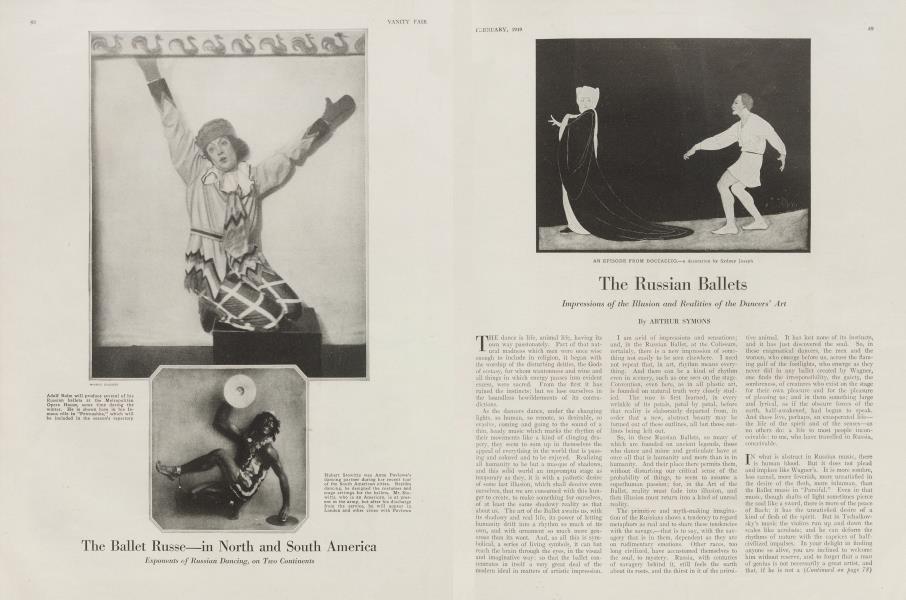
THE dance is life, animal life, having its own way passionately. Part of that natural madness which men were once wise enough to include in religion, it began with the worship of the disturbing deities, the Gods of ecstasy, for whom wantonness and wine and all things in which energy passes into evident excess, were sacred. From the first it has ruined the instincts: but.we lose ourselves in the boundless bewilderments of its contradictions.
As the dancers dance, under the changing lights, so human, so remote, so desirable, so evasive, coming and going to the sound of a thin, heady music which marks the rhythm of their movements like a kind of clinging drapery, they seem to sum up in themselves the appeal of everything in the world that is passing and colored and to be enjoyed. Realizing all humanity to be but a masque of shadows, and this solid world an impromptu stage as temporary as they, it is with a pathetic desire of some last illusion, which shall deceive even ourselves, that we are consumed with this hunger to create, to make something for ourselves, of at least the same shadowy reality as that about us. The art of the Ballet awaits us, with its shadowy and real life, its power of letting humanity drift into a rhythm so much of its own, and with ornament so much more generous than its wont. And, as all this is symbolical, a series of living symbols, it can but reach the brain through the eyes, in the visual and imaginative way: so that the ballet concentrates in itself a very great deal of the modern ideal in matters of artistic impression.
I am avid of impressions and sensations; and, in the Russian Ballet, at the Coliseum, certainly, there is a new impression of something not easily to be seen elsewhere. I need not repeat that, in art, rhythm means everything. And there can be a kind of rhythm even in scenery, such as one sees on the stage. Convention, even here, as in all plastic art, is founded on natural truth very closely studied. The rose is first learned, in every wrinkle of its petals, petal by petal, before that reality is elaborately departed from, in order that a new, abstract beauty may be formed out of these outlines, all but those outlines being left out.
So, in these Russian Ballets, so many of which are founded on ancient legends, those who dance and mime and gesticulate have at once all that is humanity and more than is in humanity. And their place there permits them, without disturbing our critical sense of the probability of things, to seem to assume a superhuman passion; for, in the Art of the Ballet, reality must fade into illusion, and then illusion must return into a kind of unreal reality.
The primitive and myth-making imagination of the Russians shows a tendency to regard metaphors as real and to share these tendencies with the savage,—that is to say, with the savagery that is in them, dependent as they are on rudimentary emotions. Other races, too long civilized, have accustomed themselves to the soul, to mystery. Russia, with centuries of savagery behind it, still feels the earth about its roots, and the thirst in it of the primitive animal. It has lost none of its instincts, and it has just discovered the soul. So, in these enigmatical dancers, the men and the women, who emerge before us, across the flaming gulf of the footlights, who emerge as they never did in any ballet created by Wagner, one finds the irresponsibility, the gaiety, the sombreness, of creatures who exist on the stage for their own pleasure and for the pleasure of pleasing us; and in them something large and lyrical, as if the obscure forces of the earth, half-awakened, had begun to speak. And these live, perhaps, an exasperated life— the life of the spirit and of the senses—as no others do: a life to most people inconceivable: to me, who have travelled in Russia, conceivable.
IN what is abstract in Russian music, there is human blood. But it does not plead and implore like Wagner's. It is more sombre, less carnal, more feverish, more unsatisfied in the desire of the flesh, more inhuman, than the Ballet music in "Parsifal." Even in that music, though shafts of light sometimes pierce the soul like a sword, there is more of the peace of Bach; it has the unsatisfied desire of a kind of flesh of the spirit. But in Tschaikovsky's music the violins run up and down the scales like acrobats; and he can deform the rhythms of nature with the caprices of halfcivilized impulses. In your delight in finding anyone so alive, you are inclined to welcome him without reserve, and to forget that a man of genius is not necessarily a great artist, and that, if he is not a great artist, he is not a quite satisfactory man of genius.
Continued on page 78
Continued from page 49
When I heard his music in "The Enchanted Princess" I was struck by the contrast of this ballet music with the overture to "Francesca da Rimini" I had heard years before. The red wind of hell, in which the lovers are afloat, blows and subsides. There is a taste of sulphur in the mouth as it ends, after the screams and spasms. Scrawls of hell-fire rush across the violins into a sharpened agony; above all, not Dante's; always hell fire, not the souls of unhappy lovers who have loved too well.
LYDIA LOPOKOVA is certainly a perfeet artist, whose dancing is a delight to the eyes, as her miming appeals to the senses. She has passion, and of an excitable kind; in a word, Russian passion. She can be delicious malicious, abrupt in certain movements when she walks; she has daintiness and gaiety; her poses and poises are exquisite: there is an amazing certainty in everything she does. A creature of sensitive nerves, in whom the desire of perfection is the same as her desire for fame, she is on the stage and off the stage essentially the same. And, in her conversations with me, I find imagination, an unerring instinct, an intense thirst for life and for her own art: she has la joie de vivre.
Her technique, of course, is perfect; and, as in the case of every artist, it is the result of tireless patience. Technique and the artist: that is a question of interest to the student of every art. Without technique, perfect of its kind, no one is worth consideration in any art. The rope-dancer or the acrobat must be perfect in technique before he appears on the stage at all; in his case, a lapse from perfection brings its own penalty, —nieath, perhaps. His art begins when his technique is already perfect. Artists who deal in materials less fragile than human life should have no less undeviating a sense of responsibility to themselves and to art. So Ysaye seems to me the type of the artist, not because he is faultless in technique, but because he begins to create his art, at the point where faultless technique leaves off.
Lubov Tchemicheva is a snake-like creature, beautiful and hieratic, solemn; and, in her aspect as in her gestures, a kind of Russian Cleopatra. Swinburne might have sung of her as he sang of the queen who ruled the world and Antony:—
"Her mouth is fragrant as a vine,
A vine with birds in all its boughs;
Serpent and scarab for a sign
Between the beauty of her brows
And the amorous deep lids divine."
And it is a revelation to our jaded imaginations of much less jaded imaginations. These may be supposed to be characters in themselves o'f little interest to the world in general; to have come by strange accident from the ends of the world. Yet these are thrown into chosen situations, apprehended in some delicate pauses of life: they have their moments of passion thrown into relief as an exquisite way. To discriminate them we need a cobweb of illusions, double and treble reflections of the mind upon itself, with the artificial light of the stage cast over them; and, as it were, constructed and broken over this or that chosen situation—on how fine a needle's point that little world of passion is balanced 1
ON seeing "Carnival" for the second time, I am more than ever struck by the fact that the Ballet is a miracle of moving motion. In the dance of Columbine and Harlequin—they danced and mimed like living marionettes—I recalled vividly my impression on seeing a ballet, a farce, and the fragments of an opera performed by the marionettes at the Costanzi Theatre in Rome. I was inclined to ask myself why we require the intervention of any less perfect medium between the meaning of a piece, as the audience conceived it, and that other meaning which it derives from our reception of it. In those inspired pieces of living painted wood, I saw the illusion that I always desire to find, either in the wings of the theatre or from a stall. In our marionettes, then, we get personified gesture, endless gesture, like all other forms of emotion, generalized. The appeal in what seems to you those childish maneuvres is to a finer, because to a more innately poetic, sense of things than the rationalistic appeal of very modern plays. If at times, we laugh—as one must in this Ballet—it is with wonder at seeing humanity . so gay, heroic, and untiring. There is the romantic suggestion of magic in this beauty. So, in Harlequin, I find the personification of grace, of souplesse, in his miming and dancing; and, when he is grotesque, I find a singular kind of beauty. A sinister gaiety pervades the ballet; a malevolent undercurrent of subtle meanings gives one the sense of an intricate intrigue; and I almost forgive the fact that the music is German.
I AM, on the whole, disappointed with the "Cleopatra" ballet; for the scenery certainly does not suggest Egypt; but, to my mind, suggests rather the scenery used in Paris when I saw Alfred Jassy's "Ubu Roi," a Symbolist dance, given under strange conditions. The action took place in the land of nowhere; and the scenery was painted to represent, by adroit conventions, temperate and torrid zones at once. Then there were closed windows and a fireplace, containing an alchemist's crucible. These were crudely symbolical, but those in the Coliseum were not. In our search for sensation we have exhausted sensation; and, in that theatre, before a people who have perfected the fine shades to their vanishing point, who have subtilized delicacy of perception into the annihilation of the very senses through which we take in ecstasy, I heard a literary Sansculotte shriek for hours that unspeakable word of the gutter which was the refrain of this comedy of masks. Just as the seeker after pleasure whom pleasure has exhausted, so the seeker after the material illusions of a literary artifice turns finally to that subjugated yet never quite exterminated element of cruelty which is one of the links which bind us to the earth.
THE Russians have cruelty enough, but not this kind of cruelty: they are more complex than cruel, and why credit them with any real sense of morality? They are gifted with a kind of sick curiosity, which makes them infinitely interesting to themselves. And —to concern myself again with these Russian dancers—they live in a prodigious illusion. Their life in them is so tremendous that they are capable of imagining anything. And, in the words of Gorky, "in every being who lives there is hidden a vagabond more or less conscious of himself."
And Lubov Tchernicheva, who looked Cleopatra and was dressed after Cleopatra's fashion, had nothing whatever to do, except to be repellant and attractive. She was given no chance to show that the queen she represented was one of those diabolical creatures whose coquetry is all the more dangerous because it is susceptible of passion; one in whom passion was at times like a will-o'-the-wisp that is suddenly extinguished after having given light to a conflagration.
Subscribers have complete access to the archive.
Sign In Not a Subscriber?Join Now
