Sign In to Your Account
Subscribers have complete access to the archive.
Sign In Not a Subscriber?Join NowThe Hunt for Happiness
Somewhat Historic Research Applied to a Problem Ever-present with Week-Enders
SHEPARD LITTLECHURCH
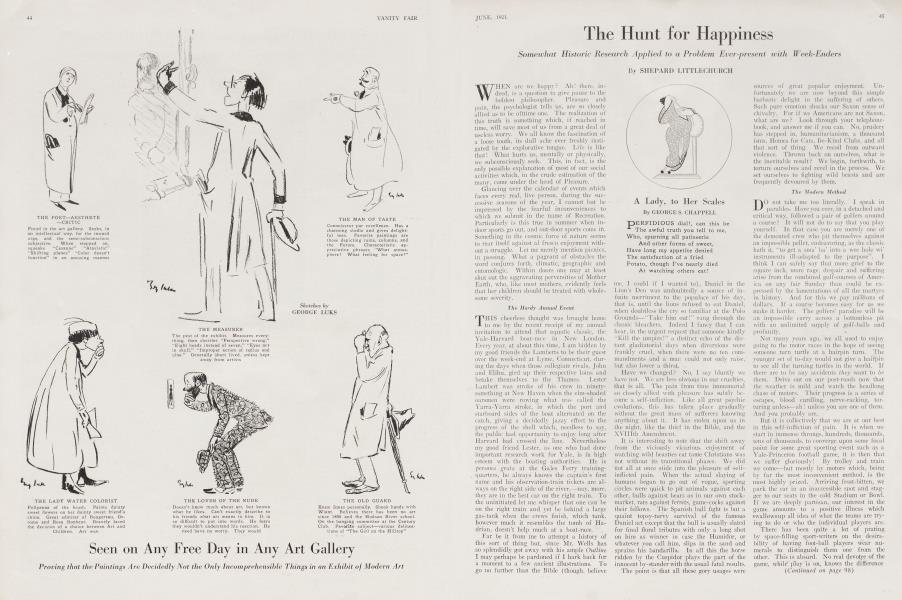
WHEN are we happy? Ah! there, indeed, is a question to give pause to the boldest philosopher. Pleasure and pain, the psychologist tells us, are so closely allied as to be ofttime one. The realization of this truth is something which, if reached in time, will save most of us from a great deal of useless worry. We all know the fascination of a loose tooth, its dull ache ever freshly instigated by the explorative tongue. Life is like that! What hurts us, mentally or physically, we subconsciously seek. This, in fact, is the only possible explanation of most of our social activities which, in the crude estimation of the many, come under the head of Pleasure.
Glancing over the calendar of events .which faces every real, live person, during the successive seasons of the year, I cannot but be impressed by the fearful inconveniences to which we submit in the name of Recreation. Particularly is this true in summer when indoor sports go out, and out-door sports come in. Something in the cosmic force of nature seems to rear itself against al fresco enjoyment without a struggle. Let me merely mention picnics, in passing. What a pageant of obstacles the word conjures forth, climatic, geographic and entomologic. Within doors one may at least shut out the aggravating perversities of Mother Earth, who, like most mothers, evidently feels that her children should be treated with wholesome severity.
The Hardy Annual Event
THIS cheerless thought was brought home to me by the recent receipt of my annual invitation to attend that aquatic classic, the Yale-Harvard boat-race in New London. Every year, at about this time, I am bidden by my good friends the Lamberts to be their guest over the week-end at Lyme, Connecticut, during the days when those collegiate rivals, John and Elihu, gird up their respective loins and betake themselves to the Thames. Lester Lambert was stroke of his crew in ninetysomething at New Haven when the elm-shaded oarsmen were rowing what was called the Yarra-Yarra stroke, in which the port and starboard sides of the boat alternated on the catch, giving a decidedly jazzy effect to the progress of the shell which, needless to say, the public had opportunity to enjoy long after Harvard had crossed the line. Nevertheless my good friend Lester, as one who had done important research work for Yale, is in high esteem with the boating authorities. He is persona grata at the Gales Ferry trainingquarters, he always knows the captain's first name and his observation-train tickets are always on the right side of the river,—nay, more, they are in the best car on the right train. To the uninitiated let me whisper that one can be on the right train and yet be behind a large gas-tank when the crews finish, which tank, however much it resembles the tomb of Hadrian, doesn't help much at a boat-race.
Far be it from me to attempt a history of this sort of thing but, since Mr. Wells has so splendidly got away with his ample Outline I may perhaps be pardoned if I hark back for a moment to a few ancient illustrations. To go no further than the Bible (though, believe me, I could if I wanted to), Daniel in the Lion's Den was undoubtedly a source of infinite merriment to the populace of his day, that is, until the lions refused to eat Daniel, when doubtless the cry so familiar at the Polo Grounds—"Take him out!" rang through the classic bleachers. Indeed I fancy that I can hear, in the urgent request that someone kindly "Kill the umpire!" a distinct echo of the distant gladiatorial days when diversions were frankly cruel, when there were no ten commandments and a mar could not only raise, but also lower a thirst.
Have we changed? No, I say bluntly we have not. We are less obvious in our cruelties, that is all. The pain from time immemorial so closely allied with pleasure has subtly become a self-infliction. Like all great psychic evolutions, this has taken place gradually without the great mass of sufferers knowing anything about it. It has stolen upon us in the night, like the thief in the Bible, and the XVIIIth Amendment.
It is interesting to note that the shift away from the viciously vicarious enjoyment of watching wild beasties eat tame Christians was not without its transitional phases. We did not all at once siide into the pleasure of selfinflicted pain. When the actual slaying of humans began to go out of vogue, sporting circles were quick to pit animals against each other, bulls against bears as in our own stockmarket, rats against ferrets, game-cocks against their fellows. The Spanish bull fight is but a quaint topsy-turvy survival of the famous Daniel act except that the bull is usually slated for final floral tributes with only a long shot on him as winner in case the Humidor, or whatever you call him, slips in the sand and sprains his bandarilla. In all this the horse ridden by the Cuspidor plays the part of the innocent by-stander with the usual fatal results.
The point is that all these gory usages were sources of great popular enjoyment. Unfortunately we are now beyond this simple barbaric delight in the suffering of others. Such pure emotion shocks our Saxon sense of chivalry. For if we Americans are not Saxon, what are we? Look through your telephonebook, and answer me if you can. No, prudery has stepped in, humanitarianism, a thousand isms, Homes for Cats, Be-Kind Clubs, and all that sort of thing. We recoil from outward violence. Thrown back on ourselves, what is the inevitable result? We begin, forthwith, to torture ourselves and revel in the process. We set ourselves to fighting wild beasts and are frequently devoured by them.
The Modern Method
DO not take me too literally. I speak in parables. Have you ever, in a detached and critical way, followed a pair of golfers around a course? It will not do to say that you play yourself. In that case you are merely one of the demented crew who pit themselves against an impossible pellet, endeavoring, as the classic hath it, "to get a sma' ba' into a wee hole wi' instruments ill-adapted to the purpose". I think I can safely say that more grief to the square inch, more rage, despair and suffering arise from the combined golf-courses of America on any fair Sunday than could be expressed by the lamentations of all the martyrs in history. And for this we pay millions of dollars. If a course becomes easy for us we make it harder. The golfers' paradise will be an impossible carry across a bottomless pit with an unlimited supply of golf-balls and profanity.
Not many years ago, we all used to enjoy going to the motor races in the hope of seeing someone turn turtle at a hairpin turn. The younger set of to-day would not give a hairpin to see all the turning turtles in the world. If there are to be any accidents they wrant to be them. Drive out on our post-roads now that the weather is mild and watch the headlong chase of motors. Their progress is a series of escapes, blood curdling, nerve-racking, torturing unless—ah! unless you are one of them. And you probably are.
But it is collectively that we are at our best in this self-infliction of pain. It is when we start in immense throngs, hundreds, thousands, tens of thousands, to converge upon some focal point for some great sporting event such as a Yale-Princeton football game, it is then that we suffer gloriously! By trolley and train we come—but mostly by motors which, being by far the most inconvenient method, is the most highly prized. Arriving frost-bitten, we park the car in an inaccessible spot and stagger to our seats in the cold Stadium or Bowl. If we are deeply partisan, our interest in the game amounts to a positive illness which swallows up all idea of what the teams are trying to do or who the individual players are.
There has been quite a lot of prating by space-filling sport-writers on the desirability of having foot-ball players wear numerals to distinguish them one from the other. This is absurd. No real devotee of the game, while play is on, knows the difference between a number and the woolen muffler which he is nervously eating. Following the fortunes of war he is either a heart-broken mourner, or a demented loon, heading for a headache. Oh I but he has a good time.
Continued on page 98
Continued from page 45
These are the considerations which made me hesitate when I read the Lamberts' boat-race invitation. I know just what it will be. We will leave Lyme at seven in the morning in time to board the train for the Freshman Race. After sitting, for two hours in the train, watching the wind blow, a man in one of the crew launches will run in close to the bank and shout through a megaphone "Blaa—goof—umph". The engineer, knowing that this means that the race is postponed until 4 P. M., will immediately start back to New London. In the interim between trains we will crowd into the hotel and fail to get luncheon, lose each other several times and finally wander back to the train. At four o'clock we are off, up river again. More waiting, more wind. The Freshmen row the two upper miles of the course. The western sun is in our eyes, we being on the right side of the river, and the crews finish invisibly in a blinding haze.
The Varsity race is even better managed. After a dramatic pause of one hour, just as the sun sinks behind Mamycake Hill, the big event is pulled off, finishing discreetly in complete darkness. Only those nearest can tell how it came out by lighting matches. We jog back to town, our eyes full of cinders, our hearts full of woe or joy at another's defeat. It's a great life, my masters. I must confess I love it. I fully expect to accept the Lamberts' invitation. In fact to be quite frank, I have already done so.
But I do so, fully realizing that the psychologists are right, that we have been making unnecessary distinctions for pleasure and pain are really one and the same thing.
Subscribers have complete access to the archive.
Sign In Not a Subscriber?Join Now
