Sign In to Your Account
Subscribers have complete access to the archive.
Sign In Not a Subscriber?Join NowWhen You and Your Car Go Camping
Some Observations on an Increasingly Popular Sport Among Motorists
GEORGE W. SUTTON, Jr.
HERE we come to a subject which is so comprehensive that it is difficult to decide where to begin.
The motor car has extended the horizon of the camper. It has brought the wild places of the whole continent to his doorstep. It has made him independent of railroads and hotels. It has given him a freedom of movement unknown to campers of other days. It has increased his camping comfort and lowered hiscamping costs.
To the average city motorist, the idea of using his car for camping purposes has never occurred. It is a comparatively new recreation, dating only from the time when automobiles became so efficient that the bugaboo of mechanical breakdowns ceased to be a prime consideration. But the growth of the movement, while still only beginning, has been enormous during the past four years. It is safe to say that, among the owners of the 9,292,000 cars in the United States, more than half a million went on some sort of touring trips during 1920. A small idea of the growing army of gasoline nomads may be gained from the following figures, giving the number of separate touring parties which have visited the National Parks in their own machines:
1917. 54,692
1918. 53,966
1919. 97,721
1920.128,074
This is but a fraction of the total number of motor tourists.
Most people prefer to get up their own parties and confine their camping adventures to three or four well-chosen companions. Others, however, like to apply their community ideas to their wanderings. During the winter just past, a nationwide organization of owners of small cars, known as the Tin Can Tourists of the World, held a rendezvous in Florida to which the automobile wayfarers came in more than 2500 camping cars, from practically every state in the Union.
Motor camping has everything to recommend it and its increase in popularity, during the next few years, will be prodigious. However, the change from the elaborate inconveniences of obsolete camping methods to those made possible by the gasoline vehicle has brought with it some problems which must be studied well by the novice embarking upon his first journey away from the ministrations of butlers, maids, bellboys, waiters and valets. Only personal experience will bring the solution of all these perplexities, but by careful thought in the preparations for a camping trip many of the pitfalls can be avoided.
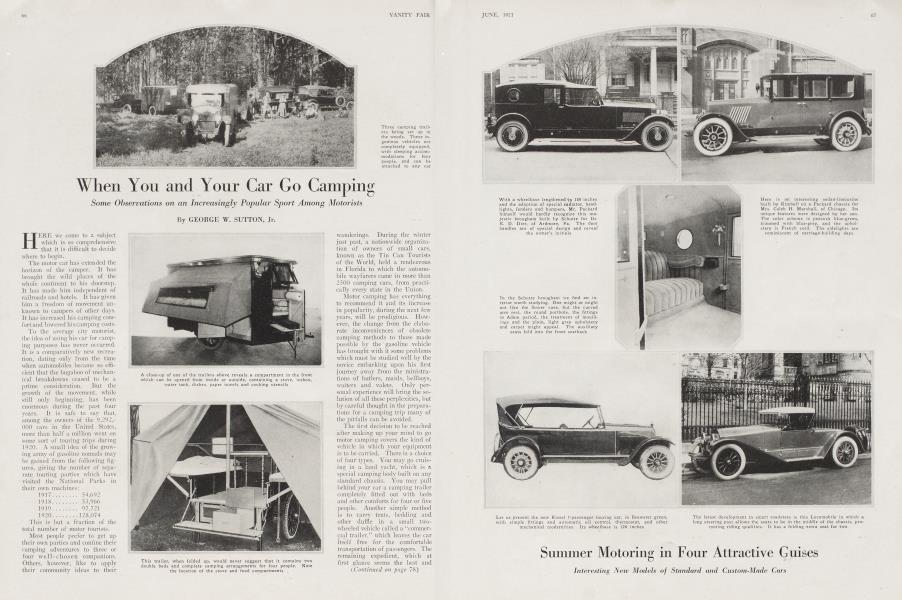
The first decision to be reached after making up your mind to go motor camping covers the kind of vehicle in which your equipment is to be carried. There is a choice of four types. You may go cruising in a land yacht, which is a special camping body built on any standard chassis. You may pull behind your car a camping trailer completely fitted out with beds and other comforts for four or five people. Another simple method is to carry tents, bedding and other duffle in a small twowheeled vehicle called a "commercial trailer," which leaves the car itself free for the comfortable transportation of passengers. The remaining expedient, which at first glance seems the best and simplest, but which is nothing of the kind, is to load everything, including campers, into an ordinary touring car or sedan and set forth to discover what's what beyond the suburbs. Each of these ways of answering the camping question has much in its favor and many followers who practise it with satisfactory results.
Continued on page 78
Continued from page 66
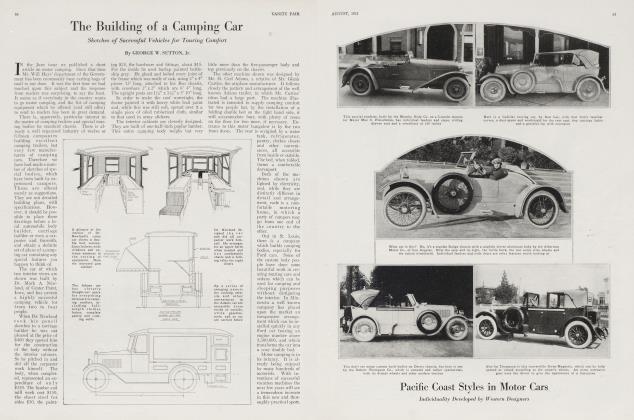
The land yacht is the most elaborate, costly and the most comfortable of all the motor aids to modern camping. It means the building of a specially designed body and its plainness or luxury is purely a matter of taste. In it can be incorporated many pet ideas of the owner as to sleeping and eating arrangements and the storage of utensils, clothing and other necessities. It can be small or large, making an ideal little rolling home for two people or a sumptuous apartment for four, or even five. It can be constructed cheaply, of plain boards or metal, or built like a limousine with ornamental and costly cabinet work and silken draperies. There are no companies specializing in the manufacture of land yachts. The man who desires to investigate the subject might do well to make a rough sketch of the kind of car he has in mind and present it, for estimate and further working out of details, to any good automobile body builder. The writer has on hand some special sketches of camping bodies which he will be glad to send to readers who are interested. He will also be pleased to recommend body builders who could do this kind of work.
The advantages of the land yacht are many; its disadvantages few. It obviates the necessity of pitching tents and clearing space for sleeping and eating quarters. In such a machine one is assured of a comfortable bed, high above ground, free from insects and dampness, regardless of weather conditions. Cooking and eating can all be done indoors. Clothing may be carried in full length closets without soiling or wrinkling. Such bulky articles as folding tables, chairs and even a phonograph can be carried without undue crowding. With a land yacht there is no need to worry about hotel reservations, train timetables and the non-arrival of baggage forwarded by express. The owner of such an outfit has his own hostelry, transportation system and baggage transfer company with him always. Practically all such cars are lighted by electricity.
The only points against the land yacht are that it is bound to be more or less clumsy in appearance, that it must be built to order, and that when not in use for camping it must lie idle unless employed as an outdoor sleeping room at home or a playhouse for children.
The camping trailer has many things in its favor and a few imaginary counts against it. In the first place, there are something like ten well established companies building standard camping trailers, which can be attached to any car, and which, when opened up, present complete movable homes for four, five or six motor campers. The cleverness displayed in the use of space in some of these vehicles is surprising. They range in price from about $300 to around $1,200, depending on size, equipment and finish. Two types are shown with this article. One has a permanent roof with sides which fall outward, making two double beds completely covered and screened, and supplied with real springs and mattresses. In this type there is room between the beds for two people to sleep on mattresses on the floor. A large water tank, ice box, clothes closet and compartment full of dishes and kitchen utensils are supplied. A wide, sturdy table folds down from the front wall and folding chairs go with it. There is even a small, quickly set-up tent and stool for use as a toilet. A curtain down the center divides the body into two compartments.
Continued on page 82
Continued, from page 78
In the other trailer shown, a large amount of equipment can be carried in very small space. The entire top folds down into little more than the size of a commercial trailer, yet when extended it has beds for four people and plenty of room for two more on the floor. These are only two of numerous types.
The trailer has been criticised as exerting too much pull on the car. This is mostly imaginary, as the average camping trailer, fully loaded, produces an extra pull of only about 25 pounds, not enough to be noticed. The fact is that when you are camping in this manner your tendency is to look back at frequent intervals to see if the trailer is still with you, because the connections which fasten it to the car have been so scientifically worked out that it tracks with the driving wheels and becomes almost a part of the car itself. On smooth, dry roads it will go around corners without swerving, skidding or toppling but on slippery highways, naturally, curvesshould be negotiated carefully. With a camping trailer behind, it is wise to apply brakes a little sooner and a little harder going down hill and on steep grades to employ the engine in first speed as an additional brake.
Those are the only disadvantages claimed against the camping trailer except that it has an unusual appearance which may tend to embarrass the fastidious motorist because it is sure to attract a great deal of attention on the road until these machines grow more numerous. The arguments in favor of the camping trailer, however, more than outweigh those against it. It does not prevent the use of the car for other purposes. It can be left at the camp site, all set up, while members of the party take day trips to nearby points. As a general rule, it is cheaper than the camping car and more cleverly and conveniently arranged.
Many successful long distance trips are made in ordinary cars to which are attached small commercial trailers on which the fittings are loaded. The fact that passengers are not cramped with an array of suit cases and other luggage is a mighty factor for enjoyment on long trips.
The great majority of motor campers carry their camping equipment in their own cars. Many ingenious camping accessories have been put upon the market, in fact so many that the greatest difficulty in starting a trip is to know what to take and what to leave behind. The beginner is liable to carry infinitely too much.
Eating is the most important function of the camper. There are great varieties of stoves, ranging from the little frame work which fits over an open fire to complete electric, fireless cookers. My own preference is for a two-burner gasoline vapor stove. Dishes and utensils are practicable when they are of the kind which nest together in a small space, rather than being a miscellaneous collection borrowed from the home kitchen. Paper plates and cups have their good points if you burn them after use, instead of littering up the countryside.
The sleeping arrangements are of tremendous importance. There are comfortable beds for two which are set up inside the car at night and rolled up under the top in the daytime. Tents and cots, for use outside the car, some employing the car itself as a side brace, are tremendously popular. The smallest tent of all, the Army "pup tent", is a good thing to leave behind on a camping trip.
Among the more important items which should be considered in laying out a journey are. trunks to carry suitcases, a sunshade visor to protect the eyes when driving into the sun, a complete tool outfit, collapsible shovel, goggles with ventilated rims, containers for dry and canned goods, ice-box, vacuum bottles, tire chains, tow rope, the best jack you can buy, the Automobile Blue Book covering the territory you are going to visit, and folding buckets.
There is no space here for a description of all the bits of equipment which should be in the camper's car. We have prepared a list covering car tools and aids to getting out of trouble; eating, sleeping and camping equipment; fishing supplies for different sections of the country and other necessities. This list is yours for the asking. A friend of the writer, Mr. Elon Jessup, has just published a book, "Motor Camping", which is brimful of practical camping information. Its perusal will save you money, time and temper.
Subscribers have complete access to the archive.
Sign In Not a Subscriber?Join Now

