Sign In to Your Account
Subscribers have complete access to the archive.
Sign In Not a Subscriber?Join NowThe Three Ages of Golf
An Attempt to Subdivide the Golfing Prodigies of the World According to Age, Rather than School
BERNARD DARWIN
THE victory of Havers in the open championship at Troon marked for us, over here in England, a distinct epoch in golf. It stood for the definite arrival of the post-war generation of professionals. Havers did, indeed, qualify for the open championship in 1914 as an infant phenomenon of fifteen; but, for practical purposes, he may be reckoned to have begun his public career in 1919. Our postwar amateurs arrived in 1920, when Mr. Tolley beat Mr. Gardner at Mairfield; but the young professionals have been more firmly kept in their places by their elders.
We have been saying that Havers could do it for the last three years, but he did not do it until this year. Now, with Mr. Wethered as amateur champion, and Havers as open champion, the post-war generation is enthroned on both the branches that spring from the top of our golfing tree.
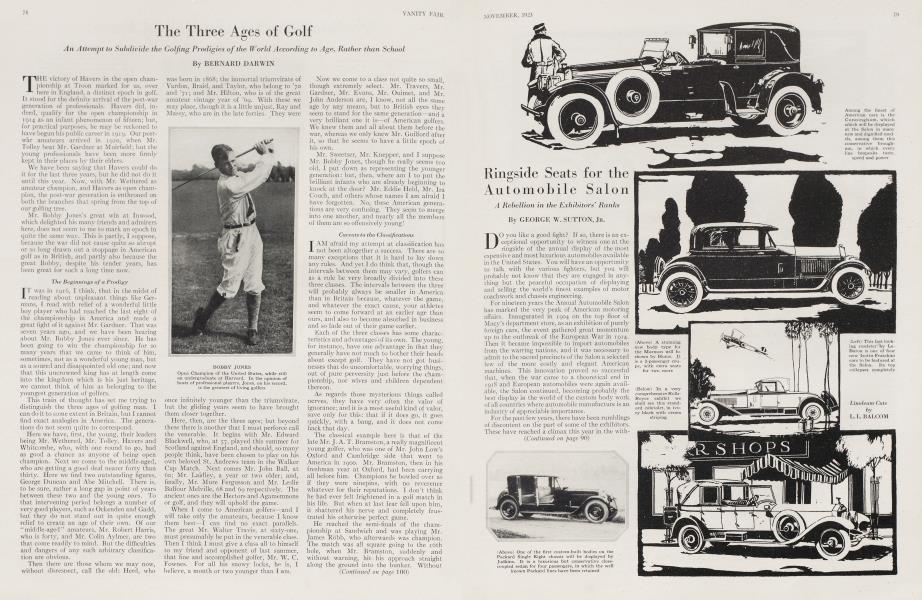
Mr. Bobby Jones's great win at Inwood, which delighted his many friends and admirers here, does not seem to me to mark an epoch in quite the same way. This is partly, I suppose, because the war did not cause quite .so abrupt or so long drawn out a stoppage in American golf as in British, and partly also because the great Bobby, despite his tender years, has been great for such a long time now.
The Beginnings of a Prodigy
IT was in 1916, I think, that in the midst of A reading about unpleasant things like Germans, I read with relief of a wonderful little boy player who had reached the last eight of the championship in America and made a great fight of it against Mr. Gardner. That was seven years ago, and we have been hearing about Mr. Bobby Jones ever since. He has been going to win the championship for so many years that we came to think of him, sometimes, not as a wonderful young man, but as a soured and disappointed old one; and now that this uncrowned king has at length come into the kingdom which is his just heritage, we cannot think of him as belonging to the youngest generation of golfers.
This train of thought has set me trying to distinguish the three ages of golfing man. I can do it to some extent in Britain, but I cannot find exact analogies in America. The generations do not seem quite to correspond.
Here we have, first, the young, their leaders being Mr. Wethered, Mr. Tolley, Havers and Whitcombe, who, with one round to go, had as good a chance as anyone of being open champion. Next we come to the middle-aged, who are getting a good deal nearer forty than thirty. Here we find two outstanding figures, George Duncan and Abe Mitchell. There is, to be sure, rather a long gap in point of years between these two and the young ones. To that intervening period belongs a number of very good players, such as Ockenden and Gadd, but they do not stand out in quite enough relief to create an age of their own. Of our "middle-aged" amateurs, Mr. Robert Harris, who is forty, and Mr. Colin Aylmer, are two that come readily to mind. But the difficulties and dangers of any such arbitrary classification are obvious.
Then there are those whom we may now, without disrespect, call the old: Herd, who was born in 1868; the immortal triumvirate of Vardon, Braid, and Taylor, who belong to '70 and '71; and Mr. Hilton, who is of the great amateur vintage year of '69. With these we may place, though it is a little unjust, Ray and Massy, who are in the late forties. They were once infinitely younger than the triumvirate, but the gliding years seem to have brought them closer together.
Here, then, are the three ages; but beyond these there is another that I must perforce call the venerable. It begins with Mr. Edward Blackwell, who, at 57, played this summer for Scotland against England, and should, so many people think, have been chosen to play on his own beloved St. Andrews team in the Walker Cup Match. Next comes Mr. John Ball, at 60; Mr. Laidley, a year or two older; and, finally, Mr. Mure Fergusson and Mr. Leslie Balfour Melville, 68 and 69 respectively. The ancient ones are the Hectors and Agamemnons or golf, and they will uphold the game.
When I come to American golfers—and I will take only the amateurs, because I know them best—I can find no exact parallels. The great Mr. Walter Travis, at sixty-one, must presumably be put in the venerable class. Then I think I must give a class all to himself to my friend and opponent of last summer, that fine and accomplished golfer, Mr. W. C. Fownes. For all his snowy locks, he is, I believe, a month or two younger than I am.
Now we come to a class not quite so small, though extremely select. Mr. Travers, Mr. Gardner, Mr. Evans, Mr. Ouimet, and Mr. John Anderson are, I know, not all the same age by any means, but to British eyes they seem to stand for the same generation—and a very brilliant one it is—of American golfers. We knew them and all about them before the war, whereas we only knew Mr. Guilford after it, so that he seems to have a little epoch of his own.
Mr. Sweetser, Mr. Knepper, and I suppose Mr. Bobby Jones, though he really seems too old, I put down as representing the younger generation: but, then, where am I to put the brilliant infants who are already beginning to knock at the door? Mr. Eddie Held, Mr. Ira Couch, and others whose names I am afraid I have forgotten. No, these American generations are very confusing. They seem to merge into one another, and nearly all the members of them are so offensively young!
Caveats to the Classifications
I AM afraid my attempt at classification has not been altogether a success. There are so many exceptions that it is hard to lay down any rules. And yet I do think that, though the intervals between them may vary, golfers can as a rule be very broadly divided into these three classes. The intervals between the three will probably always be smaller in America than in Britain because, whatever the game, and whatever the exact cause, your athletes seem to come forward at an earlier age than ours, and also to become absorbed in business and so fade out of their game earlier.
Each of the three classes has some characteristics and advantages its own. The young, for instance, have one advantage in that they generally have not much to bother their heads about except golf. They have not got businesses that do uncomfortable, worrying things, out of pure perversity just before the championship, nor wives and children dependent thereon.
As regards those mysterious things called nerves, they have very often the valor of ignorance; and it is a most useful kind of valor, save only for this: that if it does go, it goes quickly, with a bang, and it does not come back that day.
The classical example here is that of the late Mr. J. A. T. Bramston, a really magnificent young golfer, who was one of Mr. John Low's Oxford and Cambridge side that went to America in 1900. Mr. Bramston, then in his freshman year at Oxford, had been carrying all before him. Champions he bowled over as if they were ninepins, with no reverence whatever for their reputations. I don't think he had ever felt frightened in a golf match in his life. But when at last fear fell upon him, it shattered his nerve and completely frustrated his otherwise perfect game.
He reached the semi-finals of the championship at Sandwich and was playing Mr. James Robb, who afterwards was champion. The match was all square going to the 16th hole, when Mr. Bramston, suddenly and without warning, hit his approach straight along the ground into the bunker. Without appearing to realize that he still had a chance, he plunged into the bunker and hacked away at the ball with his mashie. At the next, a short hole, he played a tee shot of exactly the same kind, all along the floor into a water jump, picked out, dropped, and hit the ball anywhere or nowhere. At the 17th he entirely missed another approach shot, and there was the end of the match. One moment he had been a very fine golfer, full of confidence; the next he was a shattered wreck. All of a sudden the situation had been too much for him; he had experienced an unknown and horrible sensation, and he had collapsed. Moreover, I doubt if Johnny Bramston ever quite got over that dramatic collapse, or was quite the same player after it. No doubt he would have been, and a better one, too. He was one of the golfers who, like Mr. Bobby Jones, were bound to be champion; but soon afterwards he was overcome by the illness from which he ultimately died.
(Continued on page 100)
(Continual from page 78)
That kind of complete demoralization does not set in with an older player. He has cracked before—he knows the symptoms—and can often take a pull at himself and recover, wholly or in part. Experience is often, I think, an overrated asset in a game player, but it does sometimes help when a rot is beginning to set in.
So, the outstanding losses and profits of middle age seem to be these: that the player is not so gloriously brave as he was in his first youth, because he understands better what there is to be afraid of, but neither is he so liable to attacks of overwhelming terror. He plays no longer with unpremeditated art; but if something goes wrong, he knows how to right it.
And now, the losses being so painfully obvious that we will pass them over, can we find anything to put on the profit side for the old? That is largely, I think, a matter of temperament. There are those who, as long as they believe or half believe that they are still at their best, worry themselves to death over that fatal thing, "reputation". They are for ever picturing their friends as saying. "Poor So-and-so is not quite so good as he was." After a few years however, there comes over them a merciful change. They accept the inevitable, and are modestly pleased with the best they can do; and then it is sometimes amazing how good that best can be, so far better it is than it was when they agonized so much.
It is certainly a state of mind to pray for, since to those who have it. even a score reckoned by an average of sixes may ultimately represent a "sundown, splendid and serene".
Subscribers have complete access to the archive.
Sign In Not a Subscriber?Join Now
