Sign In to Your Account
Subscribers have complete access to the archive.
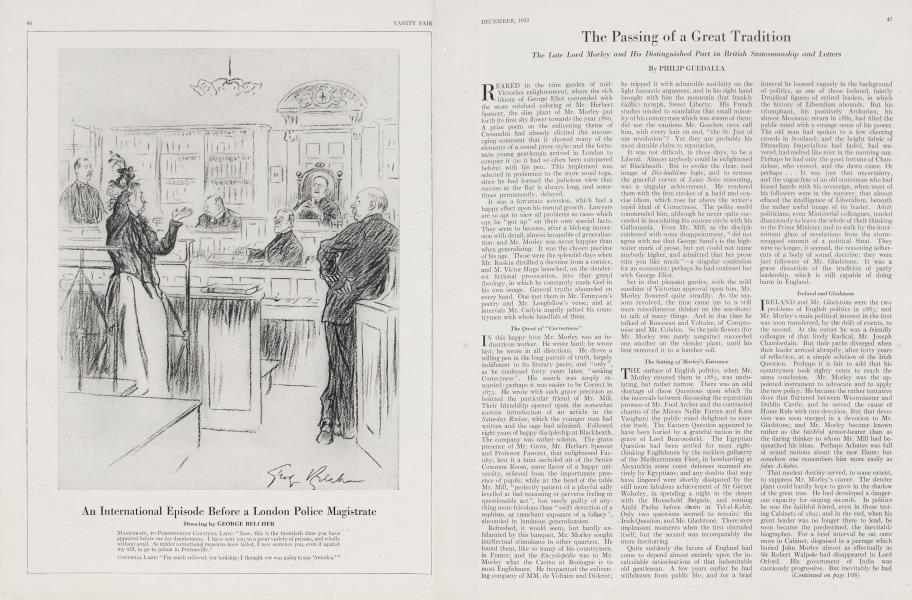
Sign In Not a Subscriber?Join NowThe Passing of a Great Tradition
PHILIP GUEDALLA
The Late Lord Morley and His Distinguished Part in British Statesmanship and Letters
REARED in the trim garden of midVictorian enlightenment, where the rich bloom of George Eliot contended with the more subdued coloring of Mr. Herbert Spencer, the slim plant of Mr. Morley put forth its first shy flower towards the year i860. A prize poem on the enlivening theme of Cassandra had already elicited the encouraging comment that it showed many of the elements of a sound prose style: and the fortunate young gentleman arrived in London to conquer it (as it had so often been conquered before) with his pen. This implement was selected in preference to the more usual toga, since he had formed the judicious view that success at the Bar is always long, and sometimes permanently, delayed.
It was a fortunate aversion, which had a happy effect upon his mental growth. Lawyers are so apt to view all problems as cases which can be "got up" on their own special facts. They seem to become, after a lifelong immersion with detail, almost incapable of generalization: and Mr. Morley was never happier than when generalizing. It was the chosen pastime of his age. Those were the splendid days when Mr. Ruskin distilled a doctrine from a cornice, and M. Victor Hugo launched, on the slenderest fictional provocation, into that grand theology, in which he constantly made God in his own image. General truths abounded on every hand. One met them in Mr. Tennyson's poetry and Mr. Longfellow's verse; and at intervals Mr. Carlyle angrily pelted his countrymen with whole handfuls of them.
The Quest of " Correctness "
IN this happy hive Mr. Morley was an industrious -worker. He wrote hard; he wrote fast; he wrote in all directions. He drove a willing pen in the long pursuit of truth, largely indifferent to its literary paces, and "only", as he confessed forty years later, "seeking Correctness". His search was amply rewarded : perhaps it was easier to be Correct in 1873. He wrote with such grave precision as befitted the particular friend of Mr. Mill. Their friendship opened upon the somewhat austere introduction of an article in the Saturday Review, which the younger man had written and the sage had admired. Followed eight years of happy discipleship at Blackheath. The company was rather solemn. The grave presence of Mr. Grote, Mr. Herbert Spencer and Professor Fawcett, that enlightened Faculty, lent it a faint secluded air of the Senior Common Room, some flavor of a happy university, relieved from the importunate presence of pupils; while at the head of the table Mr. Mill, "perfectly patient of a playful sally levelled at bad reasoning or perverse feeling or questionable act", but rarely guilty of anything more frivolous than "swift detection of a sophism, or trenchant exposure of a. fallacy", abounded in luminous generalization.
Refreshed, it would seem, but hardly exhilarated by this banquet, Mr. Morley sought intellectual stimulants in other quarters. He found them, like so many of his countrymen, in France; and the Encyclopedic was to Mr. Morley what the Casino at Boulogne is to most Englishmen. He frequented the enlivening company of MM. de Voltaire and Diderot; he tripped it with admirable assiduity on the light fantastic argument, and in his right hand brought with him the mountain (but frankly Gallic) nymph, Sweet Liberty. His French studies tended to scandalize that small minority of his countrymen which was aware of them; did not the cautious Mr. Goschen once call him, with every hair on end, "the St. Just of our revolution"? Yet they are probably his most durable claim to reputation.
It was not difficult, in those days, to be a Liberal. Almost anybody could be enlightened at Blackheath. But to evoke the clear, cool image of Dix-huiticmc logic, and to retrace the graceful curves of Louis Seize reasoning, was a singular achievement. He rendered them with the firm strokes of a lucid and concise idiom, which rose far above the writer's tepid ideal of Correctness. The polite world commended him, although he never quite succeeded in inoculating his austere circle with his Gallomania. Even Mr. Mill, as the disciple confessed with some disappointment, "did not agree with me that George Sand's is the highwater mark of prose, but yet could not name anybody higher, and admitted that her prose stirs you like music"—a singular confession for an economist: perhaps he had confused her with George Eliot.
Set in that pleasant garden, with the mild sunshine of Victorian approval upon him, Mr. Morley flowered quite steadily. As the seasons revolved, the time came (as to a still more miscellaneous thinker on the sea-shore) to talk of many things. And in due time he talked of Rousseau and Voltaire, of Compromise and Mr. Cobden. So the pale flowers (for Mr. Morley was rarely sanguine) succeeded one another on the slender plant, until his fate removed it to a harsher soil.
The Setting of Morley's Entrance
THE surface of English politics, when Mr. Morley entered them in 1883, was undulating, but rather narrow. There was an odd shortage of those Questions upon which (in the intervals between discussing the equestrian prowess of Mr. Fred Archer and the contrasted charms of the Misses Nellie Farren and Kate Vaughan) the public mind delighted to exercise itself. The Eastern Question appeared to have been buried by a grateful nation in the grave of Lord Beaconsfield. The Egyptian Question had been settled for most rightthinking Englishmen by the reckless gallantry of the Mediterranean Fleet, in bombarding at Alexandria some coast defenses manned entirely by Egyptians; and any doubts that may have lingered were shortly dissipated by the still more fabulous achievement of Sir Garnet Wolseley, in spending a night in the desert with the Household Brigade, and routing Arabi Pasha before dawn at Tel-el-Kebir. Only two questions seemed to remain: the Irish Question, and Mr. Gladstone. There were unpleasant moments when the first obtruded itself; but the second was incomparably the more fascinating.
Quite suddenly the future of England had come to depend almost entirely upon the incalculable ratiocinations of that indomitable old gentleman. A few years earlier he had withdrawn from public life; and for a brief interval he loomed vaguely in the background of politics, as one of those isolated, faintly Druidical figures of retired leaders, in which the history of Liberalism abounds. Hut his triumphant, his positively Arthurian, his almost Messianic return in 1880, had filled the public mind with a strange sense of his power. The old man had spoken to a few cheering crowds in Scotland; and the bright fabric of Disraelian Imperialism had faded, had wavered, had melted like mist in the morning sun. Perhaps he had only the good fortune of Chanticleer, who crowed, and the dawn came. Or perhaps . . . It was just that uncertainty, and the vague fear of an old stat esman who had kissed hands with his sovereign, when most of his followers were in the nursery, that almost effaced the intelligence of Liberalism, beneath the rather awful image of its leader. Adult politicians, even Ministerial colleagues, tended disastrously to leave the whole of their thinking to the Prime Minister, and to walk by the intermittent glare of revelations from the stormwrapped summit of a political Sinai. They were no longer, it seemed, the reasoning adherents of a body of sound doctrine: they were just followers of Mr. Gladstone. It was a grave distortion of the tradition of party leadership, which is still capable of doing harm in England.
Ireland and Gladstone
IRELAND and Mr. Gladstone were the two problems of English politics in 1883; and Mr. Morley's main political interest in the first was soon transferred, by the drift of events, to the second. At the outset he was a friendly colleague of that lively Radical, Mr. Joseph Chamberlain. But their paths diverged when their leader arrived abruptly, after forty years of reflection, at a simple solution of the Irish Question. Perhaps it is fair to add that his countrymen took eighty years to reach the same conclusion. Mr. Morley was the appointed instrument to advocate and to apply the new policy. He became the rather tentative dove that fluttered between Westminster and Dublin Castle; and he served the cause of Home Rule with rare devotion. But that devotion was soon merged in a devotion to Mr. Gladstone; and Mr. Morley became known rather as the faithful armor-bearer than as the daring thinker to whom Mr. Mill had bequeathed his ideas. Perhaps Achates was full of sound notions about the new Ilium: but somehow one remembers him more easily as fidus Achates.
That modest destiny served, to some extent, to suppress Mr. Morley's career. The slender plant could hardly hope to grow in the shadow of the great tree. He had developed a dangerous capacity for singing seconds. In politics he was the faithful friend, even in those testing Cabinets of 1892; and in the end, when his great leader was no longer there to lead, he soon became the predestined, the inevitable biographer. For a brief interval he sat once more in Cabinet, disguised in a peerage which buried John Morley almost as effectually as Sir Robert Walpole had disappeared in Lord Orford. His government of India was cautiously progressive. But inevitably he had acceded, by 1910, to the solemn and rather silent bench of the Elder Statesmen; and when, in 1914, war sharply lowered the age-limit, he silently withdrew.
(Continued on page 108)
(Continued from page 47)
Morley as a Man of Letters
MEN, as they are called, of action, rarely respect a man of letters; and Mr. Morley was always exposed to the dangerous suspicion of literacy. Chairmen at public meetings introduced him under the damning style of "the accomplished writer"; and the worst was that the charge was true. He could never hope to purge himself of the accusation that he could both read and write. One count alone of that grave indictment might have been less serious: after all, Lord Balfour reads, and do not most contemporary statesmen write? But to do both was fatal; and perhaps his two accomplishments formed a burden under which Lord Morley's public life seemed sometimes to stumble. The French (and he often chose French models) are more broad-minded in these matters: in France, a Minister is sometimes forgiven a whole career of letters. But to the sterner Anglo-Saxon these womanish tricks are invincibly repugnant. One has seen the whole United States deflect their history, and perhaps even inflict a grave wrong on the world, by reason of a simple suspicion of a President who wrote, delivered, and positively published lectures. And the same feeling holds in England.
Against that tide, Lord Morley tacked indomitably on the surface of British politics. His books were never abandoned; even when his country was partly in his charge, on an ominous date, a slim selection of Matthew Arnold's poetry was "Read with much fortifying quietude of mind, forenoon of our departure, on the matchless terrace at Beatenberg, June 12, 1914." That day Lord Morley departed; and shortly afterwards the world departed also, on a stranger journey. He did not follow it; and one seems to leave him, still in the Nineteenth Century, sitting contentedly in front of a lovely landscape, and reading the delicately sententious poetry of his period. It was a scene that would delight Mr. Meredith: and some of the verse might even (with an allusion to Lucretius) be quoted to Mr. Gladstone.
Subscribers have complete access to the archive.
Sign In Not a Subscriber?Join Now
