Sign In to Your Account
Subscribers have complete access to the archive.
Sign In Not a Subscriber?Join NowThe Sour-Grape Complex
Is Evangelistic Reform in America the Product of a Suppressed Desire to Sin?
HENDRIK WILLEM VAN LOON
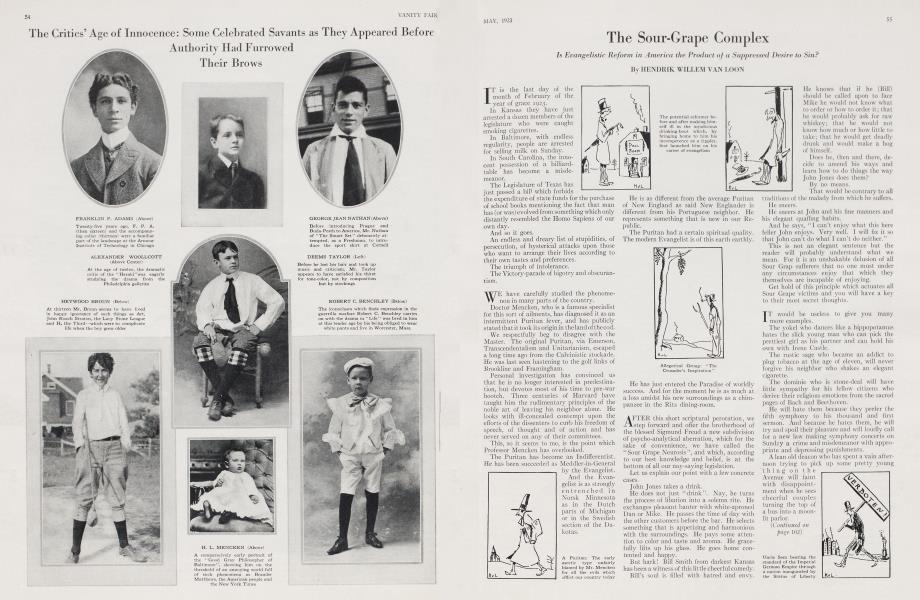
IT is the last day of the month of February of the year of grace 1923.
In Kansas they have just arrested a dozen members of the legislature who were caught smoking cigarettes.
In Baltimore, with endless regularity, people are arrested for selling milk on Sunday.
In South Carolina, the innocent possession of a billiardtable has become a misdemeanor.
The Legislature of Texas has just passed a bill which forbids the expenditure of state funds for the purchase of school books mentioning the fact that man has (or was) evolved from something which only distantly resembled the Homo Sapiens of our own day.
And so it goes.
An endless and dreary list of stupidities, of persecution, of hysterical attacks upon those who want to arrange their lives according to their own tastes and preferences.
The triumph of intolerance.
The Victory-parade of bigotry and obscurantism.
WE have carefully studied the phenomenon in many parts of the country.
Doctor Mencken, who is a famous specialist for this sort of ailments, has diagnosed it as an intermittent Puritan fever, and has publicly stated that it took its origin in the land of the cod.
We respectfully beg to disagree with the Master. The original Puritan, via Emerson, Transcendentalism and Unitarianism, escaped a long time ago from the Calvinistic stockade. He was last seen hastening to the golf links of Brookline and Framingham.
Personal investigation has convinced us that he is no longer interested in predestination, but devotes most of his time to pre-war hootch. Three centuries of Harvard have taught him the rudimentary principles of the noble art of leaving his neighbor alone. He looks with ill-concealed contempt upon the efforts of the dissenters to curb his freedom of speech, of thought and of action and has never served on any of their committees.
This, so it seems to me, is the point which Professor Mencken has overlooked.
The Puritan has become an Indifferentist. He has been succeeded as Meddler-in-General by the Evangelist. And the Evangelist is as strongly entrenched in Norsk Minnesota as in the Dutch parts of Michigan or in the Swedish section of the Dakotas.
He is as different from the average Puritan of New England as said New Englander is different from his Portuguese neighbor. He represents something that is new in our Republic.
The Puritan had a certain spiritual quality. The modern Evangelist is of this earth earthly.
He has just entered the Paradise of worldly success. And for the moment he is as much at a loss amidst his new surroundings as a chimpanzee in the Ritz dining-room.
AFTER this short scriptural peroration, we step forward and offer the brotherhood of the blessed Sigmund Freud a new subdivision of psycho-analytical aberration, which for the sake of convenience, we have called the "Sour Grape Neurosis", and which, according to our best knowledge and belief, is at the bottom of all our nay-saying legislation.
Let us explain our point with a few concrete cases.
John Jones takes a drink.
He does not just "drink". Nay, he turns the process of libation into a solemn rite. He exchanges pleasant banter with white-aproned Dan or Mike. He passes the time of day with the other customers before the bar. He selects something that is appetizing and harmonious with the surroundings. He pays some attention to color and taste and aroma. He gracefully lifts up his glass. He goes home contented and happy.
But hark! Bill Smith from darkest Kansas has been a witness of this little cheerful comedy.
Bill's soul is filled with hatred and envy.
He knows that if he (Bill) should be called upon to face Mike he would not know what to order or how to order it; that he would probably ask for raw whiskey; that he would not know how much or how little to take; that he would get deadly drunk and would make a hog of himself.
Does he, then and there, decide to amend his ways and learn how to do things the way John Jones does them?
By no means.
That would be contrary to all traditions of the malady from which he suffers. He sneers.
IT would be useless to give you many more examples.
The yokel who dances like a hippopotamus hates the slick young man who can pick the prettiest girl as his partner and can hold his own with Irene Castle.
The rustic sage who became an addict to plug tobacco at the age of eleven, will never forgive his neighbor who shakes an elegant cigarette.
The dominie who is stone-deaf will have little sympathy for his fellow citizens who derive their religious emotions from the sacred pages of Bach and Beethoven.
He will hate them because they prefer the fifth symphony to his thousand and first sermon. And because he hates them, he will try and spoil their pleasure and will loudly call for a new law making symphony concerts on Sunday a crime and misdemeanor with appropriate and depressing punishments.
He sneers at John and his fine manners and his elegant quaffing habits.
And he says, "I can't enjoy what this here feller John enjoys. Very well. 1 will fix it so that John can't do what 1 can't do neither."
This is not an elegant sentence but the reader will probably understand what we mean. For it is an unshakable delusion of all Sour Grap sufferers that no one must under any circumstances enjoy that which they themselves are incapable of enjoying.
Get hold of this principle which actuates all Sour Grape victims and you will have a key to their most secret thoughts.
A lean old deacon who has spent a vain afternoon trying to pick up some pretty young thing on the Avenue will faint with disappointment when he sees cheerful couples turning the top of a bus into a moonlit parlor.
Continued on page 102
Continued from page 55
"They are immoral," he will shriek when he comes to. "They are immoral, those people who do what I myself would like to do and cannot do. Call the police! Call the District Attorney! Have this thing stopped, lest I perish from sheer envy!"
As the land is full of lean old deacons and leaner old deaconesses, there are bound to be unlimited attacks upon the gaieties of life and the graces of social intercourse.
It has always been that way. It probably always will be that way.
Just now we notice it because the last twenty years have seen the rise of a new class which has not found itself.
THE factory has brought the country to the city. Bucolics may lose their whiskers but not their prejudices. They have acquired a certain modicum of wealth. Financially speaking they are able to cope with their rivals of an older civilization. They can live in the same houses and they can eat at the same restaurants and they can send their children to the same schools.
I am not speaking of New York City, which, of course, is merely a European suburb, but of the aspiring metropolai of our great Middle-West.
Those towns and villages are filled with people who are obliged to sail the uncharted seas of a greater world with the help of a tiny social compass which in former years served them as a safe guide among the puddles and lakes of their home-town.
They are entirely at a loss. Money, so they had been told by the periodical press of the country, was all that was needed for success and happiness. But money (as such) seems to have brought them nothing and seems to carry them nowhere.
As a result they have a grievance. The grievance soon grows into a malady. At the end of a year, they are suffering from the dreadful Sour-Grape complex.
They recognize but one single remedy; the humiliation of their more successful rivals. They send to the state legislature or to congress for the infallible nostrum of preventive legislation.
Then they sit down and gloat, Their enemies have been defeated, Their wounded vanity has been cured,
ALAS! the cure never lasts very long, Soon there is another outbreak of the great AEsopian delusion. Followed by more negative legislation,
Followed by more sentences.
Followed by an ever-increasing dreariness of our intellectual landscape,
Followed by the extinction of all art, all literature, all music, all the things beyond the comprehension of the men in the street
And then—merciful death
And burial in a "sensible cemetery"
Subscribers have complete access to the archive.
Sign In Not a Subscriber?Join Now
