Sign In to Your Account
Subscribers have complete access to the archive.
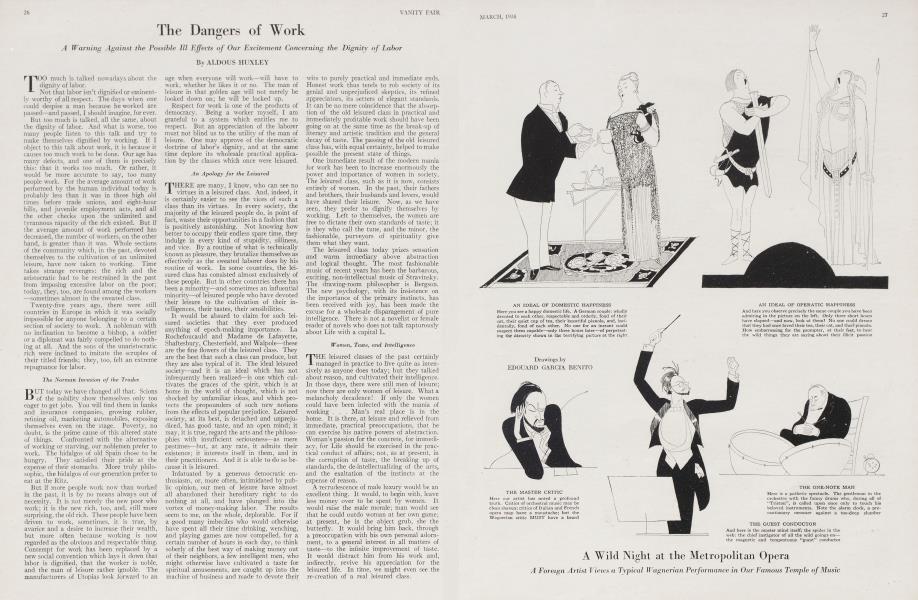
Sign In Not a Subscriber?Join NowThe Dangers of Work
A Warning Against the Possible Ill Effects of Our Excitement Concerning the Dignity of Labor
ALDOUS HUXLEY
Too much is talked nowadays about the dignity of labor.
Not that labor isn't dignified or eminently worthy of all respect. The days when one could despise a man because he worked are passed—and passed, I should imagine, for ever.
But too much is talked, all the same, about the dignity of labor. And what is worse, too many people listen to this talk and try to make themselves dignified by working. If I object to this talk about work, it is because it causes too much work to be done. Our age has many defects, and one of them is precisely this: that it works too much. Or rather, it would be more accurate to say, too many people work. For the average amount of work performed by the human individual today is probably less than it was in those high old times before trade unions, and eight-hour bills, and juvenile employment acts, and all the other checks upon the unlimited and tyrannous rapacity of the rich existed. But if the average amount of work performed has decreased, the number of workers, on the other hand, is greater than it was. Whole sections of the community which, in the past, devoted themselves to the cultivation of an unlimited leisure, have now taken to working. Time takes strange revenges: the rich and the aristocratic had to be restrained in the past from imposing excessive labor on the poor; today, they, too, are found among the workers —sometimes almost in the sweated class.
Twenty-five years ago, there were still countries in Europe in which it was socially impossible for anyone belonging to a certain section of society to work. A nobleman with no inclination to become a bishop, a soldier or a diplomat was fairly compelled to do nothing at all. And the sons of the unaristocratic rich were inclined to imitate the scruples of their titled friends; they, too, felt an extreme repugnance for labor.
The Norman Invasion of the Trades
BUT today we have changed all that. Scions of the nobility show themselves only too eager to get jobs. You will find them in banks and insurance companies, growing rubber, refining oil, marketing automobiles, exposing themselves even on die stage. Poverty, no doubt, is the prime cause of this altered state of things. Confronted with the alternative of working or starving, our noblemen prefer to work. The hidalgos of old Spain chose to be hungry. They satisfied their pride at the expense of their stomachs. More truly philosophic, the hidalgos of our generation prefer to eat at the Ritz.
But if more people work now than worked in the past, it is by no means always out of necessity. It is not merely the new poor who work; it is the new rich, too, and, still more surprising, the old rich. These people have been driven to work, sometimes, it is true, by avarice and a desire to increase their wealth, but more often because working is now regarded as the obvious and respectable thing. Contempt for work has been replaced by a new social convention which lays it down that labor is dignified, that the worker is noble, and the man of leisure rather ignoble. The manufacturers of Utopias look forward to an age when everyone will work—will have to work, whether he likes it or no. The man of leisure in that golden age will not merely be looked down on; he will be locked up.
Respect for work is one of the products of democracy. Being a worker myself, I am grateful to a system which entitles me to respect. But an appreciation of the laborer must not blind us to the utility of the man of leisure. One may approve of the democratic doctrine of labor's dignity, and at the same time deplore its wholesale practical application by the classes which once were leisured.
An Apology for the Leisured
THERE are many, I know, who can see no virtues in a leisured class. And, indeed, it is certainly easier to see the vices of such a class than its virtues. In every society, the majority of the leisured people do, in point of fact, waste their opportunities in a fashion that is positively astonishing. Not knowing how better to occupy their endless spare time, they indulge in every kind of stupidity, silliness, and vice. By a routine of what is technically known as pleasure, they brutalize themselves as effectively as the sweated laborer does by his routine of work. In some countries, the leisured class has consisted almost exclusively of these people. But in other countries there has been a minority—and sometimes an influential minority—of leisured people who have devoted their leisure to the cultivation of their intelligences, their tastes, their sensibilities.
It would be absurd to claim for such leisured societies that they ever produced anything of epoch-making importance.. La Rochefoucauld and Madame de Lafayette, Shaftesbury, Chesterfield, and Walpole—these are the fine flowers of the leisured class. They are the best that such a class can produce, but they are also typical of it. The ideal leisured society—and it is an ideal which has not infrequently been realized—is one which cultivates the graces of the spirit, which is at home in the world of thought, which is not shocked by unfamiliar ideas, and which protects the propounders of such new notions from the effects of popular prejudice. Leisured society, at its best, is detached and unprejudiced, has good taste, and an open mind; it may, it is true, regard the arts and the philosophies with insufficient seriousness—as mere pastimes—but, at any rate, it admits their existence; it interests itself in them, and in their practitioners. And it is able to do so because it is leisured.
Infatuated by a generous democratic enthusiasm, or, more often, intimidated by public opinion, our men of leisure have almost all abandoned their hereditary right to do nothing at all, and have plunged into the vortex of money-making labor. The results seem to me, on the whole, deplorable. For if a good many imbeciles who would otherwise have spent all their time drinking, wenching, and playing games are now compelled, for a certain number of hours in each day, to think soberly of the best way of making money out of their neighbors, a few intelligent men, who might otherwise have cultivated a taste for spiritual amusements, are caught up into the machine of business and made to devote their wits to purely practical and immediate ends. Honest work thus tends to rob society of its genial and unprejudiced skeptics, its refined appreciators, its setters of elegant standards. It can be no mere coincidence that the absorption of ' the old leisured class in practical and immediately profitable work should have been going on at die same time as the break-up of literary and artistic tradition and the general decay of taste. The passing of the old leisured class has, with equal certainty, helped to make possible the present state of things.
One immediate result of the modem mania for work has been to increase enormously the power and importance of women in society. The leisured class, such as it is now, consists entirely of women. In the past, their fathers and brothers, their husbands and lovers, would have shared their leisure. Now, as we have seen, they prefer to dignify themselves by worldng. Left to themselves, the womeii are free to dictate their own standards of taste; it is they who call the tune, and the minor, the fashionable, purveyors of spirituality give them what they want.
The leisured class today prizes sensation and warm immediacy above abstraction and logical thought. The most fashionable music of recent years has been the barbarous, exciting, non-intellectual music of Stravinsky. The. drawing-room philosopher is Bergson. The new psychology, with its insistence on the importance of the primary instincts, has been received with joy, has been made the excuse for a wholesale disparagement of pure intelligence. There is not a novelist or female reader of novels who does not talk rapturously about Life with a capital L.
Women, Taste, and Intelligence
THE leisured classes of the past certainly managed in practice to live quite as intensively as anyone does today; but they talked about reason, and cultivated their intelligence. In those days, there were still men of leisure; now there are only women of leisure. What a melancholy decadence! If only the women could have been infected with the mania of working . . . Man's real place is in the home. It is there, at leisure and relieved from immediate, practical preoccupations, that he can exercise his native powers of abstraction. Woman's passion for the concrete, for immediacy, for Life should be exercised in the practical conduct of affairs; not, as at present, in the corruption of taste, the breaking up of standards, the de-intellectualizing of the arts, and the exaltation of the instincts at the expense of reason.
A recrudescence of male luxury would be an excellent thing. It would, to begin with, leave less money over to be spent by women. It would raise the male morale; man would see that he could outdo woman at her own game; at present, he is the abject grub, she the butterfly. It would bring him back, through a preoccupation with his own personal adornment, to a general interest in all matters of taste—to the infinite improvement of taste. It would distract him from his work and, indirectly, revive his appreciation for the leisured life. In time, we might even see the re-creation of a real leisured class.
Subscribers have complete access to the archive.
Sign In Not a Subscriber?Join Now