Sign In to Your Account
Subscribers have complete access to the archive.
Sign In Not a Subscriber?Join NowTalking of Monkeys
Torture, Old Style, Advocated For the Modern Heretic on Aesthetic Grounds
ALDOUS HUXLEY
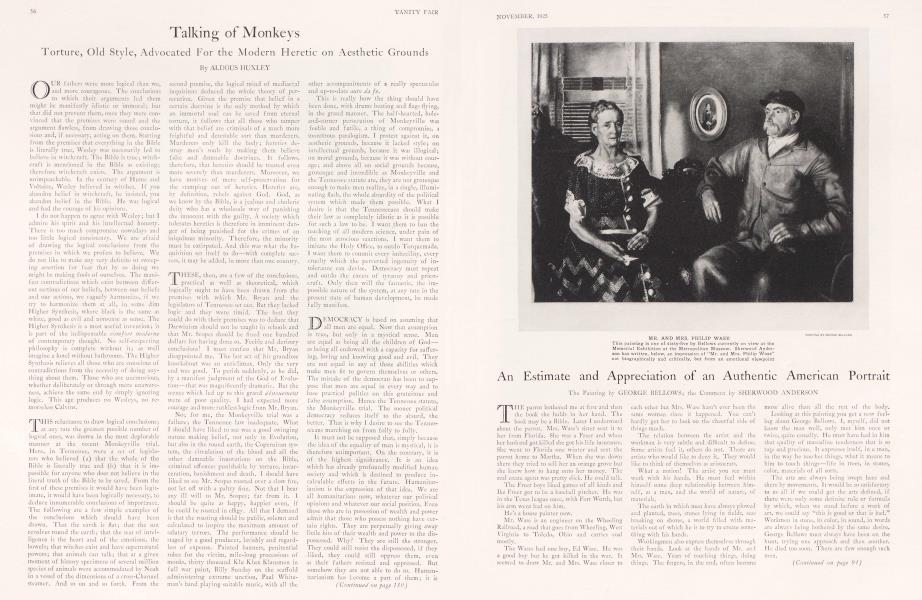
OUR fathers were more logical than we, and more courageous. The conclusions to which their arguments led them might be manifestly idiotic or immoral; but that did not prevent them, once they were convinced that the premises were sound and the argument flawless, from drawing those conclusions and, if necessary, acting on them. Starting from the premises that everything in the Bible is literally true, Wesley was necessarily led to believe in witchcraft. The Bible is true; witchcraft is mentioned in the Bible as existing; therefore witchcraft exists. The argument is unimpeachable. In the centurv of Hume and Voltaire, Wesley believed in witches. If you abandon belief in witchcraft, he insisted, you abandon belief in the Bible. He was logical and had the courage of his opinions.
I do not happen to agree with Wesley; but I admire his spirit and his intellectual honesty. There is too much compromise nowadays and too little logical consistency. We are afraid ol drawing the logical conclusions from the premises in which we profess to believe. We do not like to make any very definite or sweeping assertion for fear that by so doing we might be making fools of ourselves. The manifest contradictions which exist between different sections of our beliefs, between our beliefs and our actions, we vaguely harmonize, if we try to harmonize them at all, in some dim Higher Synthesis, where black is the same as white, good as evil and nonsense as sense. The Higher Synthesis is a most useful invention; it is part of the indispensable comfort moderneof contemporary thought. No self-respecting philosophy is complete without it; as well imagine a hotel without bathrooms. The Higher Synthesis relieves all those who are conscious of contradictions from the necessity of doing anything about them. 'Those who are unconscious, whether deliberately or through mere unawareness, achieve the same end by simply ignoring logic. This age produces no Wesleys, no remorseless Calvins.
THIS reluctance to draw logical conclusions; at any rate the greatest possible number of logical ones, was shown in the most deplorable manner at the recent Monkeyville trial. Here, in Tennessee, were a set of legislators who believed (a) that the whole of the Bible is literally true and (b) that it is impossible for anyone who docs not believe in the literal truth of the Bible to be saved. From the first of these premises it would have been legitimate, it would have been logically necessary, to deduce innumerable conclusions of importance. 'The following are a few simple examples of the conclusions which should have been drawn. That the earth is flat; that the sun revolves round the earth; that the scat of intelligence is the heart and of the emotions, the bowels; that witches exist and have supernatural powers; that animals can talk; that at a given moment of history specimens of several million species of animals were accommodated by Noah in a vessel of the dimensions of a cross-Channel steamer. And so on and so forth. From the second premise, the logical mind of mediaeval inquisitors deduced the whole theory of persecution. Given the premise that belief in a certain doctrine is the only method by which an immortal soul can be saved from eternal torture, it follows that all those who tamper with that belief arc criminals of a much more frightful and detestable sort than murderers. Murderers only kill the body; heretics destroy men's souls by making them believe false and damnable doctrines. It follows, therefore, that heretics should be treated even more severely than murderers. Moreover, we have motives of mere self-preservation for the stamping out of heretics. Heretics are, by definition, rebels against God. God, as we know by the Bible, is a jealous and choleric deity who has a wholesale way of punishing the innocent with the guilty. A society which tolerates heretics is therefore in imminent danger of being punished for the crimes of an iniquitous minority. Therefore, the minority must be extirpated. And this was what the Inquisition set itself to do—with complete success, it may be added, in more than one country.
THESE, then, are a few of the conclusions, practical as well as theoretical, which logically ought to have been drawn from the premises with which Mr. Bryan and the legislators of 'Tennessee set out. But they lacked logic and they were timid. The best they could do with their premises was to deduce that Darwinism should not be taught in schools and that Mr. Scopes should be fined one hundred dollars for having done so. Feeble and derisory conclusions! 1 must confess that Mr. Bryan disappointed me. 'The last act of his grandiose knockabout was an anticlimax. Only the very end was good. To perish suddenly, as he did, by a manifest judgment of the God of Evolution—that was magnificently dramatic. But the scenes which led up to this grand dénouement were of poor quality. I had expected more courage and more ruthless logic from Mr. Bryan.
No; for me, the Monkeyville trial was a failure; the Tennessee law inadequate. What I should have liked to see was a good swinging statute making belief, not only in Evolution, but also in the round earth, the Copernican system, the circulation of the blood and all the other damnable innovations on the Bible, criminal offences punishable by torture, incarceration, banishment and death. I should have liked to see Mr. Scopes roasted over a slow fire, not let off with a paltry fine. Not that I bear any ill will to Mr. Scopes; far from it. I should be quite as happy, happier even, if he could be roasted in effigy. All that I demand is that the roasting should be public, solemn and calculated to inspire the maximum amount of salutary terrors. The performance should be staged by a good producer, lavishly and regardless of expense. Painted banners, penitential robes for the victim, mile-long processions of monks, thirty thousand Klu Klux Klansmen in full war paint, Billy Sunday on the scaffold administering extreme unction, Paul Whiteman's band playing suitable music, with all the other accompaniments of a really spectacular and up-to-date auto da fe.
This is really how the thing should have been done, with drums beating and flags living, in the grand manner. The half-hearted, holeand-corner persecution of Monkeyville was feeble and futile, a thing of compromise, a monstrous paralogism. I protest against it, on aesthetic grounds, because it lacked style; on intellectual grounds, because it was illogical; on moral grounds, because it was without courage; and above all on social grounds because, grotesque and incredible as Monkeyville and the Tennessee statute are, they arc not grotesque enough to make men realize, in a single, illuminating flash, the whole absurdity of the political system which made them possible. What I desire is that the Tennesseeans should make their law as completely idiotic as it is possible for such a law to be. I want them to ban the teaching of all modern science, under pain of the most atrocious sanctions. I want them to imitate the Holy Office, to outdo Torqucmada. I want them to commit every imbecility, every cruelty which the perverted ingenuity of intolerance can devise. Democracy must repeat and outdo the excess of tyranny and priestcraft. Only then will the fantastic, the impossible nature of the system, at any rate in the present state of human development, be made fully manifest.
DEMOCRACY is based on assuming that all men are equal. Now that assumption is true, but only in a mystical sense. Men are equal as being all the children of God— as being all endowed with a capacity for suffering, loving and knowing good and evil. They arc not equal in any of those abilities which make men fit to govern themselves or others. The mistake of the democrats has been to suppose that men arc equal in every way and to base practical politics on this -gratuitous and false assumption. Hence the Tennessee statute, the Monkeyville trial. The sooner political democracy reduces itself to the absurd, the better. 'That is why I desire to sec the 'Tennesseeans marching on from folly to folly.
It must not be supposed that, simply because the idea of the equality of man is mystical, it is therefore unimportant. On the contrary, it is of the highest significance. It is an idea which has already profoundly modified human society and which is destined to produce incalculable effects in the future. Humanitarianism is the expression of that idea. We are all humanitarians now, whatever our political opinions and whatever our social position. Even those who are in possession of wealth and power admit that those who possess nothing have certain rights. They are perpetually giving away little bits of their wealth and power to the dispossessed. Why? They are still the stronger.
They could still resist the dispossessed, if they liked, they could still oppress them, even as their fathers resisted and oppressed. But somehow they are not able to do so. Humanitarianism has lecome a part of them; it is impossible for them to ignore it.
(Continued on gage 130)
(Continued from page 56)
It was this surrender of the powerholders to the dispossessed that outraged Nietzsche into propounding his new superman's morality—a morality indistinguishable, in truth from:
The good old rule, the simple plan That he should take who has the power
And he should keep who can.
He justified his anti-humanitarianism in the name of Natural Selection. The justification is quite invalid. Darwinism, as Benjamin Kidd pointed out long ago, justifies humanitarianism, not Nietzschean immoralism. It is by a ceaseless process of competition that the breed is improved, is even kept up to existing standards. In a tyrannical society, where humanitarian principles are not recognized, nine tenths of the individuals composing that society are so unfairly handicapped by poverty, bad conditions and inadequacy of education, that they are not in a position to compete for any of the higher prizes of life. By ameliorating the lot of the dispossessed, humanitarianism removes this handicap and thus, by multiplying the competitors, tends to create an intenser and therefore biologically more stimulating competition.
Humanitarianism, then, has a biological function—to render possible an intenser competition within society. When all men are free to compete and all start equal, the chance of getting able men at the head of affairs is obviously increased. That is the political justification of luimanitarianism. Societies should be run on humanitarian principles because an increase in the number of competitors increases the chances of efficient leadership. To deduce from the mystical theory of universal "equality that all men (not merely the best fitted to do so) should take a share in the government of society, is absurd.
The defects of democratic government have long been apparent. It remains for the Tennesseeans to make them so glaringly and grotesquely obvious that all the world may realize the impossibility of the system. A question arises; bv what should democracy be replaced? None of the alternatives hitherto put into practice is very satisfactory. Fascism is as undesirable as Bolshevism. The lynch law and the professional philanthropy with which America tempers her democratic system are no better. All these alternatives err in their antagonism to personal freedom, their antihumanitarianism, their hierarchical stiffness. In an ideal society, it is obvious, there must be the greatest possible amount of personal liberty, the greatest possible suppleness and informality of organization. The ideal of all the anti-democrats up to the present has been an ideal of increased formality and rigidity. The system that is to replace democracy has not yet been invented. I offer no suggestions, beyond the sufficiently obvious one that it would be a good thing if human societies could be governed by their best and most intelligent members. Whether it will ever be possible to induce the best and most intelligent men to take part in an occupation so thoroughly discreditable as politics is another question.
Subscribers have complete access to the archive.
Sign In Not a Subscriber?Join Now
