
Sign In to Your Account
Subscribers have complete access to the archive.
Sign In Not a Subscriber?Join NowEuropean Motoring
JOHN PRIOLEAU
Races and Mechanical Innovations in England and France
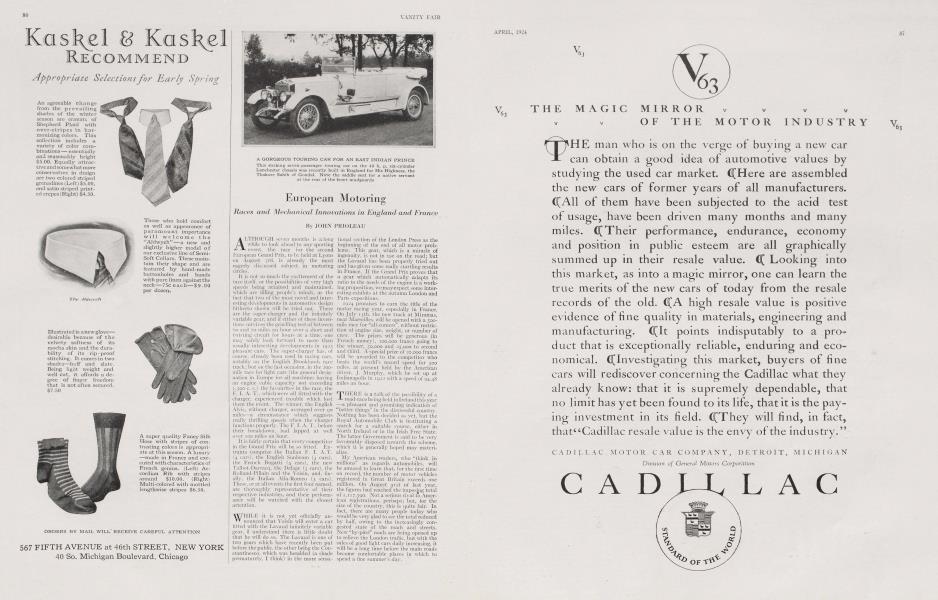
ALTHOUGH seven months is along while to look ahead to any sporting event, the race for the second European Grand Prix. to be held at Lyons on August 3rd. is already the most eagerly discussed subject in motoring circles.
It is not so much the excitement of the race itself, or the possibilities of very high speeds being attained and maintained, which are tilling people's minds, as the fact that two of the most novel and interesting developments in automotive design hitherto shown will be tried out. These are the super-charger and the infinitely variable gear; and if either of these inventions survives the gruelling test of between 60 and 70 miles an hour over a short and twisting circuit for hours at a time, one may safely look forward to more than usually interesting developments in 1923 pleasure cars. The super-charger lias, of course, already been used in racing cars, notably on the English Brooklands race track; but on the last occasion, in the 200mile race for light cars (the general designation in Europe for all machines having an engine cubic capacity not exceeding 1,500 c. c.) the favourites in the race, the F. I. A. T., which were all fitted with the charger, experienced trouble which lost them the event. The winner, the English Alvis, without charger, averaged over 90 miles—a circumstance which suggests really thrilling speeds when the charger functions properly. The F. I. A. T. before their breakdown, had lapped at well over 100 miles an hour.
It is fairly certain that every competitor in the Grand Prix will be so fitted. Entrants comprise the Italian F. I. A.T. (4 cars), the English Sunbeam (3 cars), the French Bugatti (4 cars), the new Talbot-Darracq. the Delage (3 cars), the Rolland-Pillain and the Voisin, and. finally. the Italian Alfa-Romeo (3 cars). These, or at all events the first four named, are thoroughly representative of their respective industries, and their performance will be watched with the closest attention.
WHILE it is not yet officially announced that Voisin will enter a car fitted with the Lavaud infinitely variable gear, I understand there is little doubt that he will do so. The Lavaud is one of two gears which have recently been put before the public, the other being the Constantinesco, which was heralded (a shade prematurely, I think) in the more sensational section of the London Press as the beginning of the end of all motor problems. This gear, which is a miracle of ingenuity, is not in use on the road; but the Lavaud has been properly tried out and has given some really startling results in France. If the Grand Prix proves that a gear which automatically adapts its ratio to the needs of the engine is a working proposition, wemayexpect some interesting exhibits at the autumn London and Paris expositions.
1924 promises to earn the title of the motor racing year, especially in France. On July 13th. the new track at Miramas, near Marseilles, will be opened with a 500mile race lor "all-comers", without restriction of engine size, weight, or number of crew. The prizes will be generous (in French money), 100.000 francs going to the winner, 50.000 and 25,000 to second and third. A special prize of 20,000 francs will be awarded to the competitor who beats the world's record speed for 500 miles, at present held by the American driver, J. Murphy, which he set up at Indianapolis in 1922 with a speed of 94.48 miles an hour.
THERE is a talk of the possibility of a road-race being held in Ireland this year —a pleasant and promising indication of "better things" in the distressful country. Nothing has been decided as yet, but the Royal Automobile Club is instituting a search for a suitable course, either in North Ireland or in the Irish Free State. The latter Government is said to be very favourably disposed towards the scheme, which it is generally hoped may materialize.
My American readers, who "think in millions" as regards automobiles, will be amused to learn that, for the first time on record, the number of motor vehicles registered in Great Britain exceeds one million. On August 31st of last year, the figures had reached the imposing total of 1, 117,590. Not a serious rival to American registrations, perhaps; but, for the size of the country, this is quite fair. In fact, there are many people today who would be very glad to see the total reduced by half, owing to the Increasingly congested state of the roads and streets. New "by-pass" roads are being opened up to relieve the London traffic, but with the sales of good light cars daily increasing, it will be a long time before the main roads become comfortable places in which to spend a fine summer's day.
Subscribers have complete access to the archive.
Sign In Not a Subscriber?Join Now