Sign In to Your Account
Subscribers have complete access to the archive.
Sign In Not a Subscriber?Join NowKnowledge and Art
ALDOUS HUXLEY
A Slight Dissertation Upon the Perils of Learning and the Virtues of Ignorance
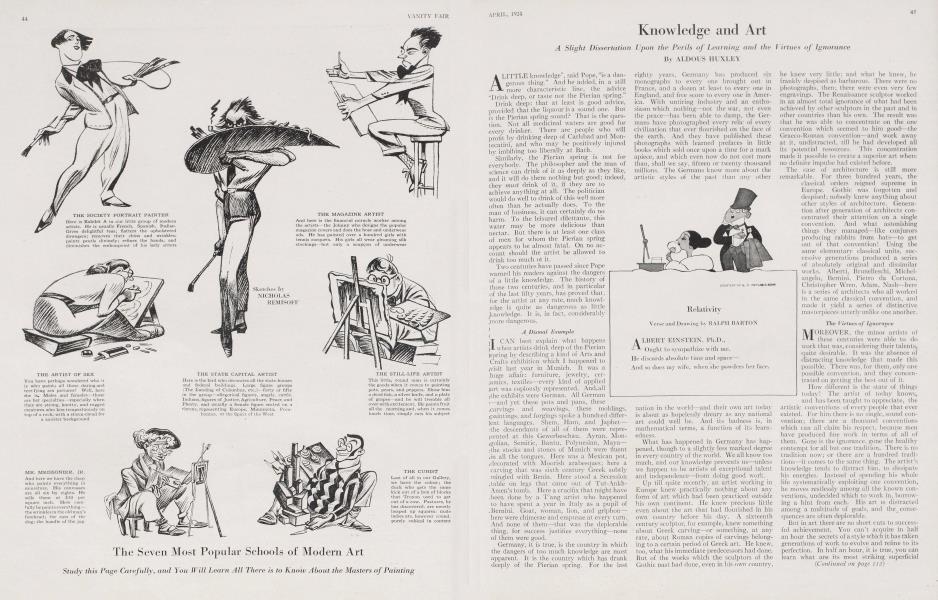
A LITTLE knowledge", said Pope, "is a dangerous thing." And he added, in a still more characteristic line, the advice "Drink deep, or taste not the Pierian spring."
Drink deep: that at least is good advice, provided that the liquour is a sound one. But is the pierian spring sound? That is the question. Not all medicinal waters are good for every drinker. There are people who will profit by drinking deep of Carlsbad and Montecatini, and who may be positively injured by imbibing too liberally at Bath.
Similarly, the Pierian spring is not for everybody. The philosopher and the man of science can drink of it as deeply as they like, and it will do them nothing but good; indeed, they must drink of it, if they are to achieve anything at all. The politician would do well to drink of this well more often than he actually does. To the man of business, it can certainly do no harm. To the leisured dilettante, this water may be more delicious than nectar. But there is at least one class of men for whom the Pierian spring appears to be almost fatal. On no account should the artist be allowed to drink too much ot it.
Two centuries have passed since Pope warned his readers against the dangers of a little knowledge. The history of those two centuries, and in particular of the last fifty years, has proved that, for the artist at any rate, much knowledge is quite as dangerous as little Knowledge. It is, in fact, considerably more dangerous.
A Dismal Example
I CAN best explain what happens when artists drink deep of the Pierian spring by describing a kind of Arts and Crafts exhibition which I happened to visit last year in Munich. It was a huge affair: furniture, jewelry, ceramics, textiles—every kind of applied art was copiously represented. And all the exhibits were German. All German -—and yet these pots and pans, these carvings and weavings, these moldings, paintings, and forgings spoke a hundied different languages. Shem, Plain, and Japhet— the descendants of all of them were represented at this Gewerbeschau. Avran, Mongolian, Semitic, Bantu, Polynesian, Maya— the stocks and stones of Munich were fluent in all the tongues. Here was a Mexican pot, decorated with Moorish arabesques; here a carving that was sixth century Greek subtly mingled with Benin. Here stood a Secession table on legs that came out of Tut-AnkhAmen's tomb. Here a crucifix that might have been done by a T'ang artist who happened to have spent a year in Italy as a pupil of Bernini. Goat, woman, lion, and griphon— here were chimerae and empusae at. every turn. And none of them—that was the deplorable thing, for success justifies everything—none of them were good.
Germany, it is true, is the country in which the dangers of too much knowledge are most apparent.. It is the country which has drunk deeply of the Pierian spring. For the last eighty years, Germany has produced six monographs to every' one brought out in France, and a dozen at least to every one in England, and five score to every one in America. With untiring industry and an enthusiasm which nothing—not the war, not even the peace—has been able to damp, the Germans have photographed every relic of every civilization that ever flourished on the face of the earth. And they have published these photographs with learned prefaces in little books which sold once upon a time for a mark apiece, and which even now do not cost more than, shall we sayq fifteen or twenty thousand millions. The Germans know more about the artistic styles of the past than any other nation in the world—and their own art today' is about as hopelessly dreary as any national art could well be. And its badness is, in mathematical terms, a function of its learnedness.
What has happened in Germany has happened, though to a slightly less marked degree in every country of the world. We all know too much, and our knowledge prevents us—unless we happen to be artists of exceptional talent and independence—from doing good work.
Up till quite recently, an artist working in Europe knew practically' nothing about any form of art which had been practiced outside his own continent. He knew precious little even about the art that had flourished in his own country before his day. A sixteenth century sculptor, for example, knew something about Greek carving—or something, at any rate, about Roman copies of carvings belonging to a certain period of Greek art. He knew, too, what his immediate predecessors had done. But of the works which the sculptors of the Gothic past had done, even in his own country, he knew very little; and what he knew, he frankly despised as barbarous. There were no photographs, then; there were even very few engravings. The Renaissance sculptor worked in an almost total ignorance of what had been achieved by other sculptors in the past and in other countries than his own. The result was that he was able to concentrate on the one convention which seemed to him good—the Graeco-Roman convention—-and work away at it, undistracted, till he had developed all its potential resources. This concentration made it possible to create a superior art where no definite impulse had existed before.
The case of architecture is still more remarkable. For three hundred years, the classical orders reigned supreme in Europe. Gothic was forgotten and despised; nobody knew anything about other styles of architecture. Generation after generation of architects concentrated their attention on a single convention. And what astonishing things they managed—like conjurors producing rabbits from hats—to get out of that convention! Using the same elementary classical units, successive generations produced a series of absolutely' original and dissimilar works. Alberti, Brunelleschi, Michelangelo, Bernini, Pietro da Cortona, Christopher Wren, Adam, Nash—here is a series of architects who all worked in the same classical convention, and made it yield a series of distinctive masterpieces utterly unlike one another.
The Virtues of Ignorance
MOREOVER, the minor artists of these centuries were able to do work that was,considering their talents, quite desirable. It was the absence of distracting knowledge that made this possible. There was, for them, only one possible convention, and they concentrated on getting the best out of it.
How different is the state of things - today! The artist of today knows, and has been taught to appreciate, the artistic conventions of every people that ever existed. For him there is no single, sound convention; there are a thousand conventions which can all claim his respect, because men have produced fine work in terms of all of them. Gone is the ignorance, gone the healthy contempt for all but one tradition. There is no tradition now; or there arc a hundred traditions—it comes to the same thing. The artist's knowledge tends to distract him, to dissipate his energies. Instead of spending his whole life systematically' exploiting one convention, he moves restlessly among all the known conventions, undecided which to work in, borrowing a hint from each. His art is distracted among a multitude of goals, and the consequences are often deplorable.
But in art there are no short cuts to successful achievement. You can't acquire in half an hour the secrets of a style which it has taken generations of work to evolve and refine to its perfection. In half an hour, it is true, you can learn what are its most striking superficial characteristics; you can learn to caricature it. That is all.
(Continued on page 112)
(Continued from page 45)
Art is not like science; there is no profiting by other people's accumulated experience, no going on from the point where they left off. Every artist has to begin at the beginning. He must solve the problem for himself; and to do that he must concentrate, he must steadily labour.
And concentration is precisely the thing that excessive knowledge tends to make impossible—for all. at any rate, but the most gifted, individual, and strong-minded artists. They, it is true, can be left to look after themselves, whatever their mental and physical environment. Knowledge has had its most disastrous effects on the minor men, on the rank and file. These, in another century, would have worked away undistracted, trying all their life long to get the best out of one convention—trying and, what is more, generally succeeding to the very limit of their natural capacities. Their descendants today are trying to get the best out of fifty conventions at once. With what results Munich most hideously shows.
And not only Munich, but Paris, too, London, New York—the whole knowledge-ridden world. One only has to look at the average contemporary building to see the disastrous effect, on the architects of the rank and file, of knowing too much.
The Restlessness of Knowledge
STILL, the knowledge exists, and is easilyavailable; there is no destroying or concealing it. There can be no recapture of the old ignorance, which allowed the artists of the past to go on peacefully working away at one main style for years, for centuries even, at a time. Knowledge has brought with it restlessness, uncertainty, and the possibility of incessant and rapid change in the conventions of art. Flow many conventions have come and gone again during the last seventy years! Pre-Raphaelitism, Impressionism, Art Nouveau, Futurism, Post-Impressionism, Cubism ... It would have taken the Egyptians fifteen or twenty thousand years to run through such a fortune of styles.
Today, we invent a new convention— or rather, we generally resuscitate a combination of old conventions out of the past —exploit it, and throw it away, all in the space of five years. The fixity of the old traditions, the sure refinement of taste, born of limitation and intolerant fastidiousness, has gone.
Will it ever return? One must be a prophet to answer that question with certainty. I can do no more than risk a guess or two. In lime, no doubt, artists will have inured themselves to the poison of the Pierian spring. The immense mass of knowledge, which in our minds is still crude, will have been gradually digested. When that has happened, some sort of fixity—or rather, some sort of slow and steady motion, for in life there is no fixity—will have been achieved. Meanwhile, we must be content to live in an age of dissipated energies, of experiments and pastiches, restlessness, and uncertainty.
The vast increase in our knowledge of art history has affected not only the artists themselves; it has profoundly influenced the minds of all those who take an interest in the arts. For tout savoir est tout pardonner; we have learned to appreciate and see the best in every style. Voltaire thought Shakespeare barbarous, and like all his contemporaries had an unbounded contempt for Gothic art. What would he have said if we had asked him to admire the plastic beauties of a Polynesian carving, or the painting of an animal by a prehistoric man? Knowledge has enabled us to sympathize with unfamiliar points of view; to appreciate artistic conventions devised by people utterly unlike ourselves.
All that, no doubt, is very good up to a point. But our sympathy is so vast, we are so much afraid of showing ourselves intolerant towards something we ought to like, to love in our all-embracing way not merely the highest (in whatever convention) when we see it, but the lowest, too. Taste at the present time is growing more and more catholic, so that we can now get real aesthetic enjoyment out of works of art which by any standard whatever must be regarded as bad. Thus, we collect the papier machd furniture of the eighteen-fifties, the feather flowers and the statuettes of Louis-Philippe—we collect them and, for a time at any rate (though not for very long), we genuinely get as much pleasure out of them as we would out of the best Heppelwhite or the choicest fourteenth century ivories.
We have achieved this by the invention of a series of entirely new aesthetic values. We like things now, not merely because they are beautiful, but because they are "amusing" or, if we happen to be a little less sophisticated, because they are "quaint". There seems no reason why this creation of new aesthetic values, once begun, should ever end. In the course of time, a really cultured and sensitive person may be able to enjoy literally every' work of art—from Giotto's frescoes to Mr. Studdy's drawings of dogs, from a drawing room decorated in the Studio style of 1905 to the palace of Duke Federigo at Urbino. from the Piela of Michelangelo to a Gold Coast mumbojumbo. That highly desirable consummation, when it comes, will have been due entirely, in the first instance, to the sprPad of knowledge.
WHERE TWO HAVE SAT
By LESLIE NELSON JENNINGS
SEA-WATER in a cup were fitter Than good wine drunk alone,
And bread unshared turns hard and bitter As any stone.
Where two have sat, though served but little, A man may rise full-fed,
For whoso takes a friend to victual Has banqueted!
Oh. salt the meat with sand; bring baken Cakes of the coarsest stuff—
Where two have pleasantly partaken, There is enough!
Subscribers have complete access to the archive.
Sign In Not a Subscriber?Join Now
