Sign In to Your Account
Subscribers have complete access to the archive.
Sign In Not a Subscriber?Join NowThe Menace of the Un-kept Press
An Expostulation Prompted by the Terrifying Mortality Among Metropolitan Newspapers
GILBERT SELDES
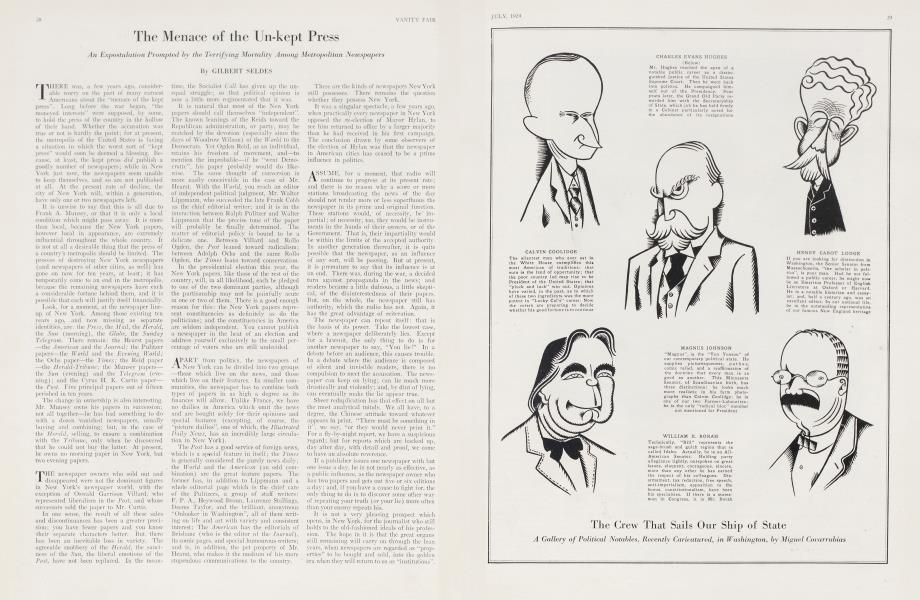
THERE was, a few years ago, considerable worry on the part of many earnest Americans about the "menace of the kept press", bong before the war began, "the moneyed interests" were supposed, by some, to hold the press of the country in the hollow of their hand. Whether the accusation was true or not is hardly the point; for at present, the metropolis of the United States is facing a situation in which the worst sort of "kept press" would soon be deemed a blessing. Because, at least, the kept press did publish a goodly number of newspapers; while in New York just now, the newspapers seem unable to keep themselves, and so are not published at all. At the present rate of decline, the city of New York will, within a generation, have only one or two newspapers left.
It is unwise to say that this is all due to Frank A. Munsey, or that it is only a local condition which might pass away. It is more than local, because the New York papers, however local in appearance, are extremely influential throughout the whole country. It is not at all a desirable thing that the press of a country's metropolis should be limited. The process of destroying New York newspapers (and newspapers of other cities, as well) has gone on now for ten years, at least; it has temporarily come to an end in the metropolis, because the remaining newspapers have each a considerable fortune behind them, and it is possible that each will justify itself financially.
Look, for a moment, at the newspaper lineup of New York. Among those existing ten years ago, and now missing as separate identities, are: the Press, the Mail, the Herald, the Sun (morning), the Globe, the Sunday Telegram. There remain: the Hearst papers —the American and the Journal; the Pulitzer papers—the World and the livening World; the Ochs paper—the Times; the Reid paper —the Herald-Tribune; the Munsey papers— the Sun (evening) and the Telegram (evening); and the Cyrus H. K. Curtis paper— the Post. Five principal papers out of fifteen perished in ten years.
The change in ownership is also interesting. Mr. Munsey owns his papers in succession; not all together—he has had something to do with a dozen vanished newspapers, usually buying and combining; but, in the case of the Herald, selling, to ensure a combination with the Tribune, only when lie discovered that he could not buy the latter. At present, he owns no morning paper in New York, but two evening papers.
THE newspaper owners who sold out and A disappeared were not the dominant figures in New York's newspaper world, with the exception of Oswald Garrison Villard, who represented liberalism in the Post, and whose successors sold the paper to Mr. Curtis.
In one sense, the result of all these sales and discontinuances has been a greater precision ; you have fewer papers and you know their separate characters better. But there has been an inevitable loss in variety. The agreeable snobbery of the Herald, the sauciness of the Sun, the liberal emotions of the Post, have not been replaced. In the meantime, the Socialist Call has given up the unequal struggle; so that political opinion is now a little more regimentated that it was.
It is natural that most of the New York papers should call themselves "independent". The known leanings of the Reids toward the Republican administration, or party, may be matched by the devotion (especially since the days of Woodrow Wilson) of the World to the Democrats. Yet Ogden Reid, as an individual, retains his freedom of movement, and—to mention the improbable—if he "went Democratic", his paper probably would do likewise. The same thought of conversion is more easily conceivable in the case of Mr. Hearst. With the World, you reach an editor of independent political judgment, Mr. Walter Lippmann, who succeeded the late Frank Cobb as the chief editorial writer; and it is in the interaction between Ralph Pulitzer and Walter Lippmann that the precise tone of the paper will probably be finally determined. The matter of editorial policy is bound to be a delicate one. Between Villard and Rollo Ogden, the Post leaned toward radicalism; between Adolph Ochs and the same Rollo Ogden, the Times leans toward conservatism.
In the presidential election this year, the New York papers, like those of the rest of the country, will, in all likelihood, each be pledged to one of the two dominant parties, although the partisanship may not be painfully acute in one or two of them. There is a good enough reason for this: the New York papers represent constituencies as definitely as do the politicians; and the constituencies in America are seldom independent. You cannot publish a newspaper in the heat of an election and address yourself exclusively to the small percentage of voters who are still undecided.
A PART from politics, the newspapers of New York can be divided into two groups —those which live on the news, and those which live on their features. In smaller communities, the newspaper has to combine both types of papers in as high a degree as its finances will allow. Unlike France, we have no dailies in America which omit the news and are bought solely for their opinions and special features (excepting, of course, the "picture dailies", one of which, the Illustrated Daily News, has an incredibly large circulation in New York).
The Post has a good service of foreign news, which is a special feature in itself; the Times is generally considered the purely news daily; the World and the American (an odd combination) are the great feature papers. The former has, in addition to Lippmann and a whole editorial page which is the chief care of the Pulitzers, a group of staff writers: F. P. A., Heywood Broun, Laurence Stallings, Deems Taylor, and the brilliant, anonymous "Onlooker in Washington", all of them writing on life and art with variety and consistent interest; The American has the editorials of Brisbane (who is the editor of the Journal), its comic pages, and special humourous writers; and is, in addition, the pet property of Mr. Hearst, who makes it the medium of his more stupendous communications to the country.
These are the kinds of newspapers New York still possesses. There remains the question whether they possess New York.
It was a singular spectacle, a few years ago, when practically every newspaper in New York opposed the re-election of Mayor Hylan, to see him returned to office by a larger majority than he had received in his first campaign. The conclusion drawn by some observers of the election of Hylan was that the newspaper in American cities has ceased to be a prime influence in politics.
ASSUME, for a moment, that radio will continue to progress at its present rate; and there is no reason why a score or more stations broadcasting the news of the day should not render more or less superfluous the newspaper in its prime and original function. These stations would, of necessity, be impartial; of necessity, too, they would be instruments in the hands of their owners, or of the Government. That is, their impartiality would be within the limits of the accepted authority. In another generation thereafter, it is quite possible that the newspaper, as an influence of any sort, will be passing. But at present, it is premature to say that its influence is at an end. There was, during the war, a decided turn against propaganda in the news; and readers became a little dubious, a little skeptical, of the disinterestedness of their papers. But, on the whole, the newspaper still has authority, which the radio has not. Again, it has the great advantage of reiteration.
The newspaper can repeat itself: that is the basis of its power. Take the lowest case, where a newspaper deliberately lies. Except for a lawsuit, the only thing to do is for another newspaper to say, "You lie!" In a debate before an audience, this causes trouble. In a debate where the audience is composed of silent and invisible readers, there is no compulsion to meet the accusation. The newspaper can keep on lying; can lie much more drastically and violently; and, by dint of lying, can eventually make the lie appear true.
Sheer reduplication has that effect on all but the most analytical minds. We all have, to a degree, the Chinese attitude toward whatever appears in print. "There must be something in it", we say, "or they would never print it." For a fly-by-night report, we have a suspicious regard; but for reports which are backed up, day after day, with detail and proof, we come to have an absolute reverence.
If a publisher issues one newspaper with but one issue a day, he is not nearly as effective, as a public influence, as the newspaper owner who has two papers and gets out five or six editions a day; and, if you have a cause to fight for, the only thing to do is to discover some other way of repeating your truth (or your lie) more often than your enemy repeats his.
It is not a very pleasing prospect which opens, in New York, for the journalist who still holds to the old-fashioned ideals of his profession. The hope in it is that the great organs still remaining will carry on through the lean years, when newspapers are regarded as "properties" to be bought and sold, into the golden era when they will return to us as "institutions".
Subscribers have complete access to the archive.
Sign In Not a Subscriber?Join Now