Sign In to Your Account
Subscribers have complete access to the archive.
Sign In Not a Subscriber?Join NowThe Second-Hand Coat
How a Secret Shared in Common Makes a Friendship Between Two Women
MADDY VEGTEL
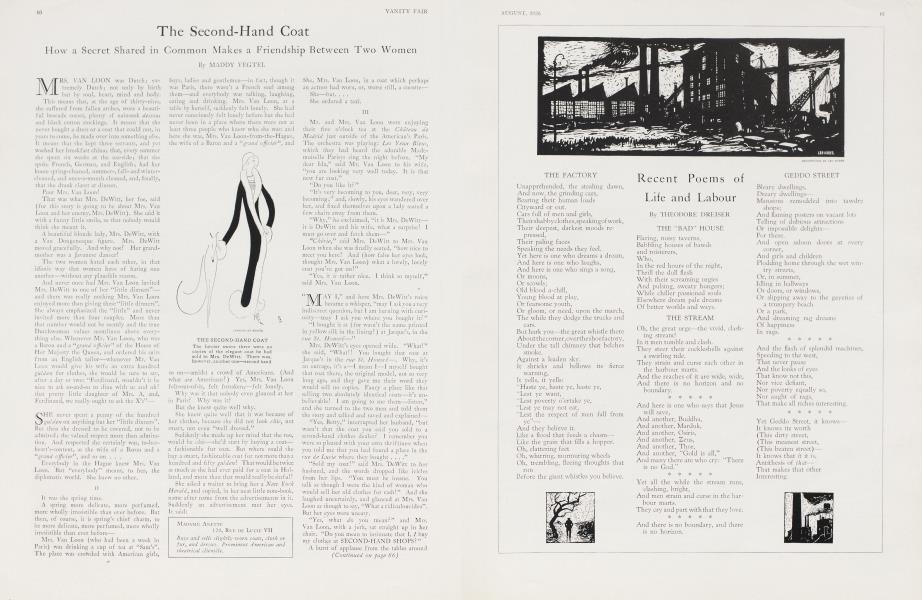
MRS. VAN LOON was Dutch; extremely Dutch; not only by birth but by soul, heart, mind and body. This means that, at the age of thirty-nine, she suffered from fallen arches, wore a beautiful brocade corset, plenty of nainsook dessous and black cotton stockings. It means that she never bought a dress or a coat that could not, in years to come, be made over into something else. It means that she kept three servants, and yet washed her breakfast china; that, every summer she spent six weeks at the sea-side; that she spoke French, German, and English; had her house spring-cleaned, summer-, fall-and wintercleaned, and once-a-month cleaned, and, finally, that she drank claret at dinner.
Poor Mrs. Van Loon!
That was what Mrs. DeWitt, her foe, said (for this story is going to be about Mrs. Van Loon and her enemy, Mrs. DeWitt). She said it with a funny little smile, so that nobody would think she meant it.
A beautiful blonde lady, Mrs. DeWitt, with a Van Dongenesque figure. Mrs. DeWitt moved gracefully. And why not? Her grandmother was a Javanese dancer!
The two women hated each other, in that idiotic way that women have of hating one another—without any plausible reason.
And never once had Mrs. Van Loon invited Mrs. DeWitt to one of her "little dinners"— and there was really nothing Mrs. Van Loon enjoyed more than giving these "little dinners". She always emphasized the "little" and never invited more than four couples. More than that number would not be seemly and the true Dutchwoman values seem! incss above everything else. Whenever Mr. Van Loon, who was a Baron and a "grand officier" of the House of Her Majesty the Queen, and ordered his suits from an English tailor—whenever Mr. Van Loon would give his wife an extra hundred gulden for clothes, she would be sure to say, after a day or two: "Ferdinand, wouldn't it be nice to ask so-and-so to dine with us and oh! that pretty little daughter of Mrs. A, and, Ferdinand, we really ought to ask the X's"—
SHE never spent a penny of the hundred gulden on anything but her "little dinners". But then she dressed to be covered, not to be admired; she valued respect more than admiration. And respected she certainly was, to-herhcart's-content, as the wife of a Baron and a "grand officier", and so on ... .
Everybody in the Hague knew Mrs. Van Loon. But "everybody" meant, to her, the diplomatic world. She knew no other.
II
It was the spring time.
A spring more delicate, more perfumed, more wholly irresistible than ever before. But then, of course, it is spring's chief charm, to be more delicate, more perfumed, more wholly irresistible than ever before—
Mrs. Van Loon (who had been a week in Paris) was drinking a cup of tea at "Sam's". The place was crowded with American girls,
boys, ladies and gentlemen—in fact, though it was Paris, there wasn't a French soul among them—and everybody was talking, laughing, eating and drinking. Mrs. Van Loon, at a table by herself, suddenly felt lonely. She had never consciously felt lonely before but she had never been in a place where there were not at least three people who knew who she was: and here she was, Mrs. Van Loon-from-the-Hague, the wife of a Baron and a "grand officier", and
so on—amidst a crowd of Americans. (And what are Americans?) Yes, Mrs. Van Loon felt-out-of-it, felt forsaken,—felt lonely.
Why was it that nobody even glanced at her in Paris? Why was it?
But she knew quite well why.
She knew quite well that it was because of her clothes, because she did not look chic, not smart, not even "well dressed."
Suddenly she made up her mind that she too, would be chic—she'd start by buying a coat— a fashionable fur coat. But where could she buy a smart, fashionable coat for not more than a hundred and fifty gulden? That would be twice as much as she had ever paid for a coat in Holland, and more than that would really be sinful!
She asked a waiter to bring her a New York Herald, and copied, in her neat little note-book, name after name from the advertisements in it. Suddenly an advertisement met her eyes. It said:
MADAME ANETTE
120, RUE DE LUCIE VIIBuys and sells slightly worn coats, cloth or fur, and dresses. Prominent American and theatrical clientele.
She, Mrs. Van Loon, in a coat which perhaps' an actress had worn, or, worse still, a cocotte—
She—-but. . . .
She ordered a taxi.
III
Mr. and Mrs. Van Loon were enjoying their five o'clock tea at the Chateau de Madrid just outside of the American's Paris. The orchestra was playing: Les Yeux Bleus, which they had heard the adorable Mademoiselle Parisys sing the night before. "My dear Ida," said Mr. Van Loon to his wife, "you are looking very well today. It is that new. fur coat."
"Do you like it?"
"It's very becoming to you, dear, very, very becoming;" and, slowly, his eyes wandered over her, and fixed themselves upon a lady seated a few chairs away from them.
"Why," he exclaimed, "it is Mrs. DeWitt— it is DeWitt and his wife, what a surprise! I must go over and fetch them—"
"Chérie," said Mrs. DeWitt to Mrs. Van Loon when she was finally seated, "how nice to meet you here! And (how false her eyes look, thought Mrs. Van Loon) what a lovely, lovely coat you've got on!"
"Yes, it is rather nice. I think so myself," said Mrs. Van Loon.
"MAY I," and here Mrs. DeWitt's voice became a whisper, "may I ask you a very indiscreet question, but I am burning with curiosity—may I ask you where you bought it?"
"I bought it at (for wasn't the name printed in yellow silk in the lining?) at Jacque's, in the rue St. Honore—"
Mrs. DeWitt's eyes opened wide. "What!" she said, "What!! You bought that coat at Jacque's in the rue St. Honore—. Why, it's an outrage, it's a—I mean I—I myself bought that coat there, the original model, not so very long ago, and they gave me their word they would sell no copies. Fancy a place like that selling two absolutely identical coats—it's unbelievable! I am going to sue them—listen," and she turned to the two men and told them the story and talked and raved and explained—
"Yes, Betty," interrupted her husband, "but wasn't that the coat you said you sold to a second-hand clothes dealer? I remember you were so pleased with your own thriftiness when you told me that you had found a place in the rue de Lucie where they bought . . . ."
"Sold my coat!" said Mrs. "DeWitt to her husband, and the words dropped like icicles from her lips. "You must be insane. You talk as though I were the kind of woman who would sell her old clothes for cash!" And she laughed uncertainly, and glanced at Mrs. Van Loon as though to say, "What a ridiculous idea". But her eyes were uneasy.
"Yes, what do you mean?" and Mrs. Van Loon, with a jerk, sat straight up in her chair. "Do you mean to insinuate that I, I buy my clothes at SECOND-HAND SHOPS?"
A burst of applause from the tables around them suddenly disturbed further conversation : once more, the orchestra was playing: Les Yeux Bletts.
Continued on page 86
Continued from page 60
IV
Mrs. Van Loon was once again back in Holland, with one hundred gulden to spend on a "little dinner". After all that wasn't so very much, what with flowers to be bought and a chicken-and-mushroom vol-auvent for fifteen people (for some people really did take twice), and the wages a butler asked for four hours' service.
Mrs. Van Loon would not have thought of having a butler if it
had not been for Mrs. DeWitt.
But Mrs. DeWitt would be sure to tell everybody what had been served, and how. . . .
"My dear Ida."
"Betty, dear."
They kissed.
"I am so glad you could come."
"So am I—enchantee/"
Their mouths smiled eagerly at each other. But in their eyes there lurked a hardly definable expression: an expression of fear and curiosity. But their hands remained clasped, in a warm embrace. Impossible, you will say? Not at all. Were they not sharing, and guarding the self-same secret?
Subscribers have complete access to the archive.
Sign In Not a Subscriber?Join Now
