Sign In to Your Account
Subscribers have complete access to the archive.
Sign In Not a Subscriber?Join NowThe Charming Wife
Presenting Several Exterior Views and One Interior View of a Happy Home—With a Difference
MADDY VEGTEL
BARON Sandor de Giskra came to The Hague as secretary to the Austrian Embassy. As his was not merely Maria Theresa nobility his colleagues forgave him his platinum bracelet and shell-pink shirts. When he had been in The Hague a month his friend Willem Sloet said, "I want you to meet the Steyns, they're awfully nice. We'll go up for the week-end. It will be interesting for you to see how Dutch people live in the country."
Jack Steyn met his guests in Utrecht and drove them in his car to his estate, which bordered on the river Vecht. Their host wore a blonde tooth-brush moustache, shabby tweeds and he smoked a pipe; thus, out of England, he managed a thoroughly English appearance. The river past which they drove the latter part of the way, was frozen, covered with thick grey ice. The sky, too, was grey and so also, though in a darker shade, were the leafless trees. It was all very dismal.
"Attie will probably be skating with the children," said their host as they rode up the drive toward the house, which was square and low and white but, as white houses are apt to do, changed its shade with the seasons. Thus in summertime it was as white as snow, while amidst snow it became almost as yellow as a buttercup. Now it was greyish and as dismal as its surroundings.
"Hi—ee!" cried Jack Steyn, his hands cupped before his mouth.
"Hi—ee!" a woman's voice sounded faintly from far behind the house.
"I thought so. They are on the river."
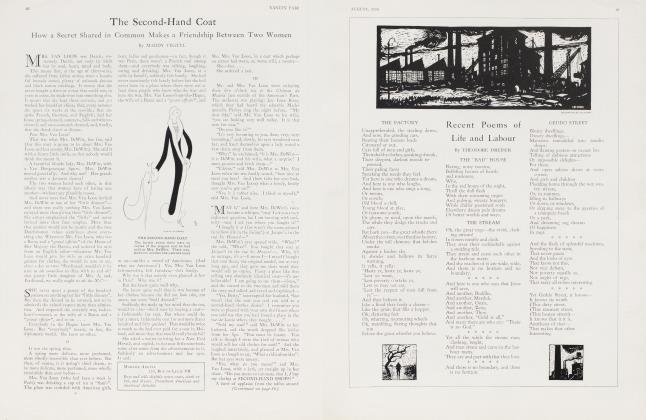
THE first glimpse Sandor had of Attie Steyn was as she came skating toward them holding a small girl by each hand. She was a slim young woman dressed in clothes of several seasons past. She wore a long purple skirt, an astrakhan jacket fastened high up under her chin and very full in the shoulders, and on her head a round woolly cap. She came up to where the three men were standing and, freeing herself from her children, put a hand on her husband's arm. She said, "Hello, darling!" in English and "Hello, Willem. Awfully glad you could come," and with Sandor she shook hands. She is charming, thought Sandor, absolutely charming.
"We've been skating ever since lunch but I think we'll stop now and have tea."
"We needn't go in yet, Mummie, need we, we needn't, need we?" one of the small girls whined.
"No, darling, no. This is Daisy, Baron de Giskra, and that one is Violet and the little boy over there with nurse is Jackie . . . You don't mind my speaking English? My German is not so awfully good ..."
They had tea in the salon, an immense room, three windows of which looked out on the river and on the estate beyond.
"Who lives there?" Sandor asked.
"The Burgomaster," said Jack Steyn, "an awfully nice fellow."
A man servant entered to light the oil lamp which hung on a chain from the low ceiling. "We have no gas or electricity," Attie said, "we have to do everything with oil!" And if she had told Sandor "We have but to clap our hands and lo! there is light and there is heat! " she could not have looked more pleased . . .
"I have been staying at the Steyns'," Sandor found himself telling someone over and over again.
"Oh, you have? Aren't they delightful?"
"Charming."
"I have been staying at the Steyns'."
"Oh, really. Didn't you think them charming?"
"Perfectly delightful!"
"Attie is a darling and she is so good to Jack and wonderful to her children!"
"Doesn't she ever come to The Hague?"
"Oh yes, she's coming to my little dinner next week. I'll put you beside her."
And at that little dinner Sandor asked her, "Don't you ever get bored living out there?"
"Bored? No. Why?"
"I should think it would be terribly lonely and boring. Wouldn't you like to live somewhere else?"
"Where?"
"HERE in The Hague, for instance, or better still in Vienna. I am sure you would adore Vienna, the music alone . . ."
"I have a radio and a Victrola," said Attie and then "Pardon?" to an elderly lady who was speaking to her from across the table.
The children soon called Sandor "Uncle". He no longer sent his card in when he called. He no longer waited to be invited. He had in fact become a friend-of-the-family. And he agreed with the others, with the other men, the young girls, the couples, with all those who came to Vechtzicht that the Steyns were a most delightful couple.
And "She has bonté du coeursaid Willem Sloet.
"Charm," said Sandor de Giskra.
"Oh, more than that! " exclaimed his friend, who like the true Dutchman he was, thought charm but a veil to cover defects. "The way she thinks of others. Did I ever tell you when . . ." and so on. So Willem Sloet spoke and Sandor and like them other men, and to all she behaved in the same sweet, unaffected way, as only a pretty young woman can whose heart has already been given away.
Late in June, a few days before he left for his vacation, Sandor spent another week-end at the Steyns'. After lunch they went into the garden. Besides Sandor there was one more guest, a young girl. She and Attie seated themselves side by side on a white wooden bench. Between them they held a coarse tan cloth on which they stitched crosses. Sandor pressed a sprig of sweet woodruff against his nose and glanced up at the sky. It was bright blue, but pale pink and golden clouds drifted by like small dirigibles. In such surroundings Sandor could not help but become melancholy. He sighed and said, "I will never forget this evening. When I am gone . . ."
"Gone?" interrupted Attie. She glanced up from her needlework, bit off a thread and repeated, "Gone? Where are you going to?"
"To Vienna. Oh, surely I told you. I won't be back till October. I thought I had told you."
He did not only think it. He knew he had. They had spoken at length about his journey and he had planned to bring her some Hungarian embroidery.
"But darling!" said Jack Steyn. "I heard you talk about it with Sandor myself."
"Well, if you all say so!" she laughed gayly. She looked at Sandor and for the first time he saw an expression of embarrassment in her eyes.
Several months passed by. Sandor returned from his holiday, visited the Steyns and commenced his second winter in The Hague. One afternoon in November he decided on the spur of the moment to go to Vechtzicht. It had snowed for several days and as he drove up in a carriage he was again struck by the extreme dismalness of its surroundings. The motionless trees, heavy with snow, the dark river forever gliding past, the flat white meadows, the lead-coloured sky. He thought of Vienna where snow remained pure only till it fell, where at this moment women no younger and prettier than Attie Steyn were hurrying to a tea, or a dance.
It was a dark day and already the lamp in the hall had been lit. He took off his hat, coat and gloves. "Madame is in the salon," the man servant said. Sandor went in.
"HPA-DA ta-da ta-da," a voice hummed. It -iwas Attie, waltzing to the melody of the gramaphone. She held a tip of her skirt, spread out fan-like, by each hand, her head tilted backward, her eyebrows raised over halfshut eyes. Often Sandor had seen women dance thus, a trifle pale with parted lips, but never alone, never alone in a chilly dark room with snow piled up against the window-panes.
"Ta-da ta-da ta-da ... Oh!" she said suddenly and stopped. "Oh!" She let her skirt fall and stood quite still. Sandor came forward. "I am awfully sorry. Please go on. Please don't let me disturb you . . ."
"Ah no!" said Attie blushing. She turned and stopped the gramaphone. She lit a lamp and set it on the mantelpiece. "Sit down. How nice of you to come in this weather." She seated herself opposite him.
"I didn't know you liked to dance," said Sandor. He thought he had never before seen her look like this, look so young, so animated.
"Did I tell you that?"
"Yes, you told me that."
"Jack doesn't care for it . . ."
"Attie," said Sandor suddenly.
"Yes?"
"Attie, do you really and truly like living here, do you really like all this, this great big house, and the draughts and the oil lamps and the loneliness . . ."
Continued on page 118
Continued from page 91
"Why do you think I don't?"
"You don't, do you?"
"Jack does, he loves it, he wouldn't live anywhere else."
"Jack! I am not talking about Jack. I am talking about you. Do you like it?"
"Yes . . "
"Oh come, Attie!"
"Yes, Sandor. I don't mind." She looked at him very gravely. The flush, the sparkle, all animation had once again left her. She was as he had always known her, sweet and charming.
"I can't understand it. Now in Vienna a woman would . . ."
"No, you can't understand it, Sandor, because you don't know that I am very much in love, and that's why I don't mind it. It makes it all different. Do you think that your ladies in Vienna or Budapest are any happier than I am, if they are not in love? I don't think so. Isn't that what really matters, isn't that what we all want, and do you think that I don't feel the same, feel what they do when I hear a waltz just because I hear it by myself and not in a tearoom?"
The children came in from a walk, they flung their arms around their mother's neck and pressed cold red cheeks against hers. They went out again.
Day after day, thought Sandor, day after day. He thought of Jack Steyn, nice, kind Jack Steyn who during all these years had held Attie's love. It seemed incredible! But then was any man nice and kind enough to merit Attie's love for years and years?
"If you'd like to go up and change, Sandor, Jack will be home sooa The Burgomaster is coming to dinner."
Softly Sandor shut the door behind him.
Attie Steyn got up and went over to a window. She leaned her head against the panes, crossed her arms and hugged her shoulders. She stared into the black-and-white garden, over the river and over the snow-covered grounds beyond.
She smiled, she closed her eyes. With a little shiver she raised her hand and laid it over her mouth. This love! What would she be without it, how would she exist, how would she be able to bear everything? It made her good and kind and tolerant. It made her thus because, beside it, everything lost its importance. "Dear, dear . . ." She whispered a name, the name of the Burgomaster.
Subscribers have complete access to the archive.
Sign In Not a Subscriber?Join Now
