Sign In to Your Account
Subscribers have complete access to the archive.
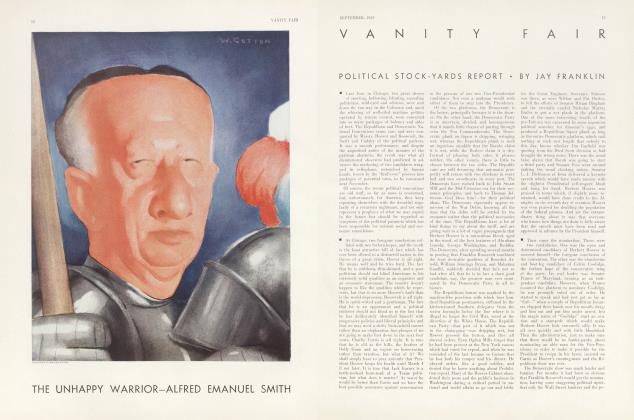
Sign In Not a Subscriber?Join NowBack in the days before we began to suspect that the Great White Father habitually wore a great white feather in his war-bonnet, we thought that Hoover was a trained economist, a broad-gauged administrator, an "engineer in politics", who would distill great big constructive policies from his high-pressure, copper-lined brain, instead of playing peanut politics with the party henchmen. That, at any rate, was the sort of man the majority thought they were voting for in the days when the name Smith suggested side-walks rather than cough-drops, and when we decided to keep a Republican in the White House for another four years.
Look at what has happened! President Hoover and the Republican Party have landed the country in the worst tariff mess in American history. Prosperity and our foreign trade are sick as dogs. Our tariff has offended thirty-six foreign governments which threaten reprisals and the country has been treated to fifteen solid months of sordid, imbecile Congressional wrangling over the silliest tariff since the Payne-Aldrich Bill which "did" for Taft.
Let it be said that the Smoot-Hawley Tariff is not a bad tariff. As protective tariffs go, it is pretty good. Its rates are not as high as the McKinley or the Dingley Tariffs; they are less than one-half of one per cent higher than the Payne-Aldrich Tariff and only three per cent higher than the Fordney Tariff under which we have managed to get along quite comfortably for eight years. The Smoot-Hawley Tariff is not bad, it is worse than bad: it is stupid. It comes just at a moment when the economic recovery of the world from the effects of the war leaves other nations for the first time in a decade in a position to take a crack at our prosperity. The present tariff has given them their opportunity and their excuse. It comes just at the moment when the economic development of America is leading us away from protection in the direction of freer trade. Finally, the tariff has got all tangled up with the question of farm relief and has led to the solemn promulgation of fiscal principles which sound like a satire on protection and which threaten to turn national sympathy for the distressed farmers into acute resentment. And Hoover can't do a thing to stop it.
The trouble began as soon as Hoover was nominated.. Before he knew what was happening he found himself all tied up in a chain of pronouncements and promises which made the tariff the paramount issue of the campaign of 1928 in the mind of this man who was engaged in beating Smith with the aid of the Cannons, McBrides and professional Protestants of the American theocracy. On July 4, 1928, the Republican campaign manager said that the tariff would be the leading issue of the campaign. Smoot, Curtis, Hughes and the other protectionist witch-doctors took up the refrain. In his speech of acceptance at Palo Alto, on August II, 1929, Hoover said, "We have pledged ourselves to make such changes in the tariff laws as may be necessary to provide real protection against the shifting of economic tides in our various industries." In his speech at Newark on September 18 and in his raid into the then Solid South at Elizabethtown, Tennessee, the engineer in politics advocated, "strengthening of the protective tariff as Henry Clay of Kentucky advocated it ... I wish to see complete protection fox the farmer of our home market." In his big tariff speech at Boston, ten days later, he remarked that "one of the most important economic issues of this campaign is the protective tariff ... to give adequate protection to American labor, American industry and the American farm against foreign competition." They had him sewed up.
Came the election, but the victorious candidate did not come out of the Tariff ether. In his inaugural address he announced that "limited changes in the tariff cannot in justice to our farmers, our labor and our manufacturers, be postponed." Three days later he summoned a special session of Congress to meet on April 15, 1929, to consider these changes. He even sent that special session a message which claimed that "The government has a special mandate from the recent election ... to revise the agricultural tariff. . . . It is not as if we were setting up a new basis of protective duties. We did that seven years ago." A campaign which had been waged and won largely on the ground that Smith was a Catholic, a Wet and a member of Tammany Hall, became a "special mandate" to revise the tariff.
So the mess began. The House, where autocratic methods of political jobbing pass muster as statesmanship, did its bit and passed the Bill on May 28, by a vote of 264 to i47Then the Senate took over. Days and weeks and months rolled by, and still the Bill rumbled around the Senate, where the erudite Smoot had laid it in September, 1929. The stock-market had spasms, delirium tremens and nervous prostration and still the Senate crooned over the Bill. Coalitions formed, triumphed and dissolved, and the Bill was not yet law. First Smoot, then Borah, then Norris, and finally Grundy had the leadership. In his message to Congress at the regular session in December, the President plaintively remarked that "no condition has arisen in my view to change these principles stated at the opening of the special session" and asked for speed. The Senate held night sessions. Reckless promises were made and broken. The Bill would pass the Senate by Christmas, well, by February 15; it finally did pass on March 24, 1930, by a vote of 53 to 31, and it included 1,253 amendments to the Bill as passed by the House.
So the Tariff went to Conference, went back to the House, back to the Senate, back to Conference. The Senate backed down on debenture and the flexible provisions. The first was a proposal to pay the farmers to export their produce; the second was designed to end the Presidential power to juggle the rates. This was hailed as a Presidential victory but it removed the President's last legitimate excuse to veto the Bill, and it became evident that a veto would wreck his Party and a signature his Administration.
Time rolled on. Five million men walked the streets for work. A few of them found it. The country got excited over Prohibition, over Naval Disarmament, over Admiral Byrd, over Bobby Jones, and still the Bill meandered in and out of conference and still votes and roll-calls and orations resounded in Congress. The Bill began to threaten to do for Mr. Hoover what the Payne-Aldrich Tariff did for Mr. Taft, and still the White House conferred and Senators sounded off and the public yawned.
The effect has been to make the current American Tariff the best advertised bit of protection on the face of the globe. As protection goes, it is not extortionate. If there is a case for a protective tariff the Smoot-Hawley Bill is justified. It is not the only tariff in the world, nor even the highest tariff in the world. Spain, Brazil and Russia all maintain far stiffer rates. However, for fifteen months the entire world has seen us washing our dirty fiscal linen in public and our trade rivals have been quick to take advantage of the situation.
They began retaliating against us long in advance of any real or fancied injury to themselves. In the interval between Hoover's election and the beginning of tariff revision, twenty-five foreign countries raised their tariffs against American goods. These included the Irish Free State, Malta, Nigeria, Palestine and British Guiana, to mention only the British "free-trade" countries, as well as such great powers as France, Germany, Spain, Italy and Japan. Since then there have been further increases in Australia, whose protective tariff is now sky-high, Canada, which has adopted special discriminatory duties against American goods, Austria, Egypt, New Zealand, Chile, Cuba, Panama, Peru and Sweden. All of this occurred before a single American duty was changed.
Not content with having started a tariff war against the United States, these same countries in many cases have protested against our projected tariff increases. Threats of a Tariff War are now taking definite shape. The British Empire plans further discriminations against our trade. M. Briand tries to weld Europe into an economic union against the United States. Argentina is eager to foment a similar union in South America. It is hard to forgive the administrative folly which permitted such a situation to develop: it is particularly hard to forgive a man like President Hoover, who knows much better.
The truth is that the United States is rapidly growing away from the need of protection. Great exporting interests have been created in the last decade and they realize that it is impossible to sell if you refuse to buy and they have demonstrated that American goods can compete on equal terms anywhere in the world. Leading these interests are the automobile manufacturers. Henry Ford and General Motors have taken a strong stand against the tariff, but there is not a protected product of American industry which is not to-day being profitably sold in foreign markets, where they have no benefit of American protection and have to overcome foreign tariffs.
There is another element, however, which is opposed to the tariff. That is Wall Street. Bankers realize that we have* invested fifteen billion dollars abroad—twenty-five billion, if we count the war debts. These dollars must presumably be repaid. In the meantime, they earn interest amounting to about a billion dollars a year. Bankers know that unless our debtors are allowed to repay these loans in goods or services, our investments will fail and our loans be repudiated. It is to the interest of Wall Street that these loans should be repaid and if the Tariff gets in their way, so much the worse for the tariff.
America is not a unit on tariff protection. Big industry does not need it. Big banking is hurt by it. The farmer is being squeezed by it. The small manufacturer regards as preposterous the new theory that raw materials as well as manufactured goods must be excluded. However, the farmer is going to be blamed for this tariff. The only sort of a tariff that helps the farmer is a low tariff for industrial goods. He must sell in a world market and buy in a protected market and he gets a rotten deal.
Who does want the Tariff, if the farmer doesn't? Wall Street doesn't. Big industry doesn't. American business has no use for it. There isn't an executive Department in Washington that would take responsibility for the proposed Tariff. The only beneficiaries of this Bill seem to be that wobbly and inefficient section of American industry which lacks the brains to produce efficiently—the same type of industry which consumed the capital of the New England cotton mills in fat dividends and then let the cotton industry go to North Carolina rather than to take the trouble to compete; wool manufacturers of the type of Joe Grundy of Pennsylvania, who imports his machinery from Great Britain but demands high duties on everything he makes; a few fruit growers in California and Florida who want to cash in on a monopoly of the citrus fruit market in the United States; the Mormon beet-sugar industry which wants to swell its already swollen profits; the shoe factories of Massachusetts which resent being forced to compete with the skillful designers of Czecho-Slovakia's American-equipped factories.
Labor wants the tariff; organized penny-wise, pound-foolish Labor wants to keep few jobs and high wages and high prices rather than get more jobs with lower wages and lower prices and be enabled to compete in the markets of the world. Labor has been sold on the protective tariff. Labor protests against Henry Ford and other American manufacturers establishing branch factories abroad, but labor does not see that a deflation of wages and prices here would keep the jobs and the branch factories at home.
There is no end, no justice and no sense to the stupid business. A bill which was too raw for America twenty years ago will not last long in the America of mass-production, world-trade and international finance. The Hoover Tariff has no justification in fact, in theory or in practice, in the light of the modern United States. The forces which will overthrow it are preparing to use it as an argument in behalf of a lower tariff than the country is economically prepared to stand. It is being pushed by politicians of both parties against their better judgment, in deference to an outworn tradition that a protective tariff is good for America. The Democrats have been making a dumb-show of virtuous indignation but they have voted protection for themselves all along the line. The Republicans have been bleating the thread-bare phrases that went over big with the Full Dinner Pail and did yeoman service against Grover Cleveland. Hoover has done nothing.
The result is an economic monstrosity, conceived in bipartisan flatulence and destined to wreck the Hoover Administration and to recast both of the major political parties. The world of our competitors will seize the occasion to declare a tariff war against us, not because of the tariff itself but because of the indiscreet advertisement it has given to our blatant economic self-satisfaction. And in four years' time the whole job will have to be undone. America has grown a little too big and too powerful to require skyscraping protectionism any longer. This will be a tariff to end high tariffs.
Subscribers have complete access to the archive.
Sign In Not a Subscriber?Join Now
