






Sign In to Your Account
Subscribers have complete access to the archive.
Sign In Not a Subscriber?Join NowTHE EDITOR'S UNEASY CHAIR
■ And in that town there is a fair called Vanity Fair and in it are all such merchandise sold as places, honours, preferments, titles, lusts, pleasures and delights of all sorts; and, moreover there are at all times to be seen there, jugglings, games, plays, apes and rogues of every kind. And they that keep this fair are the men of this world.
THE PILGRIM'S PROGRESS BY JOHN BUNYAN, 1478
A bouquet for Mr. Hoover
The cover of this issue is by Miguel Covarrubias, the •well-known Mexican artist, and whereas he pokes a little mild fun at Mr. Hoover, he joins the rest of the world in handing the President a pretty bunch of posies, a gesture which happily acknowledges the great Engineer's own beau geste and firm and vigorous stand on the matter of Reparations.
Red writer
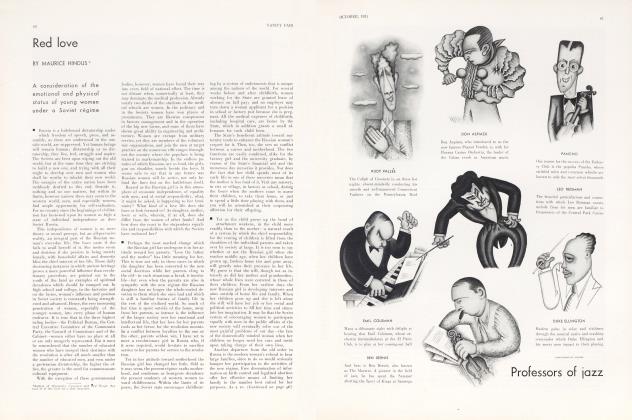
Maurice Hindus was born thirty-nine years ago in a remote Russian village. When he was fourteen years old his family migrated to America. After a scant two years of a New York high school training, Hindus went to work on a farm, his ambition being to become a scientific farmer. He was refused admission to the State Agricultural College at Cornell University, but later entered Colgate University, from which he was graduated with high honours. It was while a student in the Harvard graduate school that the young Russian wrote his first book, The Russian Feasant and the Revolution (1920). The next three years were times of discouragement and hardship, and it was not until the appearance of Broken Earth in 1923, which he wrote after revisiting his native land, that Hindus received any attention from either publishers or public. Humanity Uprooted and Red Bread, his next two volumes on the Russian question, won him a fame that was international. Intimate studies of Russia under the Soviets, their material was gathered on the author's extensive and intensive wanderings throughout the Russias and from his close contacts with the Russian peasant, as well as the authorities of the Soviet regime. Of the countless books on Russia being published today, Maurice Hindus' works stand out for three reasons: they were written by an Americo-Russian; they are warmly human rather than coldly theoretical documents; and they are, in so far as this is possible, objective in their approach to the communistic experiment. Mr. Hindus, a contributor to Vanity Fair in the past, presents his views of the Soviet woman and of her relations to the Soviet man, in Red Love, on page 60 of this issue.
Flying high
Mr. C. B. Allen, whose second article on Learning to Fly appears on page 58 of this issue, himself learned to fly in the United States Army during the World War, and has been a gentleman of the air ever since. He holds a Transport Pilot's license, and a Captain's commission in the Air Corps Reserve. Aviation editor of World-Telegram, he is one of the few newspapermen who is also an active flier. He won the Sportsman Pilots' cup at the National Air Races in Chicago in 1930 taking "lime out" of the press box to do so. A year ago he flew Lindbergh's Curtiss Falcon across the continent to cover the Air Corps maneuvers at Mather Field. He was the first passenger (1927) to go through with the mail in continuous flight from New York to San Francisco. He loured Europe with Clarence D. Chamberlin and was co-author of his Record Flights. He covered the Army Air Corps' "big parade" over New York this year by radio-telephone into World-Telegrain s offices from a plane which paced the "raiders" down the Hudson.
And that, ladies and gentlemen, is flying.
Campus delight
Dear Sirs: 1 am naive enough, to believe that those on the editorial staffs of publications like to know what their readers think.
Before listing my own likes and dislikes, I should like to mention one fact concerning your circulation: namely, the frequency with which one finds Vanity Fair among eastern colleges (particularly at Yale, Harvard, Princeton, Dartmouth, and Williams). Now, obviously, yours is not primarily or even secondarily a college publication. . . . God forbid!
. . . but the fact that it is read in some, albeit effete eastern colleges, should tend to prove that what you have to say is of interest to at least a part of the Younger Generation.
If you have sent the above valuable data to the Circulation Dept., we will now proceed to various personal reactions:
Re Pictures, Caricatures, and Art: The studies of your photographs, especially Steichen, and the satires of your several caricaturists are fine. Most of the Art is more difficult than one with the meagre background of a college course can fairly judge, but at least the effect is good and gives a je-ne-sais-quoi which probably pleases the many of us who sometimes fail to fully comprehend.
Re Sports: Mr. Gallico appears to he the Walter Winchell of his subject. . . .
Re Politics: Despite the fact that this is my third point in this list, I think your articles on Politics are probably the best single feature. Mr. Lippmann writes sagely and well. The mysterious Mr. Franklin is also fine ... a bit more sparkling on coining of apt phrases, but therefore a hit apt to make things too simple.
Re the Theatre: Mr. Nathan is probably one of the best of his craft, tho' at times he verges on the Shavian in ego.
CARL S. OXTOBY
P.S. (That personal touch) . . . Please tell your above-mentioned Circ. Dept, to get in touch with me to renew my subscription.
P.P.S. (Even more personal) : The above was written while slightly "under the influence"—but—in vino veritas, so will send it anyhow.
The Editors have notified the Circ. Dept., congratulated Steichen, chided the too simple Mr. Franklin, warned Mr. Nathan against his manifestations of Shavian ego, and in all other ways suggested by Mr. Oxtoby, shown their appreciation of its albeit effete eastern college clientele. Will Mr. Oxtoby, in exchange, inform the Editors of the name and address of his bootlegger in order that we may develop an equally generous attitude about campus humourists?
Prodigy survives
Jack von Reppert-Bismarck, whose drawings of four well-known beauties appear on page 56 of this issue, was proclaimed in her childhood as something of a prodigy. Having survived this difficult and often disastrous classification, she is now, at the age of twenty-two, considered one of Germany's outstanding women painters. Frau von Bismarck's real name is Elsa, hut her young husband, Jorg von Bismarck, who is himself a painter and decorator and (he grandson of the Iron Chancellor, imagining in the early days of their courtship that he saw in his wife a resemblance to Jackie Coogan, called her Jack, which, pronounced by him "Jake," has become to the world the young painter's name.
Her style, fresh, gently perverse, untutored (she studied for only a short time at the Berlin Academy of Arts) and as delicate as the artist herself, is admirably suited to the models which she prefers: exquisite, subtle and youthful beauties.
Smorgasbord
Dear Sirs: In the July issue of Vanity Fair I find an article by Mr. Charles G. Shaw in which he attempts to give us the low-down on the fine restaurants of five European capitals. M. Shaw, in the ill-fitting robe of a connoisseur par excellence, cuts a pitifully sorry figure, but, alas! there are thousands of gullible souls who believe his every word and consider him an authority of supreme importance.
(Continued on page 94)
(Continued from page 29)
Having never been in London and being none too familiar with the byways of Paris, I shall restrict myself to Senor Shaw's observations concerning Budapest, Berlin and Vienna. I note that he notes that the restaurants in these cities are "of increasing excellence." This sounds like a praise but is, as a matter of plain fact, a slap in the face of any self-respecting Viennese or Budapestian. I do not doubt that Mynheer Shaw actually did spend some time in the above mentioned cities, for he jots down Horcher in Berlin, the Sacher in Vienna, and Gerbeaud in Budapest. But—:
How about the Bristol in Berlin, undoubtedly one of the two best eating places in the German capital? Or the Eden? Or the Adlon? Or, to go to the other extreme, why not Frau Vlutzbauer's? I haven't been in Marburgerstrasse for three years, but I hope her restaurant is still there. And why omit the Imperial in Vienna? And the Erzherzog Karl, and the Opernrestaurant, and Meissl und Schadn? And why the discovery of curry d'agneau à I'lndienne as a Viennese specialty when they have Kalbsnierenbraten and boiled beef with cucumber or horseradish sauce and, yes, Wiener Schnitzel, and Salzburger Nockerln, and, indeed, Zwetschkenknoedel? Ask Squire Shaw whether he ever tasted Zwetschkenknoedel at the Posta opposite the Hauptpostamt? And what's happened to the Hungaria in Budapest, and to Gundel's, and the Carlton Grill, and Weingruber's, and to the dozen or so little Buda restaurants?
Yours for a charlesgshawless Vanity Fair, I am,
GEORCE HALASZ Port Washington, L. I.
Subscribers have complete access to the archive.
Sign In Not a Subscriber?Join Now
