Sign In to Your Account
Subscribers have complete access to the archive.
Sign In Not a Subscriber?Join NowTHE GREAT DEBATE, CONTINUED
Christopher Hitchens, Catholic League hero?; poking holes in Rummy’s line of defense; badass Samaritans; not-so-dear Dame Edna; knickers in a twist over Swedes in skivvies; and more
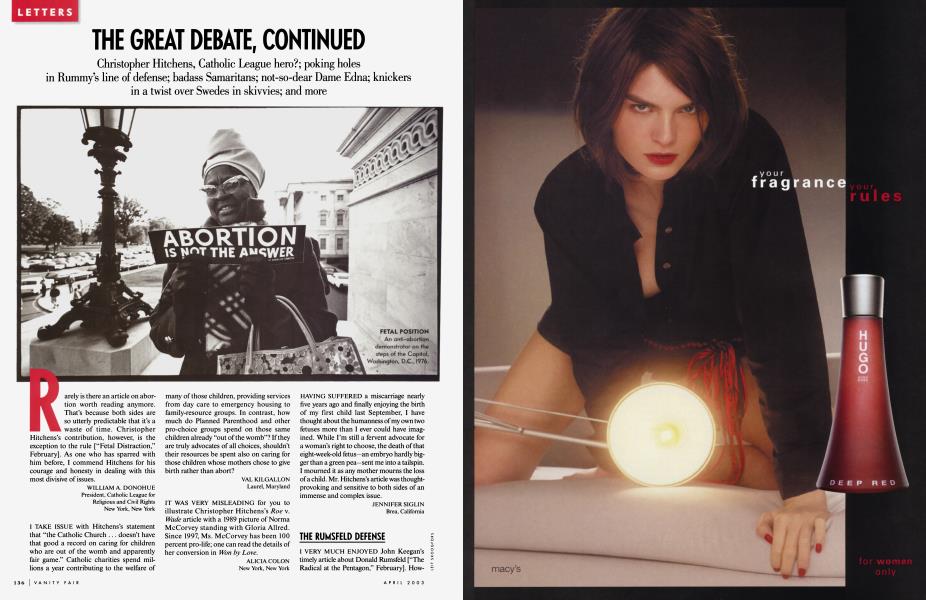
Rarely is there an article on abortion worth reading anymore. That's because both sides are so utterly predictable that it's a waste of time. Christopher Hitchens’s contribution, however, is the exception to the rule [“Fetal Distraction,” February]. As one who has sparred with him before, I commend Hitchens for his courage and honesty in dealing with this most divisive of issues.
WILLIAM A. DONOHUE
President, Catholic League for Religious and Civil Rights
New York, New York
I TAKE ISSUE with Hitchens’s statement that “the Catholic Church ... doesn’t have that good a record on caring for children who are out of the womb and apparently fair game.” Catholic charities spend millions a year contributing to the welfare of many of those children, providing services from day care to emergency housing to family-resource groups. In contrast, how much do Planned Parenthood and other pro-choice groups spend on those same children already “out of the womb”? If they are truly advocates of all choices, shouldn’t their resources be spent also on caring for those children whose mothers chose to give birth rather than abort?
VAL KILGALLON
Laurel, Maryland
IT WAS VERY MISLEADING for you to illustrate Christopher Hitchens’s Roe v. Wade article with a 1989 picture of Norma McCorvey standing with Gloria Allred. Since 1997, Ms. McCorvey has been 100 percent pro-life; one can read the details of her conversion in Won by Love.
ALICIA COLON
New York, New York
HAVING SUFFERED a miscarriage nearly five years ago and finally enjoying the birth of my first child last September, I have thought about the humanness of my own two fetuses more than I ever could have imagined. While I’m still a fervent advocate for a woman’s right to choose, the death of that eight-week-old fetus—an embryo hardly bigger than a green pea—sent me into a tailspin. I mourned it as any mother mourns the loss of a child. Mr. Hitchens’s article was thought-provoking and sensitive to both sides of an immense and complex issue.
JENNIFER SIGLIN
Brea, California
THE RUMSFELD DEFENSE
I VERY MUCH ENJOYED John Keegan’s timely article about Donald Rumsfeld [“The Radical at the Pentagon,” February]. However, I was more than a bit surprised that a keen intellect such as Keegan would compare our defense secretary to F.D.R.’s adviser Harry Hopkins. Yes, Hopkins tirelessly carried out innumerable errands—while risking his own health—that molded Roosevelt’s domestic and foreign agendas. Yet, before he became a New Dealer, Hopkins, who had been born in Sioux City, Iowa, was a New York City social worker with a degree from Grinnell College. He was not drawn from the eastern establishment’s proving grounds of the Ivy League, Wall Street, and international commerce.
If Keegan is looking for a precursor of Rumsfeld, why not cite such titans as Henry Stimson, John McCloy, or Robert Lovett, each of whom exemplifies the tradition of successful establishmentarians willing to set aside personal gain to serve their country in times of crisis. These men, like Rummy, moved effortlessly between the public and private sectors, leaving indelible marks on both, all in the name of “public service.” Being a Brit, however, Keegan should not be faulted too greatly for not understanding this aspect of 20th century U.S. history. Perhaps he should consult Walter Isaacson’s The Wise Men if he wants to learn more about this phenomenon and how it shaped the modern world.
K. RICHMOND TEMPLE
Bronxville, New York
I HAVE NEVER READ John Keegan’s books, but I hope they are meatier than his feathery homage to Donald Rumsfeld. “Rummy, as he is called,” writes Mr. Keegan, “might have been one of the Rhodes scholars I knew so well at Oxford in the 1950s.” Because Rumsfeld is the right sort, Keegan seems to suggest, he is also “the right man at the right time for the messy, thankless job” of fighting al-Qaeda and Saddam.
Keegan’s piece is reminiscent of Life magazine’s Cold War endorsements of militarism, uranium mining, and J. Edgar Hoover, but his writing lacks the conviction of that era. He sings admiration for Rumsfeld, but doesn’t explain why any reader who isn’t a member of Keegan’s club should share his sentiments. He uses the word “radical” affectionately to refer to the defense secretary’s efforts to reshape the U.S. military. Radicals, however, tend to be dangerous, and a radical who prefers military action over diplomacy ought to give us pause—in spite of his Princeton pedigree.
BRUCE J. MILLER
Chicago, Illinois
I WAS INVITED by Secretary of Defense Donald Rumsfeld to Washington, D.C., to attend a briefing at the Pentagon on January 28, 2003.
After the briefing I asked the secretary to sign the Annie Leibovitz photo that appeared in the February 2003 issue of Vanity Fair. When he saw the photo he beamed a huge smile. Annie obviously captured his essence!
Based on what I learned at the Pentagon that day, Sir John Keegan’s article was right on as well. Thanks for great coverage on America’s great leaders.
PATRICIA DU MONT
Fort Lauderdale, Florida
SIR JOHN KEEGAN’S writing is even more obtuse and hazy than the defense secretary’s frequently murky press conferences, Today, Secretary Rumsfeld has essentially stated that Germany and France are obsolete. The glaring hypocrisy of the man, who is perhaps the last remaining Cold War conservative politician who will ever sit on a president’s Cabinet, is stunning. Rumsfeld is the poster boy for obsolete global political agendas. Has V.F. been taken over by Bill Buckley? You should probably be made aware of the fact that there are a few subscribers on the Left Coast who still vote Democratic.
JEFFREY C. GILLESPIE
Bel Air, California
ANGELS AMONG US
AFTER READING “Uneasy Riders” [by Steve Garbarino, February], I feel compelled to relate an incident that happened to my mother and me back in 1969, when I was 10 years old.
We were in my mother’s car when she ran out of gas. She repeatedly attempted to flag down a passerby, but had no luck. Then a Hell’s Angel roared up on his chopper. Since Altamont was fresh in the news, my mother and I became nervous. He politely inquired as to what the problem was and then asked if she had a gas can. Before taking off with the can, he told us to get into the car, roll up the windows, and lock the doors. “Too many crazies around!” he said.
After returning with gas, he refused any money from my mother. He asked only that, the next time she saw people who needed help, she help them, refuse repayment, and advise them to help others in return. This way, he said, good deeds just perpetuate themselves. He winked and smiled at me, got on his bike, and roared off. Sometimes the most unlikely people are sources of aid and wisdom.
LINDA BERG HULL
Sunnyvale, California
IN THE MID-80S, a boyfriend and I attended a motorcycle race in San Jose, California. The bleachers were packed with spectators and my companion abandoned me at the bottom row, bounding solo to the top. As I tried to climb my way up the bleachers, I felt a gentle pressure on my elbow. I turned to find a Hell’s Angel who had witnessed my wobbly efforts. He guided me with great care to the top row and gave the then boyfriend a lecture on manners. It was a great moment!
ERIN FLANAGAN
New Braunfels, Texas
MAKE NO MISTAKE about it, the Hell’s Angels are not to be romanticized. I had never had a case of hives until I was 13 years old and met Hell’s Angels patriarch Sonny Barger. It was 1968 and I was at a car show in Oakland, California. My foster father, also a biker but with a nonrival club, introduced me to his friend Sonny. It was with great pride that he made the introduction, but my response was one of sheer terror. Within half an hour my body was covered with giant welts from head to toe, no doubt brought on by fear and a desire to run. And run I did.
Over the next two years, the Hell’s Angels would become a “normal” part of my life as my foster father was good friends with many of them and “his girls” (there were six of us in his Oakland group home) were to be well respected by them. Yes, I was treated with great dignity and respect and came to consider many of them as my friends, but always, in the back of my mind, lurked the dangerous notion: suppose I wasn’t one of my foster father’s girls? I don't want to dwell on the matter for fear that the hives might return.
L. GARCIA
Idaho Falls, Idaho
I AM AN ENGLISH TEACHER and recently I shared with my students Steve Garbarino's article on the Hell’s Angels, which stimulated some great conversations about society. For me it brought back memories from the 70s and 80s of seeing all those motorcycles out the back window of my mother’s station wagon, lined up in a perfectly organized fashion, sometimes in front of a local doughnut shop. It didn’t occur to me then that any of them might have children.
A few years ago I read about a group of Bikers for Christ who attended a Promise Keepers convention in Washington, D.C. They talked about family values. It was a different story from what we often read. Similarly, Garbarino pointed out more good qualities of the Angels than bad. My teenagers were fascinated. You cannot always tell a book by its cover, and clearly there are some good and caring people in the Hell's Angels.
LISA COBURN
Newark, Delaware
DAME EDNA'S LATIN MOMENT
I WAS DISAPPOINTED in Barry Humphries (who writes and performs in the role of Dame Edna) for his recent derogatory comments concerning the Spanish language and those who speak it [“Ask Dame Edna,” February], Humphries’s statement that “there’s nothing in that language worth reading” underscores an unfortunate oversight: the contributions of the Nobel Prize-winning literature by Octavio Paz, Pablo Neruda, Miguel Angel Asturias, Gabriel Garcia Marquez, and Gabriela Mistral—just to name a few good Spanish authors.
However, ignorance is no excuse for dimwitted behavior. Although I respect his preference, no matter how misplaced, for French and German, Humphries’s subsequent insinuation that those who speak Spanish are limited to the professions of “the help” or “leaf blower” is a mean-spirited and troubling distortion of the Latino and Spanishspeaking population. Furthermore, what is wrong with speaking to workers who are contributing to the American economy? According to the Interfaculty Committee on Latino Studies at Harvard University, in two generations one in four Americans will be of Latino origin, making the United States the second-largest Latino nation in the world.
LUIS SERGIO HERNANDEZ JR.
New York, New York
AS PROFESSIONALS in the publishing industry, we are deeply disturbed and offended by a segment of the Dame Edna column in the February issue of your magazine. While the column in question is evidently a satire about the attitudes of “old money,” it conveys a tired form of bigotry that is painful and pointless.
Of course no one would take seriously Dame Edna’s appraisal of the value of Spanish literature, but was it really necessary for her to stereotype Hispanics as domestic servants and for V.F to then juxtapose this with an illustration of someone wearing a Mexican hat trying to learn to speak Spanish from a south-of-the-border armadillo?
Latinos are living a moment when the massive weight of our cultural and material wealth is finally being recognized. But despite putting Mexican actress Salma Hayek on its cover, Vanity Fair remains trapped in the Dark Ages of the 1950s when it publishes such banalities as the Dame Edna column.
ED MORALES ADRIANA LOPEZ
Brooklyn, New York
I SUGGEST THAT DAME EDNA learn Spanish so that she can translate eres ignorante, which I am sure many Vanity Fair readers are saying after reading her appalling remarks.
MARIA ZYWICIEL
St. Louis, Missouri
VANITY FAIR REPLIES: Vanity Fair regrets that certain remarks in our February issue by the entertainer and author Barry Humphries, in the guise of his fictional character Dame Edna, have caused offense to our readers and others. In the role of Dame Edna, Humphries practices a long co medic tradition of making statements that are tasteless, wrongheaded, or taboo with an eye toward exposing hypocrisies or prejudices. Her remarks were meant to satirize stereotypes, not reinforce them. We apologize to everyone who wrote, called, or simply felt insulted. That was the opposite of our intention.
NOT-SO-DEAR Damn Edna (oops! my English is not so good): I'm sure you think that you're funny—maybe sometimes you are, but I wouldn't know. However, your humor in the February issue of Vanity Fair brings me to the conclusion that you're only funny-looking.
A victim of your column was interested in learning Spanish, and your response was "Who speaks it that you are really desperate to talk to? The help? Your leaf blower?" The great irony is that I am Mexican, I speak Spanish, and I am on the cover of the very same issue of Vanity Fair.
As for your statement that there is nothing in our language worth reading except Don Quixote, and that Garcia Lorca should be left on the intellectual back burner, you could not be more sadly mistaken. What belongs on the back burner are your ridiculous long fake eyelashes, which are clearly keeping you from reading the sublime writings of Nobel Prize winners such as Gabriel Garcia Marquez, Octavio Paz, and Camilo Jose Cela, to name but a few.
If I were you, I would start talking to the help and the leaf blowers; it seems to me they have a lot to teach you.
SALMA HAYEK
Los Angeles, California
THE PERFECT RESPONSE
I COMMEND YOU for printing Sebastian Junger’s response to State Department spokesman Richard Boucher’s February letter questioning the accuracy of Junger’s December article, “Terrorism’s New Geography.” Junger continually proves himself impeccable in his reporting and makes clear distinctions between his opinions and the apparent facts. To reprimand the messenger for reporting certain facts that then lead individuals to draw certain conclusions is altogether inappropriate and defensive on the part of Boucher. Junger reports with integrity and holds himself accountable for his words, areas in which the current administration repeatedly falls short.
MICHELE ROBBINS
Los Angeles, California
MR. RIVERS, FRAME BY FRAME
BARBARA GOLDSMITH’S insightful and affectionate memoir of my old and valued friend Larry Rivers was very Fine indeed [“When Park Ave. Met Pop Art,” January]. He was a wonderful artist with a wide-ranging sensibility and vast energy. But, alas, he did not initiate, as Goldsmith says he did, my 1959 film, Pull My Daisy (it was adapted from the third act of a play by Jack Kerouac, and was co-directed by Robert Frank), nor did the article’s beautiful author, Barbara Goldsmith, appear in the film even for a nanosecond. Goldsmith’s formidable memory has tripped her up here and probably merged events, mingling, as T. S. Eliot might say, “memory and desire.” Larry was only an actor in the film, and of course made a wonderful contribution.
ALFRED LESLIE
New York, New York
BARBARA GOLDSMITH REPLIES: My self-proclaimed “nanosecond” in the film undoubtedly ended up on the cutting-room floor, but I do have a tape of it. I believe it was shot the summer before the Frank and Leslie project got rolling and Larry did use that title. But no matter: it’s taken me longer to write this than my appearance; and what a good film that was with or without me.
SWEDE DREAMS
THE SWEDES MAY ASK, “Why not?,” but I’m still asking, “Why?” [“Swede Surrender,” by Evgenia Peretz, February]. Your cover promises “young Scandinavians in their skivvies for no particular reason”—indeed a very apt description. Bruce Weber’s photo spread is truly gratuitous, and gratuitousness is not why I buy Vanity Fair. I love your magazine for the insightful and intelligent articles. Yes, uptight American that I am, I’m asking, “Why?” Why am I looking at a bunch of nearly nude part-time grocery clerks and actors from the obscure Stockholm theater scene? Your cover called this your “first annual underwear portfolio.” I beg of you, make it your last.
NANCY DUPUIS
Ogunquit, Maine
BRAVO TO BRUCE WEBER’S Scandinavian Journal. I have never seen so many beautiful people on the pages of a magazine. It must be heaven to live there. I want to move to Sweden!
ISABELLE JENSEN
Ottawa, Ontario
COLLIDING WORLDS
IN THE FEBRUARY ISSUE you place an engaging character study of Afghan photographer Khalid Hadi [“Searching for Mullah Omar,” by Edward Grazda, February] right beside Bruce Weber’s underwear exhibition featuring pasty Swedes. My sensibilities cannot tolerate the contrast. An obviously brilliant child prodigy who shrewdly hunted down photos of Mullah Omar in Kandahar’s back alleys set against a backdrop of predictably indulgent Western hipsters. I’m all for dancing around in your underwear, but, at the risk of sounding puritanical, these kids don’t deserve to share pages with one as authentically human as Khalid Hadi.
BRADTRAUM
Seattle, Washington
IN HERB'S LENS
THE WORLD WILL NOT be a better place without Herb Ritts. However, I’m a better person for having known him. Working with Herb was truly one of the most important experiences in my life. When I first saw the photograph he took of me for Vanity Fair’s, 2001 Music Issue, tears of joy filled my eyes. His beautiful soul and talent captured who I was and the things I’d like to stand for.
JACKIE DeSHANNON
Beverly Hills, California
AS I CAUGHT SIGHT of the latest V.F. cover, a resplendent Salma Hayek caressed by golden sunlight on the beach in Malibu, I couldn’t help but be moved by an image that was so quintessentially, gloriously Herb Ritts. To think that the man who took the picture—a man, it seems, incapable of seeing anything other than beauty—was approaching the end of his life at the time of the shoot made it almost unbearably poignant.
ANDREAS LEMOS
London, England
Letters to the editor should be sent electronically with the writer’s name, address, and daytime phone number to letters@vf.com. Letters to the editor will also be accepted via fax at 212286-4324. All requests for back issues should be sent to FAIR@neodata.com. All other queries should be sent to vfmail@vf.com. The magazine reserves the right to edit submissions, which may be published or otherwise used in any medium. All submissions become the property of Vanity Fair.
Subscribers have complete access to the archive.
Sign In Not a Subscriber?Join Now


