Sign In to Your Account
Subscribers have complete access to the archive.
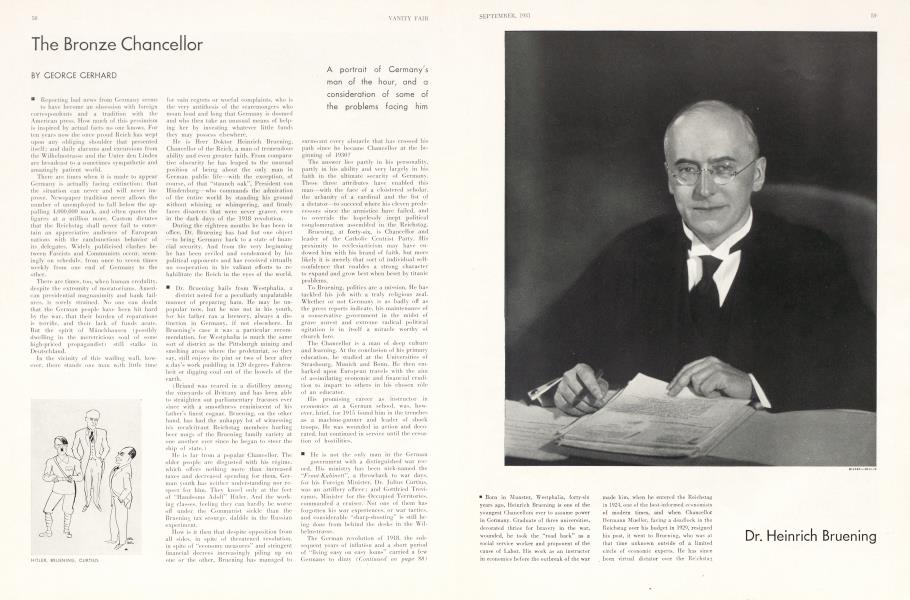
Sign In Not a Subscriber?Join NowThe Bronze Chancellor
GEORGE GERHARD
A portrait of Germany's man of the hour, and a consideration of some of the problems facing him
Reporting had news from Germany seems to have become an obsession with foreign correspondents and a tradition with the American press. How much of this pessimism is inspired by actual facts no one knows. For ten years now the once proud Reich has wept upon any obliging shoulder that presented itself; and daily alarums and excursions from the Wilhelmstrasse and the Unter den Linden are broadcast to a sometimes sympathetic and amazingly patient world.
There are times when it is made to appear Germany is actually facing extinction; that the situation can never and will never improve. Newspaper tradition never allows the number of unemployed to fall below the appalling 4,000,000 mark, and often quotes the figures at a million more. Custom dictates that the Reichstag shall never fail to entertain an appreciative audience of European nations with the rambunctious behavior of its delegates. Widely publicised clashes between Fascists and Communists occur, seemingly on schedule, from once to seven times weekly from one end of Germany to the other.
There are times, too, when human credulity, despite the extremity of moratoriums, American presidential magnanimity and bank failures, is sorely strained. No one can doubt that the German people have been hit hard by the war, that their burden of reparations is terrific, and their lack of funds acute. But the spirit of Münchhausen (possibly dwelling in the meretricious soul of some high-priced propagandist) still stalks in Deutschland.
In the vicinity of this wailing wall, however, there stands one man with little time
for vain regrets or woeful complaints, who is the very antithesis of the scaremongers who moan loud and long that Germany is doomed and who then take an unusual means of helping her by investing whatever little funds they may possess elsewhere.
He is Herr Doktor Heinrich Bruening, Chancellor of the Reich, a man of tremendous ability and even greater faith. From comparative obscurity he has leaped to the unusual position of being about the only man in German public life—with the exception, of course, of that "staunch oak", President von Hindenburg—who commands the admiration of the entire world by standing his ground without whining or whimpering, and firmly faces disasters that were never graver, even in the dark days of the 1918 revolution.
During the eighteen months he has been in office, Dr. Bruening has had but one object —to bring Germany back to a state of financial security. And from the very beginning he has been reviled and condemned by his political opponents and has received virtually no cooperation in his valiant efforts to rehabilitate the Reich in the eyes of the world.
Dr. Bruening hails from Westphalia, a district noted for a peculiarly unpalatable manner of preparing ham. He may be unpopular now, but he was not in his youth, for his father ran a brewery, always a distinction in Germany, if not elsewhere. In Bruening's case it was a particular recommendation, for Westphalia is much the same sort of district as the Pittsburgh mining and smelting areas where the proletariat, so they say, still enjoys its pint or two of beer after a day's work puddling in 120 degrees Fahrenheit or digging coal out of the bowels of the earth.
(Briand was reared in a distillery among the vineyards of Brittany and has been able to straighten out parliamentary fracases ever since with a smoothness reminiscent of his father's finest cognac. Bruening, on the other hand, has had the unhappy lot of witnessing his recalcitrant Reichstag members hurling beer mugs of the Bruening family variety at one another ever since he began to steer the ship of state.)
He is far from a popular Chancellor. The older people are disgusted with his regime, which offers nothing more than increased taxes and decreased spending for them. German youth has neither understanding nor respect for him. They kneel only at the feet of "Handsome Adolf" Hitler. And the working classes, feeling they can hardly be worse off under the Communist sickle than the Bruening tax scourge, dabble in the Russian experiment.
How is it then that despite opposition from all sides, in spite of threatened revolution, in spite of "economy measures" and stringent financial decrees increasingly piling up on one or the other, Bruening has managed to surmount every obstacle that has crossed his path since he became Chancellor at the beginning of 1930?
The answer lies partly in his personality, partly in his ability and very largely in his faith in the ultimate security of Germany. These three attributes have enabled this man—with the face of a cloistered scholar, the urbanity of a cardinal and the fist of a dictator—to succeed where his eleven predecessors since the armistice have failed, and to override the hopelessly inept political conglomeration assembled in the Reichstag.
Bruening, at forty-six, is Chancellor and leader of the Catholic Centrist Party. His proximity to ecclesiasticism may have endowed him with his brand of faith, but more likely it is merely that sort of individual selfconfidence that enables a strong character to expand and grow best when beset by titanic problems.
To Bruening, politics are a mission. He has tackled his job with a truly religious zeal. Whether or not Germany is as badly off as the press reports indicate, his maintenance of a conservative government in the midst of grave unrest and extreme radical political agitation is in itself a miracle worthy of church lore.
The Chancellor is a man of deep culture and learning. At the conclusion of his primary education, he studied at the Universities of Strasbourg, Munich and Bonn. He then embarked upon European travels with the aim of assimilating economic and financial erudition to impart to others in his chosen role of an educator.
His promising career as instructor in economics at a German school, was, however, brief, for 1915 found him in the trenches as a machine-gunner and leader of shock troops. He was wounded in action and decorated, but continued in service until the cessation of hostilities.
He is not the only man in the German government with a distinguished war record. His ministry has been nick-named the "Front-Kabinett", a throwback to war days, for his Foreign Minister, Dr. Julius Curtius, was an artillery officer; and Gottfried Treviranus, Minister for the Occupied Territories, commanded a cruiser. Not one of them has forgotten his war experiences, or war tactics, and considerable "sharp-shooting" is still being done from behind the desks in the Wilhelmstrasse.
The German revolution of 1918. the subsequent years of inflation and a short period of "living easy on easy loans" carried a few Germans to dizzy heights, but the majority to abysmal despair. To Bruening these years meant nothing. He was carried neither up nor down, but simply strolled along his chosen path of organized help and studious learning. For a few years he was identified with the Prussian Ministry of Welfare as a social service worker. Later he became Chairman of the German Labor Union, and it was as a delegate of the Christian Labor Party that he made his bow to the Reichstag in 1924. It was only a year and a half ago that he was catapulted onto the government bench.
Continued on page 88
Continued from page 58
At the time of his rise to power, Bruening's light shone brightest among the statistical sharps and the "research ramblers". To the public he was an enigma, and for the most part, still remains so. Quiet, well-mannered, conservative in his dress, dull to the point of boredom in his official speeches, he talks with the earnest and somewhat absent-minded concentration of a man whose thoughts are several paragraphs ahead of his words. He is absolutely indifferent to popular acclaim and publicity. He is not liked by the people, he knows it, and yet he governs them with an iron hand.
A tyrant? A dictator? Far from it! He is certainly not the former, and in theory only the latter. Of his salary, none too large, the bulk goes to charity. Before the new addition to the Berlin chancellery was built, he lived and worked in three small inadequate rooms and was nevertheless satisfied. He wields his baton because he feels he must. There is little doubt that Bruening would rather be a student, a collector, a connoisseur or a commentator, than a Chancellor. But to him his work is his destiny, and he pursues it with monkish zeal.
In importance, only one man in Germany ranks with Dr. Bruening, and that is Adolf Hitler. But whereas the ardent Nazi leader is an evangelist thumping the drum of patriotic propaganda, Bruening is a missionary. He is the very reverse of the spectacular. His long face, narrowing toward the chin, thin nose, pale countenance, cool and peaceful eyes hidden behind thick lenses, and the tightly compressed lines of his lips suggest a wealth of hidden energy. They leave one with the impression of tremendous selfdiscipline and a driving will-power. Neither rowdy agitation in the Reichstag, nor the exaggerated decorum of his own bearing in public can detract from the simple picture of an individual so strong in himself that he can carry the fate of a whole nation on his drooping shoulders.
Almost monastic in his private life, and incorruptible in office, Bruening has won the appellation at home of the "Man of Bronze," doubtless with a certain allusion to Bismarck, the "Iron Chancellor." Some call him the "India rubber man", as a tribute to his durability in the face of opposition from a Reichstag that, particularly since the inclusion of more than 100 Hitlerites, is more of a Wild West show than a parliament.
Nevertheless an abundance of simple faith and determination are not sufficient to govern a democratic nation, for Germany is still run on the parliamentary scheme, and a Chancellor must pacify the politicians to carry on. Bruening has shown himself to be an astute and powerful leader. His immediate predecessor, Hermann Mueller, resigned because the Reichstag would not pass his budget. Bruening met with similar recalcitrance, and when suasion failed, instead of resigning he dissolved the Reichstag, passed his budget, under a virtual dictatorship and called for new elections.
This was hardly a step likely to enhance his popularity. The German Deputies, not unlike their Congressional brethren in Washington, are inordinately fond of their salaries and the so-called dignity of their jobs. New elections consequently are anathema to them, particularly as recent events have shown that popular polling in Germany has the annoying tendency of lessening the power of all parties save the Communists and Fascists. Bruening handled the results of his enforced elections with a masterly hand. He split the Left Wing (Communists, Socialists, et al.) with the aid of a policy designed to take better care of the unemployed, and thus won unexpected support in their ranks. The Right Wing (Nationalist, Fascist, etc.) votes he wooed by promising agricultural relief for East Germany, still largely in the hands of the Junkers, and boosting Deutschland über Alles while at the same time he placated the nationalists by plaguing France, —building a magnificent 10,000-ton "vest-pocket battleship" and striving for a customs union with Austria.
The Reparations tangle is the most difficult problem that the German Chancellor has yet had to solve. His own people are unanimous about the "folly" of continuing reparations. He has to consider their voice or else his cabinet is bound to fall. The victorious nations are just as sure that reparations must be paid. Bruening cannot afford to ignore their stand, to lose their confidence and to be shaken out of the bitterly-needed foreign credits. Net result: a diplomat emerges, with the rare ability to sit, not fall, between two stools and to steer a wise, though winding course, between "damn the reparations", at home and the cry for fulfillment abroad.
It is not hard to sing a paean of praise for one man in a million, or rather one man in 60,000,000, which is more nearly the case with Germany in its present state of hysteria. But Bruening has accomplished much in the face of the economic problems and the political turmoil which have confronted him. His nation may be a starving, crying nation, but it is not a nation without a leader. No other Chancellor has done so much since Bismarck, "The Pilot", was dropped summarily by Kaiser Wilhelm and took with him his rejected talents to the grave.
Subscribers have complete access to the archive.
Sign In Not a Subscriber?Join Now
