


Sign In to Your Account
Subscribers have complete access to the archive.
Sign In Not a Subscriber?Join NowArgentine blues
PAUL MORAND
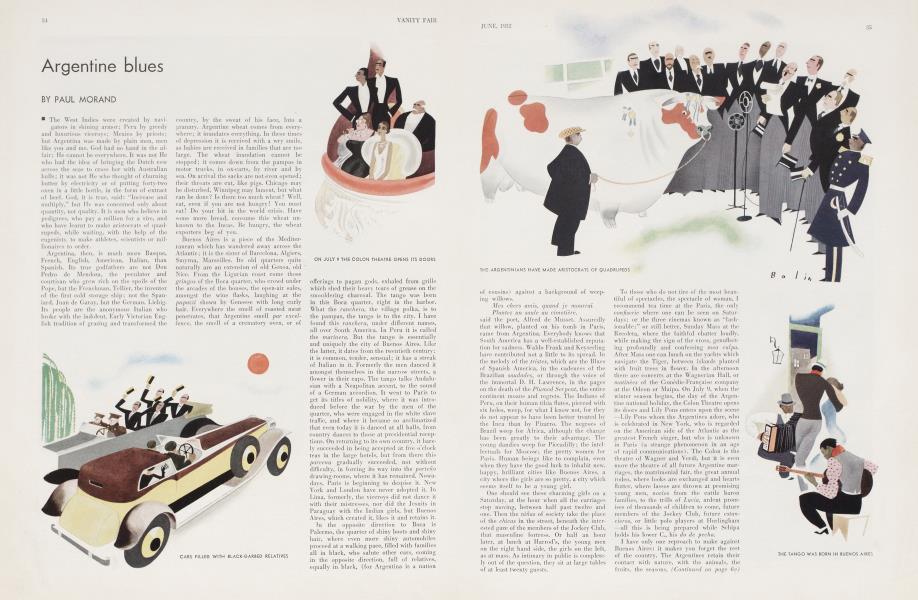
The West Indies were created by navigators in shining armor; Peru by greedy and luxurious viceroys; Mexico by priests; but Argentina was made by plain men, men like you and me. God had no hand in the affair; He cannot be everywhere. It was not He who had the idea of bringing the Dutch cow across the seas to cross her with Australian bulls; it was not He who thought of churning butter by electricity or of putting forty-two oxen in a little bottle, in the form of extract of beef. God, it is true, said: "Increase and multiply," but He was concerned only about quantity, not quality. It is men who believe in pedigrees, who pay a million for a sire, and who have learnt to make aristocrats of quadrupeds, while waiting, with the help of the eugenists., to make athletes, scientists or millionaires to order.
Argentina, then, is much more Basque, French, English, American, Italian, than Spanish. Its true godfathers are not Don Pedro de Mendoza, the peculator and courtisan who grew rich on the spoils of the Pope, hut the Frenchman, Tellier, the inventor of the first cold storage ship; not the Spaniard, Juan de Garay, but the German, Liehig. Its people are the anonymous Italian who broke with the indolent. Early Victorian English tradition of grazing and transformed the country, by the sweat of his face, into a granary. Argentine wheat comes from everywhere; it inundates everything. In these times of depression it is received with a wry smile, as babies are received in families that are too large. The wheat inundation cannot be stopped; it comes down from the pampas in motor trucks, in ox-carts, by river and by sea. On arrival the sacks are not even opened; their throats are cut, like pigs. Chicago may be disturbed, Winnipeg may lament, but what can be done? Is there too much wheat? Well, eat, even if you are not hungry! You must eat! Do your bit in the world crisis. Have some more bread, consume this wheat unknown to the Incas. Be hungry, the wheat exporters beg of you.
Buenos Aires is a piece of the Mediterranean which has wandered away across the Atlantic; it is the sister of Barcelona, Algiers, Smyrna, Marseilles. Its old quarters quite naturally are an extension of old Genoa, old Nice. From the Ligurian coast come those gringos of the Boca quarter, who crowd under the arcades of the houses, the open-air sales, amongst the wine flasks, laughing at the pupazzi shown by Genoese with long curly hair. Everywhere the smell of roasted meat penetrates, that Argentine smell par excellence, the smell of a crematory oven, or of offerings to pagan gods, exhaled from grills which shed their heavy tears of grease on the smouldering charcoal. The tango was born in this Boca quarter, right in the harbor. What the ranchera, the village polka, is to the pampas, the tango is to the city. I have found this ranchera, under different names, all over South America. In Peru it is called the marinera. But the tango is essentially and uniquely the city of Buenos Aires. Like the latter, it dates from the twentieth century; it is common, tender, sensual; it has a streak of Italian in it. Formerly the men danced it amongst themselves in the narrow streets, a flower in their caps. The tango talks Andalusian with a Neapolitan accent, to the sound of a German accordion. It went to Paris to get its titles of nobility, where it was introduced before the war by the men of the quarter, who were engaged in the white slave traffic, and where it became so acclimatized that even today it is danced at all balls, from country dances to those at presidential receptions. On returning to its own country, it barely succeeded in being accepted at five o'clock teas in the large hotels, but from there this parvenu gradually succeeded, not without difficulty, in forcing its way into the porteno drawing-rooms, where it has remained. Nowadays, Paris is beginning to despise it. New York and London have never adopted it. In Lima, formerly, the viceroys did not dance it with their mistresses, nor did the Jesuits in Paraguay with the Indian girls, but Buenos Aires, which created it, likes it and retains it.
In the opposite direction to Boca is Palermo, the quarter of shiny boots and shiny hair, where even more shiny automobiles proceed at a walking pace, filled with families all in black, who salute other cars, coming in the opposite direction, full of relatives, equally in black, (for Argentina is a nation of cousins) against a background of weeping willows.
Ales chers amis, quand je mourrai
Plantez un saule au cimetiere. said the poet, Alfred de Musset. Assuredly that willow, planted on his tomb in Paris, came from Argentina. Everybody knows that South America has a well-established reputation for sadness. Waldo Frank and Keyserling have contributed not a little to its spread. In the melody of the tristes, which are the Blues of Spanish America, in the cadences of the Brazilian saudades, or through the voice of the immortal D. H. Lawrence, in the pages on the death of the Plumed Serpent, the entire continent moans and regrets. The Indians of Peru, on their human tibia flutes, pierced with six holes, weep, for what I know not, for they do not appear to have been better treated by the Inca than by Pizarro. The negroes of Brazil weep for Africa, although the change has been greatly to their advantage. The young dandies weep for Piccadilly; the intellectuals for Moscow; the pretty women for Paris. Human beings like to complain, even when they have the good luck to inhabit new, happy, brilliant cities like Buenos Aires, a city where the girls are so pretty, a city which seems itself to be a young girl.
One should see these charming girls on a Saturday, at the hour when all the carriages stop moving, between half past twelve and one. Then the ninas of society take the place of the chicas in the street, beneath the interested gaze of the members of the Jockey Club, that masculine fortress. Or half an hour later, at lunch at Harrod's, the young men on the right hand side, the girls on the left, as at mass. As intimacy in public is completely out of the question, they sit at large tables of at least twenty guests.
To those who do not tire of the most beautiful of spectacles, the spectacle of woman, I recommend tea time at the Paris, the only confiserie where one can be seen on Saturdays; or the three cinemas known as "fashionable;" or still better, Sunday Mass at the Recoleta, where the faithful chatter loudly, while making the sign of the cross, genuflecting profoundly and confessing mea culpa. After Mass one can lunch on the yachts which navigate the Tiger, between islands planted with fruit trees in flower. In the afternoon there are concerts at the Wagnerian Hall, or matinees of the Comedie-Francaise company at the Odeon or Maipo. On July 9, when the winter season begins, the day of the Argentine national holiday, the Colon Theatre opens its doors and Lily Pons enters upon the scene —Lily Pons whom the Argentines adore, who is celebrated in New York, who is regarded on the American side of the Atlantic as the greatest French singer, but who is unknown in Paris (a strange phenomenon in an age of rapid communications). The Colon is the theatre of Wagner and Verdi, but it is even more the theatre of all future Argentine marriages, the matrimonial fair, the great annual rodeo, where looks are exchanged and hearts flutter, where lassos are thrown at promising young men, novios from the cattle baron families, to the trills of Lucia, ardent promises of thousands of children to come, future members of the Jockey Club, future estancieros, or little polo players at Hurlingham —all this is being prepared while Schipa holds his lower C., his do de pecho.
I have only one reproach to make against Buenos Aires: it makes you forget the rest of the country. The Argentines retain their contact with nature, with the animals, the fruits, the seasons, thanks to their estancias, their ranchos, but the foreigner is in danger of being lulled by the charms of the city. . . . The cellar of the Jockey Club is so good, the food at the Circulo de Armas so exquisite, the houses so well kept, everybody so kind, the United States Embassy, where Mrs. Bliss is no less popular than she was in Paris, is so hospitable, the women so ravishing, even more beautiful than the beauties of other countries because they are full of Latin modesty, such "sirens", that one remains captive.
Continued on page 62
Continued from page 35
I confess that l look at Argentine women with the same admiring eyes as Stendhal had for the beautiful Milanese women of Austrian Italy, as Balzac had for the Poles, or Horace Walpole for the Parisiennes of Louis the Fifteenth's time. I like the reserve of the portena ladies, the passionate attention with which they listen to anyone who talks the language of modern frankness to them, their uneventful lives, recluse and secret, like that of Oriental women, a prolonged sacrifice, their voluntary self-effacement, their exquisite terror when one suggests chatting alone with them at tea, their taste for politics, golf and Paul Valery, the design of their dresses on bodies free from the physical blemishes of the Mediterranean women, their impulses towards the conquest of their liberties at Mar del Plata, or the lruguayan seaside resorts, the melancholy of their long feverish summers beneath the eucalyptus trees on their estancias, their endless reading which never goes to their heads nor disturbs their simple and traditional wisdom. Who will be their Ibsen, their Henry James, their Hawthorne? Who will be the Balzac of these adorable "Lilies of the Valley"?
Subscribers have complete access to the archive.
Sign In Not a Subscriber?Join Now

