


Sign In to Your Account
Subscribers have complete access to the archive.
Sign In Not a Subscriber?Join NowChild's play
PAUL GALLICO
A deliberate expose of the theory that such sports as golf, tennis and fishing are difficult or important
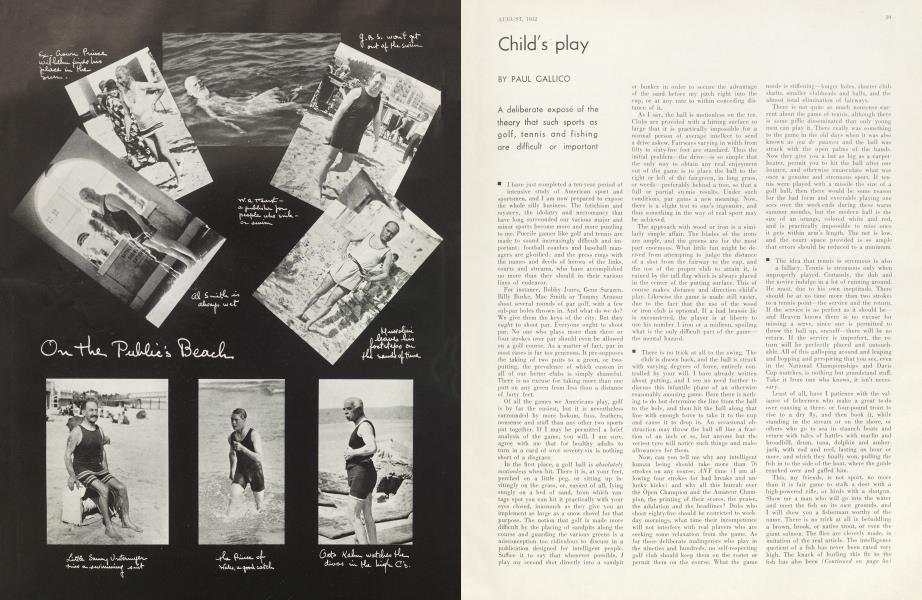
I have just completed a ten-year period of intensive study of American sport and sportsmen, and I am now prepared to expose the whole silly business. The fetichism and mystery, the idolatry and necromancy that have long surrounded our various major and minor sports become more and more puzzling to me. Puerile games like golf and tennis are made to sound increasingly difficult and important; football coaches and baseball managers are glorified; and the press rings with the names and deeds of heroes of the links, courts and streams, who have accomplished no more than they should in their various lines of endeavor.
For instance, Bobby Jones, Gene Sarazen, Billy Burke, Mac Smith or Tommy Armour shoot several rounds of par golf, with a few sub-par holes thrown in. And what do we do? We give them the keys of the city. But they ought to shoot par. Everyone ought to shoot par. No one who plays more than three or four strokes over par should even be allowed on a golf course. As a matter of fact, par in most cases is far too generous. It pre-supposes the taking of two putts to a green, or twoputting, the prevalence of which custom in all of our better clubs is simply shameful. There is no excuse for taking more than one putt on any green from less than a distance of forty feet.
Of all the games we Americans play, golf is by far the easiest, but it is nevertheless surrounded by more hokum, fuss, feathers, nonsense and stuff than any other two sports put together. If I may be permitted a brief analysis of the game, you will, I am sure, agree with me that for healthy adults to turn in a card of over seventy-six is nothing short of a disgrace.
In the first place, a golf ball is absolutely motionless when hit. There it is, at your feet, perched on a little peg, or sitting up invitingly on the grass, or, easiest of all, lying snugly on a bed of sand, from which vantage spot you can hit it practically with your eyes closed, inasmuch as they give you an implement as large as a snow shovel for that purpose. The notion that golf is made more difficult by the placing of sandpits along the course and guarding the various greens is a misconception too ridiculous to discuss in a publication designed for intelligent people. Suffice it to say that whenever possible, I play my second shot directly into a sandpit or bunker in order to secure the advantage of the sand before my pitch right into the cup, or at any rate to within conceding distance of it.
As I say, the ball is motionless on the tee. Clubs are provided with a hitting surface so large that it is practically impossible for a normal person of average intellect to send a drive askew. Fairways varying in width from fifty to sixty-five feet are standard. Thus the initial problem—the drive—is so simple that the only way to obtain any real enjoyment out of the game is to place the ball to the right or left of the fairgreen, in long grass, or weeds—preferably behind a tree, so that a full or partial stymie results. Under such conditions, par gains a new meaning. Now, there is a slight test to one's ingenuity, and thus something in the way of real sport may be achieved.
The approach with wood or iron is a similarly simple affair. The blades of the irons are ample, and the greens are for the most part enormous. What little fun might be derived from attempting to judge the distance of a shot from the fairway to the cup, and the use of the proper club to attain it, is ruined by the tall flag which is always placed in the center of the putting surface. This of course makes distance and direction child's play. Likewise the game is made still easier, due to the fact that the use of the wood or iron club is optional. If a bad brassie lie is encountered, the player is at liberty to use his number I iron or a midiron, spoiling what is the only difficult part of the game— the mental hazard.
There is no trick at all to the swing. The club is drawn back, and the ball is struck with varying degrees of force, entirely controlled by your will. I have already written about putting, and I see no need further to discuss this infantile phase of an otherwise reasonably amusing game. Here there is nothing to do but determine the line from the ball to the hole, and then hit the ball along that line with enough force to take it to the cup and cause it to drop in. An occasional obstruction may throw the ball off line a fraction of an inch or so, but anyone but the veriest tyro will notice such things and make allowances for them.
Now, can you tell me why any intelligent human being should take more than 76 strokes on any course, ANY time (I am allowing four strokes for bad breaks and unlucky kicks) and why all this hurrah over the Open Champion and the Amateur Champion, the printing of their scores, the praise, the adulation and the headlines? Dubs who shoot eighty-five should be restricted to weekday mornings, what time their incompetence will not interfere with real players who are seeking some relaxation from the game. As for those deliberate malingerers who play in the nineties and hundreds, no self-respecting golf club should keep them on the roster or permit them on the course. What the game needs is stiffening—longer holes, shorter club shafts, smaller clubheads and balls, and the almost total elimination of fairways.
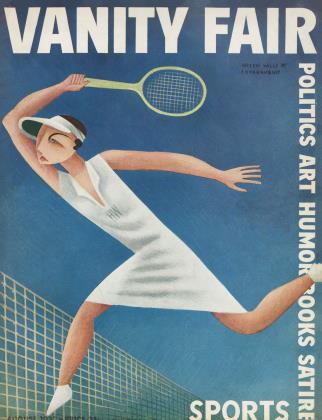
There is not quite as much nonsense current about the game of tennis, although there is some piffle disseminated that only young men can play it. There really was something to the game in the old days when it was also known as jeu de paumes and the ball was struck with the open palms of the hands. Now they give you a bat as big as a carpetbeater, permit you to hit the ball after one bounce, and otherwise emasculate what was once a genuine and strenuous sport. If tennis were played with a missile the size of a golf ball, then there would be some reason for the bad form and execrable playing one sees over the week-ends during these warm summer months, but the modern ball is the size of an orange, colored white and red, and is practically impossible to miss once it gets within arm's length. The net is low, and the court space provided is so ample that errors should be reduced to a minimum.
The idea that tennis is strenuous is also a fallacy. Tennis is strenuous only when improperly played. Certainly, the dub and the novice indulge in a lot of running around. He must, due to his own ineptitude. There should be at no time more than two strokes to a tennis point—the service and the return. If the service is as perfect as it should be— and Heaven knows there is no excuse for missing a serve, since one is permitted to throw the ball up, oneself—there will be no return. If the service is imperfect, the return will be perfectly placed and untouchable. All of this galloping around and leaping and hopping and perspiring that you see, even in the National Championships and Davis Cup matches, is nothing but grandstand stuff. Take it from one who knows, it isn't necessary.
Least of all, have I patience with the valiance of fishermen who make a great to-do over causing a threeor four-pound trout to rise to a dry fly, and then hook it, while standing in the stream or on the shore, or others who go to sea in staunch boats and returnwith tales of battles with marlin and broadbill, drum, tuna, dolphin and amberjack, with rod and reel, lasting an hour or more, and which they finally won, pulling the fish in to the side of the boat, where the guide reached over and gaffed him.
This, my friends, is not sport, no more than it is fair game to stalk a deer with a high-powered rifle, or birds with a shotgun. Show me a man who will go into the water and meet the fish on its own grounds, and I will show you a fisherman worthy of the name. There is no trick at all in befuddling a brown, brook, or native trout, or even the giant salmon. The flies are cleverly made, in imitation of the real article. The intelligence quotient of a fish has never been rated very high. The knack of hurling this fly to the fish has also been vastly overrated, since the fly is attached to leader and line and may be flicked hither and yon, and once the prey is hooked, there is no trick at all to pulling it in. But this is all pot hunting. Come with me sometime up to the Beaverkill, or the Mongaup, or the Willewomac, or the Brodhead, or out onto the ocean or into the bay, and I'll show you sport that is sport. What are you after: trout, salmon, tarpon, tuna, bass, stripers, drum, fluke or flounder? Then off with your clothes. Into the water we go. There's your fish. Swim after him. Catch him. Grab him. Pinch him. Squeeze him, barehanded. Subdue him at last; bring him to the surface and dump him into the boat or on shore. That's fishing.
(Continued on page 50)
(Continued from page 39)
Just about this time, the newspapers will be ringing with the praises of some baseball manager whose team is on the verge of winning the pennant, praising his acumen, his knowledge and his skill in handling men, with special emphasis on his deep knowledge of "inside baseball". Twaddle, my friends. Someone once asked Frank Chance about "inside baseball". Chance said —"Inside baseball—I never heard of it. There's the bat and there's the ball, nine men in the field and one at the plate, and that's all there is to it."
Baseball is probably one of the simplest games ever devised, but is made to seem difficult due to the fact that it is played and directed for the most part by parties equally simple. No manager was ever able to think a ball into the grandstand, or out of the park for a home run. Occasionally an intellectual in charge of a team will admit modestly to the press that he "ordered a certain player to hit," but only the lower grade morons go for that.
Men like Connie Mack of the Athletics and John McGraw, now retired from the Giants, appear to be great strategists and field generals only because most of their hired hands are incapable of thinking for themselves. An athlete who has to be told every move he must make while playing a game doesn't appear as much of a hero to me, but the baseball leagues are full of them.
Baseball is probably the only game where the spectator knows as much, if not frequently a little more than the men in the field and on the bench. The crowd at a ball game senses immediately when a pitcher is about to weaken. Apparently the last one to discover this is the manager. Sending a right-handed batter in to pinchhit against a left-handed pitcher is conceded to be the height of resourcefulness and strategy.
I, for one, mourn the passing of the only game that ever threatened to turn America into a nation of hardhitting, well-conditioned and thinking athletes—Tom Thumb golf. Here was a sport which called for iron nerve, resourcefulness, courage, a steady hand and a fine physique.
Here was the ancient Scottish game developed to its highest degree and along the lines I have advocated earlier in this thesis. The skill required to manoeuver a ball through a little tunnel, or through the mouth of an iron frog, up a chute, around a bend, through a hollow log, was simply amazing. I am not setting myself up as a perfect athlete, though all so-called sports are easy for me, but I tell you that a round of Midget Golf, disparagingly as it was called, left me exhausted in body and mind.
But the game was foredoomed. It was just too tough. None of us have the necessary iron or discipline in our souls. We are a nation of softies. Golf in the Nineties, pit-a-pat tennis, plug horses, flounder fishing, breaststroke swimming—what is to become of us. Wake up, America!
Subscribers have complete access to the archive.
Sign In Not a Subscriber?Join Now
