Sign In to Your Account
Subscribers have complete access to the archive.
Sign In Not a Subscriber?Join NowBrightening up politics
MARCUS DUFFIELD
■ The politician who knows a trend when he sees one will, on the dawn of the New Year, swear off boring his constituents. The old dull stufT about tariff and car-loadings just isn't holding the radio listeners. Long before the voting in the recent elections, the people were fed up with speeches that harped on the drab problems of the nation. Politicians do not need to be relevant, they need to he imaginative. The occasional candidates throughout the country who cut loose with fresh appeals brightened up the whole campaign. and whether or not they won, the popular applause was tremendous. Vast fields of virgin issues were opened up.
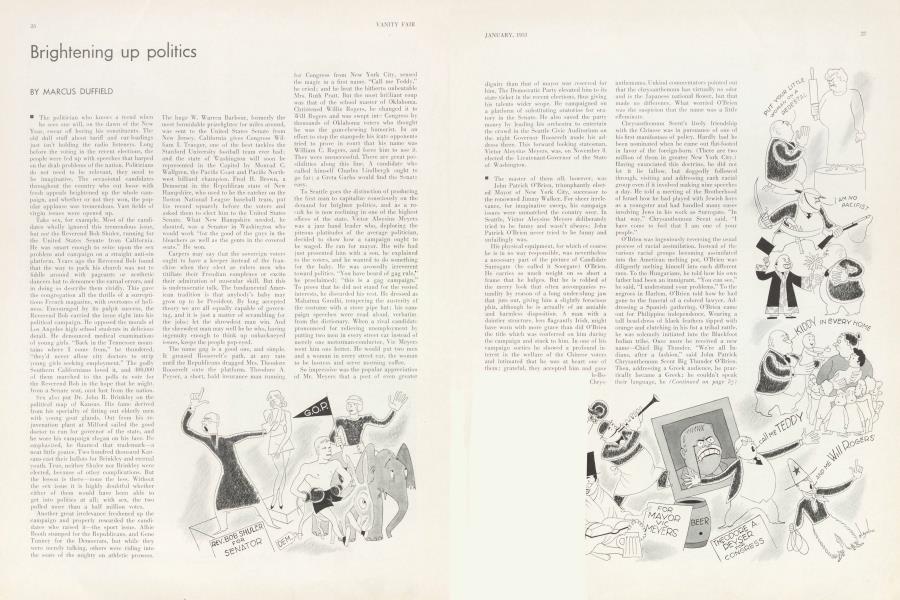
Take sex, for example. Most of the candidates wholly ignored this tremendous issue, hut not the Reverend Boh Shuler, running for the United States Senate from California, lie wras smart enough to seize upon the sex problem anil campaign on a straight anti-sin platform. Years ago the Reverend Bob found that the way to pack his church was not to fiddle around with pageants or aesthetic dancers hut to denounce the carnal errors, and in doing so describe them vividly. This gave the congregation all the thrills of a surreptitious French magazine, with overtones of holiness. Encouraged by its pulpit success, the Reverend Bob carried the issue right into his political campaign. He opposed the morals of Los Angeles high school students in delicious detail. He denounced medical examinations of young girls. ''Back in the Tennessee mountains where l come from," he thundered, "they'd never allow city doctors to strip young girls seeking employment." The godlv Southern Californians loved it, and 400,000 of them marched to the polls to vote for the Reverend Bob in the hope that he might, from a Senate seat, oust lust from the nation.
Sex also put Dr. John R. Brinkley on the political map of Kansas. His fame derived from his specialty of fitting out elderly men with young goat glands. Out from his rejuvenation plant at Milford sailed the good doctor to run for governor of the state, and he wore his campaign slogan on his face. He emphasized, he flaunted that trademark—a neat little goatee. Two hundred thousand Kansans cast their ballots for Brinkley and eternal youth. True, neither Shuler nor Brinkley were elected, because of other complications. But the lesson is there—none the less. Without the sex issue it is highly doubtful whether either of them would have been able to get into politics at all; with sex, the two polled more than a half million votes.
Another great irrelevance freshened up the campaign and properly rewarded the candidates who raised it—the sport issue. Albie Booth stumped for the Republicans, and Gene Tunney for the Democrats, hut while they were merely talking, others were riding into the seats of the mighty on athletic prowess. The huge W. Warren Barbour, formerly the most formidable prizefighter for miles around, was sent to the United States Senate from New Jersey. California gives Congress William I. Traeger, one of the best tackles the Stanford l Diversity football team ever had; and the state of Washington will soon be represented in the Capitol by Monrad C. Wallgren, the Pacific Coast and Pacific Northwest billiard champion. Fred H. Brown, a Democrat in the Republican state of New Hampshire, who used to be the catcher on the Boston National League baseball team, put his record squarely before the voters and asked them to elect him to the United States Senate. What New Hampshire needed, he shouted, was a Senator in Washington who would work "for the good of the guys in the bleachers as well as the gents in the covered seats." He won.
Carpers may say that the sovereign voters ought to have a keeper instead of the franchise when they elect as rulers men who titillate their Freudian complexes or excite their admiration of muscular skill. But this is undemocratic talk. The fundamental American tradition is that anybody's baby may grow up to be President. By long accepted theory wre are all equally capable of governing, and it is just a matter of scrambling for the jobs: let the shrewdest man win. And the shrewdest man may well be he who, having ingenuity enough to think up unhackneyed issues, keeps the people pop-eyed.
The name gag is a good one, and simple. It greased Roosevelt's path, at any rate until the Republicans dragged Mrs. Theodore Roosevelt onto the platform. Theodore A. Peyser, a short, bald insurance man running for Congress from New York City, sensed the magic in a first name. "Call me Teddy, he cried; and he beat the hitherto unbeatable Mrs. Ruth Pratt. But the most brilliant coup was that of the school master of Oklahoma. Christened Willie Rogers, he changed it to Will Rogers and was swept into Congress by thousands of Oklahoma voters who thought he was the gum-chewing humorist. In an effort to stop tlie stampede his irate opponents tried to prove in court that his name was William C. Rogers, and force him to use it. They were unsuccessful. There are great possibilities along this line. A candidate who called himself Charles Lindbergh ought to go far; a Greta Garbo would find the Senate easy.
To Seattle goes the distinction of producing the first man to capitalize consciously on the demand for brighter politics, and as a result he is now reclining in one of the highest offices of the state. Victor Aloysius Meyers was a jazz band leader who, deploring the piteous platitudes of the average politician, decided to show how a campaign ought to be waged. He ran for mayor. His wife had just presented him with a son, he explained to the voters, and he wanted to do something for the baby. He was avowedly irreverent toward politics. "You have heard of gag rule," he proclaimed; "this is a gag campaign." To prove that he did not stand for the vested interests, he discarded his vest. He dressed as Mahatma Gandhi, tempering the austerity of the costume with a stove pipe hat; his campaign speeches were read aloud, verbatim from the dictionary. When a rival candidate pronounced for relieving unemployment by putting two men in every street car instead of merely one motorman-conductor, \ ic Meyers went him one better. He would put two men and a woman in every street car, the woman to be hostess and serve morning coffee.
So impressive was the popular appreciation of Mr. Meyers that a post of even greater dignity than that of mayor was reserved for him. The Democratic Party elevated him to its state ticket in the recent elections, thus giving his talents wider scope. He campaigned on a platform of substituting oratorios for oratory in the Senate. He also saved the party money by leading his orchestra to entertain the crowd in the Seattle Civic Auditorium on the night Governor Roosevelt made his address there. This forward looking statesman. Victor Aloysius Meyers, was, on November 8, elected the Lieutenant-Governor of the State of Washington.
* The master of them all, however, was John Patrick O'Brien, triumphantly elected Mayor of New York City, successor to the renowned Jimmy Walker. For sheer irrelevance, for imaginative sweep, his campaign issues were unmatched the country over. In Seattle, Victor Aloysius Meyers deliberately tried to be funny and wasn't always; John Patrick O'Brien never tried to be funny and unfailingly was.
His physical equipment, for which of course he is in no way responsible, was nevertheless a necessary part of the picture of Candidate Surrogate (he called it Soorgate) O'Brien. He carries so much weight on so short a frame that he bulges. But he is robbed of the merry look that often accompanies rotundity by reason of a long under-slung jaw that juts out, giving him a slightly ferocious phiz, although he is actually of an amiable and harmless disposition. A man with a daintier structure, less flagrantly Irish, might have worn with more grace than did O'Brien the title which was conferred on him during the campaign and stuck to him. In one of his campaign sorties he showed a profound interest in the welfare of the Chinese voters and intimated that he was at heart one of them; grateful, they accepted him and gave anthemums. Unkind commentators pointed out that the chrysanthemum has virtually no odor and is the Japanese national flower, but that made no difference. What worried O'Brien was tin* suspicion that the name was a little effeminate.
Chrysanthemum Scent's lively friendship with the Chinese was in pursuance of one of his first manifestoes of policy. Hardly had he been nominated when he came out flat-footed in favor of the foreign-horn. (There are two million of them in greater New York City.) Having enunciated this doctrine, he did not let it lie fallow, but doggedly followed through, visiting and addressing each racial group even if it involved making nine speeches a day. He told a meeting of the Brotherhood of Israel how he had played with Jewish boys as a youngster and had handled many cases involving Jews in his work as Surrogate. "In that way," Chrysanthemum Scent said. '"I have come to feel that I am one of your people."
O'Brien was ingeniously reversing the usual process of racial assimilation. Instead of the various racial groups becoming assimilated into the American melting pot, O'Brien was diligently melting himself into each different race. To the Hungarians, he told how his own father had been an immigrant. "You can see," he said, "I understand your problems." To the negroes in Harlem, O'Brien told how he had gone to the funeral of a colored lawyer. Addressing a Spanish gathering, O'Brien came out for Philippine independence. Wearing a tall head-dress of black feathers tipped with orange and clutching in his fist a tribal rattle, he was solemnly initiated into the Blackfoot Indian tribe. Once more he received a new name—Chief Big Thunder. "We're all Indians, after a fashion," said John Patrick Chrysanthemum Scent Big Thunder O'Brien. Then, addressing a Greek audience, he practically became a Greek; he couldn't speak their language, he said, but he had once won a school prize for translating Horace.
Continued on page 57
(Continued from page 27)
Horace's life-long habit of writing in Latin had evidently slipped the Surrogate's mind; the confusion must have been only temporary, because he had already come out unequivocally in support of the classics. This was while speaking to a group of newspapermen. He thought he would love to be a newspaperman. "I love the classics and I love good literature," he said. Repeated references to his college careers cropped up in his speeches, frequently without any noticeable connection with the topic under discussion. He told a rambling anecdote on one occasion about a man who had brought his son to the Surrogate's office. The point of the story came at its end: "His father asked me if I had gone to Harvard, being as I was from Massachusetts, and I said no that I had gone to Holy Cross and then to Georgetown—I have degrees from both places—and he asked me what year and I told him and he said that he had also gone to Georgetown. Now, just think of that!"
Lest the common people think they were electing a pedant, O'Brien now and then let fall some minor slip. He told a Brooklyn audience that they "would ruin the day" if they returned a big Socialist vote. He spoke of his son's having been graduated "with cum laude." And he praised the late Father Shealy for "teaching his students to love the classics, Latin and Greek, and so enervating them with the desire for culture."
Having taken a firm stand in favor of the foreign horn, the classics and Philippine independence, O'Brien added another issue which had been overlooked by all previous candidates throughout the history of the mayoralty. He called for a big Army and Navy. "I am," he declared, "no pacifist." He had given four sons to the R.O.T.C., and one of them had gone through "the terrible, torrid heat of this last summer" at a training camp in Maryland.
Candidates less inventive than Surrogate O'Brien might have been drawn into dull subjects such as New York City's finances. The city was dangerously near bankruptcy and the taxpayers so burdened that they were threatening revolt. Citizens' committees had pointed out that the municipal government was wasting a hundred million dollars a year. From some quarters came a demand for O'Brien to take up that topic in his speeches. But he courageously resisted the temptation to bore his listeners. Immediately after his nomination he announced that an early address would outline in detail his plans for economy. He postponed that address. In the middle of the campaign, he assured the citizens that after he was elected he would resort to no beating about the bush, but would let everybody know his mind. The day after his election, he announced that he would delay making public bis plans for economy until after he took office on January first.
Moreover, there was an undercurrent of curiosity in the electorate as to what O'Brien thought of the astonishing revelations of municipal corruption disclosed by the Seabury inquiry. The Surrogate might have some expert opinions, inasmuch as he had been a life-long Tammany man and w'as even now a nominee at the behest of the Tammany boss. But was O'Brien to be lured into muddy bypaths? Not he!
Instead, he launched into a fullthroated cry against the Red Menace. He neither quibbled nor dodged: The Reds must be crushed! A distressed father had told O'Brien only the other day that his daughter was preparing to vote the Socialist ticket instead of the straight Democratic, and the father had blamed her decision on the teachings of professors in her college. "This is a symbol," thundered O'Brien, "of what's going on in our schools and colleges. I tell you, we are on the danger line when our schools foster a terrible, iconoclastic, communistic spirit . . ."
It was O'Brien's handling of the sex issue, however, which showed the full flower of the man's genius. While President Hoover and Governor Roosevelt completely failed to commit themselves on sex, John Patrick O'Brien came to grips with this issue and ultimately announced his stand in favor of it.
He broached the topic delicately with one of the anecdotes which he was so fond of telling in his campaign speeches. "The young daughter of a wealthy family," he related, "met a Greek or Armenian butcher-boy in a moving picture theater—I don't refer to it in any disparaging way that he was Greek or Armenian or a butcherboy, but just show the difference between them ' and the two were married and later on "in some manner, the lovely little wife's nose was shot off— her cheek was shot off, too." The little wife came to the Surrogate's office, and there she found consolation.
"I told her," said the Mayor-to-be, "of being at a dinner given for General Gouraud and there was a Frenchman there who got up and talked— I've studied French, I don't talk it, though—and this young Frenchman had only one eye and half his face was gone away, but he was the most charming conversationalist I ever heard in my life." Then it was that Mr. O'Brien came out with the first of his pronouncements on woman. "'There is something more in this world than beauty of face,' I told her. 'There is something more than mere pulchritude. It's the beauty of soul in a woman that counts.'"
Having endorsed beauty of soul, he did not go on to tell what became of the young woman with her nose and cheek shot off. Instead, he expanded his endorsement to include women as a whole. "If she's a member of the fair sex in my court," said the Surrogate, "I'm always in her corner." And on another occasion lie emphasized his stand: "Personally, I'm in favor of the ladies having what they want, about all the time."
There was a subsequent reservation, however, regarding women whose reputations were tarnished. With no beating around the bush, O'Brien put himself on record on the paramour problem, an issue admittedly ticklish in New York City and hitherto skirted around by candidates less fearless than the sturdy Surrogate. "The day of a man putting aside his wife," said O'Brien, "the wife of his bosom, who has helped him make his fortune, gone through thick and thin with him, all for an interloper, is gone. . . ." He made a ringing denunciation of husbands who before their deaths try to disinherit wives in favor of other women. And his peroration was: "I don't believe in placing paramours on pedestals and of ignoring wives."
(Continued on page 59)
(Continued from page 57)
The representative opinions of Mr. Mayor O'Brien on sex were becoming well rounded out, but there remained one final dictum to dispel any remaining shred of uncertainty. In an address to the City Club of New York, he warmed up on the subject of children. He told of his Surrogate's work in facilitating the adoption of waifs. "It is beautiful," he said, "to sit on the bench and watch a blue-eyed child pass in the wink of an eye from an ash can to a home of luxury.
"I would like to establish a slogan," said John Patrick O'Brien, "of 'A KIDDIE IN EVERY HOME.'"
Whereupon, more than a million voters made him Mayor of New York City.
There is still another way to brighten up politics, which might be mentioned in a postscript. That way is to deliver literate speeches that set forth an intelligent point of view clearly and honestly. References to the motherhood of the nation, the rockribbed coast of Maine, home and fireside, the principles of Thomas Jefferson and the struggles of our forefathers are eschewed. But we may as well count this method out, because it doesn't win votes. Its chief exponent in the last campaign was Norman Thomas, and look what happened to him.
Subscribers have complete access to the archive.
Sign In Not a Subscriber?Join Now


