Sign In to Your Account
Subscribers have complete access to the archive.
Sign In Not a Subscriber?Join NowCHARLES DICKENS COMES BACK
GEORGE DANGERFIELD
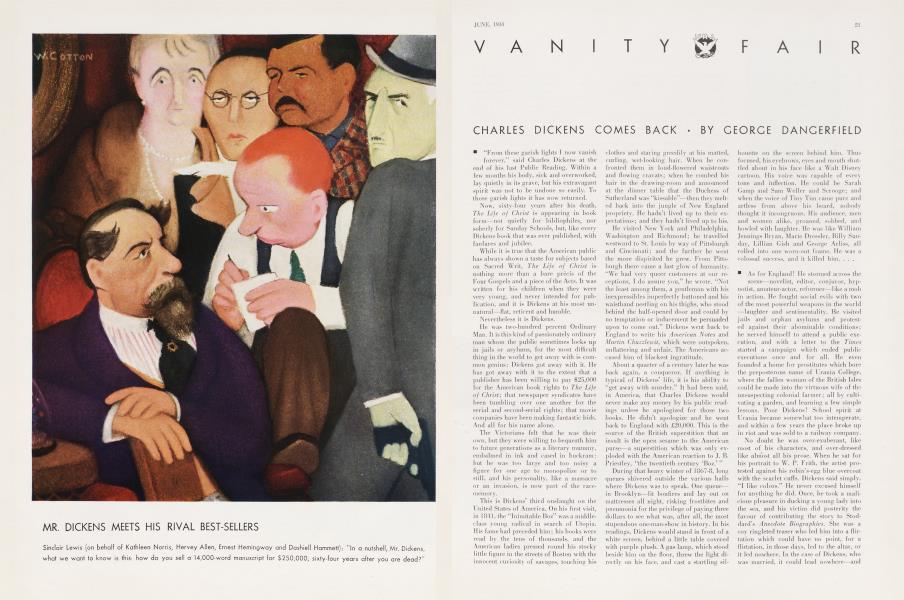
■ "From these garish lights 1 now vanish forever," said Charles Dickens at the end of his last Public heading. Within a few months his body, sick and overworked, lay quietly in its grave, but his extravagant spirit was not to be undone so easily. To those garish lights it has now returned.
Now, sixty-four years after his death, The Life of Christ is appearing in book form—not quietly for bibliophiles, nor soberly for Sunday Schools, but, like every Dickens book that was ever published, with fanfares and jubilee.
While it is true that the American public has always shown a taste for subjects based on Sacred Writ, The Life of Christ is nothing more than a bare précis of the Four Gospels and a piece of the Acts. It was written for his children when they were very young, and never intended for publication, and it is Dickens at his most unnatural—flat, reticent and humble.
Nevertheless it is Dickens.
He was two-hundred percent Ordinary Man. It is this kind of passionately ordinary man whom the public sometimes locks up in jails or asylums, for the most difficult thing in the world to get away with is common genius: Dickens got away with it. He has got away with it to the extent that a publisher has been willing to pay $25,000 for the American book rights to The Life of Christ; that newspaper syndicates have been tumbling over one another for the serial and second-serial rights; that movie companies have been making fantastic bids. And all for his name alone.
The Victorians felt that he was their own, but they were willing to bequeath him to future generations as a literary mummy, embalmed in ink and cased in buckram: but he was too large and too noisy a figure for one age to monopolize or to still, and his personality, like a massacre or an invasion, is now part of the racememory.
This is Dickens' third onslaught on the United States of America. On his first visit, in 1841, the "Inimitable Boz" was a middle-class young radical in search of Utopia, His fame had preceded him; his books were read by the tens of thousands, and the American ladies pressed round his stocky little figure in the streets of Boston with the innocent curiosity of savages, touching his clothes and staring greedily at his matted, curling, wet-looking hair. When he confronted them in loud-flowered waistcoats and flowing cravats; when he combed his hair in the drawing-room and announced at the dinner table that the Duchess of Sutherland was "kissable"—then they melted back into the jungle of New England propriety. He hadn't lived up to their expectations; and they hadn't lived up to his.
He visited New York and Philadelphia, Washington and Richmond; he travelled westward to St. Louis by way of Pittsburgh and Cincinnati; and the further he went the more dispirited he grew. From Pittsburgh there came a last glow of humanity. "We had very queer customers at our receptions, I do assure you," he wrote. "Not the least among them, a gentleman with his inexpressibles imperfectly buttoned and his waistband nestling on his thighs, who stood behind the half-opened door and could by no temptation or inducement be persuaded upon to come out." Dickens went back to England to write his American Notes and Martin Chuzzlewit, which were outspoken, unflattering and unfair. The Americans accused him of blackest ingratitude.
About a quarter of a century later he was hack again, a conqueror. If anything is typical of Dickens' life, it is his ability to "get away with murder." It had been said, in America, that Charles Dickens would never make any money by his public readings unless he apologized for those two books. He didn't apologize and he went hack to England with £20,000. This is the source of the British superstition that an insult is the open sesame to the American purse—a superstition which was only exploded with the American reaction to J. B. Priestley, "the twentieth century 'Boz.'"
During that heavy winter of 1867-8, long queues shivered outside the various halls where Dickens was to speak. One queue— in Brooklyn—lit bonfires and lay out on mattresses all night, risking frostbites and pneumonia for the privilege of paying three dollars to see what was, after all, the most stupendous one-man-show in history. In his readings, Dickens would stand in front of a white screen, behind a little table covered with purple plush. A gas lamp, which stood beside him on the floor, threw the light directly on his face, and cast a startling silhouette on the screen behind him. Thus focused, his eyebrows, eyes and mouth shuttled about in his face like a Walt Disney cartoon. His voice was capable of every tone and inflection. He could be Sarah Gamp and Sam Weller and Scrooge; and when the voice of Tiny Tim came pure and artless from above his beard, nobody thought it incongruous. His audience, men and women alike, groaned, sobbed, and howled with laughter. He was like William Jennings Bryan, Marie Dressier, Billy Sunday, Lillian Gish and George Arliss, all rolled into one worn-out frame. He was a colossal success, and it killed him. . . .
• As for England! He stormed across the scene—novelist, editor, conjuror, hypnotist, amateur-actor, reformer—like a mob in action. He fought social evils with two of the most powerful weapons in the world —laughter and sentimentality. He visited jails and orphan asylums and protested against their abominable conditions; he nerved himself to attend a public execution, and with a letter to the Times started a campaign which ended public executions once and for all. He even founded a home for prostitutes which bore the preposterous name of Urania College, where the fallen woman of the British Isles could be made into the virtuous wife of the unsuspecting colonial farmer; all by cultivating a garden, and learning a few simple lessons. Poor Dickens! School spirit at Urania became somewhat too intemperate, and within a few years the place broke up in riot and was sold to a railway company.
No doubt he was over-exuberant, like most of his characters, and over-dressed like almost all his prose. When he sat for his portrait to W. P. Frith, the artist protested against his robin's-egg blue overcoat with the scarlet cuffs. Dickens said simply, "I like colors." He never excused himself for anything he did. Once, he took a malicious pleasure in ducking a young lady into the sea, and his victim did posterity the favour of contributing the story to Stoddard's Anecdote Biographies. She was a coy ringleted teaser who led him into a flirtation which could have no point, for a flirtation, in those days, led to the altar, or it led nowhere. In the case of Dickens, who was married, it could lead nowhere—and they both knew it. She had goaded him too far, and on a moonless night he held her in the rising tide until her best silk dress was entirely ruined. He was screaming with laughter and she was whimpering with rage and fear. "Don't struggle, poor little bird, he declaimed, Crummles to the life, "you are powerless in the claws of such a kite as 1. Dress! Talk not to me of dress! When the pall of night is enshrouding us in Cimmerian darkness, when we already stand on the brink of the great mystery, shall our thoughts be of fleshly mysteries?"
The words she may have exaggerated, but not the spirit which informs them: Dickens was naturally theatrical. Probably the most accepted accusation against him is that he always sought the limelight. But it is sometimes true of characters as unaffectedly flamboyant as his that the limelight is always seeking them; and that it does not always find them prepared. There is the story of Maria Beadnell.
Dickens first met Maria Beadnell when he was nineteen and she was a dark little beauty of eighteen, known among her friends as the "Pocket Venus." She was the daughter of a bank-manager, and "bank-manager" in England was a workable synonym for "bourgeois." Time and time again she concealed Charles Dickens in the Beadnell china-closet, for her father did not approve of many visits from a young reporter with a talent and no perceptible future. Eventually, Maria herself jilted him and married a steady dullish person with a small income.
Dickens never forgot her, and never ceased to love her, even after he had married Catherine Hogarth, and raised a family, and become famous on two continents. Maria Beadnell was the origin of Dora Spenlow in David Copper field—that rather nauseating little "child-wife," the creation of an optimist in a fit of misery. Twenty years passed. And then one day Dickens received a letter from Maria, who confessed quite openly that she had always loved him, and that she would like to sec him again.
Dickens' own marriage had not turned out too well, and the very sight of Maria's handwriting made him tremble all over. In all his dramatic and tempestuous existence, this was the most dramatic situation. A meeting was arranged, like the setting of a stage. And this time the limelight caught him off his guard, and has preserved him for all time in the pathetic attitude of a popular actor at whom somebody has just thrown an egg. Heaven knows what bright mixture of Maria and Dora he expected: what he found was a dumpy, dingy little woman with a taste for gin.
So Dora Spenlow of David, Copper field became Flora Finching of Little Dorrit. the crudest piece of character writing that Dickens ever did: for twenty years he had built up the image of an ideal woman, only to murder her in cold print. Life had dealt him a sorry blow. But Charles Dickens, whether as writer or as a man, always went life one better. . . .
The older he grew, the more he thought of himself as a public institution—which he was. After his wife had presented him with ten children, Dickens left her because she got on his nerves. This simple logic was a challenge to Victorian convention, and Dickens, like all unconscious Bohemians, clung to convention as a drunkard clings to a lamp post. He published a bombastic explanation of his position in all the important newspapers, and in Household Words, his own magazine; afterwards, when he was seen in the company of actresses whom he innocently adored, as he adored everything connected with the stage, there were scandalous whispers. But he had the kind of personality which instinctively woos danger, and from whom danger furtively retreats. Queen Victoria, that touchstone of middle-class respectability, not only gave him an audience, but presented him with a copy of her Journal in which she had inscribed, "From one of the humblest of authors to one of the greatest." He had survived a scandal not only with arrogance, but with distinction.
He died, as he had always promised himself, in harness. On June 8, 1870, he had been at bis desk all day, writing Edwin Drood. His publishers had paid him an advance of £7,500; the highest advance he ever received, and certainly the highest that will ever be paid for a mystery story, this side of the millennium. The writing of this book had put far too much strain on him, but he did not want to disappoint his beloved public. That evening, as he was sitting at dinner, he suddenly collapsed, and "died of popularity," on June 9, 1870.
He was buried in Westminster Abbey with the reverence of his public, the approval of his Queen, and the enmity of Samuel Butler. The nineteenth century could offer no more.
And when they buried him, they buried the last of the great English comic writers; he was fortunate enough to die before Rudyard Kipling thought up the strong silent Englishman, that foe of self-expression. Himself, he liked a good laugh, and a good cry, and an honest rage, and a fit of the horrors: and he liked to give these things to other people. Some critics could never understand how so great an artist could have such vulgar impulses, but since literary abuse, he confessed, made him feel "dreary and mouldy," he refused to read it. And why should he? His public gave him all the advice he needed and all the applause. His novels came out in monthly numbers, and from month to month he was besieged with letters, imploring him to keep some character alive, or even to change his plot. A dire old Scotch lawyer burst into tears at the death of Little Nell; a gentleman who had been given two weeks to live, thanked God that the next number of Pickwick Papers would be out in ten days. This was a public, and this was a man!
And, if one can imagine this exuberant and imperious figure surrounded by the best sellers of today, Hemingway, Dashiell Hammett, Sinclair Lewis, Kathleen Norris, or Hervey Allen, he wouldn't be offering them advice, but flinging them a challenge. You have written, he might say, a few successful novels, and you may die worth half a million. J hat is easy. But, sixty-four years after your death will you be good enough for this sort of a comeback? He might even address them in the words of that insane and immortal epitaph which he composed for bis character, Mrs. Thomas Sapsea, who had been a "reverential" wife in bed and at board. "Stranger, pause! and ask thyself this question, Canst thou do likewise? If not, with a blush retire."
Subscribers have complete access to the archive.
Sign In Not a Subscriber?Join Now

