
Sign In to Your Account
Subscribers have complete access to the archive.
Sign In Not a Subscriber?Join NowSTILL LIVES
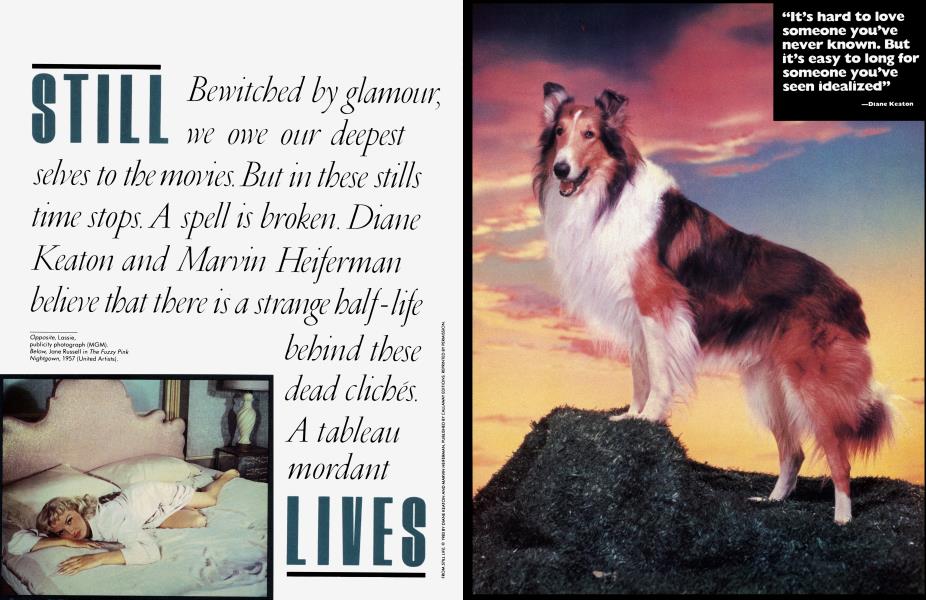
Bewitched by glamour, we owe our deepest selves to the movies. But in these stills time stops. A spell is broken. Diane Keaton and Marvin Heiferman believe that there is a strange half-life behind these dead clichés. A tableau mordant
"It's hard to love someone you've never known. But it's easy to long for someone you've seen idealized" -Diane Keaton
"I was really susceptible to the idea that life, in the best possible way, was a dream**
—Diane Keaton
Carol Squiers
Movie reality informs our lives. And to prime our thirst for Hollywood's version, the studios, over the years, have blitzed us with advertising, gossip, "news"—and an endless stream of stills from each new production. Black-and-white glamour portraits of the stars from the 1930s and 1940s are familiar to us. But there are many color stills—some taken to document individual scenes while movies were being shot, others to show the stars at home in quasi-candid style—that are rarely seen. It is exactly these kinds of images Diane Keaton and Marvin Heiferman went after for their traveling exhibition and for a new book called Still Life. As Keaton explains in her introduction: "The photographs from Still Life pull back from the close-up to reveal other people, sets, backgrounds, and the particular period in which the photographs were taken. By doing this we see the stars dethroned. We don't want them adorning our walls because they no longer promise us lives we could only wish for. It's like they've become cardboard cutouts whose inner presence is absent."
Keaton and Heiferman dug through thousands of photographs in the archives of Hollywood studios, picture magazine files, and private collections, and selected a group from the 1940s through the 1960s. What they chose were pictures from lesser movies and of half-forgotten stars, picked not for glamour or nostalgic value but because of the curious assortment of ambiguous situations and skewed social formu-
las they represent. "The photographs we've selected for Still Life," Keaton writes, "remind me of those strangely beautiful dioramas at the Museum of Natural History. There's something eerie about trying to recreate life with stuffed animals displayed in nice boxes. It's extremely jarring; nothing at all like anything remotely resembling life. It's interesting, because if you were to look at a photograph of, say, the elephant at your local museum of natural history, I bet you might think he's alive if you didn't see something highly theatrical in the painted background. By the same token, our real-life portrait of Lassie on artificial turf could easily be a photograph of the famous canine star's stuffed hide."
Stills let us scrutinize what usually goes unnoticed at the reeling pace of movies. And virtually everything in the photographs here—the arrangement of characters, their attire, attitudes, and environments—provides disquieting evidence of the way Hollywood instructs and entertains. "I guess you could say Still Life is pretty funny," Keaton writes. "There are probably not a lot of us who in going back through our old photographs don't laugh at how hard we tried to be something we weren't. Of course, when you see yourself years later in a little blackand-white print trying to look like Annette Funicello you wonder what the hell you were up to, especially since you probably looked about as much like Annette Funicello as I did."
A fizzled blonde sprawls awkwardly on a bed. This nearly unrecognizable picture of Jane Russell is a prime example of manufactured cliche gone sour. Although Russell's bust made her a star in the '40s even before her first movie was released, her fabled endowments are hidden here under her reclining body, which is swathed in a nightie only a grandmother would wear. Her eyes and mouth sketch out a hollow facsimile of seduction. Russell is obviously supposed to be the archetypal 1950s blond bombshell, but she is robbed of her own attributes—her insolent stare and abundant physique—in order to match that decade's notion of a sex queen.
In fact, blondes dominate these pictures in a number of different guises, from cool June Haver to cute Connie Stevens, from sweet Jane Powell to hard-edged Dolores Gray, whose hairdo, car, and poodles are color coordinated. A former West End and Broadway star turned minor Hollywood player, Gray pops up from the front seat like an inflated rubber doll, as seemingly artificial as
her car and her semisynthetic pets. The image conflates the Hollywood star and the suburban housewife, showing how stars appeal as leading exemplars of the status quo. A crucial and unnerving difference between Dolores Gray and someone like Jane Russell is that Russell was acting the blond cliche; Gray was playing herself.
While some photographs tell a straightforward story, in others what's missing is equally important. In the auto corporation tableau from Woman s World the real protagonists of the movie are absent. Although in the still the young executives appear to be competing for the favor of the older executive, in the movie their efforts are futile; he decides on their promotion by judging their wives, and the meat of the movie is the sadistic maneuvering the women endure. This is probably just a standard scene documentation, but the photograph subverts the movie's real story. It gives us an image which reinforces an acceptable version of male competition: fighting it out till the best man wins.
Hollywood wives did have a major, highly visible role, especially in pictures of the stars' private lives. Dana Andrews-at-home-with-family was probably intended to present— through the fan mags—this movieland household as thoroughly normal. But even though Andrews is able to flash his smile on cue, the rest of the family can't play to the camera so easily. In this bungled shot, disorder reigns in all their gestures. The baby pulls the little girl's hair; the girl tilts like a broken puppet. The son stares grimly out in a daze. Mom smiles distractedly, and the dog appears recently tranquilized. Fittingly, the scene looks as two-dimensional as a stage set, even though we're assured this is the new family home. Everything in the image conspires to defeat an illusion of homogeneous happiness. The uncontrollable messiness of real life is almost an affront.
Actually, in comparison with the tearful mothers, leering psychiatrists, and venal girlfriends in these movie stills, the ordinary domestic bliss of the stars-at-home pictures is
ridiculous. Ann Blyth gives us a big grin as she proudly displays her new refrigerator, while Betty Hutton and her hubby giddily toast each other from individual snack tables in their knotty-pine den. Jane Wyman and Ronald Reagan relaxing on lounge chairs in their yard have a similar cloying effect until we notice Jane's small, tense smile. Worse, Reagan hunches up his shoulders and sucks in his stomach as if he's poised for an attack. Wheeled up against their manicured bushes they look anything but relaxed, yet any fan would grasp this picture's message: the Reagans' success has provided them with this impressive albeit empty sweep of lawn and a thick hedge which separates them from the outside world, enabling them to carry on as a Perfect Couple in welldeserved peace.
In contrast to all this regulation domesticity, the movies allowed life to go slightly awry and indeed exploited things like familial misery to the hilt. In a picture from Bigger Than Life, James Mason leans menacingly over his distraught young son. What's intriguing, especially in comparison with the Andrews family, is that now Mom is pushed into the background, relegated to the far wall with the furniture and the shadows. When the message was upbeat, Mom was right in front with a lapful of kids; in a scene of conflict she holds her tongue. In A New Kind of Love Paul Newman offers Joanne Woodward a plate of food in what looks like an early vision of sex role reversal. More to the point, though, is Woodward's unpleasant career girl getup, from short hair to man-tailored suit. In view of her disastrously compromised femininity, Newman looks like an angel of mercy—a real man come to save her from her peculiar ambitions. Unfortunately, even when Hollywood toys with the idea of human difference, parody and a return to understandable values are most often its only conclusions.
Tableaus of social norms account for perhaps one-half of the images in Still Life. The other half tells us more about the way still photography can record endless, unintelligible moments of enigmatic human drama, and about the weird, fragmentary nature of Hollywood movies in general, especially in a picture of Elvis Presley standing fully clothed next to a man who appears to be underwater, even though he's obviously not. A few science fiction images are laughably naive and indicate how sophisticated the fear industry has become. Of all the stars photographed, only Lassie, that paragon of bravery, loyalty, and unconditional love, looks relaxed and natural. Even perched on a fake grass mound in front of a Technicolor sunset, Lassie glows, free of the burden of personal style, outdated fashion, and stilted posture.
"It is observations made in the field of the animals you are about to pose that counts" -John W. Moyer, Practical Taxidermy
STILL LIVES
It's tempting to conclude that these pictures are merely the product of Hollywood at its worst—sloppy, dumb, and uninspired. They might be, but they are just as surely a record of the small follies of civilized life, played out in the dynamics of desire and success, delusion and failure. For instead of serving up the tasty illusions we expect from the movies, these photographs diagram the breakdown of illusion, the absurdity of stereotype, and the whole cranky machinery of hackneyed social prescription.
"These photographs are like entering a very real town... in the IWilight Zone*
Diane Keaton
Subscribers have complete access to the archive.
Sign In Not a Subscriber?Join Now


