Sign In to Your Account
Subscribers have complete access to the archive.
Sign In Not a Subscriber?Join NowPHOTOGRAPHY
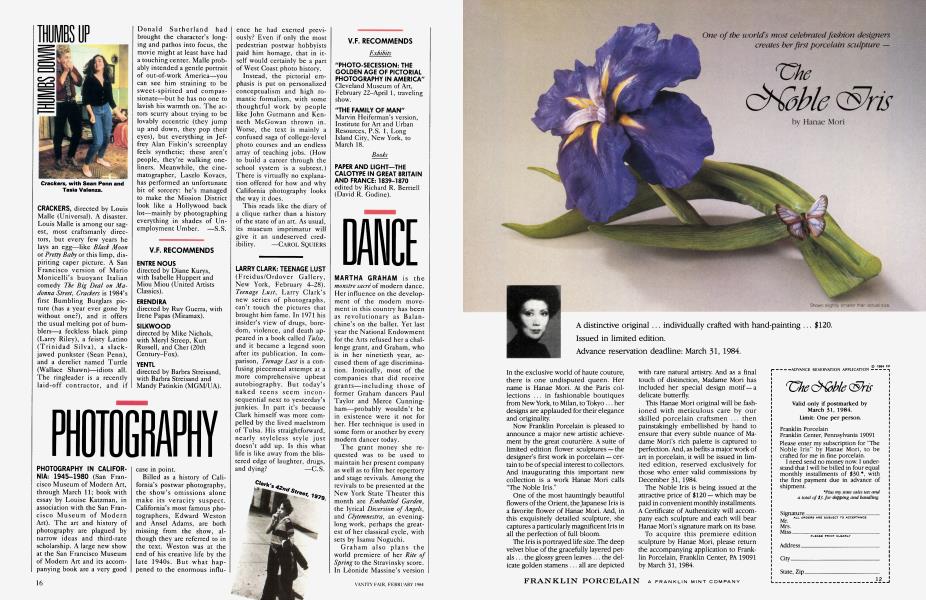
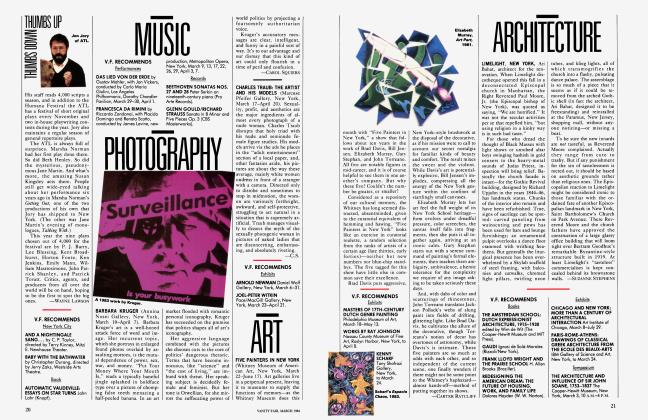
PHOTOGRAPHY IN CALIFORNIA: 1945—1980 (San Francisco Museum of Modern Art, through March 11; book with essay by Louise Katzman, in association with the San Francisco Museum of Modern Art). The art and history of photography are plagued by narrow ideas and third-rate scholarship. A large new show at the San Francisco Museum of Modern Art and its accompanying book are a very good case in point.
Billed as a history of California’s postwar photography, the show’s omissions alone make its veracity suspect. California’s most famous photographers, Edward Weston and Ansel Adams, are both missing from the show, although they are referred to in the text. Weston was at the end of his creative life by the late 1940s. But what happened to the enormous influence he had exerted previously? Even if only the most pedestrian postwar hobbyists paid him homage, that in itself would certainly be a part of West Coast photo history.
Instead, the pictorial emphasis is put on personalized conceptualism and high romantic formalism, with some thoughtful work by people like John Gutmann and Kenneth McGowan thrown in. Worse, the text is mainly a confused saga of college-level photo courses and an endless array of teaching jobs. (How to build a career through the school system is a subtext.) There is virtually no explanation offered for how and why California photography looks the way it does.
This reads like the diary of a clique rather than a history of the state of an art. As usual, its museum imprimatur will give it an undeserved credibility.
CAROL SQUIERS
LARRY CLARK: TEENAGE LUST (Freidus/Ordover Gallery, New York, February 4—28). Teenage Lust, Larry Clark’s new series of photographs, can’t touch the pictures that brought him fame. In 1971 his insider’s view of drugs, boredom, violence, and death appeared in a book called Tulsa, and it became a legend soon after its publication. In comparison, Teenage Lust is a confusing piecemeal attempt at a more comprehensive upbeat autobiography. But today’s naked teens seem inconsequential next to yesterday’s junkies. In part it’s because Clark himself was more compelled by the lived maelstrom of Tulsa. His straightforward, nearly styleless style just doesn’t add up. Is this what life is like away from the blistered edge of laughter, drugs, and dying?
C.S
V.F. RECOMMENDS
Exhibits
"PHOTO-SECESSION: THE GOLDEN AGE OF PICTORIAL PHOTOGRAPHY IN AMERICA" Cleveland Museum of Art, February 22—April 1, traveling show.
"THE FAMILY OF MAN” Marvin Heiferman’s version, Institute for Art and Urban Resources, P.S. 1, Long Island City, New York, to March 18.
Books
PAPER AND LIGHT—THE CALOTYPE IN GREAT BRITAIN AND FRANCE: 1839-1870 edited by Richard R. Berttell (David R. Godine).
Subscribers have complete access to the archive.
Sign In Not a Subscriber?Join Now