Sign In to Your Account
Subscribers have complete access to the archive.
Sign In Not a Subscriber?Join NowVENICE
Auberon Waugh
"In Venice in August, as nowhere else on earth, you see the modern age in its historical perspective"
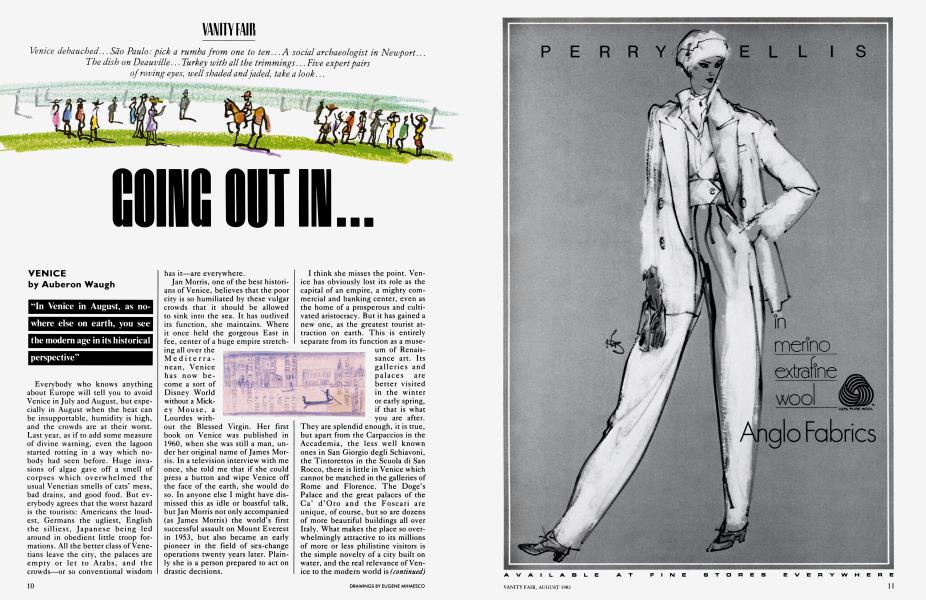
Everybody who knows anything about Europe will tell you to avoid Venice in July and August, but especially in August when the heat can be insupportable, humidity is high, and the crowds are at their worst. Last year, as if to add some measure of divine warning, even the lagoon started rotting in a way which nobody had seen before. Huge invasions of algae gave off a smell of corpses which overwhelmed the usual Venetian smells of cats' mess, bad drains, and good food. But everybody agrees that the worst hazard is the tourists: Americans the loudest, Germans the ugliest, English the silliest, Japanese being led around in obedient little troop formations. All the better class of Venetians leave the city, the palaces are empty or let to Arabs, and the crowds—or so conventional wisdom has it—are everywhere.
Jan Morris, one of the best historians of Venice, believes that the poor city is so humiliated by these vulgar crowds that it should be allowed to sink into the sea. It has outlived its function, she maintains. Where it once held the gorgeous East in fee, center of a huge empire stretching all over the Mediterranean, Venice has now become a sort of Disney World without a Mickey Mouse, a Lourdes without the Blessed Virgin. Her first book on Venice was published in 1960, when she was still a man, under her original name of James Morris. In a television interview with me once, she told me that if she could press a button and wipe Venice off the face of the earth, she would do so. In anyone else I might have dismissed this as idle or boastful talk, but Jan Morris not only accompanied (as James Morris) the world's first successful assault on Mount Everest in 1953, but also became an early pioneer in the field of sex-change operations twenty years later. Plainly she is a person prepared to act on drastic decisions.
I think she misses the point. Venice has obviously lost its role as the capital of an empire, a mighty commercial and banking center, even as the home of a prosperous and cultivated aristocracy. But it has gained a new one, as the greatest tourist attraction on earth. This is entirely separate from its function as a museum of Renaissance art. Its galleries and palaces are better visited in the winter or early spring, if that is what you are after. They are splendid enough, it is true, but apart from the Carpaccios in the Accademia, the less well known ones in San Giorgio degli Schiavoni, the Tintorettos in the Scuola di San Rocco, there is little in Venice which cannot be matched in the galleries of Rome and Florence. The Doge's Palace and the great palaces of the Ca' d'Oro and the Foscari are unique, of course, but so are dozens of more beautiful buildings all over Italy. What makes the place so overwhelmingly attractive to its millions of more or less philistine visitors is the simple novelty of a city built on water, and the real relevance of Venice to the modern world is not to be found in any of its beautiful monuments, its churches, its unexpected small squares and palaces tucked away on a minor canal—not even in the poignant reminder of a prosperity and a civilization which have disappeared. The real relevance lies in the spectacle of the modern world, in all its affluence, its ignorance and its vulgarity, gaping at these things and debauching them by its presence.
continued
Which is why I say that the best time to visit Venice is in August. Of course the place is a museum, but it is a living museum. Just as the Russians have museums dedicated to antireligious propaganda, so Venice has become a museum against the modern age—where the horrors of proletarian affluence can be contemplated in the best setting.
One may see worse sights on Miami Beach or in that vast museum of modern culture in Orlando, Florida, called Disney World. But those places were specially built for the purpose, and it is quite possible to admire the vitality of the age which gave birth to such monstrosities. In Venice in August, as nowhere else on earth, you see the modern age in its historical perspective.
Various tours suggest themselves. Buy a huge, multicolored ice cream on the Riva degli Schiavoni, and when it has started melting, take it into the Doge's Palace, joining whichever conducted group most recommends itself to your purpose. Observe how the other members of the group will admire and envy your ice cream while shuffling past great murals by Tintoretto, Veronese and Bassano. Observe how bored they all are by what the guide is telling them, how the younger ones invariably decide that the Bridge of Sighs is a suitable place for spooning.
Follow your group into the Piazza San Marco and observe how most of them decline to enter the cathedral, preferring to admire the pigeons outside. Photograph them eating a huge ice cream with a pigeon perched on the ribboned gondolier-style straw hat they have just bought for about five dollars. Buy a transistor radio and play it full blast on the vaporetto as you chug down the Grand Canal past the incomparable Santa Maria della Salute, built by Longhena in 1632 to celebrate the end of an earlier visitation of plague. This is the true Venice experience. In the evening, put on a Florida T-shirt and sit on the terrace of the Gritti Palace hotel drinking a Margherita cocktail and looking across the Grand Canal toward the exquisite little palace of Desdemona, which has since become a favorite haunt of American homosexuals, many of whom seem to come to sticky ends. Also nearby is the hideous building that houses Peggy Guggenheim's modern art collection, but the real purpose of this vigil is to listen to the conversation from neighboring tables, which gets louder and louder as the evening wears on. These people are the rich tourists, inheritors of the noble tradition of the Grand Tour, who will be showing each other the various glass and china animals they have bought as their souvenirs of an unforgettable experience.
Oddly enough, even in August, the tourists are concentrated in a tiny area of Venice—between the Piazza San Marco and the Rialto Bridge, mostly in the maze of small but expensive shopping lanes called La Frezzeria and Le Mercerie—so that it is easy to get away from them. Few venture into any of the churches even in this tight area, and outside it one can sit for hours alone, cultivating one's misanthropy, one's hatred of the modern age, and one's agreeable illusions of superiority. Even the magnificent Palladian church of San Giorgio Maggiore, just across the water from the Piazza San Marco, is almost unvisited on its island in August. From the piazza in front of it you can see the crowds of tourists in San Marco and on the Riva degli Schiavoni and feel, once again, that heightened perception of what the modern world is all about.
Throughout August there are only two possible hotels in Venice, both on the Giudecca, which few tourists even visit. Cipriani is grotesquely expensive even for the rich, and at other times of the year I do not recommend it, and prefer the Gritti Palace or the Danieli. But in August Cipriani has the tremendous advantage of being away from the crowds and possessing its own swimming pool—the Lido is unthinkable in August, even for the purposes of philosophical inspiration. Eat at Locanda Cipriani on the island of Torcello, about half an hour by boat, or at La Colomba, an excellent restaurant in the Frezzeria which is slightly too expensive for the masses. Physical suffering is not part of any sane philosophy. For the poor, I recommend the Casa Frollo, a handsome old palace on the part of the Giudecca called Le Zitelle which has been turned into a slightly seedy pensione with a robust smell of tomcat on its handsome staircase and a large garden. From here, once again, you look across the water to the Doge's Palace and the horrors going on in the Piazza San Marco, feeling all the more virtuous for being poor.
(continued)
Subscribers have complete access to the archive.
Sign In Not a Subscriber?Join Now

