
Sign In to Your Account
Subscribers have complete access to the archive.
Sign In Not a Subscriber?Join NowOut to Lunch
with Mordecai Richler, who is anything but crabby with DAVID SACKS
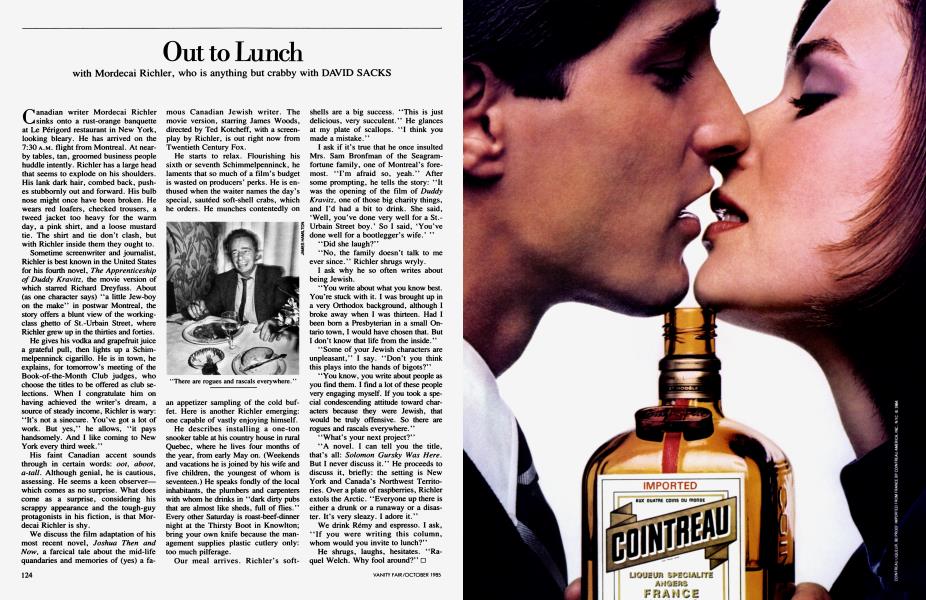
Canadian writer Mordecai Richler sinks onto a rust-orange banquette at Le Perigord restaurant in New York, looking bleary. He has arrived on the 7:30 A.M. flight from Montreal. At nearby tables, tan, groomed business people huddle intently. Richler has a large head that seems to explode on his shoulders. His lank dark hair, combed back, pushes stubbornly out and forward. His bulb nose might once have been broken. He wears red loafers, checked trousers, a tweed jacket too heavy for the warm day, a pink shirt, and a loose mustard tie. The shirt and tie don't clash, but with Richler inside them they ought to.
Sometime screenwriter and journalist, Richler is best known in the United States for his fourth novel, The Apprenticeship of Duddy Kravitz, the movie version of which starred Richard Dreyfuss. About (as one character says) "a little Jew-boy on the make" in postwar Montreal, the story offers a blunt view of the workingclass ghetto of St.-Urbain Street, where Richler grew up in the thirties and forties.
He gives his vodka and grapefruit juice a grateful pull, then lights up a Schimmelpenninck cigarillo. He is in town, he explains, for tomorrow's meeting of the Book-of-the-Month Club judges, who choose the titles to be offered as club selections. When I congratulate him on having achieved the writer's dream, a source of steady income, Richler is wary: "It's not a sinecure. You've got a lot of work. But yes," he allows, "it pays handsomely. And I like coming to New York every third week."
His faint Canadian accent sounds through in certain words: oot, aboot, a-tall. Although genial, he is cautious, assessing. He seems a keen observer— which comes as no surprise. What does come as a surprise, considering his scrappy appearance and the tough-guy protagonists in his fiction, is that Mordecai Richler is shy.
We discuss the film adaptation of his most recent novel, Joshua Then and Now, a farcical tale about the mid-life quandaries and memories of (yes) a famous Canadian Jewish writer. The movie version, starring James Woods, directed by Ted Kotcheff, with a screenplay by Richler, is out right now from Twentieth Century Fox.
He starts to relax. Flourishing his sixth or seventh Schimmelpenninck, he laments that so much of a film's budget is wasted on producers' perks. He is enthused when the waiter names the day's special, sauteed soft-shell crabs, which he orders. He munches contentedly on an appetizer sampling of the cold buffet. Here is another Richler emerging: one capable of vastly enjoying himself.
He describes installing a one-ton snooker table at his country house in rural Quebec, where he lives four months of the year, from early May on. (Weekends and vacations he is joined by his wife and five children, the youngest of whom is seventeen.) He speaks fondly of the local inhabitants, the plumbers and carpenters with whom he drinks in "dark dirty pubs that are almost like sheds, full of flies." Every other Saturday is roast-beef-dinner night at the Thirsty Boot in Knowlton; bring your own knife because the management supplies plastic cutlery only: too much pilferage.
Our meal arrives. Richler's softshells are a big success. "This is just delicious, very succulent." He glances at my plate of scallops. "I think you made a mistake."
I ask if it's true that he once insulted Mrs. Sam Bronfman of the Seagramfortune family, one of Montreal's foremost. "I'm afraid so, yeah." After some prompting, he tells the story: "It was the opening of the film of Duddy Kravitz, one of those big charity things, and I'd had a bit to drink. She said, 'Well, you've done very well for a St.Urbain Street boy.' So I said, 'You've done well for a bootlegger's wife.' "
"Did she laugh?"
"No, the family doesn't talk to me ever since." Richler shrugs wryly.
I ask why he so often writes about being Jewish.
"You write about what you know best. You're stuck with it. I was brought up in a very Orthodox background, although I broke away when I was thirteen. Had I been bom a Presbyterian in a small Ontario town, I would have chosen that. But I don't know that life from the inside."
"Some of your Jewish characters are unpleasant," I say. "Don't you think this plays into the hands of bigots?"
"You know, you write about people as you find them. I find a lot of these people very engaging myself. If you took a special condescending attitude toward characters because they were Jewish, that would be truly offensive. So there are rogues and rascals everywhere."
"What's your next project?"
"A novel. I can tell you the title, that's all: Solomon Gursky Was Here. But I never discuss it." He proceeds to discuss it, briefly: the setting is New York and Canada's Northwest Territories. Over a plate of raspberries, Richler extols the Arctic. "Everyone up there is either a drunk or a runaway or a disaster. It's very sleazy. I adore it."
We drink Remy and espresso. I ask, "If you were writing this column, whom would you invite to lunch?"
He shrugs, laughs, hesitates. "Raquel Welch. Why fool around?"
Subscribers have complete access to the archive.
Sign In Not a Subscriber?Join Now