Sign In to Your Account
Subscribers have complete access to the archive.
Sign In Not a Subscriber?Join NowIn Praise of Older Values
Stephen Vizinczey's roman á clef reeks of revenge
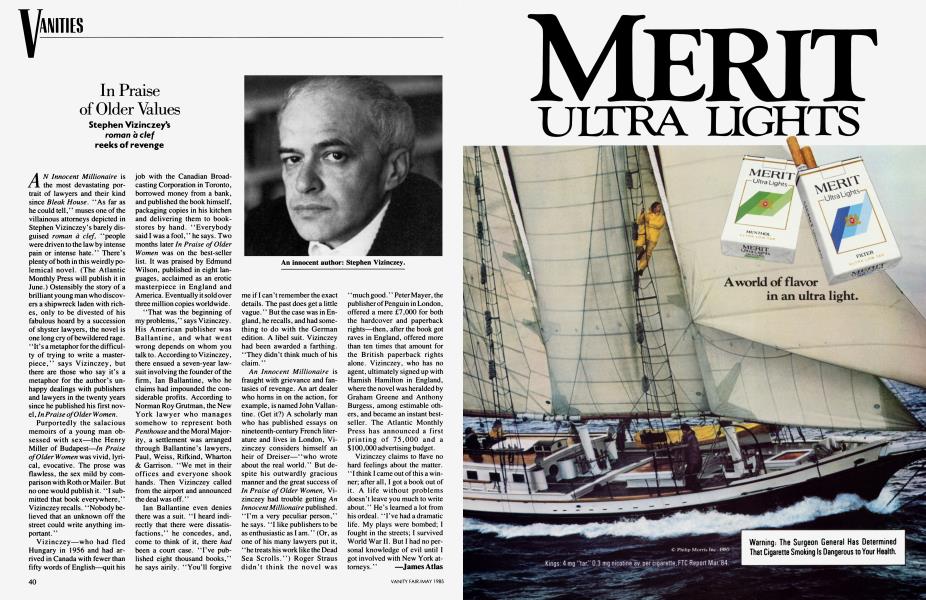
N Innocent Millionaire is the most devastating portrait of lawyers and their kind since Bleak House. "As far as he could tell,'' muses one of the villainous attorneys depicted in Stephen Vizinczey's barely disguised roman a clef, "people were driven to the law by intense pain or intense hate." There's plenty of both in this weirdly polemical novel. (The Atlantic Monthly Press will publish it in June.) Ostensibly the story of a brilliant young man who discovers a shipwreck laden with riches, only to be divested of his fabulous hoard by a succession of shyster lawyers, the novel is one long cry of bewildered rage. " It's a metaphor for the difficulty of trying to write a masterpiece," says Vizinczey, but there are those who say it's a metaphor for the author's unhappy dealings with publishers and lawyers in the twenty years since he published his first novel , In Praise of Older Women.
Purportedly the salacious memoirs of a young man obsessed with sex—the Henry Miller of Budapest—In Praise of Older Women was vivid, lyrical, evocative. The prose was flawless, the sex mild by comparison with Roth or Mailer. But no one would publish it. "I submitted that book everywhere," Vizinczey recalls. "Nobody believed that an unknown off the street could write anything important."
Vizinczey—who had fled Hungary in 1956 and had arrived in Canada with fewer than fifty words of English—quit his
job with the Canadian Broadcasting Corporation in Toronto, borrowed money from a bank, and published the book himself, packaging copies in his kitchen and delivering them to bookstores by hand. "Everybody said I was a fool," he says. Two months later In Praise of Older Women was on the best-seller list. It was praised by Edmund Wilson, published in eight languages, acclaimed as an erotic masterpiece in England and America. Eventually it sold over three million copies worldwide.
"That was the beginning of my problems," says Vizinczey. His American publisher was Ballantine, and what went wrong depends on whom you talk to. According to Vizinczey, there ensued a seven-year lawsuit involving the founder of the firm, Ian Ballantine, who he claims had impounded the considerable profits. According to Norman Roy Grutman, the New York lawyer who manages somehow to represent both Penthouse and the Moral Majority, a settlement was arranged through Ballantine's lawyers, Paul, Weiss, Rifkind, Wharton & Garrison. "We met in their offices and everyone shook hands. Then Vizinczey called from the airport and announced the deal was off. ' '
Ian Ballantine even denies there was a suit. "I heard indirectly that there were dissatisfactions," he concedes, and, come to think of it, there had been a court case. "I've published eight thousand books," he says airily. "You'll forgive
me if I can't remember the exact details. The past does get a little vague. " But the case was in England, he recalls, and had something to do with the German edition. A libel suit. Vizinczey had been awarded a farthing. "They didn't think much of his claim."
An Innocent Millionaire is fraught with grievance and fantasies of revenge. An art dealer who horns in on the action, for example, is named John Vallantine. (Get it?) A scholarly man who has published essays on nineteenth-century French literature and lives in London, Vizinczey considers himself an heir of Dreiser—"who wrote about the real world." But despite his outwardly gracious manner and the great success of In Praise of Older Women, Vizinczey had trouble getting An Innocent M illionaire published. "I'm a very peculiar person," he says. "I like publishers to be as enthusiastic as I am." (Or, as one of his many lawyers put it, "he treats his work like the Dead Sea Scrolls.") Roger Straus didn't think the novel was
' ' much good. ' ' Peter Mayer, the publisher of Penguin in London, offered a mere £7,000 for both the hardcover and paperback rights—then, after the book got raves in England, offered more than ten times that amount for the British paperback rights alone. Vizinczey, who has no agent, ultimately signed up with Hamish Hamilton in England, where the novel was heralded by Graham Greene and Anthony Burgess, among estimable others, and became an instant bestseller. The Atlantic Monthly Press has announced a first printing of 75,000 and a $ 100,000 advertising budget.
Vizinczey claims to Have no hard feelings about the matter. "I think I came out of this a winner; after all, I got a book out of it. A life without problems doesn't leave you much to write about." He's learned a lot from his ordeal. "I've had a dramatic life. My plays were bombed; I fought in the streets; I survived World War II. But I had no personal knowledge of evil until I got involved with New York attorneys.
James Atlas
Subscribers have complete access to the archive.
Sign In Not a Subscriber?Join Now